Some brief notes written in response to a request from the Parliamentary Select Committee on Intergenerational Housing Inequity)
Class not cohort
The current crisis reflects the interaction between three main forces
* Changes in the life course meaning that most major stages of life are reached later than in the past. These include completion of education, entry into the mainstream labour force, family formation, childbirth, retirement and death.
* Growing inequality, particularly in relation to inter-generational transfers of wealth within families
* Decades of misguided public policy which have kept housing prices high
Contrary to the implications of a concept like “intergenerational inequity”, within-family transfers of wealth between generations have increased. These transfers traditionally focused on inheritance, but are now increasingly dominated by “in vivo” gifts and loans (the “Bank of Mum and Dad”) from wealthy parents to their adult children. This is better described as “intergenerational transmission of inequality”
The interaction between these forces has created a large class of young adult renters, in age groups where home ownership was the norm. In the mid-late 20th century, when current social attitudes were formed, renting was, for most young people, a brief transitional stage. The normal expectation was that marriage would be followed in short order by the birth of children and the purchase of a (heavily mortgaged) “home of one’s own”.
Only a small proportion of the population, around 20 per cent of the population, were lifelong renters.
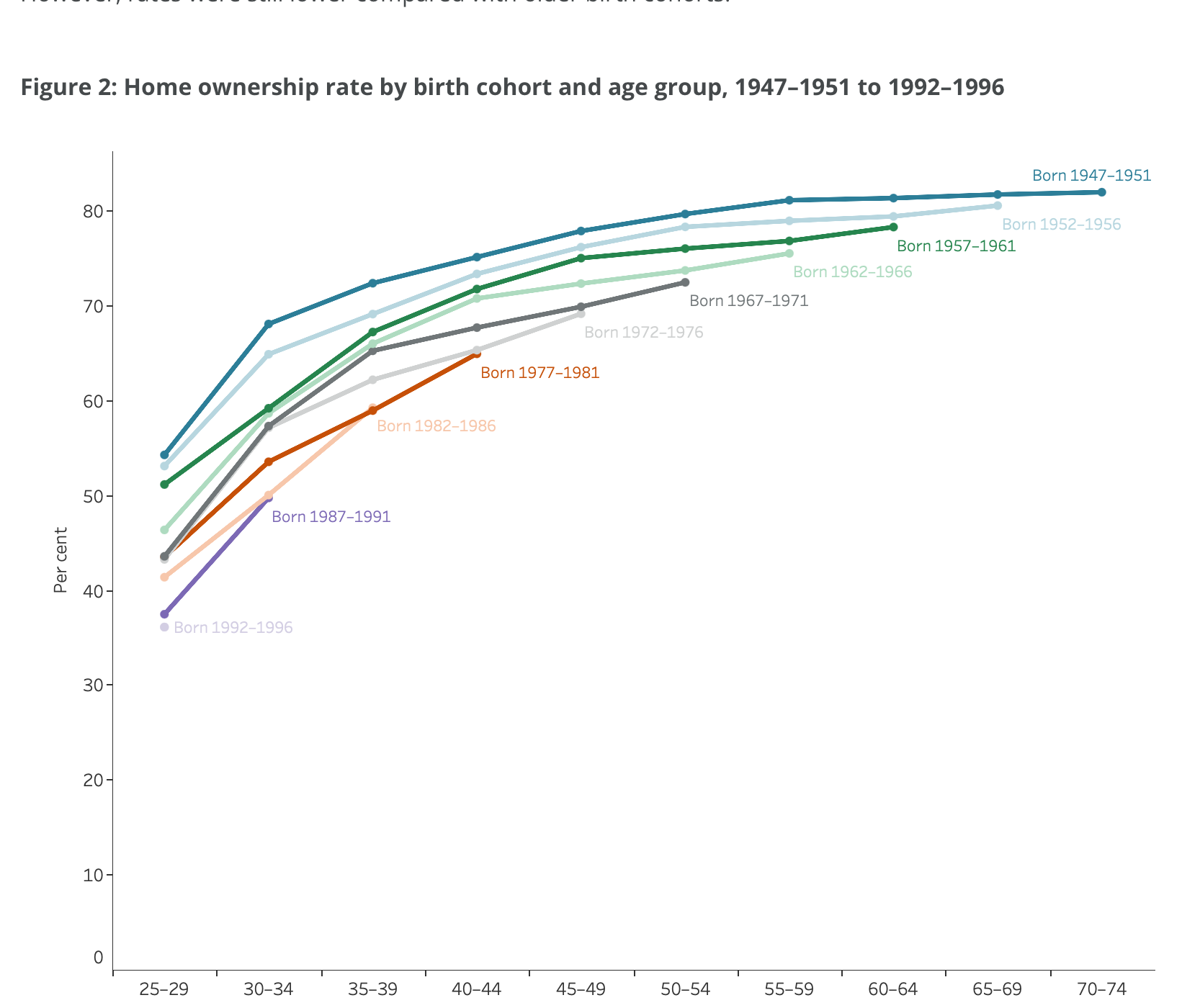
Source: AIHW https://www.aihw.gov.au/reports/australias-welfare/home-ownership-and-housing-tenure
But this is primarily a matter of delay. As in the past, around 80 per cent of Australians are home-owners by the time they retire from the labour market.
Summing up:
* The issue is not one of inequality between different generations, but the transmission of inequality from one generation to the next. The children of well-off homeowners will mostly become well-off homeowners themselves, with a delay reflecting later entry to the labour force
* This delay means that, for many people, renting is no longer a transitory experience between youth and adulthood, but a significant life stage.
*.As in the past most deprived group are the minority of long-term renters.

