Another Message Board
Post comments on any topic. Civil discussion and no coarse language please. Side discussions and idees fixes to the sandpits, please.
I’ve moved my irregular email news from Mailchimp to Substack. You can read it here. You can also follow me on Mastodon here
I’m also trying out Substack as a blogging platform. For the moment, I’ll post both at this blog and on Substack.
 John Quiggin
I am more than a little bit worried.
.. but if you look hard there are rays of hope
Time for your regular sugar fix of good news. I’m an addict myself, and recognize that meeting the craving is no substitute for a dispassionate assessment of the odds. Still, dispassionate assessments are not what you give the troops about to go over the top.
– The IEA reports that global production capacity for solar panels is likely to reach nearly 1 TW a year in 2024. https://www.pv-magazine.com/2023/06/08/global-pv-manufacturing-capacity-to-reach-1-tw-by-2024/ This is a staggering number. The total of all solar PV installed in the world today, going back to its invention in 1954, is estimated at 1.2 TW. The addition in 2022 was 190 GW. The agency’s scenario of net zero in 2050 requires annual PV annual installation to reach 650 GW in 2030, which can now be very comfortably exceeded.
Will the essentially Chinese manufacturers be able to sell it all? My mental model of the industry is “Manchester textiles in 1830”, with constant returns to scale, very low marginal costs of production – even more than in textiles as the factories are highly automated – , no collusion, and little really important IP. The rational strategy for the leading firms is to produce flat out, sell as long as they cover marginal costs, and expect that weaker competitors will go bust. Does anybody know what they are really thinking? Do they see themselves, not fancifully, saving the world as a side-benefit?
– Italian researchers are working on combining agrivoltaics with vertical farming. https://www.pv-magazine.com/2023/06/08/agrivoltaics-for-vertical-farming/ The installations would look more like something you would put in a spaceship to Mars than a conventional farm or even greenhouse. Apparently baby lettuce don’t need sleep so they will grow round the clock under LED lamps, like commercial marijuana in California. With global population still a billion or so short of its expected peak in a few decades, there is going to be a lot of economic and cultural pressure to use land more frugally and sustainably. Edible seaweed, tofu, imitation meat and lots of mushrooms are all coming to your kitchen and pizzeria. About time.
– Domestic air-source heat pumps typically go up to 16 kw, sayeth Google. Toys. “Germany’s MAN Energy Solutions has supplied two 50 MW seawater heat pumps for district heating at the port of Esbjerg, Denmark.”
https://www.pv-magazine.com/2023/06/06/man-energy-installs-worlds-largest-seawater-co2-heat-pump-in-denmark/
Photo: https://www.pv-magazine.com/wp-content/uploads/2023/06/ezgif.com-webp-to-jpg11.jpg
We can take it as read that equipment from a large German engineering firm, using well-established technology, and delivered to a technically literate Danish municipality, works as advertised. These monsters, with gratifyingly macho huge bolt-heads, can deliver heat at 150 deg C – industrial process steam. As this is a drop-in replacement for old coal boilers in an existing district heating network servicing 25,000 Esbjerger households, they will be capped in use at 90 deg C, a safe limit for unpressurised hot water. Wouldn’t it be nice if these machines became Veblen goods for billionaires, rather than megayachts?
The realistic market is a bit of a niche, but not trivial. Spain has 5.6 GW of combined-heat-and-power generators (CHP), powered by fossil gas. The heat goes to seasonal district heating or continuous industrial processes, which can’t be switched off. So awkwardly Spain has been forced to burn a lot of expensive gas for CHP, contrary to its general commonsense policy of cutting gas usage. Monster heat pumps will come in very handy.
– “The Queensland government has awarded two key contracts for what it says will be the largest pumped hydro energy project in the world, with the proposed 5 GW/120 GWh Pioneer-Burdekin pumped hydro energy storage system…” https://www.pv-magazine.com/2023/06/09/worlds-largest-pumped-hydro-storage-project-secures-key-contracts/
I include this to assure Australian readers that my wobbly finger is still on the pulse of your concerns. These are preliminary contracts for detailed geophysical surveys and the like. Cross your fingers that Brisbane is hiring better experts for its megaproject than those responsible for Snowy 2. At last report, Snowy’s state-of-the-art tunnelling machine Florence is still stuck in loose mud and sand, scarcely exotic hazards. https://reneweconomy.com.au/snowy-2-0-project-gets-new-boss-as-florence-still-stuck-in-the-mud/ Before she* got stuck, Florence was quite cute:
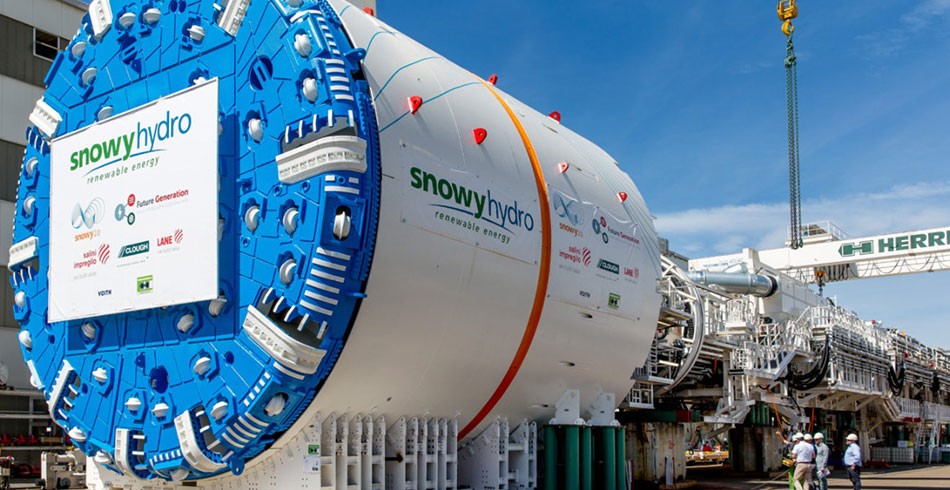
* Tunnelling machines, like ships, have female gender. When asked why, Dr. Freud confessed himself baffled.
Ikonoclast: – “I am more than a little bit worried.”
It seems to me that NSW Premier Chris Minns apparently is not worried, based on his on-air conversation with Radio 2GB’s host Ben Fordham last Monday, Jun 5.
In the podcast, Ben Fordham said from time interval 0:00:29:
“Well, today we’ve got climate activists marching through Sydney. Protestors will take to the streets to demand that the NSW Government rule out new coal and gas projects. Well, I can make it easy for them, because I’ve got the NSW Premier, Chris Minns with me in the studio right now. Chris Minns, good morning to you.”
Chris Minns responded with: “Good morning Ben.”
Then Ben Fordham said from the time interval 0:00:48:
“So this is the Sydney Climate Coalition. They say the fate of the environment is hanging in the balance. They want you, Chris Minns today, to rule out any new coal or gas projects.”
Evidence/data I see suggests the fate of human civilisation could well be determined over the next few years.
Chris Minns then responded with:
“Well, I can’t do that, and obviously we’ve got an independent planning and assessment commission that looks at any new projects in relation to resource extraction, either for domestic use or to sell to countries around the world; that’s a rigorous process. We need that to take… We need that to run its course. And in relation to gas in particular, that’s going to be a necessary fuel to manage the transition to renewable energy, and if we don’t have that in our economy then you’ll see blackouts, you’ll see cost overruns, you’ll see prices spike even greater than we’ve seen over the last 12 months. And then the broad public support for action in relation to climate change and the renewable energy revolution, I think, will melt away. So this is all about ensuring we get the balance right – I think the government’s doing that.”
https://www.2gb.com/heated-clash-chris-minns-grilled-over-plan-to-solve-rental-crisis/
Professor Petteri Taalas, Secretary-General of the World Meteorological Organization (WMO), apparently has a different perspective:
https://news.sky.com/story/world-has-lost-battle-to-stop-glaciers-melting-and-sea-level-rising-un-meteorological-chief-says-12898899
Published in this month’s Futures journal was a paper by C.E. Richards, H.L. Gauch and J.M. Allwood titled International risk of food insecurity and mass mortality in a runaway global warming scenario. The Abstract included:
https://doi.org/10.1016/j.futures.2023.103173
The Earth is on fire. Humanity’s negligence is rendering our planet increasingly unsafe for our civilisation. Yet NSW Premier Chris Minns’s government entities continue to encourage and approve more fossil fuel projects in NSW.
I think Chris Minns is effectively contributing to facilitating the collapse of our civilisation.
Examples aplenty.
“Machine Learning for Economics Research: When, Which and How?
Ajit Desai
View at Medium.com
Ajit Desai
Principal Data Scientist, Bank of Canada
https://www.ajitdesai.com/
View at Medium.com
It’s patently obvious that the Labor Party are not going to do anything about stopping climate change. It is equally obvious they are not going to do anything about stopping COVID-19 and any other new diseases which arise from now on. It is also obvious they are not going to do anything about the housing crisis, the overall health crisis and the many other major problems which face Australia. They are totally beholden to their oligarchic and corporate donors. They are totally corrupt. Of couse, the other major parties are equally bad on these points and worse on others like race relations and identity politics.
Warming of SST is not just in the North Atlantic – it’s global!
We will likely see more of this as the anticipated super El Niño strengthens:
As Dr David Berger says, the global ocean anomaly is:
“Nudging towards a five sigma event.”
“A result that has a statistical significance of five sigma means the almost certain likelihood that a bump in the data is caused by a new phenomenon, rather than a statistical fluctuation.”
“Five-sigma corresponds to a p-value, or probability, of 3×10⁻⁷, or about 1 in 3.5 million….”
What’s the probability of 4.30σ? I can’t find it quickly.
I remember mentioning the real danger of ocean death on this blog in about 2014. I seem to remember being called an alarmist and pessimist. I simply maintain that I was, and still am, correct. I knew this was coming. I also knew the human race would do nothing about it. By “knew” I mean I assessed these outcomes were at least 95% certain. The BAU mob and the over-optimists have done us all a lethal disservice. Those approaches bred complacency, inaction, fake solutions, boondoggles and rampant corruption. The proof is in the empirical outcomes. We are all boiled frogs now.
Iko: “The BAU mob and the over-optimists have done us all a lethal disservice. Those approaches bred complacency, inaction, fake solutions, boondoggles and rampant corruption.”
I’ll take the bait, suspecting that I am included in your anathema as an “over-optimist”. As it happens, I feel the same way about over-pessimists, whose approach breeds defeatism, inaction, rejection of workable solutions, promotion of illusory fairy-tale alternatives, and creeping corruption, as nothing has any point.
However, I will refrain from charging you with defeatism. Mens rea is required for guilt both ways. Whether we are despondent or cheerful, we are entitled to feel that way and to share our feelings and thinking with others. What is wrong is do so with the objective of inciting these others to inaction. Why do you think I want to spread the news that there will very soon be enough solar PV manufacturing capacity in the world to keep us under 1.5 degrees C of warming, if demand allows it to run flat out? My item will have an infinitesimal effect by itself, but won’t the effect be in the right direction, and add to efforts by many others?
Instead I’ll use the space to suggest that you are not drawing the right inferences from the very striking example of military production in WWII. The Axis powers and the Soviet Union were very much not democracies, and their war economies were built on coercion. The USA and Britain were functioning democracies, and the restrictions on civil and economic liberties they introduced did not alter their fundamental character. (The USA overstepped the mark with its non-lethal internment of Japanese-Americans.) Their citizens overwhelmingly supported the gigantic shift in their economies, and the corresponding fall in consumption.
An iconic example is General Motors’ repurposing of its large Frigidaire factory to make .50 calibre Browning machine guns – 363,000 of them – versus no refrigerators. It is true that the Depression had led, especially in the USA, to a very large output gap, which cushioned the fall in consumption as employment rose.
I suggest the example shows that if they are convinced of the necessity and have confidence in their leaders, democratic electorates will support policy measures far more drastic than anything in today’s cramped Overton window slits. This also unfortunately held for Nazi Germany: the policies supported are sure to be suboptimal and may not even be sane. I am much less worried about the emergence of a political will for carbon reduction than about its capture by vested interests, hucksters and cranks.
James W.,
I used the phrase “the BAU mob and the over-optimists” to give a let-out clause to myself and to those who might feel targeted by me. The “BAU mob” can have different interpretations from neoliberal market fundamentalists to mixed economy advocates to “anyone who is not radical enough to please Iko”. Over-optimists can be anyone who has gone beyond being simply a reasonable optimist. I excoriate over-optimism not optimism.
Julian Simon was the quintessential over-optimist and fantasist when it came to the denial of real limits. I am not saying anyone here is in his league. However, I guess I am saying we are all not radical enough. Only the most radical reconfiguration of our entire political economy and real economy can (maybe) save us now. Or we may already be beyond the tipping point. The real damage (to people’s beliefs and reality checking) was done in the 1980s and 1990s when we doubled down on everything we should have been getting out of of. I refer to fossil fuels, endless growthism and consumer cornucopianism.
In that era, a lot of reasonable leftists, sensible centrists and “otherwise realists” still bought the kool-aid on endless growth and the general mood of excess techno-optimism. The precautionary principle would have suggested a slow-down in over-production and over-consumption. We needed not a bigger pie but a better shared pie and one produced with more regard to reducing negative externalities. But neither geostrategic competition nor capitalist competition are geared or can be geared to work in this fashion. They must always engage in a breakneck race to no real goal but more of everything to have more than the other guy until the world is ruined.
These are emergent problems, inherent in and emerging from the civilization project itself and more deeply from evolved human nature. The faults are in our nature and in the character of civilization itself. The first step in changing is admitting fault. This system, neoliberal capitalism, needs to admit fault (meaning its advocates, acolytes and those who run with it) and to consent and cooperate in its radical reform: else it will have reform enforced on it (and thus on us) by the fundamental laws of physics and biology, if by nothing else.
On another topic, my Firefox browser is interacting very oddly with the John Quiggin blog site and it only. If I attempt to access and blog on this site in Firefox my CPU usage rises to 100% or very close to it. My computer slows down terribly and Firefox gets a freeze bug. If I use Chrome browser this bug does not occur.
I have made the following checks and changes:
(a) Checked for computer viruses. None detected.
(b) Cleared all browser history and caches in Firefox. Cleared out a LOT of trash.
(c) Installed CCleaner (free version) and cleared a LOT trackers and other trash.
(d) Run CheckDisk. No problems detected.
(e) Tried Chrome for the blog. No problems then.
(f) Retested Firefox for the blog. Same problem persists.
The only theories I have are maybe that JQ’s blog is hacked and hijacks / exploits Firefox somehow. Could it be a crypto mining hack? This is a long shot. Second theory, something is bugged about Firefox or with my installation of Firefox. I will work on this second theory from my end.
Anyone else had any problems? Oh yes, my disk drive is about 1/10th full and 9/10ths free. I really don’t have a lot of stuff on it so it can’t be a full disk problem.
Dr James E Hansen has published another communication, dated Jun 14, titled El Nino and Global Warming Acceleration. He tweeted:
New developments are coming thick and fast… It’s difficult to keep up with the latest details.
Yesterday (Jun 14), the Australian Parliament House of Representatives Standing Committee on Agriculture published my 2nd Supplementary to Submission (#165.2) on their submissions webpage for their Inquiry into Food Security in Australia. My Supplementary Submission was lodged on the afternoon of Jun 5.
https://www.aph.gov.au/Parliamentary_Business/Committees/House/Agriculture/FoodsecurityinAustrali/Submissions
Ikon, I look a bit silly above as my comment included a link to
“Machine Learning for Economics Research: When, Which and How?”
Ajit Desai
https://arxiv.org/abs/2304.00086
Link not published 1st time.
The link failed to appear 2nd?!
Will it appear this time?
My comments via phone are not logged by site until window closed and reopened.
Reinstall Firefox and try basic install. Try another browser. Check java settings & version.
Beware “economist-induced harm”…DeMartino -“”The Tragic Science: How Economists Cause Harm (Even as They Aspire to Do Good)” (^1.)
In “Does Economics Do More Harm than Good?” DeMartino says: “Moral geometry represses irreparable ignorance and harm’s complexity, trivializes economic harm, and disregards the claims of those who are badly harmed in the economy.”
*
I appreciate the analogies Yves Smith’s review highlights from the book by DeMartino; “shocks are not like dropping a stone in a pond**, but much more like an avalanche” and “economists have influence but no power, ironically the same position McKinsey occupies.” – now THAT is a DISMAL comparison.
So economics and policy effects are more like a pile than a pond** – unstable and prone to avalanches.
*
“Does Economics Do More Harm than Good?”
June 12, 2023
by Yves Smith
“… DeMartino points out that many shocks are not like dropping a stone in a pond, but much more like an avalanche, where a comparatively small event can produce a cascade. More generally, he argues that economics has no notion of economist-induced harm, and highlights that as a huge and conveniently self-serving blind spot.
“DeMartino points out that economists have influence but no power, ironically the same position McKinsey occupies.”
[Links]
nakedcapitalism com
/2023/06/does-economics-do-more-harm-than-good.html
*
^1.
“The Tragic Science: How Economists Cause Harm (Even as They Aspire to Do Good)
George F. DeMartino
9 August 2022
Abstract
“Economists cause harm even as they do good. That is the tragedy of economics. Econogenic (economist-induced) harms can be devastating, and even irreparable.
“Why do economists cause harm? Policies that economists advocate have uneven effects, benefiting some individuals while harming others. Moreover, economists face irreparable ignorance—they can’t know what they need to know about economic causality, which prevents them from making dependable predictions of future policy effects. They must rely on fictional counterfactual accounts of imaginary worlds to try to infer causality.
“Rather than engage the problem of econogenic harm, the profession trains economists to repress it. The profession embraces a paternalistic ethos that presents economists as knowing best when it comes to deciding which harms are appropriate to impose, on whom, in pursuit of social betterment.
“Welfare economics, the branch of economics that assesses economic policy, relies on moral geometry, like cost-benefit analysis, that seeks to resolve complex moral questions concerning harm by reducing them to simple math problems. Moral geometry represses irreparable ignorance and harm’s complexity, trivializes economic harm, and disregards the claims of those who are badly harmed in the economy. Advocates of the setback to interests, social harm, and capabilities approaches to harm do much better in theorizing and managing harm.
“One approach, Decision Making Under Deep Uncertainty, represents a viable way forward for economics. DMDU rejects moral geometry, embraces irreparable ignorance, and empowers those who are apt to be harmed by economic policy to decide which risks to take to promote social betterment.”
https://academic.oup.com/chicago-scholarship-online/book/45125
*
DeMartino in 2014:
“The Economist’s Oath: On the Need for and Content of Professional Economic Ethics”
“Econogenic harm, economists, and the tragedy of economics”
JUNE 25, 2014
By George F. DeMartino
…
“It needs to be said plainly: economists are in the harm business. Almost always we cause harm as we try to do good. Hence, the Hippocratic directive “first, do no harm,” if taken as an inviolable mandate or a decision rule, has no relevance in economics since it would imply that economists can do nothing at all. Moreover, for over a century the economics profession has remained stubbornly uninterested in ethical matters.”
*
“Consensus, Dissensus, and Economic Ideas: Economic Crisis and the Rise and Fall of Keynesianism”
Henry Farrell, John Quiggin
13 June 2017
“… The internal dynamics of prestige and status within the profession of economics intersected with policy arguments between states so as to make macroeconomic policy a “hinge” issue, over which coalitions in both ecologies contended. This explains how Keynesian economists and political actors worked together in the first phase of the crisis to advocate for and implement fiscal stimulus. It also explains why aggrieved policy actors, who did not favor stimulus, could help disrupt the apparent consensus in the second phase of the crisis by promoting the views of dissident economists.”
https://academic.oup.com/isq/article/61/2/269/3866994
*
Be aware of unawareness – JQ et al x 8.
“The Unawareness Bibliography”
by Burkhard C. Schipper
https://faculty.econ.ucdavis.edu/faculty/schipper/unaw.htm
*
** Discuss:
“Like ripples on a pond: Behavioral spillovers and their implications for research and policy”
“… As a result, behavioral scientists, especially those seeking to inform policy, should try to capture all the ripples from one behavior to the next when a pebble of intervention is thrown in the pond, and not just at the immediate behavioral splash it makes.”
Paul Dolan, Matteo M. Galizzi
Journal of Economic Psychology
Volume 47, April 2015
https://www.sciencedirect.com/science/article/pii/S0167487014001068
No idea about your problem Iko, I’m using Firefox and it works fine
It’s got to be my Firefox or PC setup then. It obviously needs more checking. Clearly the problem is here. It’s acting like a memory leak, maybe.
“A memory leak occurs when a process allocates memory from the paged or nonpaged pools, but doesn’t free the memory. As a result, these limited pools of memory are depleted over time, causing the Operating System to slow down.”
It’s easy to work around until it’s fixed. My PC is non-critical. It’s only for gaming, browsing and opinionizing: all unimportant in the greater scheme of things.
KT2, Thanks for the PC advice and pretty much what my son told me to try.
And don’t worry, your comments never look as silly as mine. I’m the biggest know-all of all time and too often obnoxious with it. I try to moderate myself but the levels of idiocy and callousness from the oligarchic elite are totally exasperating. So much avoidable suffering is being caused and so much avoidable damage, social and environmental.
John and KT2,
Tested Firefox in safe mode. This plus a few more tests determined that ad-blocker interference was the issue so I changed my old free ad blocker to a new free ad blocker. My guess is that it was causing some kind of memory leak. For some unknown reason (to me) the conjunction of Firefox, the old ad blocker and the JQ blog site (and it had to be all three together) caused the problem. Who knows why? That’s a rhetorical question.
KT2,
“Consensus, Dissensus, and Economic Ideas: Economic Crisis and the Rise and Fall of Keynesianism” – Henry Farrell, John Quiggin.
I’ve skimmed this paper, not read it in detail at this point. It seems to me there has been a similarity between the response to the GFC and the response to the COVID-19 pandemic. Initially, the response is Keynesian, in economic terms. Then there is a rapid retreat from the Keynesian approach back to neoliberal / monetarist austerity.
The paper seems to focus on the power or persuasiveness of advice from economic experts (real and/or supposed) of different camps to the political executive. It also appears to focus on the shifting coalitions that then occur within and between these two groups. What seems left out (or I missed it because I skimmed too rapidly) are the capitalists (owners and managers of large blocks of capital) and the public. What are the impacts of these two loose coalitions (which of course have their own internal camps as well)?
It seems to me that the political executive are initially spooked by real events (financial contagion causing real lack of access to resources or pandemic contagion causing real interruptions to life and production). The political executive becomes concerned at the possible public responses to a spreading contagion: specifically the dangers of mass unrest and the dangers of political damage to the executive’s party brand and voting support. They act and pull a lever, Keynesian spending, which they always had access to but rarely used because of the ascendancy of neoliberal dogma, which dogma in turn flourishes in conditions of the general ascendancy of the owners of capital.
The capitalist lobby then goes into action. The politicians are reminded who donates their party funds and who will give them their golden parachutes and sinecures once they leave politics. The politicians are lobbied by every industry which gets subsidies from government to the effect that more subsidies to them in particular are the way out of any crisis. The public are hit with propaganda. The media propaganda apparatus owned by the capitalists cranks out the falsehoods and myths in favor of low taxes, business subsidies and public austerity: socialism for the rich and user pays for the poor.
Some subject matter experts are either bought or suborned at this point. Recently minted subject matter “experts”, newly raised up by the capitalist recruiting machine and the media circus, are often outright charlatans. We saw and still see this very clearly in the epidemiology and immunology fields during this COVID-19 pandemic, which continues of course. Some epidemiologists suddenly became “infectologists” advocating widespread infection with a new and dangerous pathogen with unknown characteristics and potentials.
“Fence-sitters” and those uncertain of their theory in economics (and even hard science) might also be of interest. When unsure of where the truth of the matter lies or when vacillating, why not simply decide for the camp which will provide one with all the accolades and rewards? At the first stern test of their morality the turn-coats turn. The steadfast, competent practitioners of their respective disciplines may conversely face their own austerity with the employment and grant taps being turned off for them.
As I say, my claims above are no stronger than “it seems to me” and I haven’t read the paper properly. It seems to me a pattern has emerged under neoliberalism where attempts at progressive reform, which gain some impetus in the early stages of a new crisis, are then quashed as the status quo neoliberal machine mobilises its resources – it’s capital as economic and social power – to quash in reactionary any real change or progress. It uses its ability to give gifts to politicians and get gifts in return (the grey gifts thesis) and its ability to spread falsehoods to the public via its vast media propaganda machine “manufacturing consent”, as Chomksy et. al. delineated.
Republicans and ESG.
James Wimberley says: March 3, 2023 at 9:24 am “… the GOP has just discovered the sinister lefty plot of ESG finance, and they would like to stop it, but will fail.”
https://johnquiggin.com/2023/03/01/some-hope-on-global-heating/
Republicans parlaying ESG as concept, culture and capital inversion; ESG a “barrier to upward mobility” says “a former Trump EPA official”!
Luckily “another researcher” aims at analysis and fact, not propaganda; “… the evidence so far shows that ESG is not materially impacting the cost of issuing debt for these firms.”
*
“Mandy Gunasekara, a former Trump EPA official, called ESG a “barrier to upward mobility” in a congressional hearing last week. That argument was echoed by Jason Isaac, director of a pro-fossil-fuels initiative at the Texas Public Policy Foundation.
…
“Another researcher, Gautam Jain of Columbia University’s Center on Global Energy Policy, specifically looked into the industry’s cost of borrowing money.
…
https://www.scientificamerican.com/article/theres-no-evidence-for-claims-that-environmentally-friendly-investments-are-bad-for-the-poor/
Another Reseacher:
…
“This post addresses the second claim regarding the cost of issuing debt for these companies: While ESG investing appears not to have hindered access to capital for oil and gas companies, could it have resulted in a higher borrowing cost for these firms? So far, evidence shows that the answer is no.
…
“This post offers one such investigation and finds that current evidence indicates that the growth of assets under management of funds with ESG mandates is not raising the cost of debt for investment-grade oil and gas companies. ESG factors could be playing a greater role in high-yield companies, which by definition are weaker credits and are therefore vulnerable to added risks. Exploring the debt costs of these companies could help gain a fuller picture of the impact of ESG. Regardless, based on the estimate that roughly 70 percent of the outstanding debt of oil and gas companies is investment grade, the evidence so far shows that ESG is not materially impacting the cost of issuing debt for these firms.”
https://www.energypolicy.columbia.edu/is-esg-driving-debt-costs-higher-for-oil-and-gas-companies/
In the YouTube video podcast published Jun 15, titled Doomer Dr. Eliot Jacobson talks sudden ocean temperature rise, viral chart tweet, ‘Big Green Lie’, Dr Eliot Jacobson was interviewed by Joshua Molina. In this podcast he talks about three dramatic climate events happening at once: ocean temperature rise in the north Atlantic, diminishing ice near Antarctica and rising global temperatures.
From time interval 0:14:18, Dr Jacobson says:
“A doomer is someone who rejects hope; rejects the concept of deceptive expectation, and replaces it with realistic expectation. Right? The opposite of hope is not hopelessness. The opposite of hope is not fear or inaction. The opposite of somebody who has hope for our future, is somebody who has realistic expectations. Right? And so, that’s what I consider myself as a ‘doomer’. I simply consider myself as somebody who has realistic expectations about what’s going to happen to the planet going forward.”
“…the study showed that people with hope actually were less motivated to be activists than people without hope. And the logic is kind of easy to understand. If you have hope, then you believe the problem can be solved. Right? And if you believe the problem can be solved, by humans, then you believe somebody solving these, and YOU don’t have to do that. Right? You can just say: ‘Oh, we can solve this problem. Surely, somebody’s doing that. I’m going to go, you know, drive my Tesla to the mall, and shop for, you know, a new outfit I’ll wear one time.’ So, the sort of idea that hope motivates action has been proven false, right? And in fact, it’s the doomers, it’s the doomers who are activists, right, because we understand what’s happening to this planet…”
Some time ago Paul Ehrlich postulated that an over populated world would result in global famine and societal collapse during the 1970s. It was a reasonable analysis of resources at that time.
As many before and after him have learnt, it was a mistake to predict the future based on historical events.
This is the conundrum we now face; with the benefits of more precise and powerful technology our understanding of past and present data is considerably enhanced but we are haunted by the memories of failure.
Traditions may be good for bonding, for forming groups of similarly aligned people, but they are essentially only security blankets.
We don’t need this junk, we really do need to leave the past behind and move on.
I keep changing my theory about what was wrong with my PC. Latest theory: DuckDuckGo extension is bugged. Once I got rid of the DuckDuckGo extension everything was and is fine. This was the crucial change, not the ad blocker change, as a further test showed. Too bad. DDG used to be good. Institutional entropy, I guess.
Natural resource investors Goehring & Rozencwajg posted in their blog on Jun 15 a piece titled Hubbert’s Peak is Finally Here, beginning with:
And concludes with:
https://blog.gorozen.com/blog/hubberts-peak-is-finally-here
Economies cannot grow without a surplus of energy!
How does a civilization downsize gracefully?
What’s this – duck duck – stuff?
It’s important?
Wot wot?
Some time ago I got to know this Dutch sailor, Henk de Velde, sadly now deceased. He circumnavigated the world several times without too much fanfare.
Anyway he sent me one of his books titled ‘reset your mind’ Good sound advice coming from someone who had stared into the abyss and then dismissed it.
After the collapse of NVidia’s monopolistic attempt to buy the dominant processor designer ARM, it looks as if the company is headed for consensual defensive investment led by Intel and Qalcomm: https://www.theregister.com/2023/06/14/intel_arm_ipo/
So ARM will stay a benevolent monopoly, protected from takeover by the competing barons who all use its services, rather like a cosseted Japanese emperor. The solution arrived at by capitalists may well be mirrored in politics by a local political truce between China and the USA. Both countries have enormous semiconductor industries tied to ARM’s sprawling, useful and cheap IP, and leaving it alone is their best option. The same holds for giant Taiwanese chipmaker TSMC. Let’s hope everybody stays mindful of the adage: “If it ain’t broke, don’t fix it.” Dogmatic neoliberalism is not the only driving force within modern capitalism.
Rog: “Economies cannot grow without a surplus of energy! How does a civilization downsize gracefully?” But we have a practically limitless supply of solar and wind energy, and pumped hydro sites to store it! The supply curve is flat at ca. 5c per kwh as far as the eye can see. And it’s dispersed across the globe, so energy independence is attainable for very many countries (though many will find it pays to trade with trusted neighbours, as within Europe).
What awaits the fossil fuel industries is roughly this: https://youtu.be/IcPixaWL2Pg
I feel fairly confident that there is not one director who ever got a battle scene right.