Authority is powerful yet intangible. The capacity to give an order and expect it to be obeyed may rest ultimately on a threat to sanction those who disobey but it can rarely survive large-scale disobedience.
The modern era has seen many kinds of traditional authority come under challenge, but until now the “right of managers to manage” has remained largely immune. If anything, the managers’ power has increased as the countervailing power of unions has declined. But the rise of working from home and, more recently, Labor’s right to disconnect legislation pose unprecedented threats to the power of managers over information workers — those employees formerly known as “office workers.”
To see how this might play out, it’s worth considering the decline of another once-powerful authority, the Catholic Church.
Just two weeks after Prof Allan Fels reported on the extent of monopoly power and resultant price gouging, Australia’s supreme body on competition law has delivered its answer.
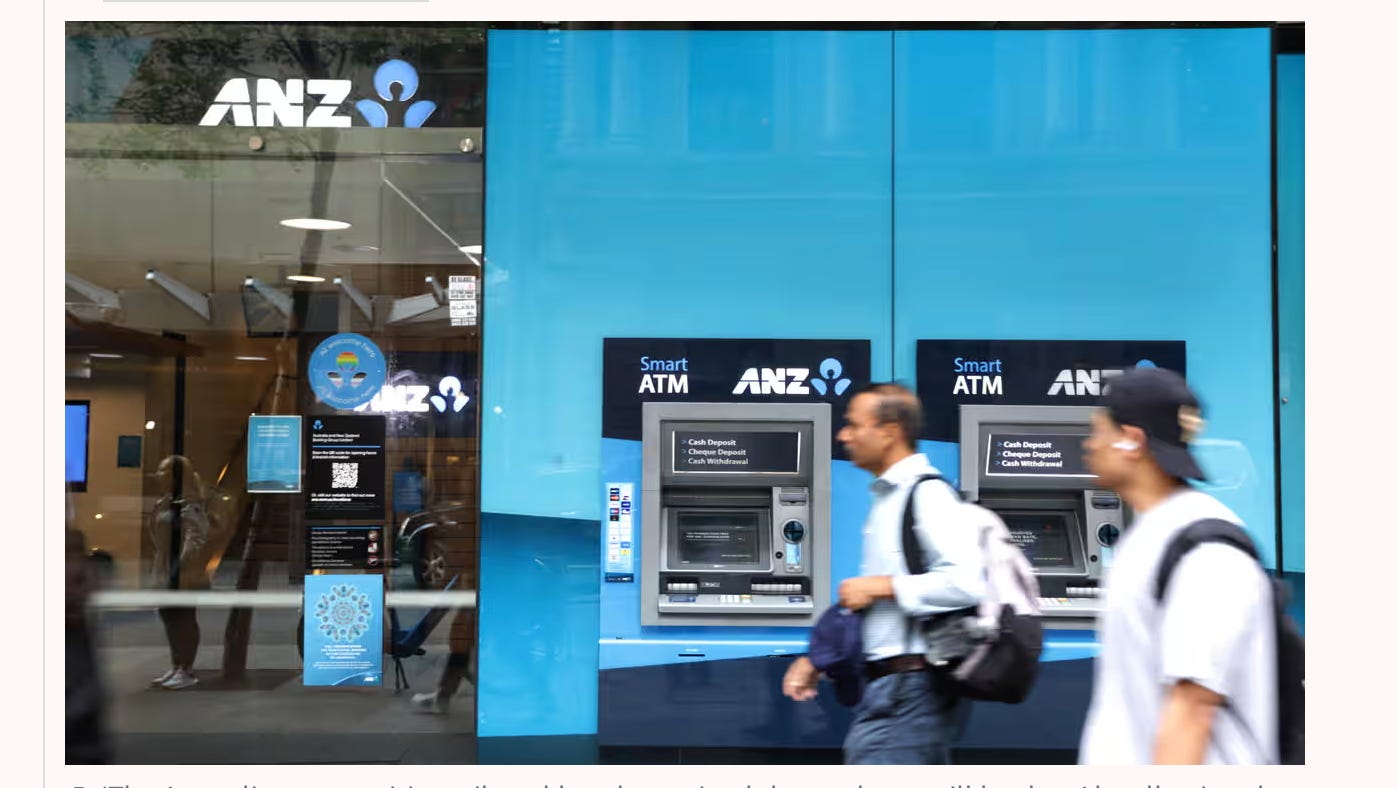
The Australian competition tribunal has determined that the banking industry has all the competition we need and that no harm will be done by allowing ANZ to swallow one of the few competitors to the Big Four by acquiring the banking operations of Suncorp. This was the latest in a string of defeats for the Australian competition and consumer commission (ACCC), the regulator formerly headed by Prof Fels.
In effect, the tribunal reversed the burden of proof. Whereas the ACCC said it was not satisfied that the merger would not reduce competition significantly, the tribunal said this was not enough. It was up to the ACCC to prove the seemingly obvious point that a large firm taking over a smaller rival would reduce competition.
Perhaps this is a case of ‘Buggins’ turn’, with the ANZ having missed out on the acquisition party so far
In making its decision, the tribunal referred to the competition provided by Macquarie Bank, the sole survivor from the rush of entrants to the banking industry in the wake of deregulation in the 1980s, and to the role played by mortgage brokers like Aussie Home Loans (established in 1992).
This account ignores the disappearance of Advance Bank, St George Bank and the Bank of Melbourne, all swallowed by Westpac, Bankwest (now part of the Commonwealth Bank) and digital bank “86 400”, taken over by NAB, among others. But perhaps this is a case of “Buggins’ turn”, with the ANZ having missed out on the acquisition party so far.
Most of the institutions that have disappeared were originally either building societies or publicly owned lending institutions. That’s true of Suncorp bank, formed from a merger of Metway (the former Metropolitan Permanent Building Society) and the Queensland Industry Development Corporation (formerly the Queensland Agricultural Bank).
In the pre-deregulation era, these institutions provided important competition for the private banks, which were subject to relatively stringent regulatory constraints in return for privileged access to support from the Reserve Bank. Deregulation removed those constraints, while maintaining the benefits of bank status. Non-bank financial institutions found it nearly impossible to compete, and most turned themselves into small banks, ripe for takeover.
Competition did produce some reductions in bank margins over the course of the 1980s, though much of the reduction was offset by increased fees and charges. But in the 15 or so years since the global financial crisis, margins have barely moved. Meanwhile, the average new mortgage (adjusted for inflation) has risen by about 60%. So the banks are making a lot more money for the same basic service.
As in other industries, such as electricity and telecommunications, the privatisation of government enterprises in the banking sector was undertaken in the belief that competition would protect consumers from exploitation. This was the central theme of the report of the National Competition Policy Review Committee, usually called the Hilmer review after its chair, Fred Hilmer, who subsequently became (among other things) a director of Macquarie Bank. The central theme of the review was the need to protect private enterprise from the unfair competition of the public sector. The ACCC was supposed to keep private monopolists in line.
Thirty years after the Hilmer review, it’s evident that nothing of the kind has happened. Markets are as concentrated as ever and the ethic of public service which continued to influence firms such as Qantas, Telstra and the Commonwealth Bank for some time after privatisation has long since disappeared.
If competition policy is to have any real effect, it must be strengthened. First, responding to the latest tribunal decision, competition policy should reverse the burden of proof. Any acquisition by a dominant firm should be presumed to be anti-competitive, and it should be up to the acquirer to prove otherwise. As recommended in the Fels report, there should be a divestiture power, enabling previous mergers to be unwound.
But this is unlikely to be enough. As in the cases of electricity and telecommunications, it is necessary for the public sector to re-enter the market. In the case of banking, the urgency is increased by the rapid disappearance of cash, which is increasing our dependence on banks whether we like it or not.
We need a public guarantee of access to cash, perhaps provided through Australia Post. In the longer term, as physical cash inevitably fades, we may need to consider the provision of digital cash issued by the Reserve Bank. This could provide the basis for publicly guaranteed savings accounts, independent of the private banking system.
Decades of “light-handed” regulation under neoliberalism have done little to benefit Australian households. In competition policy and elsewhere, it’s time to for government to get a bit more heavy-handed.
Another Monday Message Board. Post comments on any topic. Civil discussion and no coarse language please. Side discussions and idees fixes to the sandpits, please.
Another Monday Message Board. Post comments on any topic. Civil discussion and no coarse language please. Side discussions and idees fixes to the sandpits, please.
Over the last few years, the Australian and UK Labor/Labour[1] parties, have followed strikingly parallel paths.
A better-than expected result with a relatively progressive platform (Oz 2016, UK 2017)
A demoralizing defeat in 2019, followed by the election of a new more conservative leader (Albanese, Starmer)
Wholesale abandonment of the program
Failure of the rightwing government to handle Covid and other problmes
Because we have elections every three years, Australia is now ahead of the UK and we now have a Labor government led by Anthony Albanese. In its election campaign and its first eighteen months in office, Labor ran on a platform of implementing rightwing policies with better processes and minor tweaks to the most repressive aspects. This is, AFAICT, what can be expected from Starmer in the UK.
But over the last month or so, we’ve had a series of significant policy wins, which may set the stage for more.
The long-running debate over “price gouging” should have been settled yesterday by the release of a report by Allan Fels, the former chair of the Australian Competition and Consumer Commission (ACCC). The report, commissioned by the ACTU, found that a wide range of Australian industries are characterised by limited competition, giving powerful firms ample scope to extract large profit margins.
Consistent with international evidence, most of the inflation observed in the wake of the pandemic was captured in the form of increased profit margins. Contrary to the dominant economic model – in which inflation begins in the labor market, with higher wages being passed on to prices – the recent inflation has seen wages lag far behind prices. In some countries, notably the US, real wages have recovered, but in Australia they are still well below the pre-Covid level for most workers.
The facts are clear enough. But they raise the question: why now? In addition to market power, much of the discussion of price gouging has focused on denunciations of corporate greed and on the various tricks (such as “shrinkflation”) that can be used to raise prices surreptitiously.
But personal greed isn’t new (it’s one of the seven deadly sins, after all). There’s no obvious reason to think that corporate managers have become personally greedier in the years since the pandemic.
More importantly: greed in the form of profit maximisation is the driving engine of capitalism. That’s why Gordon Gecko in Wall Street, echoing his real-life models Ivan Boesky and Michael Milken, said: “Greed, for lack of a better word, is good.”
In corporate-speak, this is usually shrouded in euphemisms like “shareholder value”, or softened by pledges of “corporate social responsibility”, but profit is still the main goal.
Devices like shrinkflation have also been around for a long time. In his classic 1933 work The Theory of Monopolistic Competition, which (along with the contemporaneous work of Joan Robinson) introduced the idea of imperfect competition, Edwin Chamberlin described this and other deceptive practices.
As for uncompetitive markets, this is certainly nothing new in Australia. It has mostly got worse over time, particularly as public infrastructure services have been sold off to private monopolies; but this trend hasn’t been uniform. Notably, the arrival of Aldi has provided some competition for the dominant supermarket chains, Woolworths and Coles. And there has been no particular change that would explain the upsurge in profit margins over the last few years.
Rather, recent inflation has resulted from the interaction between corporate market power and pent-up demand from forced saving during the lockdowns. Economic analysis, including my own work with Flavio Menezes (quoted in the Fels report), shows that increased demand allows firms with market power to increase their margins, exacerbating any initial inflationary shock.
Unfortunately, the process does not work smoothly in reverse. Because wages are slow to adjust, a policy-induced slowdown – such as that now being engineered by the Reserve Bank – will prevent wages from catching up to past inflation, effectively freezing higher profit margins into place.
What then, should be done?
First, instead of focusing solely on the consumer price index as the measure of the “cost of living”, we should be looking at profit margins – largely determined by the gap between prices and wages. Restoring wages is more important than a rapid return to an arbitrary target rate of CPI inflation.
In the longer term, we need to tackle the problems of an economy in which most markets are dominated by a handful of firms. In part, this can be achieved by strengthening the powers of the ACCC. Most importantly, as suggested in the Fels report, there is the possibility of breaking up firms that are already dominant in their markets – Qantas is an obvious target here.
But in an economy as small as Australia’s, dominance by a handful of firms is inevitable in many cases. One possible solution, suggested in the Fels report, is more extensive price regulation.
In the case of infrastructure utilities, the remedy in most cases is to abandon the failed experiments of privatisation and corporatisation and return to public ownership. Ideally, this would involve a statutory authority model in which the objective is to maximise social benefits rather than profits, while setting prices sufficient to cover operating and capital costs.
It’s another idea that’s been around for a long time. But it’s one that might be worth trying.
A new sandpit for long side discussions, conspiracy theories, idees fixes and so on.
To be clear, the sandpit is for regular commenters to pursue points that distract from regular discussion, including conspiracy-theoretic takes on the issues at hand. It’s not meant as a forum for visiting conspiracy theorists, or trolls posing as such.
Another Monday Message Board. Post comments on any topic. Civil discussion and no coarse language please. Side discussions and idees fixes to the sandpits, please.
Australia looks set to adopt fuel-efficiency standards after the Albanese government on Sunday revealed options for the long-awaited policy. The government says the reform would lead to more cars that are cheaper to run, eventually saving Australians about A$1,000 per vehicle each year.
The announcement comes a decade after the Climate Change Authority first proposed such a standard for Australia. The United States has had such a policy since the 1970s and the European Union implemented mandatory standards in 2009.
The Coalition has already sought to stoke fears among tradies and regional voters by claiming Labor’s policy threatens to take utes off the road. Labor’s policy is designed to address this concern – but the opposition looks likely to continue this scare campaign.
More generally, history tells us the road to fuel-efficiency reform in Australia is a bumpy one. The Albanese government has hazards to negotiate before its proposal becomes law.
Make better decisions – find out what the experts think.
Australia looks set to adopt fuel-efficiency standards. SERGIO DIONISIO/AAP
A carbon price, by another name
Labor has outlined three options for a fuel-efficiency target, ranging from weak to aggressive. It describes its preferred middle-ground option as the sensible compromise.
The policy design for each of the options would set a national limit, averaged across all new cars sold, stipulating grams of CO₂ that can be emitted for each kilometre driven. This measure depends on fuel efficiency: that is, the amount of fuel burnt per kilometre. The designs differ in the stringency of the targets, the speed of the changes and the treatment of different vehicle classes.
The limit would not apply to individual cars. Instead, each supplier of new light vehicles to Australia would have to make sure the mix of vehicles does not exceed the limit. Low-efficiency vehicles could still be sold, but car dealers would have to balance this out by selling enough high-efficiency vehicles, such as electric vehicles.
Car suppliers that outperform the targets would earn credits that could be sold to those falling short. This system is similar to Australia’s renewable energy target for electricity and the safeguard mechanism for industry pollution.
All three are effectively a carbon price (though the political toxicity of that term means the government would never characterise them as such). Nonetheless, should the fuel-efficiency standards be implemented, Australia would end up with three carbon prices, one for each major energy use.
The government says the preferred option would lead to a saving of 369 million tonnes of CO₂ by 2050.
The Albanese government hopes the policy will lead to more electric vehicle sales. Lukas Coch/AAP
What about utes?
One tricky path the policy must navigate is allowing for the supply of both small and large vehicles without further exacerbating the trend towards oversized vehicles on our roads.
The government’s preferred option achieves this by allowing higher – but still limited – emissions for heavier vehicles such as utes, vans and SUVs, to account for their natural tendency to use more fuel.
Heavier vehicles are a sticking point in forming vehicle emissions policy in Australia. Who could forget then-prime minister Scott Morrison’s 2019 claim Labor’s electric vehicle policy would “end the weekend” by banning larger cars used to tow boats and the like.
Following Labor’s policy announcement on Sunday, Nationals leader David Littleproud picked up where Morrison left off, saying:
If you take away particularly utes, they’re tools of trade, particularly for people, not just tradies in the cities, but also people in the bush. And if you put a tonne on the back of an electric ute at the moment, you don’t get far.
Anticipating the Coalition scare campaign, the Labor government’s preferred option has been designed with the aim of ensuring a wide range of conventional utes remain on the market.
In the medium term, we can also expect the trend towards larger vehicles to be weakened by measures in Labor’s last federal budget to roll back vehicle tax breaks for small and medium businesses. But that change doesn’t come into effect until mid-year, which means there may be a rush on larger vehicle purchases until then.
The Coalition has previously claimed Labor’s vehicle policies would ‘end the weekend’. Shutterstock
Labor’s preferred policy option is broadly similar to that put forward by the Climate Change Authority in 2014. Then, the Coalition government appeared to consider the proposal for a time. But it eventually dropped the idea – in part, presumably, due to lobbying by interest groups including the car industry.
There are signs those same groups are gearing up again. The Federated Chamber of Automotive Industries, for example, said on Sunday the government’s targets will “be a challenge” to meet and may lead to more expensive vehicles, or gaps in the supply of utes and SUVs.
But the proposed policy has been welcomed by climate change advocates, the electric vehicle industry and motoring groups. The NRMA described them as “responsible and achievable”, saying “a business-as-usual approach meant that Australian families and businesses were not benefiting from the best technology designed to reduce fuel consumption”.
Progress, at last
The government intends to consult on its preferred model before introducing the legislation, with a view to enacting the policy in January 2025.
Assuming the policy is adopted, Australia would finally shed its unenviable status as the only developed country without such such standards. But we will still be at the back of pack, far behind the EU and only catching up to the US in 2028.
Despite the difficulties, it seems likely Australia will have fuel-efficiency standards in the near future. As with most measures to reduce emissions, the best time to introduce the policy was ten or more years ago. But the second-best time is now.
I’ll be presenting a talk at the Australasian Agricultural and Resource Economics Society conference. Title Irresistible Force* meets Immovable Object**
* Massive expansion in production of low-cost solar PV
** Entrenched resistance to deployment.
Shorter JQ: Irresistible force will win in the end


 John Quiggin