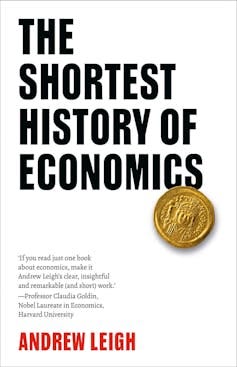
Andrew Leigh’s The Shortest History of Economics is the latest in a series of such histories, mostly focused on particular countries.
It begins with a striking mini-history of household lighting, focusing on the amount of labour required to produce the light now given off by a standard lightbulb: 58 hours for a wood fire, five hours for a candle based on animal fat, a few minutes for an early electric lightbulb, and less than one second for a modern light-emitting diode.
The Shortest History of Economics – Andrew Leigh (Black Inc.)
Importantly, what is true of labour hours is also true of material inputs. Older technologies required felling a tree or killing an animal, but an LED uses the photoelectric properties of common crystals. It only needs tiny quantities. The input of electricity is similarly modest.
Start your day with evidence-based news.
Meanwhile, because workers in all kinds of activities have become more productive, the purchasing power of their wages, expressed in terms of services like lighting, has risen. The result is that services like lighting have become exceptionally cheap.
As this example shows, The Shortest History of Economics is not, as might be supposed, a history of economic thought (a topic primarily suited to retired economists like the author of this review). Rather, it is primarily a history of economic life, from Paleolithic times to the COVID pandemic.
The history is, however, informed by modern economics, included in the narrative in palatable doses.
Standards of living
The first half of the book, covering the period up to the Industrial Revolution, is mostly about technology. Leigh begins with the transition from hunter-gatherer societies – made up of relatively small groups of people, who followed their food sources around – to agriculture, which permitted and required larger settled populations.
The effect on living standards was ambiguous at best. Farmers were less likely than hunter-gatherers to suffer violent deaths or starve in winter, but they were almost permanently undernourished. They overworked to produce a surplus that enabled a small stratum of priests and warriors to live relatively luxurious lives.
The millennia following the agricultural revolution are covered pretty quickly, with a focus on developments in transport (mostly water transport) and trade. Leigh traces the gradual emergence of a global economy, culminating in the rise of European empires, whose reach depended on sail.
There are lots of interesting vignettes, covering topics such as social mobility. There wasn’t much, as can be seen by the persistence over centuries of the same surnames in high-status positions. More depressing is the discussion of the central role of the slave trade, which was a major source of labour in the Americas and income for European nations.
The second half of the book, covering the period after the Industrial Revolution, shifts the focus from technology to economic institutions and policy. The 19th century saw the rise of the corporation and the concentration of economic power.
This produced responses in the form of “anti-trust” legislation in the United States, usually referred to as “competition policy” in Australia. This remains an issue of central concern to Leigh in his day job, as assistant minister for Competition, Charities and Treasury.
The 19th century also saw the rise of the trade union movement and the beginning of an era of continuous struggle over the distribution of income between capital labour. The balance has ebbed and flowed.
As Leigh shows, labour has been losing ground since the 1970s in most countries, while those at the top of the income distribution have gained massively. The offsetting positive development is that the very poorest people in the world have generally improved their lot, thanks to the belated arrival of modern technology.
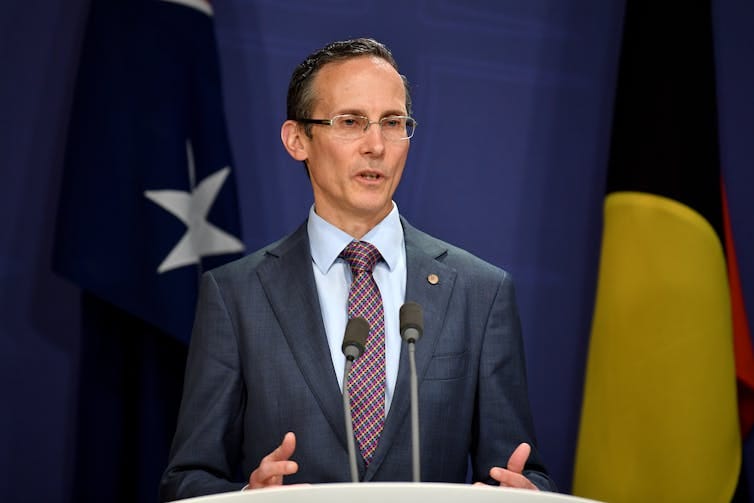
Andrew Leigh at a press conference in Sydney, August 23, 2023. Bianca De Marchi/AAP
Read more: Income redistribution or social insurance? A federal MP considers the future of the welfare state
Macroeconomics
The issues I have discussed so far have mostly concerned markets and prices, the topics studied by economists under the label “microeconomics”. But the 20th century also saw the emergence of “macroeconomics”, the analysis of booms, depressions, inflation and mass unemployment.
The key figure here was English economist John Maynard Keynes, whose General Theory of Employment, Interest and Money (1935) provided the theoretical basis for the use of public expenditure and taxation (fiscal policy) to stabilise the economy.
As Leigh notes in his introduction, The Shortest History of Economics is unusual among recent popular works on economics in covering both microeconomics and macroeconomics.
Despite proceeding briskly through millennia of economic history, Leigh manages to convey the essential points in a way that does not leave the reader feeling rushed through an incomplete argument. While it makes sense to begin by reading the book from beginning to end, it is also enjoyable to dip into it, more or less at random.
Inevitably, I have some points of disagreement. At a couple of points, Leigh gives uncritical credence to beliefs widely held among economists, but not supported by the evidence.
He repeats Adam Smith’s creation story for money as a more efficient alternative to barter. But a hundred years of anthropological evidence, beginning with my namesake Alison Hingston Quiggin and continuing to the work of the late David Graeber, suggests that money first emerged as a way of discharging debts (owed to the king whose face appeared on coins or as recompense for private injuries). It was only later adapted to use in commerce.
In his discussion of Keynesian macroeconomics, Leigh cites a popular rap video presenting a dispute between Keynes and Friedrich von Hayek, two of the great economists of the 20th century.
But in reality, although Hayek had criticised Keynes’ earlier Tract on Monetary Reform (1923), he did not even review his General Theory of Employment, Interest and Money. Arguably the most effective critic was A.C. Pigou, best known nowadays as the inventor of pollution taxes.
And Keynes was quite sympathetic to the arguments against economic planning Hayek presented in The Road to Serfdom (1944).
The idea of Hayek as Keynes’ primary antagonist is largely a piece of retroactive continuity (“retconning” in the jargon of genre fiction). The myth was created in the 1970s, following Hayek’s Nobel Prize in Economics in 1974 and his influence on political leaders, including Margaret Thatcher and Augusto Pinochet.
But these are quibbles, which will be of little concern to the general readership at which the book is aimed. As with all of the dozen or so books Leigh has produced since his election to Parliament (while also raising three children and maintaining a strenuous athletic regime – how does he do it?), The Shortest History of Economics is an engaging read, conveying economic insights to readers who would find a standard economics text both boring and impenetrable.
 John Quiggin
As a bare minimum, does the book mention Jevons Paradox and the Lauderdale Paradox? If it does not, then it is not coming near the conundrums of complex system behaviour and moral philosophy that it really needs to deal with. If it does not then it remains a set of comfortable “just so” stories in the armchair light amusement category, where people get to imagine they are intelligent and well-informed because they read popular economics.
If it does mention them, how does it deal with them? Does it mention how all these “wonders” of technology and modern economics are leading us seemingly inevitably to catastrophic disaster? Does it diagnose why? Again, if not, it’s a wasted production and it would be a waste of time to read.
Perhaps I am wrong in my negative expectations. Perhaps it does deal with these issues?
– Ikonoclast.
Ikon, The book has a chapter on global heating.
On your specific points, the Jevons paradox isn’t a paradox, it’s a well-understood implication of elastic demand. And, as regards solar PV, its a good thing. Because elasticity of demand is greater than 1, the cheaper solar PV becomes, the more is spent on it, as we observe.
I hadn’t heard of the Lauderdale paradox, but the version I’ve found seems hopelessly confused, as is commonly the case with C19 discussions of use value and exchange value.
I will hazard a guess that he doesn’t do all the work of raising those three children.
This is to telescope two distinctly different developments long separated in time. The development of farming was necessary condition for the development of a small stratum of priests and warriors living off a surplus produced by the labour of others; the one preceded the other by thousands of years.
Sorry, I meant to say ‘a necessary condition but not a sufficient condition’.
JQ,
I understand and agree that Jevon’s Paradox is not a paradox. I used the common term. I should have used quotes on “Paradox”.
The Lauderdale “Paradox” is also not a paradox. In my view, it is a theorem (or axiomatic outcome) based on the extant rules (axioms) of private ownership law and the financial/ capitalisation accounting rules under neoclassical capitalism. Simply put, if we privatised everything (as the extreme case) then there would be no public or common wealth. Lauderdale’s insight holds, in my view.
I agree that Marxist and Marxian discussions of use value and exchange value are confused. Indeed, all classical (19th C) economics discussions of this type are confused. This is so because the (ever classical) Marxists held on to and still hold on to the SNALT. The Orthodox Classicists implicitly held to a Util theory of value, in my view.
Modern economists of your school (is neo-Keynesian a fair label?) seems to me to get more things more nearly correct, if I can put it like that. However, I don’t think modern economics as a theory system is clear of internal contradictions nor even fully clear of some problematic foundational assumptions.
John, the issue you raise in the penultimate sentence of your review ranks in my mind as clearly the one truly great mystery of Australian economics. If we can find this source of productivity and harness it, there will be no stopping us as a nation.
It sounds like a worthwhile read.
I hope though that readers are not confused into thinking that agriculture led to more fighting. I doubt this – although I suppose farming did lead people to be more concerned with boundaries and ownership. And if it supported higher populations, then that could lead to conflict. (But, do we blame penicillin for this too then?)
I don’t think human nature has changed much - people could just as easily have fought over hunting grounds. I like to think there is some reason we are all here - and that that reason requires continual technical and social development, and exploration. Mind you, I’ve been brainwashed as a Catholic since birth, so.
The reason I think this matters is – I mean, the issue of is there a reason? – at least here in the US, we don’t pay enough attention to management. Good management can prevent conflict and actually increase quality across the board. Anti-trust enforcement f.e. is just a kind of management. And we too do not have enough!
And why would people keep working so hard at farming if it didn’t increase their quality of life? Hmm. Unless population rises made hunting too hard. Oh well. Maybe it was palate boredom, a maybe-ignored source of motivation.
J-D “I will hazard a guess that he doesn’t do all the work of raising those three children.”
While you have useful things to say, J-D, I find your endless tone of snark wearisome. Andrew has interrupted enough of our discussions to deal with family responsibilities to convince me that he takes them seriously. Of course, I didn’t mean to imply that he is a single parent.
Angus Deaton has had a few things to say about the growing divide between economics and ethics.
https://www.imf.org/en/Publications/fandd/issues/2024/03/Symposium-Rethinking-Economics-Angus-Deaton
Angus Deaton has interesting things to say about power, philosophy and ethics.
On the issue of power, orthodox economists fail to understand that their entire discipline is conditioned by political-social-economic power and has no direct or valid ontological grounding in the real. It is grounded in the nominal or formal (or more correctly in the bifurcation of the nominal/formal from the real) and backed by a systemic power construct of pseudo-rational mastery based on instrumental reason. One has to step outside the entire edifice of Classical, Marxist, Neoclassical, Keynesian, Neo-Keynesian etc. economics to begin to understand this.
https://bnarchives.yorku.ca/606/2/20190500_martin_the_autocatalytic_sprawl_of_pseudorational_mastery_recasp.pdf
If proper understandings of power, philosophy (including empirical ontology), ethics (moral philosophy) and science were brought back into economics, the only valid and possible outcome would be the abolition of economics as a discipline. Economics would be seen to evaporate before more fundamental concerns. Of course, that won’t be humanly permitted in what is a totalising system of power; a megamachine in Lewis Mumford’s terminology. Thus, it will be left to nature’s fundamental laws to perform the necessary deconstruction of economics. The unsustainable real economy will collapse and the discipline of orthodox economics with it.
Ikonoclast was “anonymous” above. (It’s obvious with its idee fixe about economic ontology.) It seems I can’t post as myself after cleaning trackers off my system with CCleaner.
I thought it was you when I read:
“On the issue of power, orthodox economists fail to understand that their entire discipline is conditioned by political-social-economic power and has no direct or valid ontological grounding in the real. It is grounded in the nominal or formal (or more correctly in the bifurcation of the nominal/formal from the real) and backed by a systemic power construct of pseudo-rational mastery based on instrumental reason.”
But thanks for confirming my hunch.
Harry Clarke
Harry,
Pleased to confirm your hunch.
Try reading “Capital as Power” by Bichler and Nitzan. The complete book is free online.
https://bnarchives.yorku.ca/259/2/20090522_nb_casp_full_indexed.pdf
My hunch is you won’t read it. Please get back and confirm or disconfirm my hunch. I should add that Bichler and Nitzan might or might not agree with my thumb-nail sketches of their theory, so it is better to go to the source.
I also add my own angle which is that of foregrounding or making explicit the issue of analysing the empirical ontology of real systems and formal systems and their interactions through agents. Agents in their full processes, be they human or computer for example, are in themselves hybrid real-formal systems, which makes them particularly complex and challenging to investigate.
This subject arena (empirical ontology of real systems and formal systems) is one that most orthodox economists seem particularly uninterested in exploring. I am not entirely sure why. I suspect motivated reasoning, among other issues, as a thorough analysis in this field calls into question the foundations and applications of orthodox economics in its entirety.
To shorthand my previous predictions, orthodox economics is the wrong way to run the world. That’s why the human global socioeconomic system is about to collapse catastrophically. Of course, I know this diagnosis and prediction meets disbelief and incomprehension from all orthodox thinkers. So be it.
No Iko, I won’t even try to read it. It would probably take a long time to try to sort out what the paragraph above means so reading a book-length treatment of such material would be, for me, more difficult than understanding the Book of Revelations in ancient Greek. From Wittgenstein’s Tractatus “what can be said at all can be said clearly, and what we cannot talk about we must pass over in silence”. I agree and will pass on this one in silence.
“Everything should be made as simple as possible, but not simpler.” – attributed to Einstein.
Not all that can be said, can be said clearly, at least not to the uninitiated. Every discipline has its extensive knowledge (or knowledge claims) and its technical jargon.
The Wittgenstein quotes seem disconnected and out of context.
Pears/McGuinness translation
1. The world is all that is the case.
2. What is the case—a fact—is the existence of states of affairs.
3. A logical picture of facts is a thought.
4. A thought is a proposition with sense.
5. A proposition is a truth-function of elementary propositions. (An elementary proposition is a truth function of itself.)
6. The general form of a truth-function is [p¯,ξ¯,N(ξ¯)]. This is the general form of proposition.
7. What we cannot speak about we must pass over in silence.
Statement 7 must be read in the context of the previous six statements. Wittgenstein is not saying what H.C. thinks and implies he is saying, IMHO. Wittgenstein is saying statements without sense (meaning) cannot be talked about. A statement with sense can be talked about but only if you can interpret the sense. (Merely possessing interpretable sense would guarantee truth of the statement or proposition of course.)
The phrasing “what can be said at all can be said clearly, and what we cannot talk about we must pass over in silence..” may come from the introduction. The introduction was by Russell.
“It is fascinating to note that Wittgenstein thought little of Russell’s introduction, claiming that it was riddled with misunderstandings. Later interpretations have attempted to unearth the surprising tensions between the introduction and the rest of the book (or between Russell’s reading of Wittgenstein and Wittgenstein’s own self-assessment)—usually harping on Russell’s appropriation of Wittgenstein for his own agenda.” – Stanford Encyclopedia of Philosophy, SEOP.
ORm those words in that construction may have come from Wittgenstein. But following the sense of the seven propositions above it’s not clear that both of these thoughts are from Wittgenstein and/or belong together in this construction. They may do but I cannot be not sure without seeing the preface by Wittgenstein.
I am pretty sure that Wittgenstein would have agreed that terms with a defined sense can be combined in statements with a sense and that a person interpreting the statement needs to know the definitions of all the terms to make sense of the statement.
HC,
Your unwillingness to attempt to learn anything new and expand your understanding does not surprise me. It is standard among evidence impervious ideologues.
I apologise.
Thanks
Foragers may have been more violent (the evidence is hardly conclusive). They generally did not starve in winter – or at all, or suffer from the endemic diseases that close cohabitation brings. In terms of food, health, leisure and relative freedom from social oppression they seem to have been rather better off than the bulk of humanity until the mid 19th century, to judge from skeletal remains and anthropological reports. I find inattention to this well-established fact quite puzzling. The implication is that aggregate welfare is not the sum of individual welfares – a mass of stunted, over-worked and miserable people can easily generate more ‘wealth’ and technological advance than a bunch of healthier and happier people.
The short version of one answer is that people may have been responding to changing circumstances: plausible because in general working harder is often a response to some kind of change in circumstances.
Why did the Leech Gatherer (see Wordsworth) keep working? Answer: There was no alternative for him for his “honest maintenance”. Read “poverty-stricken , illness-riddled, miserable and anemic existence”, but I guess that doesn’t make pretty romantic era poetry.
“A leech collector, leech gatherer, or leech finder was a person occupied with procuring medicinal leeches, which were in growing demand in 19th-century Europe. Leeches were used in bloodletting but were not easy for medical practitioners to obtain. The collector would sometimes gather the leeches by attracting them to the legs of animals, often old horses. More commonplace was for the collector to use their own legs, gathering the leech after it had finished sucking enough blood. Many in the profession suffered from the effects of the loss of blood and infections spread by the leeches.” – Wikipedia.