The third in the famous trilogy of spurious Chinese curses that begins with “May you live in interesting times” is “May all your wishes come true”. I may have triggered this curse with a piece I wrote for The Conversation in March. headlined “Dutton wants a ‘mature debate’ about nuclear power. By the time we’ve had one, new plants will be too late to replace coal” which ended
Talk about hypothetical future technologies is, at this point, nothing more than a distraction. If Dutton is serious about nuclear power in Australia, he needs to put forward a plan now. It must spell out a realistic timeline that includes the establishment of necessary regulation, the required funding model and the sites to be considered.
In summary, it’s time to put up or shut up.
Much to my surprise, a few days later, Dutton chose “put up”. And even though his preferred models keep falling over, he has pushed ahead, accepting the need for public ownership and compulsory acquisition of sites.
So, we are indeed having the debate the LNP has long demanded. It’s not going well for them, I think, but Labor is hamstrung by its embrace of AUKUS and acceptance of an indefinitely continuing role for coal and gas, at least internationally.
The second in the trilogy of curses is “May you come to the attention of important people”. I don’t suppose that my little article played any real role in Dutton’s decision to cross the Rubicon on nuclear power. But I’ll be pushing hard to show how misconceived that decision is, from now until the illusion of nuclear power is finally dispelled.
 John Quiggin
Interesting times indeed. We may escape a Dutton brain snap; but we are unlikely to escape the same thing happening in the USA. The land of the free can quickly turn into the land of chaos. To insulate Australia from what might happen in the US from next year, we need to look to our own interests. If the USA wants to go off on some mad burst of isolationism, we need to be more independently minded. That may mean abandoning AUKUS. If we ever need nuclear subs we should just buy them from the Japanese. They at least would give us a good deal.
Peter Dutton hasn’t specified the number of reactors and/or generating capacities of the proposed reactor fleet, let alone any costs.
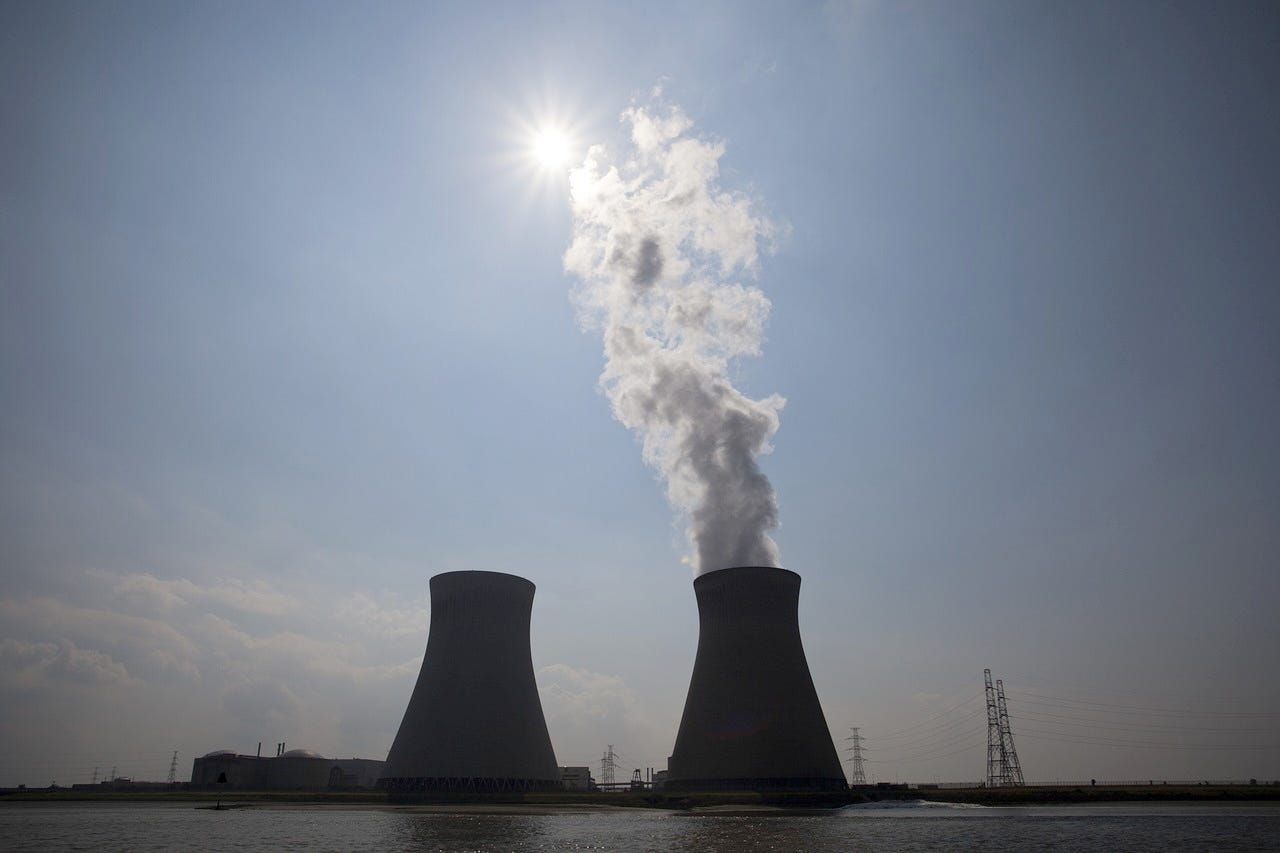
Cooling water consumption will be substantially more than equivalent capacity coal-fired plants.
Direct once-through wet cooling is out of the question for the Coalition’s nominated six inland sites as it would likely cook aquatic lifeforms in extreme summer conditions. In the UK, the water withdrawal requirement for a 1600 MWe nuclear unit with direct once-through wet cooling is about 90 cubic metres per second (7.8 GL/d).
For recirculating or indirect wet cooling, where a power plant does not have abundant water, it can discharge surplus heat to the air using recirculating water systems which mostly use the physics of evaporation. In the UK, the water requirement for a 1600 MWe nuclear unit with natural draft cooling towers is about 2 cubic metres per second (173 ML/d).
Mechanical draft cooling towers have large axial flow fans in a timber and plastic structure. The fans provide the airflow and are able to provide lower water temperatures than natural draft towers, particularly on hot dry days. Such cooling towers give rise to water consumption, with up to 3.0 litres being evaporated for each kilowatt-hour produced, depending on conditions.
Thus, 3.0 litres/kWh x 1,600,000 kW x 24 hours/day = 115 ML/d
By comparison, the 2x 730 MW capacity Mt Piper Power Station’s daily water demand is around 40 ML/day on average and 54 ML/day when the plant is operating at full capacity.
A Federal Coalition Government would initially develop two establishment projects using either small modular reactors (which don’t yet physically exist – the small reactors in China and Russia are prototypes and thus don’t fit the definition of ‘modular’ in that the reactor components were not mass-produced in dedicated factories, and took decades to get up-and-running) or modern larger plants such as the AP1000 or APR1400.
APR-1400 examples:
AP-1000 examples:
I’d suggest the Coalition’s nuclear fantasy is intended to disrupt the ongoing investment in more renewables.
In any comparison to Canada, we have to remember that Canada has abundant surface fresh water with the 4th highest reserves in the world. It’s also worth remembering that all that water is really, really cold! So cooling reactors is no problem in Canada. Not that that is an argument for having reactors, either. But our very low supply of inland water rules us out completely. You can’t safely build reactors on the coast, any coast. Sea level rise, inevitably, and tsunamis, sooner or later, rule that out.
In any case, I don’t believe Dutton has the slightest intention of building reactors if gaining government. This is all a diversion in order to delay renewables to help his coal and gas political donor mates.
The Dark Side of Solar Power
As interest in clean energy surges, used solar panels are going straight into landfill.
by
Harvard Business Review, June 18, 2021
The Dark Side of Solar Power (hbr.org)
hbr.org/2021/06/the-dark-side-of-solar-power
“…The High Cost of Solar Trash
The industry’s current circular capacity is woefully unprepared for the deluge of waste that is likely to come. The financial incentive to invest in recycling has never been very strong in solar. While panels contain small amounts of valuable materials such as silver, they are mostly made of glass, an extremely low-value material. The long life span of solar panels also serves to disincentivize innovation in this area…
It’s Not Just Solar
The same problem is looming for other renewable-energy technologies. For example, barring a major increase in processing capability, experts expect that more than 720,000 tons worth of gargantuan wind-turbine blades will end up in U.S. landfills over the next 20 years. According to prevailing estimates, only five percent of electric-vehicle batteries are currently recycled — a lag that automakers are racing to rectify as sales figures for electric cars continue to rise as much as 40% year-on-year. The only essential difference between these green technologies and solar panels is that the latter doubles as a revenue-generating engine for the consumer. Two separate profit-seeking actors — panel producers and the end consumer — thus must be satisfied in order for adoption to occur at scale.. . .
None of this should raise serious doubts about the future or necessity of renewables. The science is indisputable: Continuing to rely on fossil fuels to the extent we currently do will bequeath a damaged if not dying planet to future generations. Compared with all we stand to gain or lose, the four decades or so it will likely take for the economics of solar to stabilize to the point that consumers won’t feel compelled to cut short the life cycle of their panels seems decidedly small. But that lofty purpose doesn’t make the shift to renewable energy any easier in reality. Of all sectors, sustainable technology can least afford to be shortsighted about the waste it creates. A strategy for entering the circular economy is absolutely essential — and the sooner, the better.
RenewEconomy published today (Jul 21) a piece by John Quiggin headlined Czech nuclear deal shows CSIRO GenCost is too optimistic, and new nukes are hopelessly uneconomic. The piece included:
The Czechia nuclear project cost and duration are so far estimates/expectations, yet to be demonstrated.
Short construction times are consistently the exceptions. See the World Nuclear Industry Status Report 2023, Figure 14 · Delays for Units Started Up 2020–2022.
BARAKAH-1, -2, -3 & -4 construction only durations were expected to be 5 years each, but actually took 8.1, 8.3, 8.0 & 8.7 years respectively.
It took more than 15-years to get BARAKAH-1 up-and-running & more than 18-years to get BARAKAH-4 (yet to be) fully operational. Why would the Czechia nuclear project be significantly quicker?
In the recently published highly regarded Lazard LCOE+ v17, on page 9 includes a US nuclear LCOE data point of US$190/MWh with Note 4:
VOGTLE-3 & -4 LCOE: US$190/MWh ≈ AU$281/MWh, circa 2.5 times Australian ‘firmed’ wind + solar