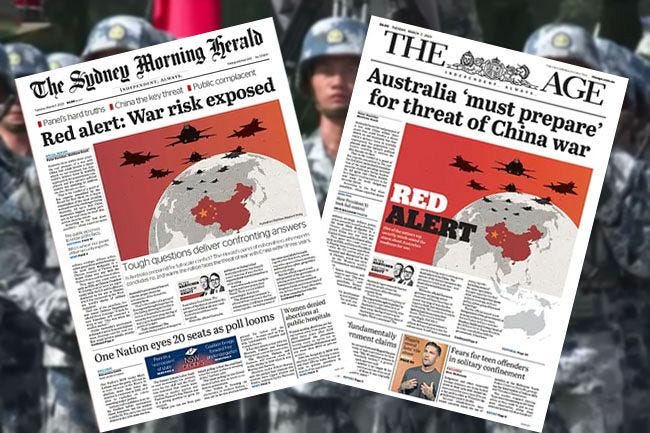
Back in March 2023, the Nine Papers ran a series of articles, entitled Red Alert, based on the claim of an “expert panel” that we should be ready to fight a war with China, within three years. With only a few weeks to go before the third anniversary of the series, the prediction is not looking good. Not only has there been no war, but relations between Australia and China are friendlier than they have been for years, going back at least as far as Turnbull’s prime ministership.
Where did Nine go wrong, and what lessons can we learn? The first, and most important error was the assumption that the PRC government could, if it chose, launch an invasion of Taiwan which would succeed in the absence of intervention by the US and its allies.
This claim was widely accepted in the US at the time, at least until analysts absorbed the lessons of Russia’s invasion of Ukraine. The most commonly proposed date was 2027, the “Davidson window” based on unverified claims that Xi Jinping wanted an invasion, or at least the capacity to undertake one, by then.
But as I argued at the time , the claim disregarded the history of seaborne invasions, which is mostly one of failure. The one success on a comparable scale, the D-Day landings in Normandy, required a preponderance of forces massively greater than that available to the the PRC.
This historical analysis was reinforced by the crushing defeat of Russia’s much-feared (before 2022) Black Sea Fleet. The anticipated assaults on ports like Odesa not take place, and the Fleet played almost no role in the grinding and brutal battle for Mariupol. Worse, beginning with the sinking of the Moskva early in the War, Ukraine, with no naval forces at all, drove Russia’s Navy off the sea entirely, forcing it to seek shelter in faraway Russian ports, but not safe even there.
All of this evidence was available at the time Red Alert was published. The authors could also have looked at China’s failure to undertake any serious preparation for a seaborne landing. China has only a dozen or so modern amphibious assault ships with a combined capacity of perhaps 10 000 troops. And, despite a massive buildup of naval forces generally, the PLA Navy is only adding one or two such ships every year. The supposed backup, dual use civilian ferries, is also proceeding slowly. A recent exercise involving twelve such ships falls far short of what is required for a serious threat
Meanwhile Taiwan is learning the lessons of the Ukraine war. Despite the resistance of the defence establishment (and particularly the navy), Taiwan is shifting expenditure towards the acquisition of missile and drone defences that would make any invasion attempt a catastrophic risk. Taiwan is shifting from reliance on imported US anti-ship missiles, such as the Harpoon to the domestically produced Hsiung Feng III with a range of 400km (considerably more the the width of the Taiwan strait).
As a result of these developments, most analysts (though not the Nine papers) have given up on the Davidson window and started talking about alternatives to invasion, such as a blockade or the more nebulous “quarantine” [1]. These won’t work but have kept the idea of imminent conflict going.
The big unforeseen development since 2023 was the re-election of Donald Trump and his shift in focus to plans to dominate the Americas (the “Donroe doctrine”). It is now pretty clear that Trump would be unwilling to commit US forces to defend Taiwan. China’s military and naval buildup, while not very useful for an invasion of Taiwan, has made such a commitment very risky.
For Australia, the withdrawal of a US commitment to defend Taiwan makes the prospect of war with China even more remote. The operating assumption, and the basis for AUKUS, has been the idea that Australian forces would serve under US command. In the absence of US participation, all we could offer Taiwan in the (remote) event of a war with China is the kind of assistance we’ve given Ukraine – thoughts, prayers and some surplus military equipment.
The UK has drawn the same lesson, scaling back the Indo-Pacific operations (the so-called “tilt the Asia Pacific) which provided the strategic rationale for its role in AUKUS, and abandoning it last permanent base ”east of Suez”. . At this point the only UK interest in AUKUS is to get as much Australian money as possible to support its submarine industry.
I will be surprised and impressed if Nine revisits this failed forecast, and even more so if the result is a change in the coverage of our relations with China and the US.
fn1. What I’ve called the Clayton’s version – the blockade you have when you’re not having a blockade.

