The relative rationality of Malcolm Roberts

Among other interesting results, the recent election gave a Senate seat to One Nation member Malcolm Roberts. Roberts is notable for his expressed belief that global warming is a fraud produced by a global conspiracy of bankers seeking to establish a worldwide government through the United Nations.

Unsurprisingly, Roberts has copped a lot of flak for these statements. But his position seems to me to be more credible than that of the average “sceptic”.
Read More »

The generation game and the 1 per cent

For a generation (fifteen years) or more I’ve been writing and rewriting the same piece about the silliness of the “generation game”, the idea that one’s year of birth matters more than class, gender or race in determining life outcomes and attitudes. But this is a zombie idea that can never be killed.

Stephen Rattner in the New York Times is the latest example, with a piece showing that US Millennials (those born after 1980) are doing much worse than previous generations at the same age, despite higher levels of education. Rattner notes the role of the recession, now nearly a decade old, but then jumps to the conclusion that it is the Baby Boomers, as a group, who are to blame. His only evidence for this is the long-discredited claim of a looming crisis in Social Security.

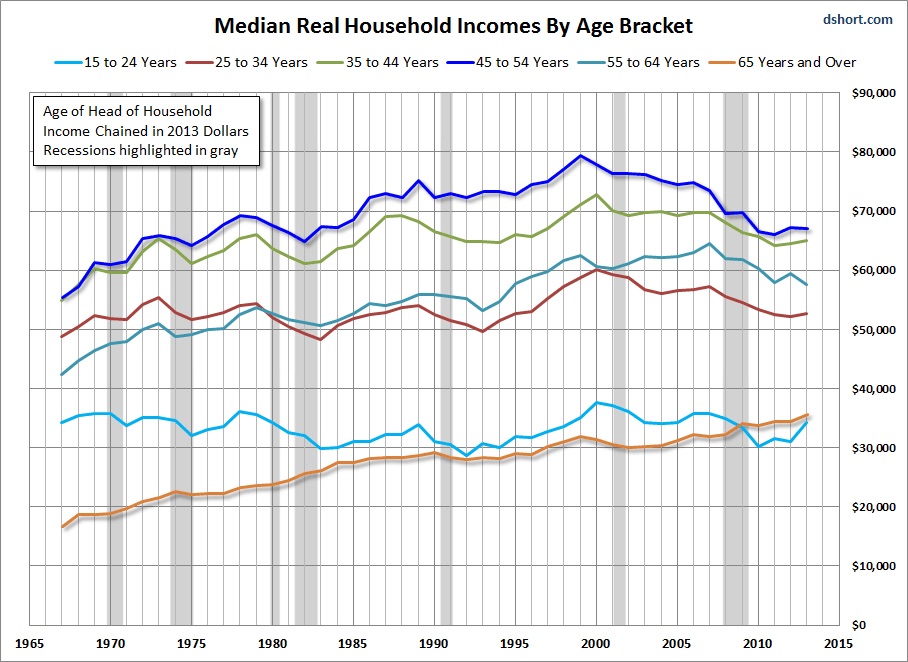
Rattner doesn’t present any evidence about the recent experience of non-Millennials, but his piece leaves the impression that the experience of doing worse than older cohorts at the same age is uniquely Millennial. So I thought I’d do his work for him, and dug out this graph prepared by Doug Short HouseholdIncomeByAge As can be seen, the group suffering the biggest loss, relative to older cohorts at the same age, are those households with heads aged 45-54 in 2013, a mix of late Boomers (for aficianados, this group is called Generation Jones) and early X-ers. But the main point is that median household income is falling for all groups except the 65+ cohort (mostly called Silents in the generation game). Part of this is due to declining household size, but (IIRC) household size has stabilized recently as forming a new household has become less affordable.

Rattner doesn’t mention, even once, the obvious and well-known explanation for the fact that median income is falling while mean income rises. This can only occur if the distribution of income is becoming more skewed, with the top tail (the 1 per cent) benefiting at the expense of everyone else.

Read More »

The IMF: An inexcusable, incorrigible failure

Chris Berrtram at Crooked Timber has already pointed out the failure of the core European institutions in their response to the global financial crisis. One excuse that can be made for these institutions is that they are still in the process of development, and were ill-prepared, intellectually and institutionally, for an event so far outside their experience. The ECB and EC developed in a period when controlling inflation and stabilizing government debt were the key imperatives, and they responded to the crisis accordingly.

No such excuse can be made for the third member of the Troika, the International Monetary Fund. The IMF has understood from the start that the austerity policies it has imposed are economically unsound and a repetition of past failures. And yet it has been unwilling and unable to do anything else.

Read More »

Profit and public health

Amid the abandonment of tariff protection and the continued assaults on trade unionism, one union/lobby group has been consistently victorious. The Pharmacy Guild has managed to restrict competition so successfully that it’s impossible to open a pharmacy if it might hurt the profitability of an existing business, even if that business is failing to serve a significant group of customers. I ran into an example when I was at James Cook University in Townsville. A request for an on-campus pharmacy was rejected because it was within the market area claimed by a suburban pharmacy, more than a kilometre away and inaccessible by public transport.

Far more important to the Guild is the imperative of keeping supermarkets out of the pharmacy business. The key argument is that supermarkets are just businesses, happy to sell anything to make a buck, whether it’s cigarettes or cancer medications.

So, I was interested to read the Guild’s reaction to a proposal that medical professionals should stop prescribing homeopathic products. Whatever you might think about alternative/complementary medicines in general, homoepathy is plain quackery, combining a magical theory of medicine with the preposterous physics of water memory. Unsurprisingly, research has proved beyond any doubt that it’s no better than a placebo. So, the Royal Australian College of General Practitioners (RACGP) has formally recommended GPs stop prescribing homeopathic remedies and says pharmacists must also stop stocking such products.

The Guild’s reaction:

it is not a regulatory authority, and as such there will be no recommendation backing RACGP’s call for homeopathic products to be taken off the market.

In other words, selling medicine in the same shop as alcohol is unthinkable, but it’s entirely OK for a health professional to promote and sell water as a treatment for serious illness.

This episode demonstrates, to anyone who cares to look, that the Pharmacy Guild is (and in fact claims to be) nothing more than a rent-seeking lobby group, whose sole concern is the profitability of its members. As the Tobacco Institute of Australia would be quick to point out (if it were still around), there’s nothing illegal about that. But when profits and public health come into conflict, the Guild and the Institute are on the same side.

One weird trick that proves the IGR is nonsense

I have a piece in today’s Guardian, written before the release of the Intergenerational Report and making the case that the intergenerational equity problem, as it was conceived in the 1980s and 1990s has already been resolved. Key quote

The resolution of the intergenerational fiscal problem was a major public policy achievement of the reform era of the 1980s and 1990s. But a political class still fixated on the most ideological version of the reform agenda, in which cutting public spending is desirable in and out of season has refused to drop the club of intergenerational equity. The idea that (very modest) budget deficits and public debt levels constitute “robbing our children” remains a staple in calls for “reform”.

Having seen the IGR, there’s a single statistical choice that shows the entire exercise to be worthless. The key issue in all this is whether changes in our demographic structure will create an unreasonable fiscal burden. The Report chooses to summarise this by reference to what it calls the “dependency ratio”, defined as the ratio of people aged over 65 to those aged 15-64.

In what kind of world would this make sense? Essentially, one in which
* Children aged 14 and under cost nothing to raise and required no public expenditure on schools, daycare etc
* Children leave school at 15. After this, they not only support themselves, but contribute to the support of those over 65
* People retire become eligible for age pensions at 65

Read More »

Anti-anti-anti-science

I’ve been meaning to write this post for a while, and Paul Krugman has given me a nice jumping off point with this column on how to respond to economists (including highly credentialled ones) who push zombie ideas such as the threat of imminent hyperinflation. As Krugman notes, providing evidence-based criticism, whether politely or rudely, has no impact on people who have strong reasons for wanting to believe something. This is even more true on topics like climate change than it is on economics.
Read More »

Vaccination a partisan issue in the US? (crosspost from Crooked Timber)

Some recent statements by Chris Christie and Rand Paul[^1] have raised the prospect that vaccination, or, more precisely, policies that impose costs on parents who don’t vaccinate their kids, may become a partisan issue, with Republicans on the anti-vax (or, if you prefer, pro-freedom) side and Democrats pushing a pro-vaccine, pro-science line. Christie and Paul took a lot of flak from other Republicans and even Fox News, and tried to walk their statements back, so it seems as if it won’t happen just yet.

But there are some obvious reasons to think that such a divide might emerge in the future, and that Christie and Paul just jumped the gun. The outline of the debate can be seen in the ferocious response to Reason magazine’s endorsement of mandatory vaccination. And, while Reason was on the right side this time, they’ve continually cherrypicked the evidence on climate change and other issues to try to bring reality in line with libertarian wishes.

The logic of the issue is pretty much identical to that of climate change, gun control, and other policies disliked by the Republican/schmibertarian base. People want to be free to do as they please, even when there’s an obvious risk to others and don’t want to hear experts pointing out those risks.[^2] So, they find bogus experts who will tell them what they want to hear, or announce that they are “skeptics” who will make up their own minds. An obvious illustration of the parallels is this anti-vax piece in the Huffington Post by Lawrence Solomon, rightwing author of The Deniers, a supportive account of climate denial[^3].

As long as libertarians and Republicans continue to embrace conspiracy theories on issues like climate science, taking a pro-science viewpoint on vaccination just makes them “cafeteria crazy”. The consistent anti-science position of people like Solomon is, at least intellectually, more attractive.

Note Another issue that fits the same frame is speeding. Anti-science ibertarians in Australia and the UK are strongly pro-speeding, but I get the impression that this isn’t such a partisan issue in the US, the reverse of the usual pattern where tribalist patterns are strongest in the US.

[^1]: Christie was just pandering clumsily, but Paul’s statement reflects the dominance of anti-vax views among his base and that of his father (take a look at dailypaul.com).
[^2]: Of course, the situation is totally different in cases like Ebola and (non-rightwing) terrorism, where it’s the “others” who pose the risk.
[^3]: The Huffington Post used to be full of leftish anti-vaxers. But the criticisms of Seth Mnookin and others produced a big shift – Solomon’s was the only recent example I could find. Similarly, having given equivocal statements back in 2008, Obama and Clinton are now firmly on the pro-vaccine side.

No pennies for Tenpenny

Following up on my earlier piece about anti-vaxer Sherri Tenpenny, I’m pleased to report that all the commercial venues that were booked for her potentially lucrative “seminars” have cancelled. It appears the bookings were made by her Australian contact, pro-disease advocate Stephanie Messenger, under the name of a bogus anti-SIDS charity. Apparently, charges of to $200 a head were proposed.

What free speech issues arise here? As I argued previously, I don’t support a ban on Tenpenny visiting Australia, and having come here, she should be free to organize and address public meetings, open to anyone to attend (and heckle!). But there’s no reason to permit her to make money out of her evil lies. As regards potential venues, if they take her money, they are complicit in her activities.

It’s worth observing that this balance only works if there is a substantial public sphere in which freedom of expression is guaranteed, leaving private businesses to make their own choices on matters like venue hire. The privatised world favored by propertarians is one in which freedom of speech and thought is subordinated to the rights of property owners. In the US, for example, the absolutist opposition to government restrictions on free speech goes hand in hand with the right of employers and landlords to sack or evict anyone whose opinions (or even abstinence from favored political organizations) they don’t like.

Living to 150: A quick reality check

Our fact challenged Treasurer, Joe Hockey raised some eyebrows when he suggested that we need to reform Medicare because children born today might live to 150. He got some support from University of New South Wales faculty of medicine dean Peter Smith, who cited the increase in life expectancy over the last century, from 55/59 (for men and women respectively) in 1910 to 80/84 today.

There’s an apparent paradox here: If life expectancy is 80/84 years today, how can a newborn child expect to live 150 years. The answer is that “life expectancy” is nothing of the sort. It’s the average age at death if current age-specific mortality rates remain unchanged. On average, people born in 1910 actually lived well beyond their “life expectancy” because death rates fell through their lifetime. So, if medical progress continues, people born today may live, on average, well past 80/84.

But how much more? Unfortunately, on past indications, not much more. Most of the 20th century extension of life expectancy came from a reduction in death rates for the young. A 65-year old in 1910 could expect to live to 76/78 (since death rates don’t change much over a decade, that’s an actual expectation not just a statistical construct). Today, that’s increased to 84/87, from 11/13 years of extra life to 19/22. For Hockey to be right, over the next 100 years or so, the conditional expectancy has to rise five-fold, to 85 years. The basis for all this, it seems, is a 2011 press release of the kind we see every week or two announcing a breakthrough that might, perhaps, lead to a cure for this or that disease.

But even in the unlikely event that this extension of life occurs, what possible relevance could it have to the amount we should pay for medical care today? Even under current rules (which would certainly change with extended life expectancy) Hockey’s hypothetical Methuselah wouldn’t be eligible for the age pension until 2085 and (given the anti-aging breakthrough he hypothesises) wouldn’t seriously burden the health care system until well into the 22nd century. Coming from a government that dismisses concerns about climate change as a problem for the indefinite future, this solicitude for Treasurers yet unborn seems misplaced.

Update Via Twitter, I discover that the source of Hockey’s claim is someone called Aubry de Grey, who is obviously in the tradition of wealthy British eccentrics, with his own foundation, journal and so on; a much more appealing instance of this kind of thing than Lord Monckton, but still not to be taken seriously.

Further update Defending Hockey’s silliness, Mark Kenny makes the point that what Hockey actually said (restating de Grey) was that it is “remarkable that somewhere in the world today, it is highly probable, a child has been born who will live to be 150”. This shift from mean to maximum helps the demographic plausibility of Hockey’s case, but only marginally (we still need an advance of nearly 30 years on 122, the longest lifespan ever recorded), but it makes the argument even weaker. Suppose that some child in, say, China is going to live to 150. What possible impact can that have on our health system. More generally, what can it matter to the budget if a handful of people live very long lives. It’s the average (measured by numbers like life expectancy at 65) that matters. As an indication of the minuscule scale of the fiscal problem posed by those with very long lives, there are currently only about 4250 Australians aged over 100, amounting to about 0.02 per cent of our population.

Yet further update It’s worth pointing out that, with pension age eligibility rising from 65/60 when the age pension was introduced around 1910 to 70/70 by 2035, men will have lost half of the extra retirement years gained from higher life expectancy and women the whole gain. The big problem we face is underemployment of prime-age workers, not the fact that we aren’t dying early enough.
Catalyst teaches the controversy

I was at the gym just now and they had a rerun of a Catalyst story from October on the alleged climate change pause, presented by Anja Taylor. It was appalling. It started off correctly attributing the 1998 peak in warming to El Nino (with a shot of Richard Morecroft).

Next there was an unnamed speaker, suggesting that this presaged a permanent El Nino . This obvious straw man (it’s called the Southern Oscillation because it’s cyclical) was presented as if it represented the view of mainstream science, but the transcript attributes it to “reporter”. Clearly, Taylor was unable to get any vision of an actual scientist making this claim.

Next, four denialists (Monckton, Paltridge, Newman and Curry) and an editorial intervention from Taylor asserting the “pause” as a reality, with some super-shoddy graphs. Then a flashback to Climategate.

After this setup, things got gradually better. Some real scientists were brought on, and we eventually reached the conclusion “All things considered, there’s been no global warming pause”. But anyone watching the program would conclude that the sceptics had a pretty strong case.

The problem is that this kind of “teach the controversy” approach is utterly inappropriate for a TV science program. In this case, the problem is (as the program admits) that the majority of the time is given to a view held by a tiny minority of scientists, so few that Taylor had to give air time to two non-scientists and one who has gone emeritus. But even on a topic where scientists are actually divided, a 15-minute TV segment isn’t going to help clarify the issues.

Unfortunately, this kind of thing is typical of Catalyst nowadays. I used to think it was just Maryanne Demasi, but obviously the producers want to present “he said, she said” controversy. It’s time for the ABC to pull the plug.