Looking at the facts, there’s no reasonable conclusion except that US democracy is done for. But rather than face facts, I’m turning to fiction. So, here’s a story about the collapse of Trumpism, crony capitalism and the AI/crypto bubble. Fiction is a relatively unfamilar mode of writing for me, so critique (on style and structure rather than plausibility) is most welcome.
Read More »Monday Message Board
Another Monday Message Board. Post comments on any topic. Civil discussion and no coarse language please. Side discussions and idees fixes to the sandpits, please.
I’m now using Substack as a blogging platform, and for my monthly email newsletter. For the moment, I’ll post both at this blog and on Substack. You can also follow me on Mastodon here.
Monday Message Board
Another Monday Message Board. Post comments on any topic. Civil discussion and no coarse language please. Side discussions and idees fixes to the sandpits, please.
I’m now using Substack as a blogging platform, and for my monthly email newsletter. For the moment, I’ll post both at this blog and on Substack. You can also follow me on Mastodon here.
Monday Message Board
Another Monday Message Board. Post comments on any topic. Civil discussion and no coarse language please. Side discussions and idees fixes to the sandpits, please.
I’m now using Substack as a blogging platform, and for my monthly email newsletter. For the moment, I’ll post both at this blog and on Substack. You can also follow me on Mastodon here.
If something can’t go on forever, it will stop
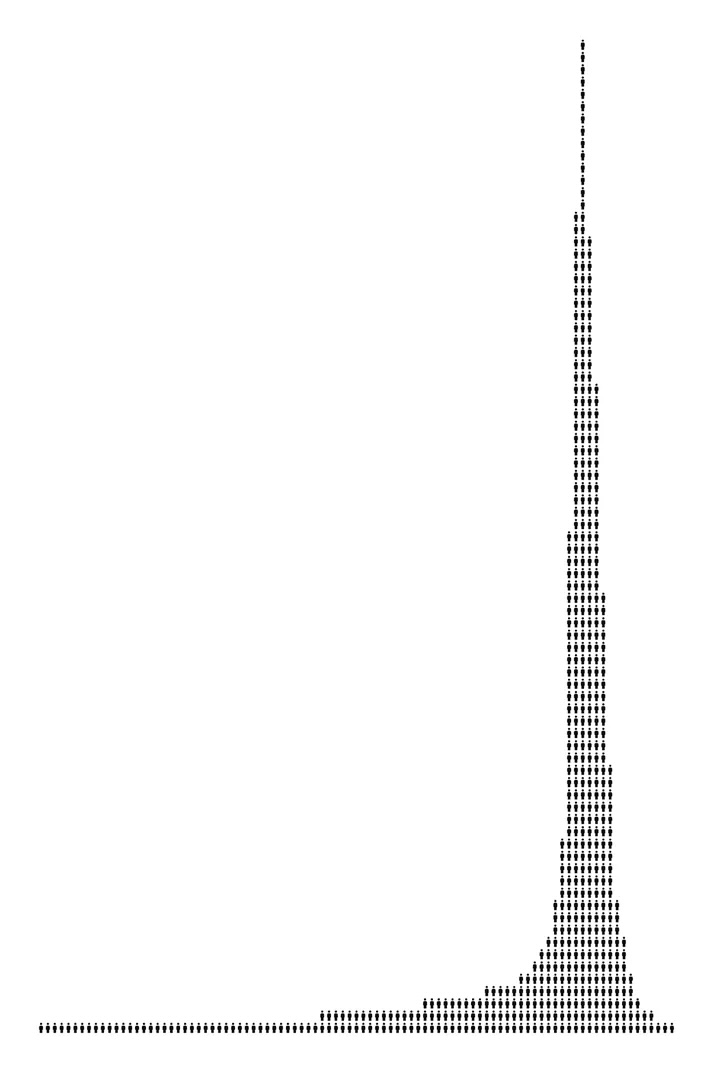
The most striking observation in Dean Spears and Michael Geruso’s new book, After the Spike, is summed up by the cover illustration, which shows a world population rising rapidly to its current eight billion before declining to pre-modern levels and eventually to zero. As the authors observe, this is the inevitable implication of the hypothesis that fertility levels will remain below replacement level indefinitely into the future.
Stop the free ride: all motorists should pay their way, whatever vehicle they drive
\A new road charge is looming for electric vehicle drivers, amid reports Treasurer Jim Chalmers is accelerating the policy as part of a broader tax-reform push.
At a forum in Sydney this week, state and federal Treasury officials are reportedly meeting with industry figures and others to progress design of the policy, ahead of next week’s economic reform summit.
Much discussion in favour of the charge assumes drivers of electric and hybrid vehicles don’t “pay their way”, because they are not subject to the fuel excise tax.
This view is based on an economic misconception: that fuel taxes are justified by the need to pay for the construction and maintenance of roads.
This is incorrect. In a properly functioning economic system, fuel taxes should be considered a charge on motorists for the harmful pollution their vehicles generate.
That leaves the problem of paying for roads. To that end, a road-user charge should be applied to all motorists – regardless of the vehicle they drive – so no-one gets a free ride.
Real science from real scientists.
Get free newsletter
What is the fuel excise?
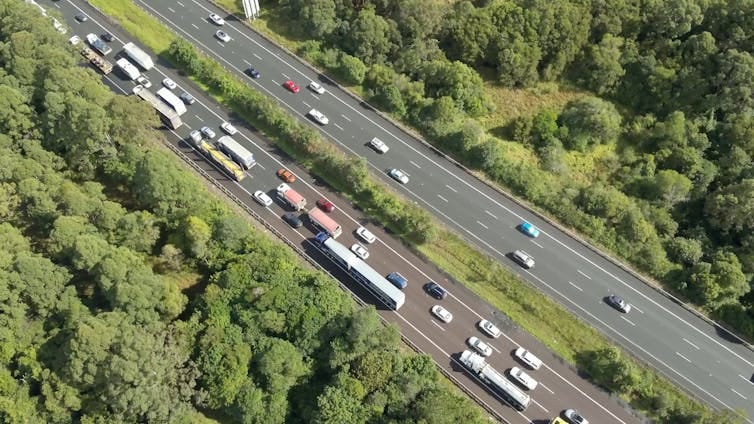
The fuel excise in Australia is currently about 51 cents a litre and is rolled into the cost of fuel at the bowser.
Some, such as the Australian Automobile Association claim revenue from the excisepays for roads. But it actually goes into the federal government’s general revenue.
The primary economic function of the fuel tax is that of a charge on motorists for the harmful pollution their vehicles generate.
Paying the cost of pollution
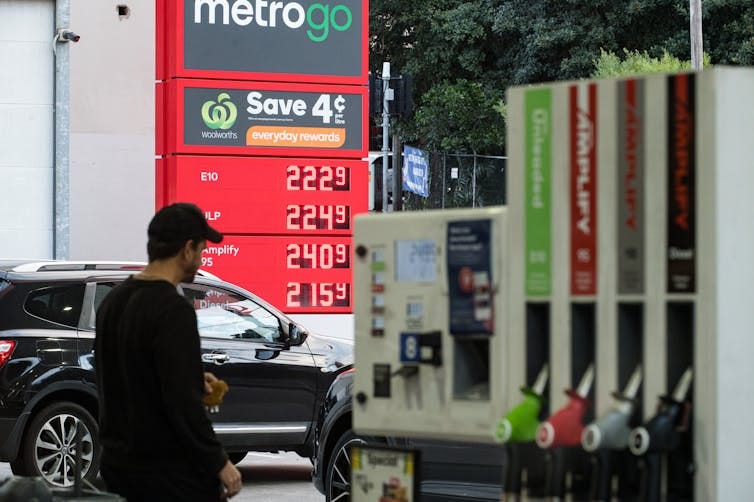
Vehicles with internal combustion engines – that is, those that run on petrol or diesel – create several types of pollution.
The first is carbon dioxide emissions, which contribute to human-caused climate change. Others include local air pollution from particulates and exhaust pollution as well as noise pollution.
In economic terms, these effects are known as “negative externalities”. They arise when one party makes another party worse off, but doesn’t pay the costs of doing so.
How big are the costs to society imposed by polluting vehicles? Estimates vary widely. But they are almost certainly as large as, or larger than, the revenue generated from fuel excise.
Let’s tease that out.
A litre of petrol weighs about 0.74 kg. But when burned, it generates 2.3 kg of CO₂. That’s because when the fuel is combusted, the carbon combines with heavier oxygen atoms.
Before the re-election of United States President Donald Trump, the nation’s Environmental Protection Agency estimated the social cost of carbon dioxideemissions at about US$190 (A$292) per metric tonne.
So in Australian terms, that means CO₂ emissions from burning petrol costs about 67 cents a litre, more than the current excise of 51 cents per litre.
Even using a more conservative estimate of US$80 a metric tonne, CO₂ emissions generate costs of around 28 cents a litre, more than half the fuel excise.
A spotlight on health impacts
Motor vehicles are a major cause of air pollution. Air pollution is causally linked to six diseases:
- coronary heart disease
- chronic obstructive pulmonary disease (COPD)
- stroke
- type 2 diabetes
- lung cancer
- lower respiratory infections.
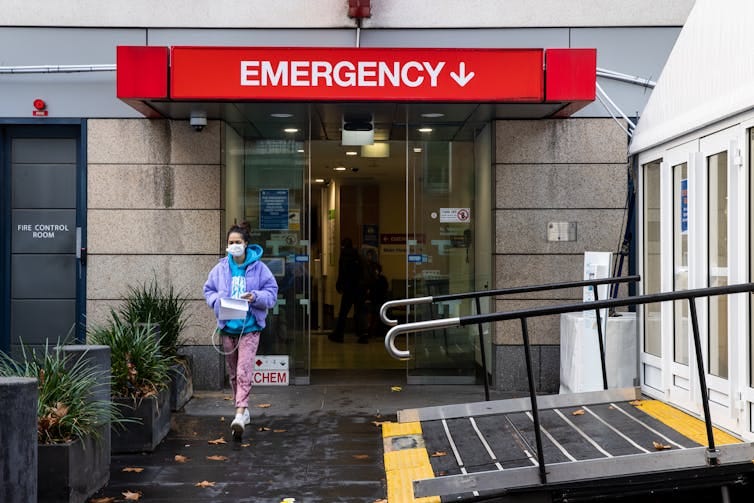
Estimates of the deaths associated with air pollution in Australia range from 3,200 to more than 4,200 a year.
Even the lower end of that range is far more than the roughly 1,200 lives lost in car crashes annually.
University of Melbourne analysis in 2023 landed at an even higher figure. It suggested vehicle emissions alone may be responsible for more than 11,000 premature deaths in adults in Australia a year.
Putting a dollar value on life and health is difficult – but necessary for good policy making.
The usual approach is to examine the “statistical” reduction in deaths for a given policy measure. For example, a policy measure that eliminates a hazard faced by 1,000 people, reducing death risk by 1 percentage point, would save ten statistical lives.
The Australian government ascribes a value of $5.7 million per (statistical) life lost or saved. So, hypothetically, a saving of 2,000 lives a year would yield a benefit of more than $10 billion.
This is more than half the revenue collected in fuel excise each year.
The best road forward
Given the harms caused by traditional vehicles, society should welcome the decline in fuel excise revenue caused by the transition to EVs – in the same way we should welcome declining revenue from cigarette taxes.
If we assume fuel excise pays for pollution costs, then who is paying for roads?
The cost of roads goes far beyond construction and maintenance. The capital and land allocated to roads represents a huge investment, on which the public, as a whole, receives zero return.
Vehicle registration fees make only a modest contribution to road costs. That’s why all motorists should pay a road-user charge.
The payment should be based on a combination of vehicle mass and distance travelled. That’s because damage to roads is overwhelmingly caused by heavy vehicles.
Then comes the question of Australia’s emissions reduction. The switch to electric vehicles in Australia is going much too slowly. A road user charge targeting only electric and hybrid vehicles would be a grave mistake, slowing the uptake further.
Monday Message Board
Another Monday Message Board. Post comments on any topic. Civil discussion and no coarse language please. Side discussions and idees fixes to the sandpits, please.
I’m now using Substack as a blogging platform, and for my monthly email newsletter. For the moment, I’ll post both at this blog and on Substack. You can also follow me on Mastodon here.
Mitigating the productivity damage from Covid-19: the case for improved ventilation standards
I wrote this for the Cleaner Air Collective, who used it as an input to their submission to the Productivity Roundtable
Given the purpose of the exercise, the discussion is framed in terms of productivity though many of the issues are broader
Covid-19 is a serious economic problem for Australia, not only as a major cause of death, but because of serious impacts in productivity.
Although most Covid-19 deaths occur among people over 80, there were over 200 deaths from Covid among people aged 40-64. This is a mortality rate comparable to that of road trauma (377 deaths in this age group in 2022) As of 2023, excess mortality remained high at 5 per cent
With the effective abandonment of most forms of reporting, it is hard to assess the prevalence and impact of Covid-related morbidity. However, there is substantial global evidence of increased worker absenteeism associated with both acute Covid-cases and post-Covid conditions (long Covid). Evidence also suggests cumulative damage to various organs associated with repeated infection.
Read More »Monday Message Board
Another Monday Message Board. Post comments on any topic. Civil discussion and no coarse language please. Side discussions and idees fixes to the sandpits, please.
I’m now using Substack as a blogging platform, and for my monthly email newsletter. For the moment, I’ll post both at this blog and on Substack. You can also follow me on Mastodon here.
Monday Message Board
Another Monday Message Board. Post comments on any topic. Civil discussion and no coarse language please. Side discussions and idees fixes to the sandpits, please.
I’m now using Substack as a blogging platform, and for my monthly email newsletter. For the moment, I’ll post both at this blog and on Substack. You can also follow me on Mastodon here.

