Twenty-five years ago, the world waited for the dawn of a new millennium (a few pedants grumbled that the millennium wouldn’t start until 2001, but no one paid much attention). The excitement of the occasion was tempered by concern, and, in some quarters panic, about the possibility of a massive computer outage resulting from the “Y2K” or “millennium” bug.
The origin story of the bug was that, in the 1970s and 1980s, computer programmers had saved space, or merely effort, by coding years with two digits rather than four. Indeed, the habit was so ingrained that the dominant operating system of the day was called Windows 98, and required some minor fixed to deal with the arrival of the year 2000.
Without such adjustments, it was feared, computer programs would misperceive dates in 2000 as if they were in 1900, producing chaotic errors. The issue had been discussed on the then-nascent Internet for years, mostly in humorous terms. But as the critical date approached, the tone turned to panic, at least in the main English speaking countries.
The catalyst was the realisation that the bug might be found in “embedded systems”, such as the microchips found in virtually every modern device, such as aircraft and lift control system. If they failed, technological society might grind to a halt producing the scenario discussed as ‘“The End Of The World As We Know It” (TEOTWAWKI). This scenario was taken seriously enough to generate an effort to check everything from fax machines to microwave ovens.
Another Monday Message Board. Post comments on any topic. Civil discussion and no coarse language please. Side discussions and idees fixes to the sandpits, please.
I’ve avoided post-mortems on the US election disaster for two reasons.
First, they are useless as a guide to the future. The next US election, if there is one [1], will be a referendum on the Trump regime. Campaign strategies that might have gained the Democrats a few percentage points in November 2024 won’t be at all relevant in 2026 or 2028, let alone in the aftermath of a regime collapse further in the future.
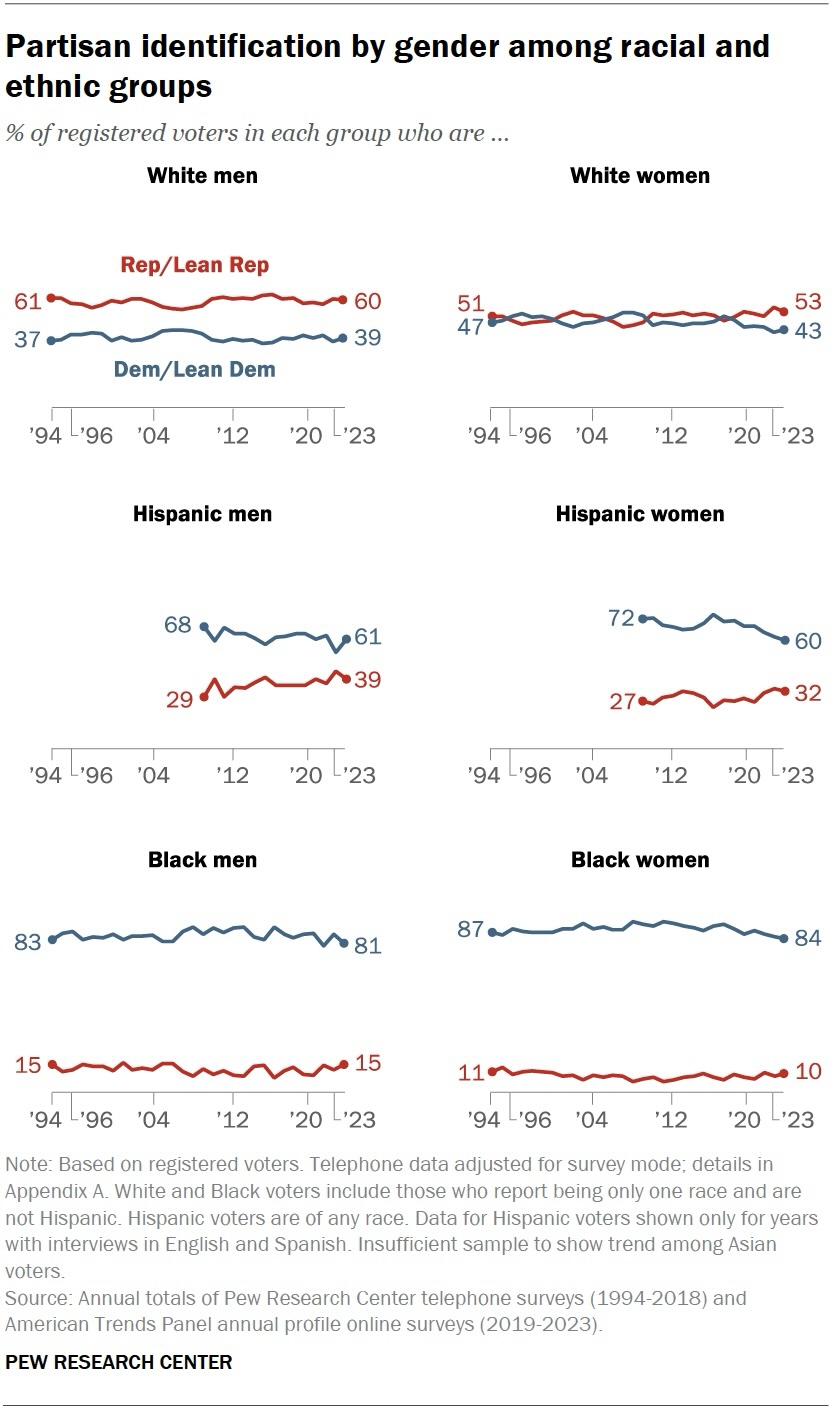
Second, by focusing on the marginal shifts between 2020 (or even 2012) and 2024, these post-mortems miss the crucial fact that the divisions in US politics have been more or less constant[2] for the last 30 years, as this graph from the Pew Foundation shows.
Throughout this period the Republican Party has been competitive only because, it has received the consistent support of 60 per cent of white men.
Of course, that wouldn’t be enough without some votes from non-whites and women. But there is no group other than white men where the Republicans have had a reliable majority over the past 30 years.
More precisely the Republicans represent, and depend on, angry white men. I first heard the term “angry white men” in relation to the 1994 mid-term election when the proto-Trump Newt Gingrich led the Republicans to their first House of Representatives majority in 40 years. The 1994 outcome was the culmination of Nixon’s Southern strategy, bringing Southern whites, angry about their loss of social dominance in the Civil Rights ere, into the Republican camp.
All that has really happened since then is that white American men, fuelled by a steady diet of Fox News and talk radio, have got angrier and angrier. This was concealed, for a while, by the fact that the Republican party establishment had sufficient control over nomination processes to ensure that most candidates were relative moderates. But over time that control has eroded, and the establishment itself has been taken over by angry white men, predominantly Southerners.
What are angry white men angry about? Lots of the discussion focuses on economic disappointments. But there are plenty of high-income Republican. The Republican affiliation of white men has remained constant through boom and bust, recovery and contraction. There has been a shift of support between more educated (now less Republican) and less educated (more Republican) white men, reflecting the increasingly stupid content of the anger diet, but there is no shortage of college-educated consumers and purveyors of white male anger.
Angry white men are overwhelmingly Christian (non-Christian white men mostly support the Democrats, and it used to be argued that they were deeply concerned about a variety of moral and ethical issues, mostly around sex and gender. But Trump has trashed all of their supposed values, notably including principled opposition to abortion, without losing any support. They are still vociferously bigoted against trans people, but really, any target will do.
Political success is going to make angry white men even angrier. By silencing their opponents they can, in the immortal words of the New York Times Editorial Board acquire “the right to speak their minds and voice their opinions in public without fear of being shamed”, but they will still be shunned, and know that they are being derided behind their backs.
Perhaps if the Democrats had been a bit luckier or cleverer in 2024, another four years might have been enough to change things, but there’s no point in regretting that now. Perhaps Trump’s rule will be so chaotic as to bring the whole enterprise crashing down around him. Or, perhaps, this shrinking minority of the population will continue to hold the vast majority of positions of power indefinitely into the future, relying on increasingly stringent repression to secure their hold.
Is there a solution to the problem of angry white men? If there is, I can’t see it, except for the eternal fact that all things must pass.
fn1. Of course, the forms of an election will be observed, as they are almost everywhere in the world. But if the press is tightly controlled, the police and army under political directions political opponents silenced or jailed, the rituals of an election don’t imply the possibility of a change of government.
fn2. The only notable trend is the increase in Republican suppport among Hispanics. This is a complicated topic, which I don’t propose to discuss here. Please, no comments on this, or on short term changes between 2020 and 2024/
Another Monday Message Board. Post comments on any topic. Civil discussion and no coarse language please. Side discussions and idees fixes to the sandpits, please.
Another Monday Message Board. Post comments on any topic. Civil discussion and no coarse language please. Side discussions and idees fixes to the sandpits, please.
I wrote this for a Guardian panel. The published version was cut for space reasons, so here’s the full version
The central concern expressed by the Reserve Bank in defending its high-interest rate policy is that expectations of higher inflation may become entrenched, requiring a further, more painful round of contractionary monetary policy in the future. Even after stripping out the effects of various “cost of living measures”, the RBA’s estimated core inflation rate is only just above 3 per cent. This suggests extreme sensitivity to the risk of even a modest increase in the long run rate of inflation.
By contrast, the RBA expresses no concern that the reduction in economic growth induced by its policies will lead to a permanent reduction in living standards. The underlying assumption of the RBA’s macroeconomic model is that the economy will always return to a long-run growth path determined by technology and economic structure.
But there is ample evidence, notably from New Zealand and the UK to suggest that the loss in productive capacity associated with slowdowns and recessions is permanent or very close to it. Until the 1980s, the New Zealand and Australian economies grew almost in parallel. But from the early 1990s, onwards, while Australia has avoided recession (at least on the widely-used measure of two quarters of negative growth) for more than thirty years, New Zealand has had at least half a dozen. This miserable performance, reflecting both policy misjudgements and overzealous neoliberal reforms has resulted in New Zealand falling far behind Australia in terms of incomes and living standards. The steady flow of New Zealanders to our shores, and the lack of any comparable flow in the opposite direction, reflects this.
In the UK, the combined effects of the GFC, Conservative austerity policies and Brexit has produced a long period of stagnation in national income. As Brad DeLong observes, had Britain continued on its pre-2008 growth trend it would now be forty percent richer than it is today
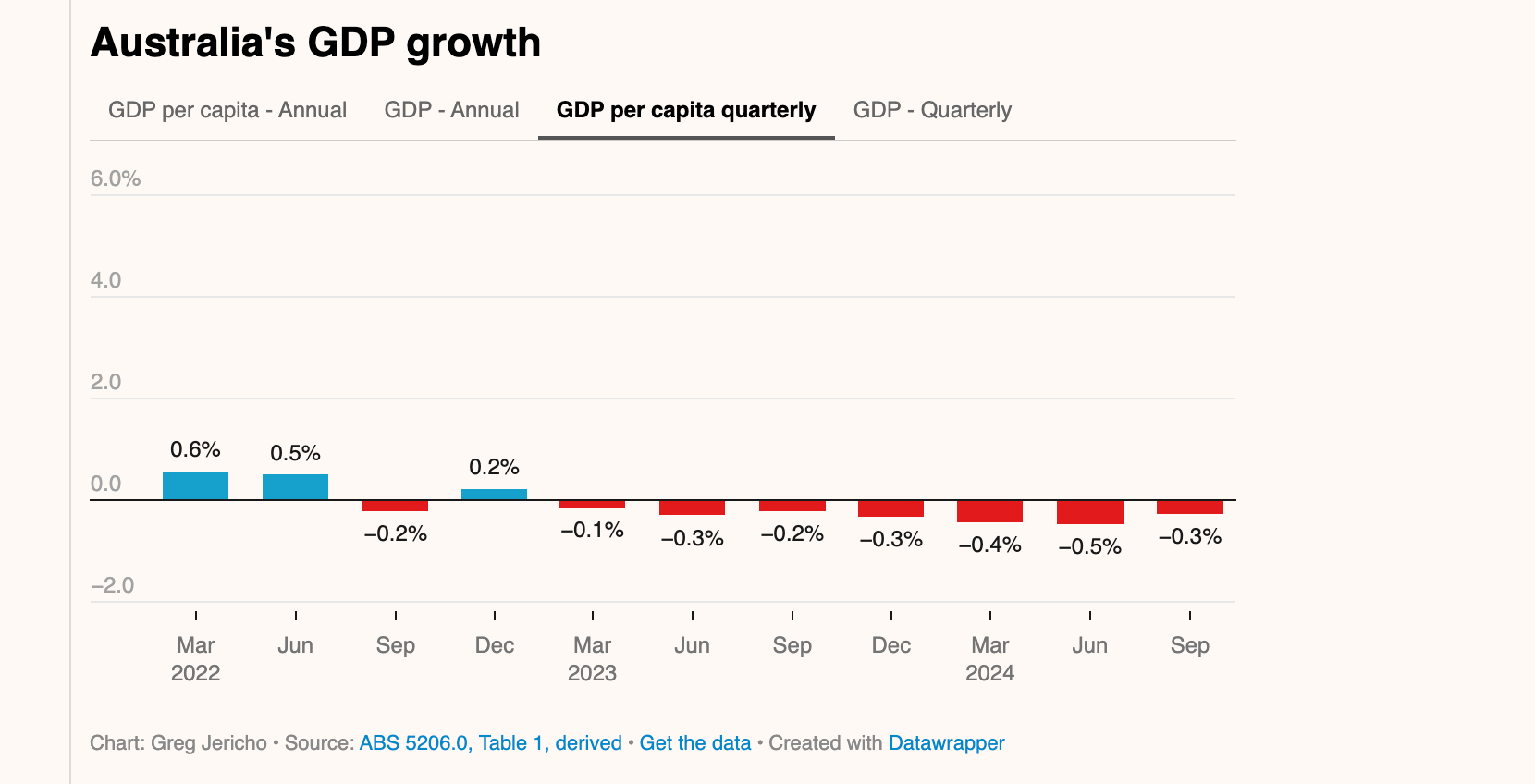
Even though Australia has experienced a lengthy period of declining national income per person, the RBA does not even mention the risk of a permanent reduction in living standards. In its pursuit of rapid achievement of an essentially arbitrary inflation target, RBA monetary policy puts all our futures at risk
Last week, I gave a presentation at the 2024 Australian Basic Income Fellows Workshop. Most of the talks were about Basic Income trials, which have been undertaken around the world. I focused on something more modest but perhaps more achievable: getting evidence on the effects of Scrapping or Scaling Back Mutual Obligation and Income Management.
You can download the Powerpoint presentation here or see the slides on my Substack
Another Monday Message Board. Post comments on any topic. Civil discussion and no coarse language please. Side discussions and idees fixes to the sandpits, please.
Another Monday Message Board. Post comments on any topic. Civil discussion and no coarse language please. Side discussions and idees fixes to the sandpits, please.
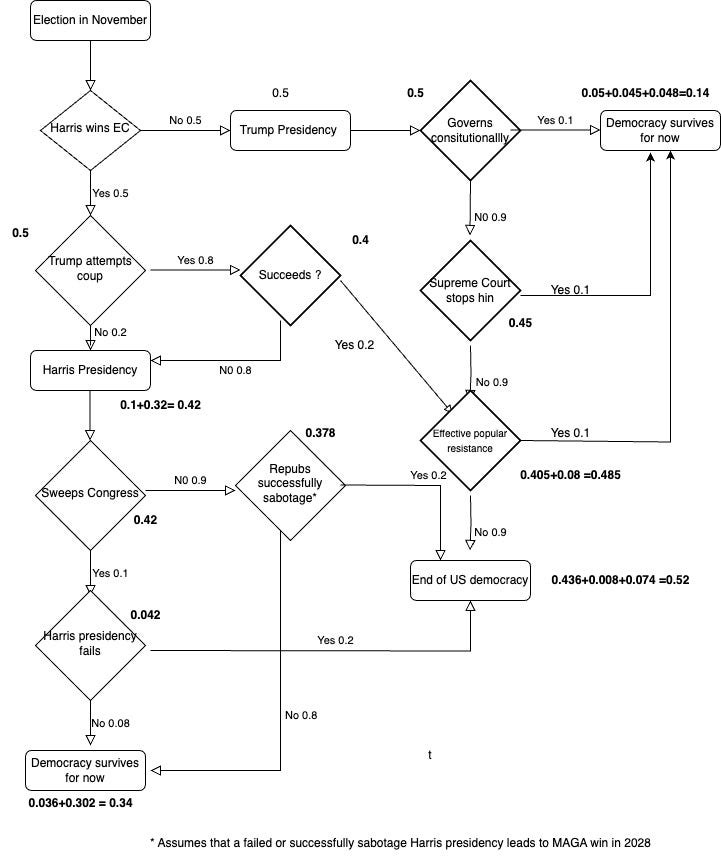
A few weeks ago, I drew up a flowchart to estimate the probability that Trump would establish a dictatorship in the US, which looked, at the time, like an even money bet.
We don’t need to speculate any more. Trump has announced the dictatorship, and there is no sign of effective resistance. The key elements so far include
Extremists announced for all major positions, with a demand that they be recess appointments, not subject to Senate scrutiny
A state of emergency from Day 1, with the use of the military against domestic opponents
Mass deportations, initially of non-citizens and then of “denaturalised” legal immigrants
A third term (bizarrely, the nervous laughter that greeted this led to it being reported as a joke).
A comprehensive purge of the army, FBI and civil service
It’s clear that Trump will face no resistance from the Republican party. There’s an outside chance that the Supreme Court will constrain some measures, such as outright suppression of opposition media, but that won’t make much difference.
It’s possible that Trump will overreach in some way, such as carrying out his threat to execute political opponents before the ground is fully prepared. Or, his economic policies may prove so disastrous that even rigged elections can’t be won. But there is no good reason to expect this.
I can’t give any hopeful advice to Americans. The idea of defeating Trump at the next election is an illusion. Although elections may be conducted for some time, the outcome will be predetermined. Street protest might be tolerated, as long as it is harmless, but will be suppressed brutally if it threatens the regime. Legal action will go nowhere, given that the Supreme Court has already authorised any criminal action Trump might take as president.
The models to learn from are those of dissidents in places like China and the Soviet Union. They involve cautious cultivation of an alternative, ready for the opportunity when and if it comes.
For Australia, the easy, and wrong, course of action will be to pretend that nothing has happened. But in reality, we are on our own. Trump is often described as “transactional”, but this carries the implication that having made a deal, he sticks to it. In reality, Trump reneges whenever it suits him, and sometimes just on a whim. If it suits Trump to drag us into a war with China, he will do it. Equally, if he can benefit from leaving us in the lurch, he will do that
Our correct course is to disengage slowly and focus on protecting ourselves. That means a return to the policy of balancing China and the US, now with the recognition that there is nothing to choose between the two in terms of democracy. We need to back out of AUKUS and focus on defending ourselves, with what Sam Roggeveen has called an “echidna” strategy – lots of anti-ship missiles, and the best air defences we can buy, from anyone willing to supply them.