Another Monday Message Board. Post comments on any topic. Civil discussion and no coarse language please. Side discussions and idees fixes to the sandpits, please.
This week’s budget was Treasurer Jim Chalmers’ third and – for practical purposes – final for the current parliamentary term.
Even if the 2025 election is delayed long enough to give Labor another budget, that speech would represent more of an election manifesto than any deliverable legislation.
We are therefore now in a position to assess the Albanese government’s record on public spending and taxation.
Most strikingly, the Albanese government’s electoral strategy has constrained it to do little more than tweak the policy settings it inherited from the previous government, and adopt them as its own.
There’s nothing new about opposition parties campaigning on a “small target” strategy. Howard, Rudd and Abbott all did the same. But on attaining office, those prime ministers all became notably bolder.
In stark contrast, the Albanese government appears to have acted less ambitiously in office than it did when seeking election.
Constrained on both income and spending
This softness is likely due in part to the size of the commitments Labor made to eliminate any policy differences that could have cost the party votes in the 2022 election.
On the revenue side, Albanese rejected all the revenue-enhancing measures Labor had fruitlessly taken to the 2019 election.
What remained were the massively expensive Stage 3 tax cuts, which ensured the ratio of tax revenue to the size of the economy would shrink over the government’s term in office. This was only exacerbated by a decline in export earnings for coal and iron ore.
The restructuring of the Stage 3 tax cuts – hastily announced in the lead-up to the Dunkley by-election – did make them much less regressive.
But the modified version will only partially offset the the expiry of the low and middle income earners tax offset, and by my calculations will still deliver big gains to the top 40% of earners. More relevantly, at least in the budget context, the cuts’ cost in terms of tax revenue was unchanged.
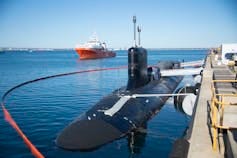
The federal government has allocated more than $2 billion to the AUKUS project in just the next
The government is also constrained on the expenditure side. Albanese’s enthusiastic embrace of the AUKUS agreement commitment has loaded the budget with hundreds of billions of dollars in future commitments, with several billion already allocated in the current budget.
The failure of successive governments to find new sources of funding for the National Disability Insurance Scheme has only added to these difficulties.
Yet despite all these constraints, the government has been unable to resist a few (it hopes) vote-grabbing extravagances. Perhaps the most lavish was the decision to provide federal funding for a new football stadium in Hobart.
More recently, the government announced it would spend a billion dollars to chase the dream of a quantum computer, one of those revolutionary technologies that has been “just over the horizon” for decades.
And of course, the headline item in the current budget, a once-off $300 discount on every household’s energy bills.
Labor doesn’t look like Labor anymore
Welfare payments again missed out on a boost in this year’s budget. James Ross/AAP
The combination of these constraints with an imperative to deliver budget surpluses means little – if anything – has been put aside to pursue the traditional goals of a Labor government.
Instead, we’ve seen largely symbolic measures puffed up to appear impressive. Most of these are better viewed as adjustments to keep policy set by the previous government on course.
An automatic inflation adjustment for welfare benefits was touted by the prime minister as “the biggest increase to the pension in 30 years”.
But meanwhile, the government has steadfastly resisted pressure to raise Jobseeker benefits to a liveable level, reluctantly squeezing out an extra $20 a week last year (Scott Morrison gave $50).
The Housing Australia Future Fund is presented as a $10 billion program to deliver over 30,000 houses. But it will be delivered as a modest subsidy of just $500 million annually, enough to build perhaps 2,000 modest homes per year. The program has since been overtaken by more extensive action at the state level.
For university students, the government has materially changed the HECS indexation formula. But it has left in place the Job Ready Graduates fee structure, a poorly thought out increase in the cost of degrees in the humanities and other subjects pushed out in the dying days of the Morrison government by Education Minister Dan Tehan.
On top of this, the underfunding of public schools has if anything become worse, with the ambitions of the Gonski program indefinitely deferred.
On health, the government has taken measures to arrest the alarming fall in bulk billing which began under the Morrison government. But it’s yet to return rates to the levels present when it took office.
Rates of bulk billing have steadied, but remain at worrying lows. Dave Hunt/AAP
More ambitious proposals – like free cancer treatment and dental care for pensioners – were abandoned after the 2019 election, and have not resurfaced.
No guarantee of a second term
The “three-term” theory pushed by the Albanese government’s supporters was that a solid performance in the first term of office would lay the groundwork for more transformative policies in the (assumed guaranteed) second and third terms.
Leaving aside the fact that a second term no longer appears certain, there seems to be no evidence this is actually happening.
dennis hutchMay 18John, for me Albanese has been a bitter disappointment. Prior to his election I had no real opinion of him; I didn’t know him, he appeared to be a reasonable person. But now, nothing but disgust, his only ambition has been to get re-elected.I get that people thought Shorten lacked charisma, but I’ve always thought it was vastly overrated. I think Australia missed out when he lost, and he lost because of our collective greed.
Paul NortonMay 18I get the strong impression that the Albanese Government has made the strategic calculation that it cannot win a public political argument with the Coalition over any except a small set of issues (and then only if its own position is only incrementally different), and so it has decided to refrain from doing anything that would require or bring on such an argument.
For quite a while I’ve been meaning to write a piece appreciating Ross Gittins’ 50 year run as Australia’s leading economic journalist. He’s one of the few who is neither an ideologue nor a recycler of corporate talking points (no names, no pack drill, but most of my readers will be able to think of plenty of examples).
This plan was pushed to the top of my agenda when Ross gave an exceptionally generous donation to support my Brissie to the Bay cycle ride in support of MS Queensland. It reminded me of the generosity of spirit Ross has displayed throughout his career.
Ross started writing economic commentary for the Sydney Morning Herald in 1974, the year I started my undergraduate economics degree at ANU. So, I’ve been in a position to follow his entire career, which coincides almost exactly with the rise and fall of the ideology variously called neoliberalism, market liberalism and economic rationalism.
Back in the Whitlam era, “economic rationalist” wasn’t the pejorative term it has now become; in fact, Whitlam saw himself as an economic rationalist. As I wrote quite a while ago
‘Economic rationalism’ then referred to policy formulation on the basis of reasoned analysis, as opposed to tradition, emotion and self-interest. With the exception of support for free trade, there was no presumption in favour of particular policy positions. The views of the first generation of economic rationalists were generally in the economic mainstream of the period — Keynesian in macro terms and supportive of the ‘mixed economy’ in micro terms.
Understood in those terms, Ross was, and remains an economic rationalist. But
During the period of the Fraser and Hawke governments, both the intellectual character and the theoretical and policy content of economic rationalism changed. The critical and sceptical thinking that characterised the first phase of economic rationalism was gradually replaced by a dogmatic, indeed, quasi-religious, faith in market forces and the private sector
Unlike many others, Ross did not follow this path. Instead, he reacted against it, looking for an understanding of economics that was more realistic and humane. This has been a consistent feature of his later writing. Ross has regularly criticised models of economic behavior based on narrowly defined self interest and promoted richer models of people’s goals and motivation.
The other thing I appreciate most about Ross is his willingness to engage with the academic economics profession, rather than taking talking points from corporate and bank economists, like so many other economic journalists. I particularly remember his description of the late Fred Gruen as a ‘useful economist’, that is, one who made serious contributions to Australian public policy rather than focusing on high-status publications in international journals.
I’ve always aspired to follow in Fred’s footsteps in this regard, though I found it necessary to do the international journal stuff as well in order to maintain credibility while pushing leftwing policy views.
More generally, Ross has regularly picked up interesting work by academic economists and explained it to his readers.
Finally, I’ve always found Ross to be a friendly and supportive person. As I mentioned already, he demonstrated this again with a very generous donation to sponsor my Brissie to the Bay ride for MS Queensland.
It’s been a great 50 years for Ross, and I hope for a decade or two more before he, and I, leave the economics scene.
Another Monday Message Board. Post comments on any topic. Civil discussion and no coarse language please. Side discussions and idees fixes to the sandpits, please.
It’s International Workers Day, still celebrated as the May Day public holiday here in Queensland, at least when the Labor party is in office. So, it’s a good day for me to set out some tentative thoughts on work and its future.
Via Matt McManus, I found this quote from Marx ‘Fragment on Machines”.
The hand tool makes the worker independent — posits him as proprietor. Machinery — as fixed capital -posits him as dependent, posits him as appropriated
Reading this, it struck me that, whereas mainframe computers were archetypal examples of impersonal and alienating machines, personal computers are, or can be, regarded as extensions of their users, that is, as tools. Employers have long struggled to exert control over office computers and the workers who use them, making them extensions of the machine that is corporate IT. But these efforts have always been resisted, and have broken down, to a large extent, with the shift to remote work. My intuition, following Marx, is that this development presages a bigger shift in the relationship between between workers and bosses.
As far as neoclassical economics in the strict sense is concerned, it makes no real difference whether workers work on machines owned by their employers or using their own tools. In the first case, the wage is a simple payment for labour, and all the surplus from the enterprise goes as capital income to the employer. In the second case, the workers’ wage will include a ‘rental price’ for the use of tools, along with the ordinary labour wage. All that matters is that each factor of production should earn its marginal product.
Economists, including those classed as ‘mainstream’, have long recognised that the simple neoclassical model is inadequate. Beginning with a classic paper by Chicago economist and Nobel award winner Ronald Coase, it has been recognised that if the neoclassical model was a complete description, there would be no reason for firms, with their internal command structures, to exist. There is no a huge literature on transactions costs, principal-agent relationships and other ways of understanding the relationship between workers and bosses.
But as far as I am aware, the machine-tool distinction hasn’t been addressed in this literature, at least not explicitly. For bosses, a central feature of the machine, exemplified by the Taylorist time-and-motion expert, is the capacity for detailed control over the work of those employed to tend it. With a skilled worker using their own tools, such detailed control isn’t possible. In simple forms of production, where output can be measured easily, control over work can be replaced with production quotas or piecework payments. But in with collective products and where quality is hard to measure, such straightforward methods of control are no longer feasible. Workers can demand, and receive, more autonomy and require more motivation than simple monetary rewards and penalties.
In the case of computers, bosses have done their best to fight back with various forms of spyware and remote control. But this has turned out to be costly and counterproductive. As far as I can tell, most of these attempt have been abandoned. Similarly, despite repeated ‘back to the office’ announcements, backed up by dire threats, working arrangement seem to have reached an equilibrium of 2-3 days a week as the median, with the weekend increasingly starting early on Friday afternoon, rather than at the traditional 5pm.
The direct effects of these changes are confined to those workers (around 50 per cent of the total) for whom computers are the central tool. But when these developments coincide with a period of low unemployment, and with the new opportunities for organization offered by an era of universal Internet access, there are signs of a broader shift in the balance of workplace power, including a resurgence in support for unions.
Another Monday Message Board. Post comments on any topic. Civil discussion and no coarse language please. Side discussions and idees fixes to the sandpits, please.
Anzac Day (the anniversary of the disastrous Gallipoli landings in 1915) is always a sad day, but even more so this year, with the horrors unfolding before us in Gaza.
The carve-up of the Ottoman Empire by the British and French, of which the Gallipoli campaign was part is the direct cause of the current catastrophe. As well as grabbing colonial possessions for themselves, the Allies made promises to Jews (seeking a homeland) and Arabs (seeking independence from Turkey) which could not both be kept. The resulting conflict has never ended.
The war in Ukraine is also a consequence of the disaster that was rightly called the Great War, and of which the 1939-45 War and the Cold War were continuations. But that’s enough sadness for one day.
Another Monday Message Board. Post comments on any topic. Civil discussion and no coarse language please. Side discussions and idees fixes to the sandpits, please.
Robert Farley has replied to my recent post on the obsolescence of naval power. Unlike our previous exchange, a pile-on where I was (as he points out) in a minority of one, Robert’s tone is mostly civil this time, and I intend to reciprocate. Our disagreements have narrowed a fair way. On many points, it’s a matter of whether the glass is half-full or half-empty.
For example, Farley observes that despite Houthi attacks, 2 million tonnes of shipping per day is passing through the Suez canal. I’d turn that around and point out that 4 million tonnes of shipping per day has been diverted to more roundabout routes. However, since we agree that naval authorities overstate the macro importance of threats to shipping lanes, we can put that point to one side.
A more relevant case is that of China’s capacity (or lack thereof) to mount a seaborne invasion of Taiwan. I said that China has only a handful of modern landing craft and that their announced plan relies on civilian ferries. Farley points out that China has constructed 16 large, modern amphibious assault vessels in the past 18 years, with more on the way. That’s more than might normally be implied by the word “handful”, but not in a way that meaningfully challenges my argument.
According to Robert’s link, the ships in question can carry 800 troops, or about 10 000 if all of them were used. That’s enough to do a re-enactment of the Dieppe raid, but not to play a major role in an invasion of a country with a standing army at least ten times as large. And the implied rate of construction (one per year) suggests this isn’t going to change any time soon. This leisurely approach is consistent with the CCPs need to maintain a public position that it is willing and able to reunite with Taiwan by force, along with a private recognition that this isn’t possible and wouldn’t be wise if it were.
Now I come to the question of expertise. Robert is miffed that as an economist, I declaim on subjects on which I have no expertise, and also by my use of the term “naval fans”. The latter was a snarky response to our previous interaction and I withdraw it.
But as Robert himself admits, naval authorities routinely make claims about the economic role of naval power on which they have no expertise (some of which have been proved thoroughly wrong by the current partial closure of the Suez Canal, as well as by lengthy closures in the 20th century). The same authorities routinely point to the vast amount of of shipping passing through the South China Sea as evidence of the need to protect this waterway against China, where most of this shipping originates or ends. This clip from Australian satirical show Utopia makes the point.
The bigger problem with claims about expertise arises when it’s applied to events that are too rare, and too unlike each other, to provide a real evidence base. That’s true of global economic crises, for example. Economists mostly failed to predict the Global Financial crisis, and disagreed about both its likely course and the appropriate policy response.
It’s true in spades about naval warfare. As Robert says “all naval wars are incredibly rare and we have to analyze the hell out of the empirical evidence we can get our hands on.” Until 2022, the only significant instance in my, or Farley’s lifetime, was the Falklands War, which can be read either as a demonstration of the continuing relevance of navies or as an illustration of their vulnerability even to weak opponents like the Argentine Air Force. But that was forty years ago, when anti-ship missiles were much less well-developed.
In the absence of significant empirical evidence, naval experts have had to rely on the outcomes of exercises and simulations to make predictions. Unsurprisingly, these have tended to reaffirm the importance and power of navies (compare the many economists who extolled the financial sector before the GFC).
In particular, most naval experts saw Russia’s Black Sea Fleet as a powerful force that would play a decisive role in a war with Ukraine. Farley points out some partial successes in obstructing Ukrainian exports, but this is nothing like the total dominance most experts predicted.
In all the discussion of Leif Wenar’s critique of Effective Altruism , I haven’t seen much mention of the central premise: that development aid is generally counterproductive (unless, perhaps, it’s delivered by wealthy surfers in their spare time). Wenar is quite clear that his argument applies just as much to official development aid and to the long-standing efforts of NGOs as to projects supported by EA. He quotes burned-out aid workers “hoping their projects were doing more good than harm.”
Wenar provides some examples of unintended consequences. For example, bednets provided to fight are sometimes diverted for use as fishing nets. And catching more fish might be bad because it could lead to overfishing (there is no actual evidence of this happening, AFAICT). This seems trivial in comparison to the lives saved by anti-malarial programs
It’s worth pointing out that, on Wenar’s telling, a project that gave poor people proper fishing nets (exactly the kind of thing that might appeal to the coastal villagers befriended by his surfer friend) might be even worse for overfishing than the occasional diversion of bednets.
Wenar applies his critique to international aid programs. But exactly the same kind of arguments could be, and are made, against similar programs at the national level or subnational level. It’s not hard to find burned-out social workers, teachers and for that matter, university professors, who will say, after some particularly dispiriting experience, that their efforts have been worse than useless. And the political right is always eager to point out the unintended consequences of helping people. But we have plenty of evidence, most notably from the last decade of austerity, to show that not helping people is much worse.














 John Quiggin