Bryan Caplan responds to the data on US and EU-15 unemployment by offering a bet
The average European unemployment rate for 2009-2018 (i.e., the next decade) will be at least 1 percentage point higher than U.S. unemployment rate. The bet will be resolved when Eurostat releases its final numbers for 2018.
Betting is usually unwise, but nonetheless I’m willing to take Bryan on, with one amendment. I will take the bet provided that people in prison are counted as unemployed. By my estimate, that raises the US rate by about 1.5 percentage points and the the EU-15 rate by about 0.2 percentage points. That is, assuming current imprisonment rates remain unchanged, the bet is that the Eurostat measure of unemployment (which excludes prisoners) should be no more than 2.3 percentage points higher in the EU-15 than in the US.
A few points about the odds. I haven’t been able to download the time series data, but eyeballing this graph suggests Bryan would have won the bet narrowly if it had been run over the last 15 years.
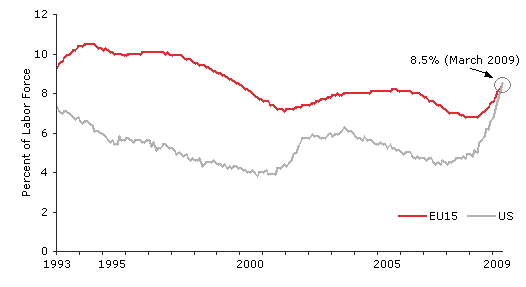
I think the bet is fair, since unlike 1993, the EU-15 is starting ahead. Also, although EU geographical mobility is still much less than in the US, it has increased dramatically over the past fifteen years, and that is likely to continue, particularly if some countries recover from the current crisis faster than others.
Looking to the short term future, the big question is whether, as I argued recently, the EU system is characterized by lower variance than the US, which would suggest EU rates should be lower during the global recession. The alternative view is that the EU is just not as far into the cycle as the US and that the US will recover earlier and faster.
Thinking about the bet more generally, if you regard it as supporting the view that the proposition “in the long-term average US unemployment rates are about 1 percentage point lower than average EU-15 rates” is an even money bet, that has a number of implications.
First, since the EU-15 countries are quite disparate, this suggests that the US is likely to be, on average, around the middle of the pack of developed countries as regards unemployment rates (adding in non-EU countries like Japan and Australia wouldn’t change this much).
Second, although the US is middling on unemployment outcomes, it’s an outlier on a range of measures that have been presented as important in promoting high employment. In addition to higher geographical mobility, it has very low minimum wages (lower now in real terms than it was in the mid-1950s), very weak trade unions, almost no restrictions on hiring and firing, and very limited welfare benefits for unemployed workers*. It’s quite surprising, even to me, that all of these things should add up to a difference of only one percentage point in unemployment. In part, I suspect that these institutions create their own kind of dual labor force structure.
In political terms, it’s hard to see how the pressure to adopt “more flexible” * labour market institutions can be justified by reference to the US example. While lower unemployment is better, it’s hard to see why a country with a decent minimum wage, strong union movement and good social welfare systems would want to scrap those things to achieve a one percentage point reduction in unemployment.
* As far as I can determine, in most US states, childless adults who have exhausted their unemployment benefits (or were ineligible) don’t have any access to cash benefits, and aren’t, in general, eligible for Medicaid or even, in some cases, food stamps. Can someone confirm or correct my understanding?
Update Quite a bit of quibbling in comments as to whether prisoners should count as unemployed. To short-circuit this dispute, can we all agree that breaking rocks (or similar) under armed guard is a bad labor market outcome, as is being unemployed. As the desire to debate this point shows, the excess prevalence of the first of these outcomes in the US, relative to the EU, is similar in magnitude to the excess prevalence of the second in the EU. Combined, they pretty much cancel out.
 John Quiggin