Another Monday Message Board. Post comments on any topic. Civil discussion and no coarse language please. Side discussions and idees fixes to the sandpits, please.
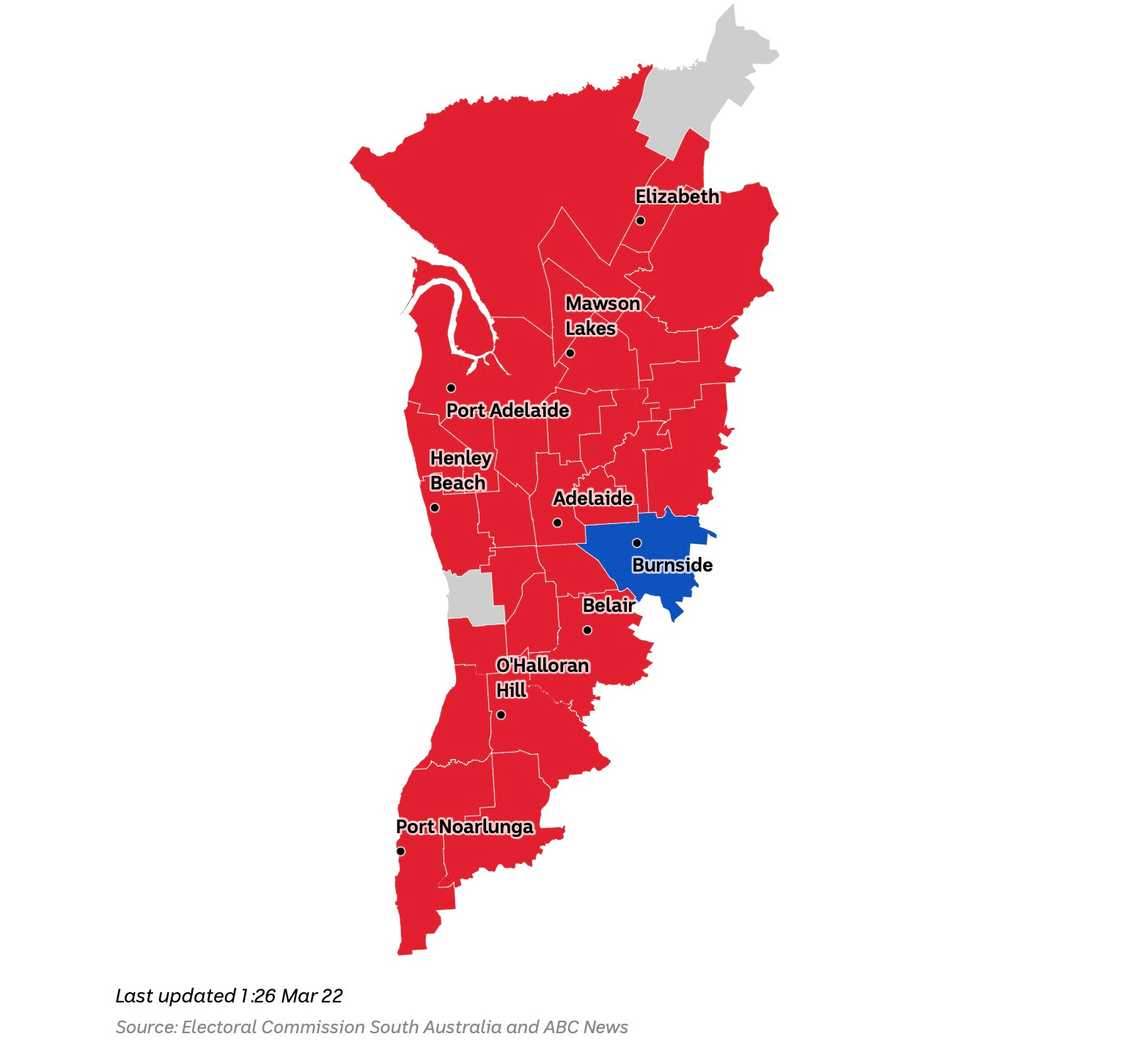
The South Australian election is done, and the results were very close to the predictions of the polls. Labor won a crushing victory, while One Nation [international readers, see note below] got more votes than the Liberals, though probably only one or two seats. Rather to my surprise, Labor finished third in lots of regional seats, and their preferences will push the Liberals over the line.
Meanwhile, the Liberals were wiped out almost completely in metropolitan Adelaide, commonly finishing fourth behind Labor, One Nation and Greens. For a party that was in government only four years ago, and won the two-party vote several times this century, this is a truly appalling result.
Despite much confused talk about “left behind” voters, the rise of One Nation, reflected in the South Australian election represents, quite simply, a split in the Liberal Party. Although it is not always safe to interpret changes in total party votes as shifts from one party to another, the evidence in the South Australian case is overwhelming. In almost every electorate, the rise in One Nation in support is exactly matched by a decline for the Liberals, while Labor and Greens are largely unchanged.
This is part of the broader global decline of rightwing “hard neoliberalism” which I first analysed back in 2016. Throughout the period of neoliberal dominance, the mainstream right relied on the votes of people who didn’t care much for free markets, but cared a lot about being the dominant identity in society. Since the GFC, the power balance has reversed, and dominant identity politics is in the ascendant. The archetypal representative of this group (emerging just after I first wrote the piece) is Donald Trump.
Most of these identity voters have not been “left behind” in an economic sense. On the contrary, One Nation gets its strongest support (above 30 per cent) from voters over 65, who are largely insulated from the economic shocks that affect those in insecure employment. Age pensions are indexed to the higher of CPI and wages, and are much more generous than unemployment benefits. Those with superannuation benefit from strong returns to capital. The only group of old people with significant exposure to economic shocks are the minority who don’t own their own home, and have no income besides the pension.
One Nation’s voters are people who in Andrew Hastie’s words, don’t recognise Australia as the country they grew up in. Like Tony Abbott, they are nostalgic for the days of the White Australia policy, when such anti-migrant prejudice as existed was directed against Italians and Greeks.
And Hastie’s comment reveals the fact that there is now no significant policy gap, between One Nation and the now-dominant right wing of the Liberal-National coalition. Both want (mostly unspecified) cuts in immigration, oppose any kind of action on climate, and trade in anti-Islamic rhetoric. But One Nation is loud and offensive, while the LNP tends to trade in euphemisms.
The convergence has been accelerated by the rise of community independents (“teals”) in formerly conservative areas. As well as replacing much of the moderate section of the Liberal party this trend has resulted in the Liberals adopting increasingly anti-urban rhetoric, once confined to complaints about the “inner city”.
The Liberal shift to the right is particularly evident in South Australia where the Christian nationalist faction led by Senator Alex Antic has crushed what remained of the moderate liberal tendency going back to Steele Hall and (in his way) Sir Thomas Playford. By contrast with this group, One Nation looks positively leftwing, advocating medicinal cannabis and having little interest in the Christianist agenda on abortion, voluntary assisted dying etc.
The big disappointment so far has been the absence of a comparable upsurge on the left. The Greens have held and slightly increased their share of votes (around 12 per cent) while others disillusioned with the major parties have gone for community independents.
In part, this reflects the responses of the incumbent parties to challengers. The Liberals have normalised One Nation, and shifted policies closer, effectively giving their own voters permission to switch. By contrast, Labor has ruthlessly demonised Greens, and has made as few concessions as possible, even though Greens policies are those put forward by Labor until recently. It’s clear which of these is working better politically.
I’ll write more about how the Greens should change their approach. But for the moment, I’ll just enjoy some quiet schadenfreude/
What is One Nation ?
Officially named Pauline Hanson’s One Nation, the party has a lot of similarities to Geert Wilder’s Party for Freedom in the Netherlands. Like Wilders, Hanson was originally a member of the main Australian conservative party (confusingly called the Liberals). She was expelled in the late 1990s for her racist views, and formed her own party, with great initial success. Also, both parties have been run by their founders, with no real party structure. Under current rules, Hanson is party President until she chooses to resign, and to choose her successor, who may also continue until resignation. The result has been a long series of splits and defections, with members elected on the One Nation ticket departing to become independents or else to form short-lived micro-parties.
The latest Quarterly Essay has just come out, including my response to Sean Kelly’s The Good Fight which asks the question: What does Labor stand for? My somewhat despondent answer “Labor stands for itself. For the moment, that seems to be enough.”
Another Monday Message Board. Post comments on any topic. Civil discussion and no coarse language please. Side discussions and idees fixes to the sandpits, please.
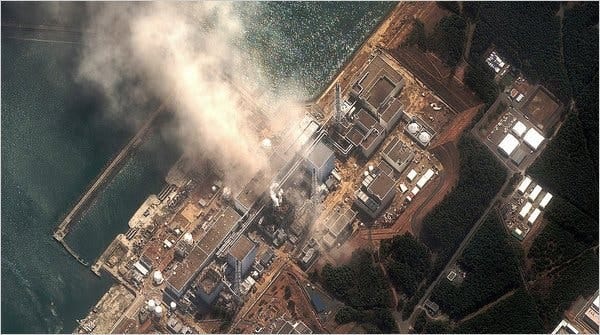
It’s the 15th anniversary of the Fukushima nuclear disaster, and any lessons from that event seem to have been forgotten by most. Political leaders of all stripes, from centre-left to far right have been keen to promote nuclear power as at least a partial solution to the problem of replacing coal and gas. The peak of enthusiasm was reached at COP 28 when Joe Biden, Emmanuel Macron and Rishi Sunak signed a pledge to triple nuclear power generation by 2050.
To call this pledge ambitious would be an understatement. No nuclear plant has started in construction (as defined by first nuclear concrete) in Europe or North America since the disastrous Hinkley C project in 2017. And the future is not much better. The UK will presumably go ahead with the Sizewell C project, duplicating Hinkley, but that will only replace retirements of existing plants. In France, sites for six reactors have been identified, but no investment decision has been made. And in the US, even the announced restart of reactors closed as uneconomic in recent years is looking doubtful.
Actually existing nuclear power programs around the world are similarly limited. China has an established industry which starts construction around 10 new plants every year, and typically connects them 5 to 6 years later. Russia builds about one per year, mainly to replace old RMBK (Chernobyl style) plants.
Russia’s nuclear firm Rosatom also has an export business. The typical pattern is a generously financed project, building two to four reactors in a middle-income country that wants the prestige of having nuclear power. South Korea has completed one such project (Barakah in UAE, which took about 15 years) and has a contract for another with the Czech Republic. Because nuclear power is uneconomic even with subsidies, these deals are typically “one and done”. Having shown that they can generate nuclear power, few countries have been willing to strain their budgets for a second vanity project.
The great remaining hope is Small Modular Reactors (SMRs).
This term is commonly used to refer to reactors small enough to be built in a factory and modular in the sense that they can be shipped to a site in the numbers required to meet the power needs of the installation. It is also used more loosely to refer to reactors generating less then 500 MW of electricity, compared to the 1000-1400 MW that have been standard in recent decades.
SMRs of the first kind don’t exist and probably never will. All the early proponents, with one exception have given up. The only surviving firm, Nuscale, had to abandon its initial plan to construct plants in the US because of cost over-runs. A contract has supposedly been signed with Romania, but the Romanian PM sounded distinctly unenthusiastic in a recent interview.
“As I remember it is a fairly big sum, USD6-USD$7 billion and the business plan must also account for how the energy will be consumed. The investment will be made once a funding formula will be found. Given the very large amount of money, the complexity of such projects and the technology being in early days, I estimate we will not see the investment immediately.”
For reference, given a capacity of 462 MW (6 units of 77MW), the implied unit cost is $US13-15 billion per GW or $A20-23 billion. This is well above the much-criticised CSIRO GenCost estimates.
There are quite a few small but non-modular reactors around. Unfortunately most of these are relics from the early days of nuclear power (Gen II in the jargon). There are only two recent prototypes, one in China and one in Russia. Quite a few others have been announced, but they have no real advantage over the larger designs from which they are derived. Even if a handful get built, they are irrelevant to the future of energy.
In summary, nuclear power is a technology of the past. The only routes to a clean energy system are renewables and energy efficiency.
Another Monday Message Board. Post comments on any topic. Civil discussion and no coarse language please. Side discussions and idees fixes to the sandpits, please.
It’s a truism that every child should be wanted. While there are plenty of exceptions, the birth of an unwanted child often turns out badly for both mother and child (and father, if they are present). Sometimes, once a child is born, the fact that they were initially unwanted fades into irrelevance, and the bond between parents and child is as strong as with a planned birth. But this isn’t true on average: children born after their mother was denied an abortion (due to time limits) experience, on average, more poverty and poorer maternal bonding The extreme case is that of Ceausescu’s Romania, where abortions were banned, and the resuling unwanted children received miserable upbringings in orphanages.
The birth of an unwanted child can be an economic as well as a personal catastrophe. This is crucial to understand when we are assessing claims that “the economy” would benefit if families had more children than they currently choose.
Another Monday Message Board. Post comments on any topic. Civil discussion and no coarse language please. Side discussions and idees fixes to the sandpits, please.