For a generation (fifteen years) or more I’ve been writing and rewriting the same piece about the silliness of the “generation game”, the idea that one’s year of birth matters more than class, gender or race in determining life outcomes and attitudes. But this is a zombie idea that can never be killed.
Stephen Rattner in the New York Times is the latest example, with a piece showing that US Millennials (those born after 1980) are doing much worse than previous generations at the same age, despite higher levels of education. Rattner notes the role of the recession, now nearly a decade old, but then jumps to the conclusion that it is the Baby Boomers, as a group, who are to blame. His only evidence for this is the long-discredited claim of a looming crisis in Social Security.
Rattner doesn’t present any evidence about the recent experience of non-Millennials, but his piece leaves the impression that the experience of doing worse than older cohorts at the same age is uniquely Millennial. So I thought I’d do his work for him, and dug out this graph prepared by Doug Short 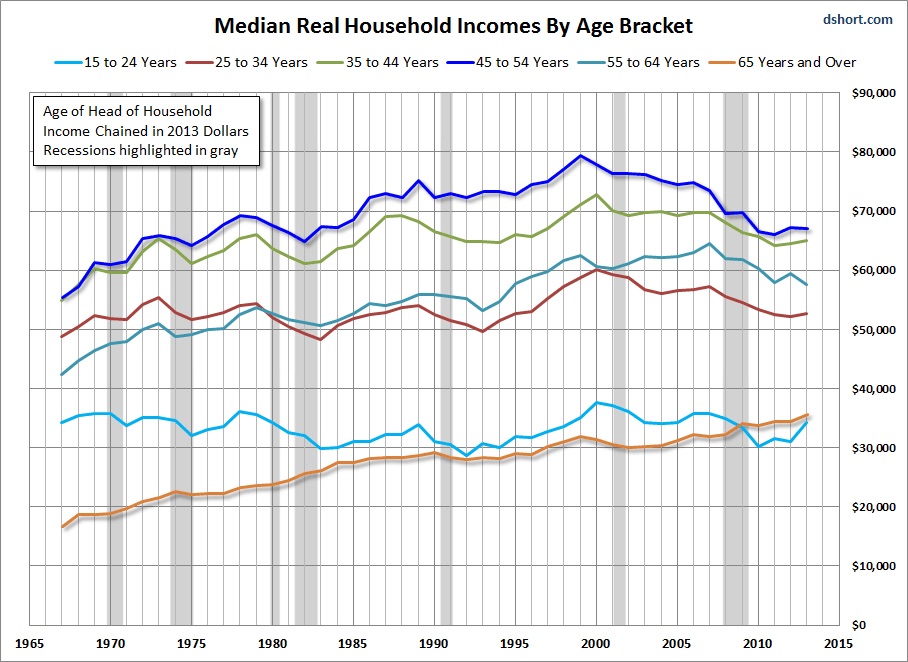 As can be seen, the group suffering the biggest loss, relative to older cohorts at the same age, are those households with heads aged 45-54 in 2013, a mix of late Boomers (for aficianados, this group is called Generation Jones) and early X-ers. But the main point is that median household income is falling for all groups except the 65+ cohort (mostly called Silents in the generation game). Part of this is due to declining household size, but (IIRC) household size has stabilized recently as forming a new household has become less affordable.
Rattner doesn’t mention, even once, the obvious and well-known explanation for the fact that median income is falling while mean income rises. This can only occur if the distribution of income is becoming more skewed, with the top tail (the 1 per cent) benefiting at the expense of everyone else.
If Boomers as a group have done no better than anyone else, can Rattner at least claim that it was Boomer mismanagement that brought the economy to its present pass. Not really. Here’s Time Magazine’s list of 25 people who made big contributions to bringing about the Global Financial Crisis. The top three (Angelo Mozilo, Alan Greenspan and Phil Gramm) are all Silents, as is the emblematic Ponzi figure Bernie Madoff, and, a striking omission, Robert Rubin. And that’s without even considering the financial deregulation of the 1970s, which set the whole process in motion. Inevitably, given that they constitute a large share of the adult population, there are plenty of boomers among the bit players in the list. Equally, given the preference of Wall Street firms for young hotshots, much of the actual work of designing and selling bogus securities was done by X-ers in their 20s and 30s.
The point here is not that one generation is more or less to blame than another. As I said back in 2000, most of what passes for discussion about the merits or otherwise of particular generations is little more than a repetition of unchanging formulas about different age groups. The people who caused the crisis were mostly born before 1945 because they were of the right age to hold powerful positions in the financial sector in the 1990s. But it was their membership of the 1 per cent that is what matters here.
 John Quiggin