Post comments on any topic. Civil discussion and no coarse language please. Side discussions and idees fixes to the sandpits, please.
I’m now using Substack as a blogging platform, and for my monthly email newsletter. For the moment, I’ll post both at this blog and on Substack. You can also follow me on Mastodon here.
 John Quiggin
Snyder on the short-lived but spectacular Prigozhin mutiny:
“This was a preview of how the war in Ukraine ends. When there is meaningful conflict in Russia, Russians will forget about Ukraine and pay attention to their own country. ”
https://snyder.substack.com/p/prigozhins-march-on-moscow
Fun observation about Philosophy as an academic discipline:
-One can get a minor in philosophy (should be at least 20% of the BAs curriculum) in Germany without ever having heard of a trolley problem.*
-Or get a major in it and assert that Bavarian dialect is racist and misogynistic** without being challenged by any of the philosopher bystanders
…….. in Munich.
*My non joke answer to the question if that is an improvement compared to the English speaking world would be no.
**Not the speaking any dialect is racist because it excludes migrants version, which has some merit if it is applied to specific communication situations, this time literally.
In the days when I used to go to supermarkets, there was always a trolley problem.
Ikon, you gave me a chuckle and smile. Thanks.
I vote for “Chicken: Trolley Problem Version’.” too. And the Kant & Bentham one, where thay are yelling out to the kever puller about revising their beliefs, while holding a copy of each others treatises.
The Trolley problem it seems, is more popular than many popular causes.
“Behind the Absurd Popularity of Trolley Problem Memes
“Aljoša: I love all of them! However, if I had to choose my favourite one, it would have to be the ‘Chicken: Trolley Problem Version’.
https://www.huffpost.com/entry/behind-the-absurd-popular_b_10247650
“Game theory joke on the trolley problem I ran into in a strange place.”
Nuclear revived in Sweden. 100% carbon free target remains but nuclear to be used to get more “reliability” into the energy system. The “dog” refuses to disappear:
https://www.theage.com.au/world/europe/sweden-dumps-renewables-target-as-it-seeks-more-nuclear-power-20230629-p5dkae.html
Greenland ice surface melt extent is perhaps another thing this year to watch emerging:
And Prof Jason Box tweeted:
The nuclear bone dogs!
Harry said “The “dog” refuses to disappear”. You beat me.
I missed this. France promoting an extra 50Gw nuclear via EU Nuclear Alliance. Sweden just changd legislation to accept nuclear. Statements which incl 150Gw are including extending existing nuclear plants.
“16 Member States call on the EU to support low-carbon fossil-free energy sources, including nuclear”
May 17, 2023
https://www.foronuclear.org/en/updates/news/16-member-states-call-on-the-eu-to-support-low-carbon-fossil-free-energy-sources-including-nuclear/
*
“This represents the equivalent of up to 30 to 45 new-build large reactors and small modular reactors in the EU and such new projects would also ensure that the current share of 25% electricity production be maintained in the EU for nuclear energy.” (1.)
Same inflated employment jobs’n”groaf argument as mining industry:
“Taking into account retirements, the nuclear energy sector would recruit more than 450,000 employees in the EU over the next 30 years, including more than 200,000 highly skilled people.” (1.)
Build all at once! 45 x 7,000 (fn2.) = 315,000 workers against 450,000 above.
Run. 45 x 800 (fn2.)= 36,000 against ? 450k or 200,000 highly skilled?
Ala mining, nuclear promoters are promoting false employment numbers.
And triggering my vigilance.
*
“Sweden dumps renewables target as it seeks more nuclear power
By Rob Harris
June 29, 2023
“London: Sweden’s parliament has dumped its 100 per cent renewable target amid ongoing concerns about short-term energy security as it looks to join several European nations to build new nuclear plants.”
https://www.theage.com.au/world/europe/sweden-dumps-renewables-target-as-it-seeks-more-nuclear-power-20230629-p5dkae.html
*
fn1.
“At the end of the meeting, the member countries of the Nuclear Alliance signed a joint statement calling for a European action plan to develop cooperation around nuclear power, especially in terms of skills, innovation, safety, dismantling and waste standards.
“Nuclear power may provide up to 150 GW of electricity capacity by 2050 to the European Union (vs roughly 100 GW today),” the statement says. “This represents the equivalent of up to 30 to 45 new-build large reactors and small modular reactors in the EU and such new projects would also ensure that the current share of 25% electricity production be maintained in the EU for nuclear energy.”
“It added: “In terms of impact on jobs and growth, the European nuclear sector expects to create in the EU, by 2050, 300,000 additional, new direct, indirect and induced jobs. Taking into account retirements, the nuclear energy sector would recruit more than 450,000 employees in the EU over the next 30 years, including more than 200,000 highly skilled people.”
https://www.world-nuclear-news.org/Articles/Alliance-calls-for-greater-European-support-for-nu
fn2.
– “Each nuclear power plant employs 500 to 800 workers
– “Building a nuclear power reactor employs up to 7,000 workers at peak construction.
https://www.nei.org/advantages/jobs
Swedes can be idiots too.
Nuclear as well as fossil fuel advocates have yet to digest this:
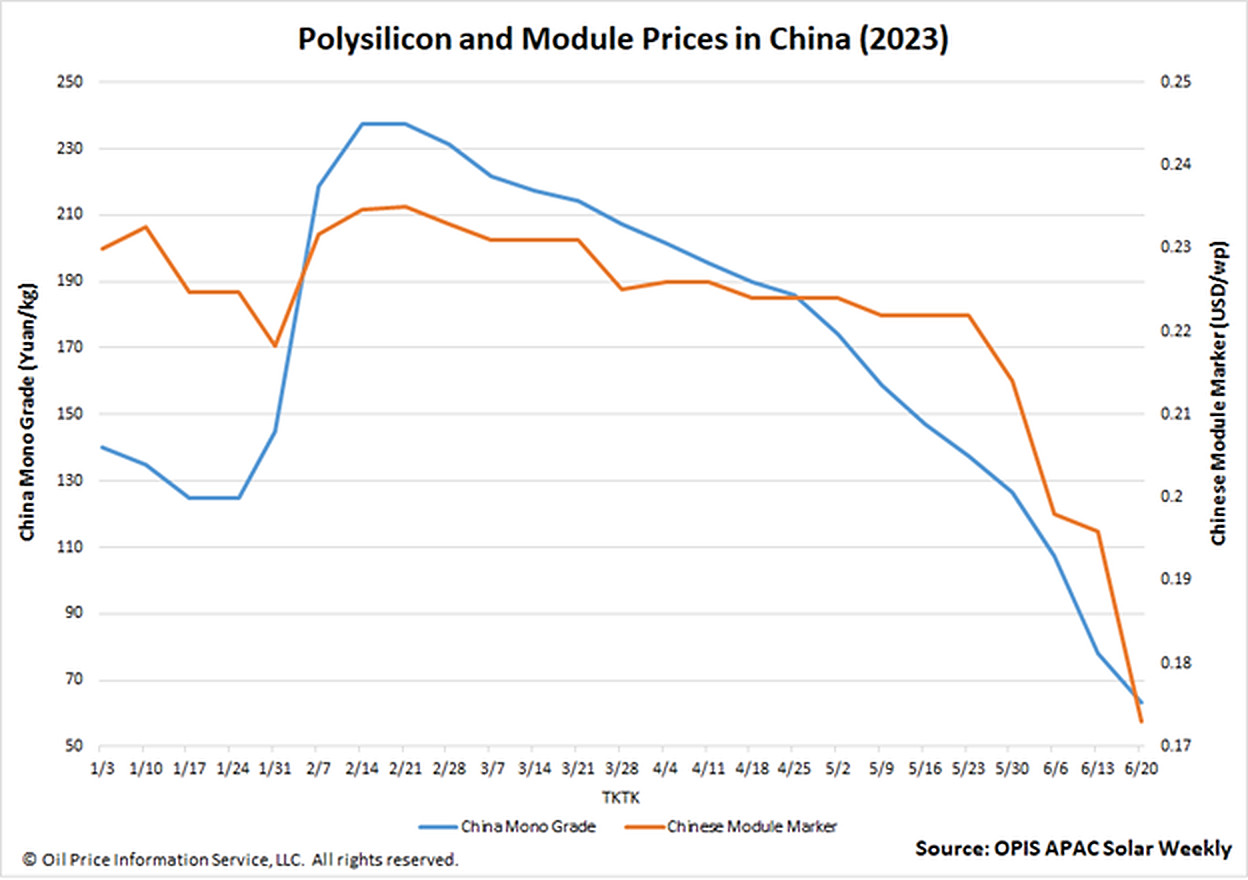
PV module prices are sliding, well before the truly massive expansion of pv manufacturing capacity in China really kicks in. Won’t be long before we see 15c per watt, and that won’t be the floor. PV developers who have locked in PPAs based on 20c per watt modules, ad have not yet bought them, are sitting on very nice windfall profits. Who exactly expects to make money from a pink unicorn nuclear revival?
More rationally, the Spanish government has nearly doubled its 2030 target for total pv installation from 39 GW to 78 GW, plus 22 GW of storage: https://www.pv-magazine.com/2023/06/29/spain-targeting-56-gw-of-new-solar-by-2030-under-new-energy-strategy/
In other dead horse news, IEEFA reports in detail on major problems with two large CCS projects in Norway: https://ieefa.org/resources/norways-sleipner-and-snohvit-ccs-industry-models-or-cautionary-tales
“During the fifty years since the early 1970s, neoliberalism has gone from being an economic policy revolution (or counterrevolution) to a dominant ideology, before finally
fading to near-irrelevance. – JOURNAL OF AUSTRALIAN POLITICAL ECONOMY No 91-
“THE PRODUCTIVITY COMMISSION REVIEW” – John Quiggin.
I don’t share John Quiggin’s assessment or optimism here. Neoliberalism has not faded to near-irrelevance. This is unless he means it has been superseded by crony capitalism, gangster capitalism and a full-blown scam economy run by and for oligarchs, corporation managers and media moguls. If he means that, then I might agree. But then again, that is really just the last and natural final stage of neoliberalism. After that comes environmental, economic and societal collapse… unless there is radical change very, very soon. Maybe John Quiggin can see green shoots of radical change. I can see none whatsoever. Things are still getting worse, rapidly, IMHO.
“Repeating myself, monopolies/oligopolies don’t cause demand inflation, but they amplify it.” – John Quiggin.
Monopolies/oligopolies cause profit push inflation via monopoly/oligopoly administered pricing. They are price gouging workers and the poor in these difficult times, pocketing record profits and forcing real wages to drop.
Phew… “poorer individuals are not uniquely prone to cognitive biases that alone explain protracted poverty.”
“Economic inequality cannot be explained by individual bad choices, study finds
by Columbia University’s Mailman School of Public Health
…
‘Taken along with related work showing that temporal discounting is tied more to the broader societal economic environment rather than individual financial circumstances, the new findings are a major validation of arguments stating that poorer individuals are not uniquely prone to cognitive biases that alone explain protracted poverty.
https://phys.org/news/2023-06-economic-inequality-individual-bad-choices.html
Kai Ruggeri et al, The persistence of cognitive biases in financial decisions across economic groups,
Scientific Reports (2023).
DOI: 10.1038/s41598-023-36339-2
Australians deaths from COVID-19 in the last 7 days:
NSW: 97
VIC: 58
AUS: 155 (to date, no data yet from QLD, TAS, ACT, SA, NT, WA)
A Vimeo video published on 26 Jun 2023, titled Ticktective: Biosafety Is Key to Our Future: the Truth About Germs, Lab Leaks, and Information Warfare, duration 1:14:48, is an interview by Dana Parish with Raina MacIntyre (MBBS Hons 1, M App Epid, PhD, FRACP, FAFPHM), Head of the Biosecurity Program, Kirby Institute, UNSW and author of “DARK WINTER”.
0:43:01: “Well, I think we’re in a very bad place because COVID is a chronically disabling illness that attacks multiple organ systems; the brain; the heart, the lungs; the immune system; the kidneys; pretty much every organ system you can think of…”
0:43:42: “But there’s silence around that from a public health perspective… we’ve cut off our nose to spite our face. Maybe that was the intention? I don’t know!”
Oops, try this:
It seems from this afternoon, Twitter is now denying access to tweets to those people not logged in to an account. Anyone else having this experience?
Twitter is broken. Would you buy an electric car from that man?
Of course, it is hard these days to tell if Twitter is broken intentionally or incompetently. The result is the same though.
KT2 shines the light on one of the most intractable constants of any economy at any time. POVERTY!
I have studied this area for over fifty years and still see no answer to how to keep people out of poverty. In the 1970s, the Henderson Commission raised every bodies hopes in the Whitlam era only to have them dashed by Malcolm Fraser. Then Bob Hawke made his famous gaffe. It would have been funny if it had not been so sad. That children will live in poverty is a given in any country in the world. Even the socialist countries like Sweden have child poverty among the refugees in that country.
If I could just paraphrase a famous saying
“ No assets leads to poverty
Absolutely no assets leads to absolute poverty”
There is no answer to this that I can find.
The economic system hardly matters, though it can make things worse,
Redistribution of income does not work because it does not address the lack of wealth. Wealth distribution is rare but has failed the few times it has occurred mainly due to political corruption.
I have studied economics for over fifty years but never have I found an answer to child poverty.
Gregory J McKenzie, Apart from bequests people have to buy their way into a society. To purchase land, homes, motor vehicles and so on, to pay for their sustenance – food and clothing and to accumulate wealth. For the most part (not entirely given the significant welfare state) people have to purchase these things from their income. In general these things are not given gratis by the state.
Hence getting people into the position where they can earn enough income is a great start to reducing poverty. Having a poor education and having poor health are important obstacles to achieving this. These things can be achieved by redistributing income and through government policies improving education and health options. Welfare dependence is a trap that can be reduced by appropriately designing incentives to work for those on low income.
The difficulty is that handing out incomes via a negative income tax may not change behaviour much – it is fairly useless if it is spent on booze, drugs or low quality food. On the other hand direct transfers have the advantage of cutting back on massive bureaucracies that don’t seem to help much. The billions spent annually on indigenous bureaucracy in Australia have only had moderate effects in moderating indigenous disadvantage. A compromise here is inevitable – some direct transfers and some (smaller) bureaucracy makes sense.
Update on the PV boom
The third “Terawatt workshop” of solar PV experts has concluded that 75TW of PV is a realistic target for 2050. https://www.pv-magazine.com/2023/07/01/weekend-read-waiting-is-not-an-option/ The meetings are convened by the three leading governmental labs in the field from the USA, Germany and Japan. The format guarantees that the attendees will be enthusiasts not sceptics, so the optimism is not necessarily or even probably representative of the whole PV community. But they are experts, not tifosi like me. Published paper : https://www.science.org/doi/10.1126/science.adf6957
Snippets from report in PVMagazine:
“The past five years to 10 years have seen solar installations and manufacturing capacity grow at a rate of around 25% per year and, if this rate can be maintained, then the goal of 75 TW by 2050 can be reached. “Of course, people say it will be challenging,” says [Nancy] Haegel [director of the NREL’s National Center for Photovoltaics]. “But many don’t realize that solar has already been growing at the required rate. … An important message for policymakers is that there is, in principle, no limitation on the materials side, the resources we need to reach 75 TW are available. It is very important that we have no fear. The message here is that yes, we can do it.” ”
“Twitter is broken. Would you buy an electric car from that man?”
No, not even if i could afford one. Still losing my bet against the Tesla share price -_-. Tesla has no monopoly power like many other evil billionaires companies. Don´t get it.
Hybrid immune damping is what the SARS-Cov-2 Omicron variants have demonstrated, not the mythic hybrid immunity.
https://www.news-medical.net/news/20220725/Researchers-report-e28098hybrid-immune-dampinge28099-following-SARS-CoV-2-Omicron-infection.aspx
It’s getting harder and harder for the layperson to find any reliable information about the progress of the COVID-19 pandemic. Testing has been deliberately reduced, data reporting reduced and obfuscated and general public reportage also reduced. At every level, the impression being generated, very intentionally, is that the pandemic is over. It is not over. Deaths and hospitalizations being reported are still seen to be high, despite all the data suppression. The published numbers would be even higher without the rampant data suppression going on.
The week ending June 30 deaths being reported for Australia are 204. If we run at that for a year, that’s 10,400 (extra) deaths for the year. The current indicators are that we will run at these numbers indefinitely. The real deaths from COVID-19, including later on from raised rates of heart attacks, strokes and many other systemic conditions are likely much higher. But in line with the suppression of truth none of this is counted or reported, in terms of attribution to COVID-19. The excess deaths themselves can’t be easily hidden of course.
ABS Provisional Mortality Statistics Reference period Jan – Mar 2023 showed:
“There were 14,578 deaths in March, 11.3% more than the baseline average but 1.0% less than March 2022.”
The pandemic continues unabated with no sign of reduction to a minimal, controlled level. COVID-19 remains a major cause of morbidity and death. We continue to run the long term risk of a collapse in national health in all age groups and the collapse of our health services. We continue to run the risk of immune dysregulation of the majority of the population. We continue to run the risk of the evolution of a far more severe variant and its spread through the entire population. We continue to run the risk of an escalating pandemic disaster. This is all so rich people can become even richer while more people die.
Ikonoclast: – “We continue to run the risk of an escalating pandemic disaster. This is all so rich people can become even richer while more people die.”
I’d suggest money becomes worthless if civilisation collapses.
A Vimeo video published 26 Jun 2023, titled Ticktective: Biosafety Is Key to Our Future: the Truth About Germs, Lab Leaks, and Information Warfare, duration 1:14:48, included an interview by Dana Parish with epidemiologist Raina MacIntyre, who said from time interval 0:43:01:
“Well, I think we’re in a very bad place because COVID is a chronically disabling illness that attacks multiple organ systems; the brain; the heart, the lungs, the immune system, the kidneys; um, pretty much any organ system you can think of; and of course it’s a highly vascular disease, so it affects your small blood vessels everywhere. And there’s so many studies now; a huge body of evidence showing that, you know, your risk of having a heart attack, a stroke, a blood clot, a coronary embolus, um, cognitive impairment, dementia even, is increased after COVID for, you know, at least 12 months after having COVID. But there’s silence around that from a public health perspective, because public health agencies around the world have kind of gone down that narrative of “it’s just a cold, it’s over now, forget about it. Get infected; it’s good for you!” So it’s like collectively as well we’ve cut off our nose to spite our face. Maybe that was the intention? I don’t know!”
From time interval 0:45:14:
“And I think ah, you know, in a lot of instances I think, you know, people are disposable and cheap. You know, if your workforce is affected, well, you can import cheap people from elsewhere, to do the job. You know, we are considered disposable assets. You know, ah, so if you haven’t got enough nurses you can just import them from somewhere else. Um, if you haven’t got enough people to run your factory, you set up your factory somewhere else where there are, you know, abundant people. So we are, we are not being valued as, as, you know… It’s quite depressing, really, to watch what’s unfolding, and really we’re seeing a lot of sections of the community who have kind of bought in to this narrative, cheering on their own demise and disablement, which is really sad.”
From time interval 0:47:15:
“And we know other infections like measles, for example, do cause an immune paresis. So when you do get measles, for about 2 to 3 years afterwards, you’re at increased risk of virtually every other infection. It kind of paralyses your immune system for a period of time, and then you recover. That’s been well-studied and that’s well-accepted by those who know about measles, um, although I have to say I was on a teleconference with some virologist once, and when I mentioned that, they said: ‘Oh, measles doesn’t do that’. And I had to provide them all the references. It’s like, people live in their own little bubble and if they don’t know something, they think it’s not true. Um, yeah, knowledge is out there if you care to seek it out, you know, I mean reputable knowledge. There’s also… There is a lot of disinformation and disreputable knowledge out there as well, that’s not knowledge; it’s disinformation, and it’s hard for individuals as ah… But in terms of medical people and public health people, you know, knowledge is out there. If you don’t know it, then you’re ignorant, you know, but ah, don’t tell other people who do know it’s not true.”
There’s much more recommended listening.
Geoff Miell – “I’d suggest money becomes worthless if civilisation collapses.”
You are correct, obviously. The rich, and many others, don’t believe civilisation can collapse or don’t believe it can collapse in their lifetime. Their estrangement and insulation from the forces of nature mean they don’t understand what they are dealing with. They don’t understand the massive forces of nature at the macro and the micro scale. They think reality is controlled by their glass bead games.
Henry Clarke- all you suggest has been tried before. But transfer payments or windfall gains do not change the primary cause of poverty which is unemployment. You were right to mention poor education and poor health as contributing factors to entrenched poverty. Unless tertiary education is free then it is outside the reach of poor people. I taught in many schools where the senior students I had taught, who were from poor families, did not even consider tertiary studies. I taught many talented country kids who even left after year 10. Neither, their families, nor their friends considered higher education. As for poor health, this comes back to unaffordable medicines and being unable to access the best medical services. Again, regional areas do worse here in terms of available health services.
To maintain any employment status a worker needs affordable housing, a good diet and emotional support. These are social assets that give any person the ability to increase their earned income. They can also build their savings for any unexpected demand on their wealth. But this wealth cushion is rarely available to very low paid workers. It is totally inaccessible to the long term unemployed. Geographic unemployment is the hardest to eradicate as it does not respond to retraining programs.
The lack of both money assets and social assets makes poverty an intractable problem. Solutions do exist but are rarely supported by governments. One such solution is microfinancing. But many countries will not licence microfinancing institutions.
Any solution must be at the local level and be supported by community groups AND the local population.