I was looking at this picture of people (mostly tourists, it appears) fleeing massive fires in Rhodes, feeling despair about the future of the world

when I was struck by an even more despairing thought.
Almost certainly, a lot of the people in the picture are climate denialists. And even more certainly, they will mostly remain so despite this experience.
Australia was one of the first countries to experience massive fires clearly attributable to global heating. In December 2019, fires burned up and down the east coast for weeks. Most of our major cities were blanketed in toxic smoke.
The conservative government of Scott Morrison, which had scored a surprise election win earlier in the year, made of botch of dealing with the fires (Morrison himself secretly jetted off to Hawaii for a holiday) and played down any role of climate, ably supported by the Murdoch press. Despite this, the denialist National Party retained its seats in most of the worst-affected parts of the country at the next election.
Labor, which had gone to the 2019 election with a reasonably good climate policy, dumped it in favor of marginal tweaks to the governments non-policy. Since winning office in 2022, the Labor government has approved massive new coal mines and gas fields.
And there’s nothing uniquely Australian about this. UK Labour is apparently considering winding back its climate policies on the basis of a mildly disappointing by-election result, and the denialist faction of the Conservative party is gaining strength.
Perhaps there is hope to be had somewhere, but I’m not feeling it right now.
 John Quiggin
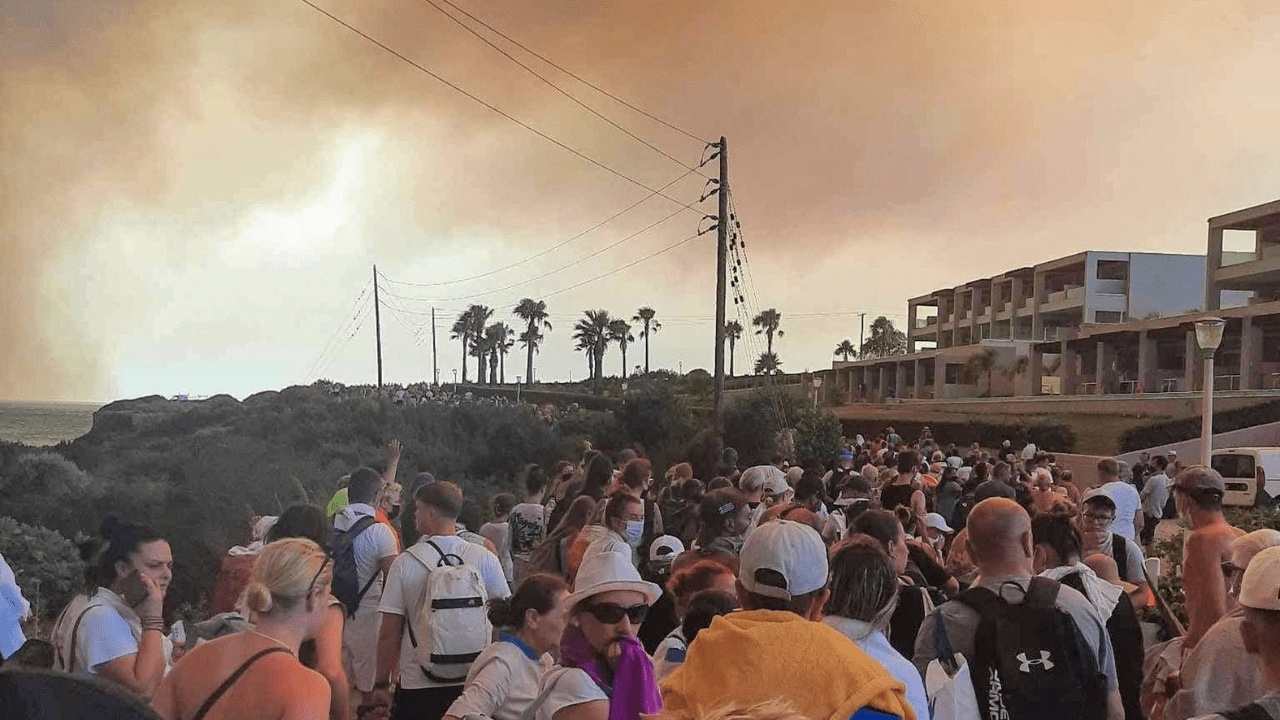
JQ: – “Almost certainly, a lot of the people in the picture are climate denialists. And even more certainly, they will mostly remain so despite this experience.”
I think you’re correct. And as the climate crisis continues to get inevitably worse, and more deniers are swept-up to directly experience their own pain and sufferings from these consequences (in the forms of wildfire, heat stroke, extreme storm, extreme flood, extended famine, unaffordable insurance, SLR, etc.) they likely still won’t have a clue why.
Meanwhile, the North Atlantic SST (on 22 Jul 2023) is only 0.11 °C below the the 2022 record of 24.89°C (76.80°F) with about 5-6 weeks of warming still to go.
Has the North Atlantic SST run out of heat or are there more heat records to be broken for this year (and in 2024), exceeding 25.0 °C, 25.5 °C or perhaps 26.0 °C? And the more heat this likely brings to Europe & North America?
So far there has been 20 days in a row breaking the 2 m air surface World record high-temperature of 16.924°C (62.46°F) set on July 24, 2022.
More heat records are close to being broken.
Not optimistic either. Countries like Greece and cities like Cairns are dependent on Tourism, so Governments aren’t likely to say, “no, stay at home”. Or stop flying and driving so much.
I’ve found that people, by and large, believe what they are told to believe. This is especially so when what they are told aligns with what they want to believe. It is also very much the case when they are taught little logic, less science and are never encouraged to develop any capacity for critical thinking. In this system, they end up in a state marked by atomized self-interest, wilful ignorance and deference to appeals to ideological authority. This is the current position of the majority of the human race propagandized under neoliberal capitalism.
For the system to change ideologically, people will have to stop believing in the claims of neoliberal capitalism. Its central claim is to deliver material plenty to all, forever, by means of endless growth in its prescribed property and value system. People will lose faith, or blind belief, in this system on “the day prophecy fails”. The day prophecy fails will be different for each credulous, atomized person; meaning the atomized self-interest encouraged by neoliberal capitalism.
What will be required for social and political change will be a critical mass of disillusioned, desperate and angry people who have nothing further to lose. Even then, positive change won’t be assured. It could all turn far worse at that point. Further thoughts on this would probably need to go to the sandpit. I haven’t addressed the despair issue here either. I am trying to keep my comments relatively short.
Re-posted of my comment at Substack –
I swing from deep pessimism to cautious optimism. The mean does end up in negative territory.
Deep pessimism is for the inability of Australia’s LibNatLab triopoly to treat it like the existential risk to our nation that decades of top level expert advice and evolution of real world impacts says it is; it isn’t like they don’t know.
Australia appears to go into international climate negotiations with intent to do the least that can be gotten away – to protect Australia’s fossil fuel resources from global climate commitments – not the most we are capable of. This is in an industrialised nation with vast clean energy resources that is also at great risk from global warming. Not that any nation is free of great risk.
The optimism comes from clean energy crossing a price tipping point that makes them cost competitive and the continuing pipeline of improvements to clean energy technologies that will keep renewables on the right side of it.
I am a big supporter of R&D; whilst I don’t subscribe to a belief in exponential technological growth – I think it follows S-curves, which do look similar for a while – I do think there is room for some seriously useful advances in important areas. Batteries need to get better – and they are, with significant performance improvements in the pipeline. China not only features in such developments, they appear to be charging ahead; they are certainly prominent in publishing new science.
I am not so convinced about Hydrogen as an alternative to battery electric transport or fusion for energy or even cost effective modular fission reactors but would be pleased to be wrong – even about the latter. A pet possibility I would like to see get more attention is optical rectenna’s aka nantenna’s, that could deliver direct heat to electricity and not only make power from the sun by day but from ground radiation by night. Or used for waste heat utilisation or dry rock geothermal or thermal energy storage.
As levels of wind and solar have grown to the point where storage is needed we are seeing investment in storage of several different sorts, all seeming to be cost effective enough; I just can’t buy into the economic alarmist fear of renewables.
Physical oceanographer Edward Doddridge said vast regions of the Antarctic coastline were ice free for the first time in the observational record.
Petra Heil, a sea ice physicist from the Australian Antarctic Division, fears a further change in the balance could trigger a tipping point from where it’s difficult to reverse the trajectory.
https://www.abc.net.au/news/2023-07-24/antarctic-sea-ice-levels-nosedive-five-sigma-event/102635204
It seems to me the remaining hardline climate science deniers will have to find out by personal experience, and even then are likely to continue to deny the real cause.
Dear John,
one of the murmurs I heard pretty much straight after the bushfires were over was that they were the result of a lack of hazard reduction burns and that was due to pressure by the greens (somehow). (None of which I believe holds up to scrutiny btw.)
I think it’s worth reviewing the YouTube video published by the BCC News on 9 Jan 2020 titled Australia fires: Debunking ‘arson emergency’ claims – BBC News, duration 0:05:28. Hazard reduction burns make no difference to wildfires of the magnitude seen in the Australian 2019-20 ‘black summer’ period, as both the Victorian fire chief and NSW RFS Commissioner were quoted saying. The other meme was that arsonists were the cause. Ros Atkins debunks:
1) “extensive hazard reduction burns would have substantially reduced the severity of the Australian wildfires” meme;
2) “it’s the arsonists” meme.
What’s the chance that the same false memes will emerge for Australia’s next megafire?
I have always assumed that people will react to adverse heating events by pushing harder for more climate action. It seems things need to be really globally catastrophic and sustained for this effect to work – otherwise politicians and others write them off as random events. The difficulty is that really catastrophic events may signal a tipping point into a irreversible and permanent climate-induced global disaster.
Yes I am pessimistic too. No smart ideas on this one. We obviously need enlightened leadership to focus minds but that is a big ask in itself.
Not optimistic, either. Best case scenario is carbon neutral by 2050. Then factor in a temperature lag of a reported 40 years. This suggests it wont be until 2090 that the world starts to cool. And then who knows how long until temperatures return to current levels. Technology might save us ???
Depressing indeed. Reputable pollster Ipsos : “Climate change is still the seventh biggest concern globally, with 17% worried, unchanged from last month. Canada has over a quarter (27%) worried, increasing 5pp.” This holds for Spain, voting yesterday in a killer heatwave. https://www.ipsos.com/en/what-worries-world-july-2023
Starmer disappoints me greatly. Labour do not need to take Uxbridge to win a large majority at the next general election, and they nearly did. Anxiety about the London ULEZ expansion is at a peak, as it will be introduced very shortly, on August 29. Come election time, and voters will be used to it, and enjoying the benefits as well as paying the costs. I expect Sadiq Khan will push back effectively.
Harry: My longer comment on the Message Board today has some ideas on what to do.
I have to disagree about the Ulez. As I understand it, they are just trying to improve the air quality in certain areas? (At least, that is the purported motive.)
As a person who can’t afford an electric car yet – and yes, I try to minimize driving, and have done for years – these kinds of schemes offend me greatly.
People who live in the central areas will get cleaner air, so of course they will favor the plan. But there isn’t going to be an overall benefit, since non-centrally-located people will probably just drive their dirty cars somewhere else. (Maybe further distances.)
I just don’t like these ideas that we should let the wealthy buy their way out of everything. (And living in the restricted area is a way of doing that.) I am not a socialist, but there should be limits to this kind of government favoritism.
The neoliberal “Dems” who run California are salivating over these kinds of plans, and it is very painful to see. I’d rather just see straight rationing of the roadside, if that’s what we need to do. Find another way to clean the air. And clean it for everyone. To me, this is class warfare, and the same people always seem to lose.
Oh also, they always fix it so that the plans for the low income exemptions will cover like, two people. I mean, of course, otherwise what would be the point?
I hope New Jersey wins their lawsuit, too.
While all the above might be true, data from the European Environment Agency, an official EU site, area burnt is trending down.
https://www.eea.europa.eu/data-and-maps/daviz/burnt-forest-area-in-five-4#tab-chart_5
Survival bias? Is the area being burnt each year going down because;
(a) all the most vulnerable areas are burnt first and do not always recover; and thus
(b) the total area of forest left uncleared and unburnt and is less and less each year?
It would take a deeper dive into all the data to assess what is really happening. Has the definition of “forest” been changed? Are untouched, regrown and plantation forest types all accounted or discounted as appropriate to the assessment method and its aims? What would a graph of mass of forest trees burnt show (as opposed to area burnt)? What is the definition of “burnt”? What intensities and degrees of ground cover burnt / mature tree burnt count as “burnt”? What would graphs extended further into the past show about such trends over the longer term?
NOAA provides a time series for US billion-dollar disaster events 1980-2023 (CPI-adjusted). It looks to me that the combined costs of disasters, whether they be due to drought, flood, freezing, severe storm, tropical cyclone, wildfire, and/or winter storm, are on the rise.
https://www.ncei.noaa.gov/access/billions/time-series
IMO, it’s worth viewing the YouTube video titled The Brink: Climate disaster or climate solution?, duration 0:52:32. Andrew Dressler talks about non-linear climate impacts (and renewable energy) he gave at NASA Goddard on 8 Mar 2023.
Geoff, all.
Here is NOAA “Marine Heatwave Forecast Forecast period July 2023 – June 2024”. Scary.
“Hot as a hot tub! Coral reefs out there are cooked, with “100% mortality” as one expert put it.” (^Via)
No wonder the Gulf Steam may slow / cease! Even the Earth can’t cope with such a dynamic: 44% to 50% or 6% increase in Marine Heat Waves in of all oceans between July and September 2023. 13 weeks + 6% extra of oceans in a heatwave.
“National Oceanic and Atmospheric Administration (NOAA)
“Marine Heatwave Forecast Monthly Report
“Marine heatwave forecasts are experimental and intended for research purposes
[Generate your own forecasts with “Interactive Forecasts”
“Forecast initial time July 2023
Forecast period July 2023 – June 2024
Global Marine Heatwave Forecast Discussion
“Observed and forecasted values include the effects of long-term warming. Values with the long-term warming trend removed are in brackets.
“Current marine heatwave conditions:
“Approximately 44% [25%] of the global ocean is currently experiencing MHWs, which ranks 1st [13th] among all months since 1991.
“Widespread marine heatwaves (MHW) are currently found in the eastern equatorial Pacific, the Northeast Pacific, the Northwest Pacific and the Sea of Japan, the tropical North Atlantic, the Caribbean Sea, the Gulf of Mexico, the Northeast Atlantic from northern Africa to Norway, the Southwest Pacific near New Zealand, and the Southern Indian Ocean, and all sectors (Indian, Pacific, Atlantic) of the Southern Ocean.
“Marine heatwave forecasts:
“Forecasts predict that MHW coverage will increase to approximately 50% [25%] of the global oceans in September-October 2023. Below is a regionally refined focus:
[individual ocean region forecasts]
…
https://psl.noaa.gov/marine-heatwaves/#report
^Via:
“Hot as a hot tub! Coral reefs out there are cooked, with “100% mortality” as one expert put it.
“The resistance to acknowledging climate change is really about finding a solution that’s monolithic, technological and centralized, because that’ll be easy to loot.”
https://boingboing.net/2023/07/26/101-1-degree-sea-temperature-in-florida-a-global-record-if-confirmed.html
July 2023 is the hottest month on the instrumental record (so far – more hotter months will inevitably follow in the coming years), overall about +1.55 °C over the 1850-1900 IPCC global mean temperature baseline.
Climate researcher Leon Simons suggests:
There are people alive today that will likely witness the elimination of >99% of global coral in future.