An edited version of this ran in The Guardian under the headline “Why aren’t the likes of Rex and Bonza flying high in Australian skies? Ask the politicians”. Here’s my original, a bit more sharply worded.
Politicians fly a lot, and mostly enjoy it. So do many of the people they interact with on a daily basis: senior public servants, business leaders, lobbyists and so on. That’s a crucial fact in understanding the mess that is the Australian airline industry.
Politicians in Australia routinely fly business class, and enjoy membership of Qantas’ invitation-only Chairman’s Lounge. Air travel is not only an occupational necessity but a relatively pleasant and relaxing part of a generally stressful job.
For most Australians, air travel is an occasional experience. We fly once or twice a year on average. It’s the most affordable and convenient way of covering our long distances, but it’s often stressful and not particularly comfortable. For those outside the “Golden Triangle” (Melbourne-Sydney-Brisbane) it can be expensive and the flights we want can be hard to find.
And for millions of us, aircraft noise is a daily (and in some cities nightly) source of noise that ranges from annoying to measurably harmful. In Brisbane, for example, there are six or eight international flights every night, subsidised by the state government, which disrupt the sleep of tens of thousands of people.
From the perspective of our political class, air travel is a vital industry which should not be hampered by the kinds of constraints that are routinely imposed on other industries. Despite thirty years of private ownership, and a long history of mistreating workers and travellers alike, Qantas still receives the preferential treatment of a national flag carrier.
In this context, it was unsurprising to see Queensland Deputy Premier (and now Premier) dismiss concerns over aircraft noise as coming from an “inner city elite”. The residents of Cannon Hill (one of the worst affected suburbs, 10 kilometres from the CBD) might beg to disagree. With a median personal income of $1136 per week, and a typically middle-class occupational pattern, they are scarcely “elite”. Most would rarely, if ever, fly business class, let alone get an invite to the Chairman’s Lounge.
Similary, the announcement that share trading has been suspended for regional airline Rex, coming within a few months of the collapse of low-cost entrant Bonza, comes as no surprise to those who have followed the problems of the airline industry. Beginning in 2021, Rex attempted to break into the Melbourne-Sydney-Brisbane market with a small fleet of Boeing 737s. Unsurprisingly, they ran into all kinds of difficulties, most notably the hoarding of landing and takeoff slots by the incumbent duopoly of Qantas-Jetstar and Virgin. This venture has decisively failed, and it remains to be seen whether Rex will survive even as a regional airline.
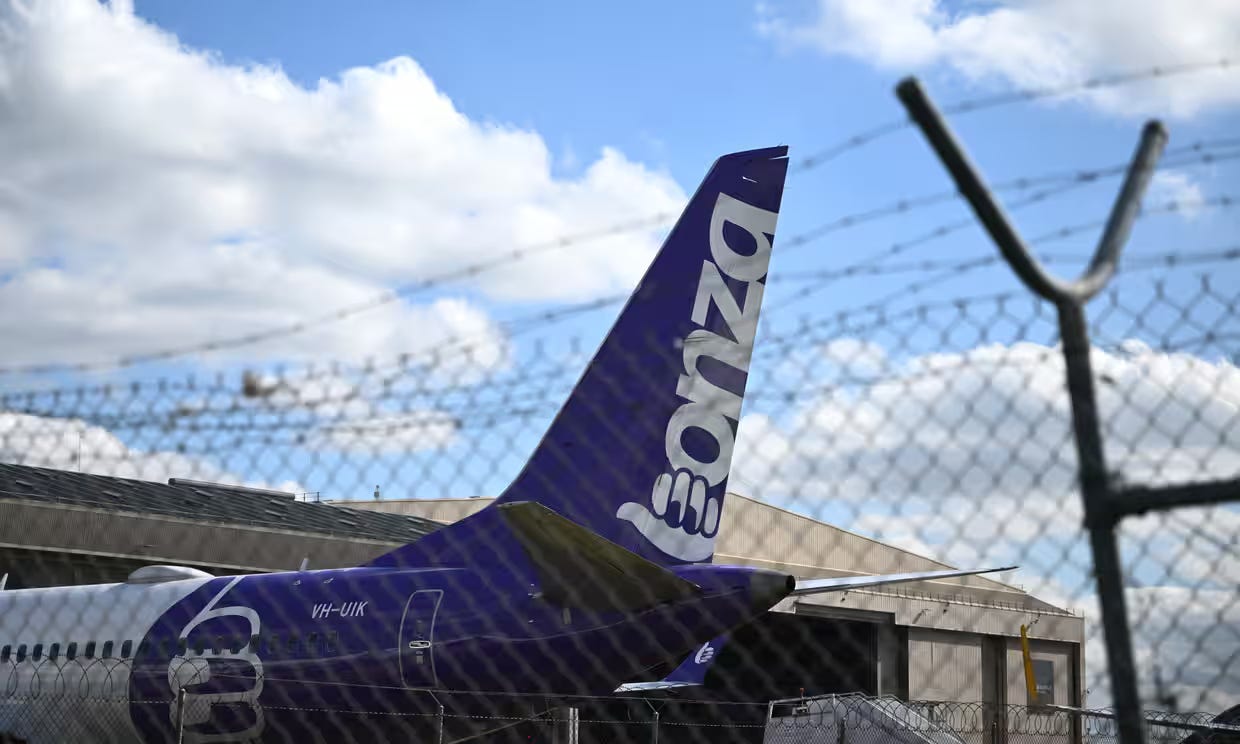
Bonza did not challenge the duopoly directly, sticking to under-served airports like Armidale and the Sunshine Coast. But, as promised by CEO Alan Joyce, Qantas defended its turf vigorously, in particular by poaching Bonza’s pilots. https://australianaviation.com.au/2023/09/rex-blames-qantas-pilot-poaching-for-service-cuts/
When Bonza collapsed, there was no help coming from the Federal government, by contrast with the $2.7 billion bailout given to Qantas during the lockdowns. And, as Rex appears set to go under, Minister Catherine King has announced that the government is “keeping an eye on the situation”.
The government is about to release an aviation white paper, but it is already clear that nothing much will change. This is, after all, the par outcome from the many reviews the current government has undertaken as a substitute for actually doing anything.
The most promising option for promoting competition, the abolition of cabotage restrictions on “foreign” airlines serving domestic routes has been rejected. The facts that Qantas has offshored much of its engineering and maintenance and that Virgin is a subsidiary of Bain Capital do not appear to have reduced the appeal of economic nationalism in this case.
As regards noise “The Australian Government is not considering imposing any additional constraints on airports such as curfews or movement caps”. Unless the major parties lose more seats to the Greens, life under flight paths is only going to get worse.
The best way to understand the priorities of Australian aviation policy is in terms of proximity to the political class. The Qantas Chairman’s lounge is the central point of a set of spheres that radiates outwards, with the privatised airports and the business class in general close to the centre. One step further out is Virgin, which is needed to maintain at least some semblance of competition, followed by the shrinking group of domestic competitors. Ordinary Australians in their capacity as air travellers come next. The “elites” unfortunate enough to live under a flight path are in the outer periphery.
There is an analogy here with the resistance of state governments to congestion charges on travel to the CBD. The daily experience of politicians and the people they mingle with in the CBD suggests that such an idea would be too politically toxic to touch. But for the great majority of people in the middle and outer suburbs, who rarely if ever drive into the city, such a charge, which might be used to pay for improved public transport, would be quite appealing.
 John Quiggin
Attempt to repost.
I detest the flying experience. I have flown, in the past with my wife, to get to and see places; flying about half as often as J.Q. says is average but maybe staying in places longer than is average for most. Flying has always been a detestable experience for me. Cooped up in a metal tube with more people than I ever like to be with in close proximity. Transport to and from the airport. Pain in the neck. All the waiting at the airports. Pain in the neck. Transfers. Ditto. Delays. Ditto. Collecting baggage. Ditto.
The food quality has gone way downhill. The seats and legroom are too small for me, a mere 5 foot 10 inch (178 c) man of considerably less girth than most of his contemporaries (but admittedly of more girth than the fit and trim triathlete John Quiggin). We travel steerage with the rest of the ordinary self-loading cargo.
As J.Q. says, “… it is already clear that nothing much will change. This is, after all, the par outcome from the many reviews the current government has undertaken as a substitute for actually doing anything.”
Yes, I continue to feel nothing will ever change, for the better, in Australia, from this current neoliberal status quo. I still see no hopeful signs of change whatsoever. Of course, I am “the glass is nearly empty” guy from way back but so far I have sadly been right on most of my pessimistic predictions, I think.
A quick switch of focus. The homeless have no home to sleep in and no comfortable warm bed to be woken up in, when hearing the pollies and the reasonably well-heeled tourists fly over.
Homelessness is a critical issue. It is dramatically worsening in Australia. My shire, Moreton Shire, is developing it’s own serious homelessness problem. Recently, the Moreton Shire Council tried to move people on from the Showgrounds car park. When the people wouldn’t move, an official of some type bleated “But we have to hold the Show and we need the carpark. One of the straight talkers said, “I don’t give a stuff about the Show. I haven’t got anywhere to live.” I think he (or she) was right. In the face of so much real need, what is the point of carnivals, sports, entertainments and parties? It is all hollow and sad.
In our suburb, partly good size suburban lots and partly one and a half acre blocks, nice homes plenty of parks, paths and bush (so not down market), a young, homeless person has turned up with a car and tent to live and sleep under power transmission lines. I assume the whole easement belongs to the State Government and/or Powerlink Qld. The local people have, on balance, been sympathetic, some taking hot food to him and making sure he has enough blankets / adequate sleeping bag, that sort of thing. I have to be honest, I have done nothing for him or against him. The campsite is not very close to me. So no kudos to me, but my wife is fighting some health issues (and still winning) but we do feel we have our hands full.
The federal, state and local governments are not doing nearly enough and they rely of the good people in the community, using their own spare resources, to substitute for what the governments should be doing in the way of proper solutions. There are not nearly enough services and accommodations for homeless people. The tiers of government are doing next to nothing, while at the same time failing to tax the rich properly, falling over themselves to hand out favours and subsidies to corporations and big businesses and spending money on extravaganzas (Commonwealth Games, Riverfire, South Bank entertainments and our eventual Brisbane Olympics). So, plenty of money for the fancy icing of events and extravaganzas for the rich and well off but no accommodation or basics (let alone cake) for the poor. This country has lost all perspective. We are heading for very severe socioeconomic problems plus climate change, plus the pandemicene and all that. And still we do nothing. Wake up Australia.
Maybe J.Q. could post on homelessness in Australia. There are so many critical subjects to cover, that’s the problem, because this federal government is doing nothing of anything that it should be doing.
Footnote. My wife and I don’t fly anymore. It’s not medically safe for either of us. It’s not actually medically safe for anyone. COVID-19 is not over, it is still dangerous and many more diseases, exploiting widespread immune system damage from Covid-19, are on the rise. Corporations and governments refuse to protect people or to even facilitate and allow them to protect themselves properly.
I’m sorry to say, I don’t know very much about Australia, so I won’t argue about it.
But where I live, it is the opposite on congestion pricing – it is elite types who love it, and regular people who don’t.
And to me it’s a question of values. It’s bad enough that we have a market that values people’s time at different amounts. But my government doesn’t get to do that to me. So, if you want less traffic, ration the darned road. Do not auction it off. This issue of Lexus lanes is one of the big reasons that I pretty much do not vote for Democrats anymore, on a state level. (I still do for fed things. I’m not crazy.) They do not share my values.