I’ve avoided post-mortems on the US election disaster for two reasons.
First, they are useless as a guide to the future. The next US election, if there is one [1], will be a referendum on the Trump regime. Campaign strategies that might have gained the Democrats a few percentage points in November 2024 won’t be at all relevant in 2026 or 2028, let alone in the aftermath of a regime collapse further in the future.
Second, by focusing on the marginal shifts between 2020 (or even 2012) and 2024, these post-mortems miss the crucial fact that the divisions in US politics have been more or less constant[2] for the last 30 years, as this graph from the Pew Foundation shows.
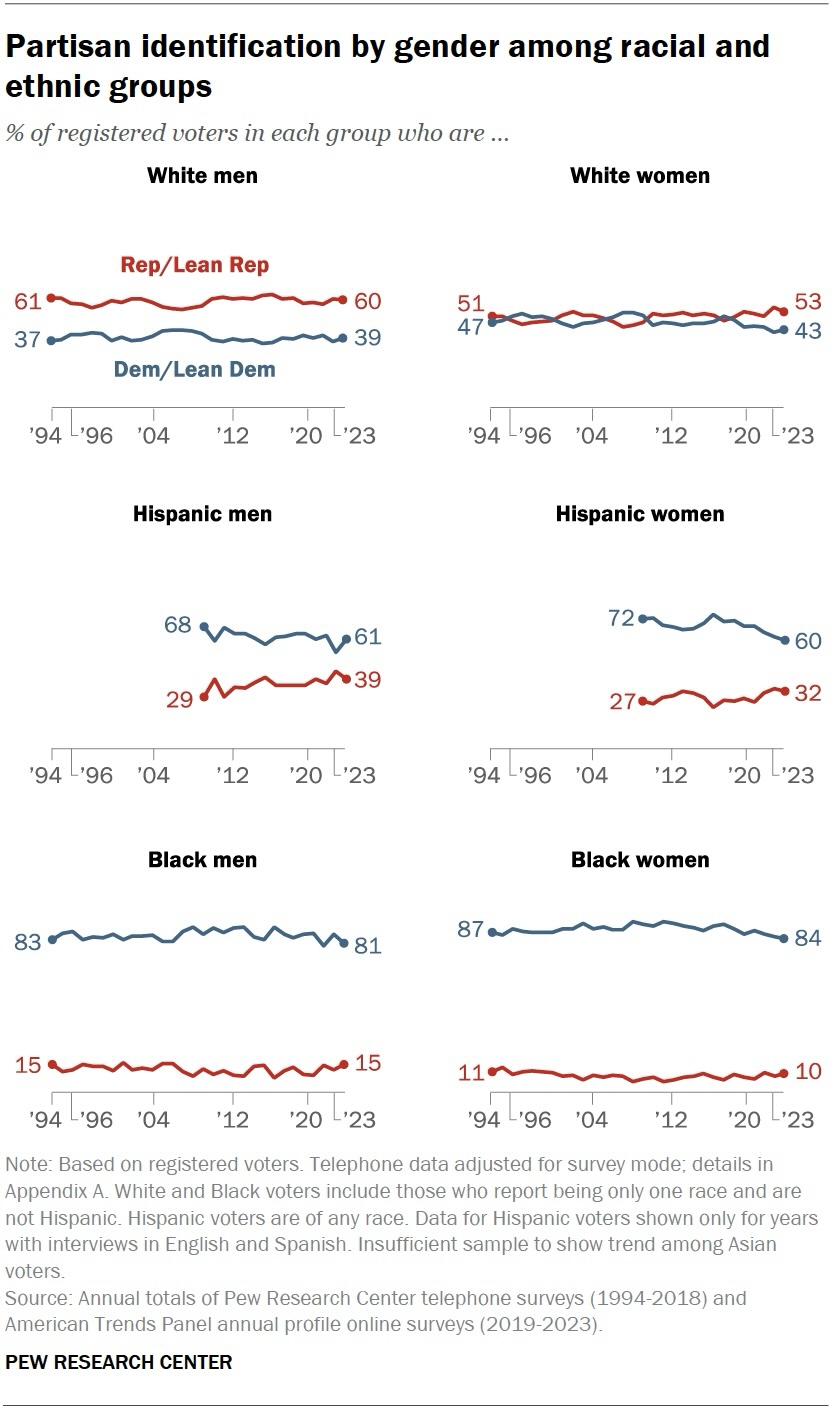
Throughout this period the Republican Party has been competitive only because, it has received the consistent support of 60 per cent of white men.
Of course, that wouldn’t be enough without some votes from non-whites and women. But there is no group other than white men where the Republicans have had a reliable majority over the past 30 years.
More precisely the Republicans represent, and depend on, angry white men. I first heard the term “angry white men” in relation to the 1994 mid-term election when the proto-Trump Newt Gingrich led the Republicans to their first House of Representatives majority in 40 years. The 1994 outcome was the culmination of Nixon’s Southern strategy, bringing Southern whites, angry about their loss of social dominance in the Civil Rights ere, into the Republican camp.
All that has really happened since then is that white American men, fuelled by a steady diet of Fox News and talk radio, have got angrier and angrier. This was concealed, for a while, by the fact that the Republican party establishment had sufficient control over nomination processes to ensure that most candidates were relative moderates. But over time that control has eroded, and the establishment itself has been taken over by angry white men, predominantly Southerners.
What are angry white men angry about? Lots of the discussion focuses on economic disappointments. But there are plenty of high-income Republican. The Republican affiliation of white men has remained constant through boom and bust, recovery and contraction. There has been a shift of support between more educated (now less Republican) and less educated (more Republican) white men, reflecting the increasingly stupid content of the anger diet, but there is no shortage of college-educated consumers and purveyors of white male anger.
Angry white men are overwhelmingly Christian (non-Christian white men mostly support the Democrats, and it used to be argued that they were deeply concerned about a variety of moral and ethical issues, mostly around sex and gender. But Trump has trashed all of their supposed values, notably including principled opposition to abortion, without losing any support. They are still vociferously bigoted against trans people, but really, any target will do.
Political success is going to make angry white men even angrier. By silencing their opponents they can, in the immortal words of the New York Times Editorial Board acquire “the right to speak their minds and voice their opinions in public without fear of being shamed”, but they will still be shunned, and know that they are being derided behind their backs.
Perhaps if the Democrats had been a bit luckier or cleverer in 2024, another four years might have been enough to change things, but there’s no point in regretting that now. Perhaps Trump’s rule will be so chaotic as to bring the whole enterprise crashing down around him. Or, perhaps, this shrinking minority of the population will continue to hold the vast majority of positions of power indefinitely into the future, relying on increasingly stringent repression to secure their hold.
Is there a solution to the problem of angry white men? If there is, I can’t see it, except for the eternal fact that all things must pass.
fn1. Of course, the forms of an election will be observed, as they are almost everywhere in the world. But if the press is tightly controlled, the police and army under political directions political opponents silenced or jailed, the rituals of an election don’t imply the possibility of a change of government.
fn2. The only notable trend is the increase in Republican suppport among Hispanics. This is a complicated topic, which I don’t propose to discuss here. Please, no comments on this, or on short term changes between 2020 and 2024/
 John Quiggin