This is the second in a series discussing the Australian legislation banning people under 16 from using social media. The previous post is here .
I’m writing from the perspective of a longstanding user of new media and also as someone with personal experience of dealing (not very successfully) with problems of under-16 screen addiction. On the other hand, I’m not a technical expert so I may get some details wrong. I’ll be happy to accept correction on these points
The evidence
The social media ban was rushed through Parliament with no real inquiry into the nature of the problem it was supposed to solve or the likely effects of a ban. Evidence from mental health experts on the question of whether and how social media use is harmful is at best inconclusive, as far as I can determine.
But the advocates of a ban haven’t worried too much about that. They’ve relied on casual correlation and on the testimony of instant experts, with no particular expertise in the mental health of young people.
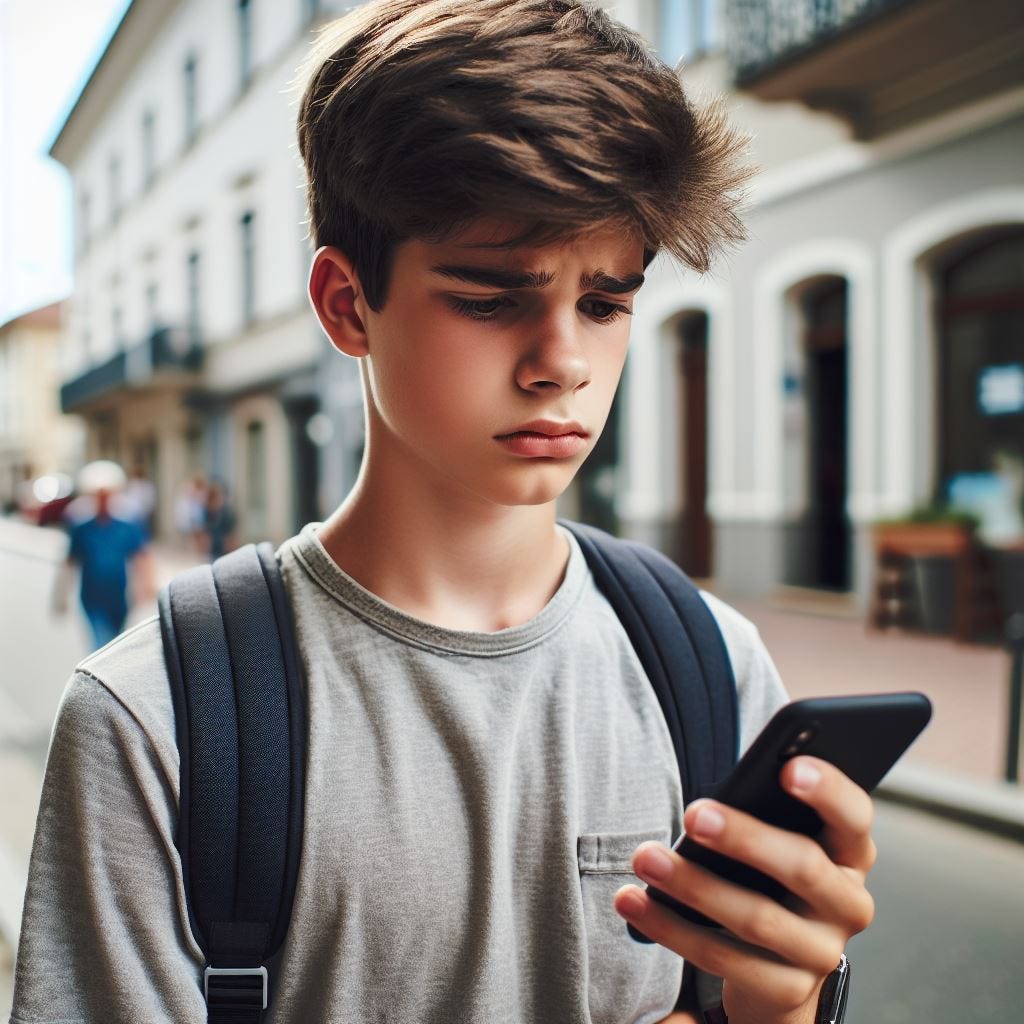
The most commonly cited piece of evidence is the fact that mental health problems among young people have increased, starting 10-15 years ago around the time that social media became a Big Thing. Correlation is assumed to imply causation.
I have to wonder whether people making this point have been watching or reading the news. It’s been increasingly awful ever since the 9/11 terror attacks more than 20 years ago. Endless wars, global heating, the Global Financial Crisis and the decade of austerity that followed, Trump, Covid and now Trump again. I have a naturally optimistic temperament, but that hasn’t been enough to stop me getting more and more depressed.
And I’m not alone. Depression among old people increased greatly between 2010 and 2019 and further since the onset of the pandemic [1]
Depression among the old has been reflected in their strong support for far-right political parties in many countries, and for the nostalgic politics of Brexit and MAGA. You could make a plausible-sounding case that exposure to talk radio, outrage media and so on is driving this. And if teenagers were making the rules, they might force old people to turn off their preferred media. But the only real solution is to work for a less depressing world.
The other main source of evidence has been from instant experts, most notably Jean Twenge and Jonathan Haidt
Twenge is an exponent of the intellectually discredited, but still popular, idea of generational analysis. I’ve been pointing out the absurdities of this idea for 25 years now. My criticisms and those of others have gradually come home. Most notably the Pew Research Center, a longstanding user of the framework, has announced “should not expect to see a lot of new research coming out of Pew Research Center that uses the generational lens.” I reviewed Twenge’s latest book here concluding “for serious scholarly work, five-year birth cohorts, categorised by race, gender and class background, are much more useful. For entertainment purposes, astrology is just as good and less divisive.”
I didn’t pay much attention to Twenge’s discussion of Generation Z. But her work perfectly illustrates a point I’ve often made that much of the generation game literature consists of restatements of long-standing cliches about “young people these days” and old people “blocking up the halls”. In 2006, Twenge published a book on Millennials, entitled Generation Me: Why today’s young Americans are more confident, assertive, entitled–and more miserable than ever before. Her description of Millennials then was very similar to that of Gen Z now.
I’m underwhelmed by Twenge’s work, but she appears to be an honest scholar. By contrast, I’ve long regarded Jonathan Haidt as a charlatan, whose message shifts over time, but always in a way that appeals to a big audience. I first came across his work in 2012, and responded critically. That was about the time he published The Righteous Mind, where he presented himself as a liberal, concerned that fellow-liberals misunderstood the concerns of conservatives. Whereas liberals saw conservatives as driven by racism and misogyny, Haidt argued that they were actually motivated by concerns about moral purity and legitimate authority. Criticising them just created unnecessary division. I saw this as an example of the well-known Internet tradition of “concern trolling” [2]
When Donald Trump emerged as the conservative standard-bearer, the moral purity stuff looked pretty silly, so Haidt moved on. Along with Bari Weiss, Ben Shapiro and Sam Harris he emerged as part of the self-described “Intellectual Dark Web”, characterised mostly by complaints about being silenced by leftwing critics. These complaints were, of course, widely aired in a variety of prominent platforms. When Republicans demanded forcible silencing of protests over the Gaza genocide, these free-speech warriors were nowhere to be found.
With his usual agility, Haidt has jumped on the bandwagon of concern about social media. And, unsurprisingly, he has been amplified by traditional media, which have been at least as problematic, but get a free pass in this debate.
Given that we have no real understanding of the problem, it’s hard to know how, if at all, the solution of a ban is going to work. But the legislation is unlikely to be repealed, so it’s worth thinking about what might happen when it takes effect. More soon, I hop.e
fn1. As is often the case, evidence is mixed. The advocates of a social media ban cite studies showing no such increase among the old.
fn2. A more comprehensive taxonomy of right wing trolls is here https://johnquiggin.com/2018/11/18/trolls-crosspost-from-crooked-timber/
 John Quiggin
Young people are more likely to be active in person taking part in protests about their dismal future prospects. They attend protests about climate change, about peace, about war, about refugees, about bau, about politics as usual, and so on. They attend school strikes en masse. Locking up kids and imposing massive bail conditions and fines on kids for peaceful protest, however disruptive it may be, doesn’t wash well with the broader public – including with most of their voting parents. Young people therefore are hard to dissuade from protest through use of the increasingly draconian methods applied to adults.
I remember the anti Vietnam War days, the posters and painted slogans all over, the poster and T-shirt shops that sprang up, visual media and wearables to spread the word, the stormings of school assemblies and grabbing microphones there to get the word out (the resultant useless beatings and crazed reactionary rantings), the daily graphic war coverage on all tv channels and in all daily papers, and in those same media the coverage of the protests as well as the patently stupid government propaganda. In 6 years… in 4 years… I’d then soon have to dodge the warpigs’ conscription myself using the same underground networks I had contact with and was aiding in a small way. I remember being dragged from occupying government buildings by both the boogeyman’s and the bagman’s police, the special branches and also the ASIO spooks. But they could not dissuade me. They could not dissuade us. Twenty-odd years later I received some apologies from, listened to a few admissions of error from those who were conformist deluded adults twenty-odd years before. They were wrong back then they said. We kids were right.
Young people today have different but similar passionate concerns and deep fears arising from what they see about them and what it all ominously portends for their future. Back in my day we were worried about being called to do something detestable, and maybe in a few years, if caught, unjustly serving a bit of prison time for taking a stand on conscience. Young people today have a lot more to worry about, a lot more to take a stand against – not just a losing unconscionable war, perhaps two years prison time if that war doesn’t end, but they face losing the planet and shortened dreadful lives for all. Their economic prospects in the interim are far worse too.
Young people today don’t have the means of communication we had back in the day. The msm all sing from the same plutocrat approved song sheet. Then there wasn’t really any authority approved msm song sheet. There was a bit of diversity. Much of the best coverage of the war was freelance. There were roneos and alternate notice boards, and non-mainstream print media also covering the issue often from a decidedly well-informed dissident viewpoint. Those provided a place in which to connect and to advertise proposed protest. Young people, school kids, today don’t have any of that, and they also don’t have websites available to serve a similar purpose – but they do have social media.
Deny young people social media today and they are denied the ability to communicate, to be informed, to organise, and to protest. And that is what the big end of town, the plutocrats, the pwned lackies in government, and the spooks seek to do in banning kids access to social media. They can’t deal with their protests, and can’t effectively, harshly punish them. So they aim to shut down the youth by shutting them off. Divide and rule. Anything else is crocodile tears and covering spin, much of it psychobabble.
On the associated shutting down of protest:
Targeting Climate Cange Protests – Binoy Kampmark, CounterPunch, January 13, 2025
Targeting Climate Change Protests – CounterPunch.org
<i>In wealthier states, the climate change protester may be safer, but hardly immune from state violence. Countries that either openly or ostensibly accept freedom of assembly protections and the right to protest – in this case the United Kingdom, the United States, and Australia – have been enthusiastically enacting laws that increase sentences for non-violent protest and negligible acts of sabotage. (The report points to the damage inflicted on a statue as an example.) <b>Arrests of such protestors in both Australia and the UK are above the international average: 20% and 17% respectively.</b>
The authors also write about the “secondary” criminalisation of climate and environmental protests, which involves that nasty trend of applying, sometimes inventively, laws that are already on the books. A popular choice in this regard is the evoking of anti-terrorism powers and the declaration of states of emergency to enable the extraction industries to continue their work unimpeded.
On the issue of oppressive laws, Australia has become something of a leader. Novel pieces of legislation that chip away and smother civil liberties is something of a specialty down under, encouraged by the glaring absence of a federal bill of rights. Since 2019, the states of Queensland, New South Wales, Tasmania, Victoria and South Australia have all passed legislation in this criminalisation frenzy.
Australia’s Environmental Defenders Office (EDO), in collaboration with the Human Rights Law Centre and Greenpeace, affirms the tendency in its 2021 report, further noting the prioritisation of deterrence and denunciation in sentencing practices in courts “particularly when climate defenders do not express remorse or contrition for their activism.”</i>
It’s no surprise that the always less than pure of motives of Mudrake’s newscorpse are behind the ban:
https://www.reuters.com/technology/australia-passes-social-media-ban-children-under-16-2024-11-28/
“Against the backdrop of a parliamentary inquiry through 2024 which heard evidence from parents of children who had self-harmed due to social media bullying, domestic media backed the ban led by Rupert Murdoch’s News Corp (NWSA.O), the country’s biggest newspaper publisher, with a campaign called “Let Them Be Kids”.”
Follow the money. Other than reducing other media competition this nasty competition killing fossil’s vested interest lies squarely with the vested interests of nasty planetary and other killer fossils.
New methods to shut down, shut out, divide and rule, are always catching:
https://www.reuters.com/world/asia-pacific/indonesia-planning-minimum-age-limit-social-media-users-minister-says-2025-01-14/
https://www.reuters.com/world/asia-pacific/indonesia-push-social-media-protections-ahead-age-limit-law-2025-01-15/
Nip it in the bud! Whatever it takes, those fossils must shutdown any and all potential resistance to dirty business as usual. Must shutdown the Next Generation of Climate Leaders. It’s their (or their) future on the line (one way or the other).
The Next Generation of Future Leaders
I feel most people have given up, don’t care, accept lies as truths and live in denialism, selfishness and hedonism. I get this impression not from what they say but what they do. They do virtually nothing to stop climate change and they do virtually nothing to step the rise of multiple pandemics, to name just two existential crises we now face. They admire, empower and choose/accept oligarchic lunatics running their societies.
These characteristics of the masses of most classes and identities, in accepting lies, denialism, selfishness and hedonism, are not fundamental to humans. Humans enculturated in another way can act in another way. It is down to enculturation in our system.
The promulgation of lies over objective truths, in those areas where there are objective truths (to a high degree of probability as moderns would say) has been the age-old activity of all the various elites. Only science, education and democracy appeared capable of changing this dynamic by enlightening, educating and empowering the masses to act in their own enlightened self-interest and generate the greatest good for the greatest number and even adequate good for all when resources and production became sufficient for these.
But we chose or tolerated the wrong system: unfettered capitalism where capital is power and no other power stands against it. We made money the highest value of our society and created an automatic or “programmed” system where money calculations determine all other decisions and all ethics with relatively little impedance from other powers like democracy or moral suasion (meant strictly here as appeal to morality).
You might want to get to a better society. You can’t get there from here. This society and civilisation is in the process of destroying itself: collective suicide by climate change, pandemics and oligarchs. Until the masses realise, en masse obviously, that they have bought into a death-cult civilization and death-cult economics, there will be no change. The questions are what rate of collapse (as collapse accelerates) will force the mass realisation and mass action.
The next question is what forms the action will take. The dichotomy still remains: socialism or barbarism. True socialism, if it can exist at all and arise at all, will not look like any socialism to date. The tired old “no true Scotsman” does not apply. This is not an appeal to system purity. It is simply to point at that a “good enough, workable and enduring” approximation to socialism has not arisen yet. Appeals to the historical extantism do not apply either. That something has not arisen yet does not mean it cannot arise by emergence.
We had better hope something like this arises or rather emerges and we should assist matters where and how we can or at least not be grit in the works. Nothing else will save the majority of humanity and even this hope is terribly slim now.