Nationals’ leader David Littleproud has singled out nuclear energy as a key reason for his party’s spectacular split from the Liberals, as both parties seek to rebuild following the Coalition’s devastating election loss.
Speaking to the media on Tuesday, Littleproud said:
our party room has got to a position where we will not be re-entering a Coalition agreement with the Liberal Party […] Those positions that we couldn’t get comfort around [include] nuclear being a part of an energy grid into the future.
The junior partner had long held strong sway over the Coalition’s climate and energy stance, including the plan to build nuclear reactors at seven sites across Australia using taxpayer funds.
After public sentiment appeared to go against nuclear power during the election, the Nationals had reportedly been weighing up changes to the policy. It would have involved walking away from the plan to build reactors and instead lifting a federal ban on nuclear power.
But some quarters of the Nationals remained deeply wedded to the original nuclear plan. Meanwhile, Nationals senator Matt Canavan had called for the net-zero emissions target to be scrapped, and Nationals senator Bridget McKenzie insisted renewable energy was harming regional communities.
Now, with the Nationals unshackled from the binds of the Coalition agreement, the future of its energy policy will be keenly watched.
Don’t let democracy run off the rails.
Donate today
A graceful way out of nuclear
Littleproud on Tuesday did not confirm where exactly he expected the Nationals to land on energy policy. But he rejected suggestions his party was unwise to stick with the nuclear policy after the Coalition’s poor election result, saying public opinion had been swayed by a “scare campaign”.
Even if the Coalition had won the election, however, the policy was running out of time.
CSIRO analysis showed, contrary to the Coalition’s claims, a nuclear program that began this year was unlikely to deliver power by 2037. But up to 90% of coal-fired power stations in the national electricity market are projected to retire before 2035, and the entire fleet is due to shut down before 2040.
Now, the earliest possible start date for nuclear is after the 2028 election. This means plugging nuclear plants into the grid as coal-fired power stations retire becomes virtually impossible.
This very impossibility provided the National Party with a graceful way out of the policy. It could have regretfully accepted the moment had passed.
With nuclear out of the picture, and coal-fired power almost certain to be phased out, that would have left two choices for the Coalition: a grid dominated by gas, or one dominated by renewables.
However, expanding gas supply frequently requires the controversial process of fracking, which is deservedly unpopular in many regions where it’s undertaken.
What’s more, gas is an expensive energy source which can only be a marginal add-on in the electricity mix, used alongside batteries to secure the system during peak times.
Logically, that would have left renewable energy as the only feasible energy policy option for the Nationals – but it wasn’t to be.

‘Technology agnostic’?
Littleproud claims the party is technology agnostic about energy policy. In practice, that would mean choosing the technology that can reduce emissions most rapidly and cheaply, rather than being bound by ideology or political expediency.
In principle, this approach is the right one. Many energy sources can reduce carbon emissions, including solar and wind (backed up by energy storage), nuclear, hydro-electricity, and even gas and coal if emissions can be captured and stored.
But the Nationals’ claim to agnosticism is not reflected in its actual policies which, in recent years, have been characterised by dogmatic faith in nuclear and so-called “clean” coal, and an equally dogmatic rejection of solar, wind and battery storage.
The Nationals’ hostility to renewables may in part be driven by pressure from anti-renewable activist groups.
The Institute of Public Affairs, for example, has sought to promote rural opposition to renewables and emissions reduction and focused its efforts on Nationals-held seats
And the now-defunct Waubra Foundation, named after the small town in northwest Victoria, opposed wind farms and claimed they caused health problems. The group was created by an oil and gas executive with no apparent links to the town.
What about net-zero?
Elements of the Nationals had been calling for the Coalition to abandon support for Australia’s target of net-zero emissions by 2050.
This would mostly have been a symbolic measure, since the target does not require, or prohibit, any particular policy in the short run. It may, however, have exposed Australia’s agricultural exports to tariffs on carbon-intensive goods.
The move would have been disastrous for the Liberals’ chances of regaining urban seats, and for investment in renewable energy. So it was never likely to be accepted as part of a Coalition agreement.
The Nationals could have chosen to accept the target in return for concessions elsewhere. Or it might have sought an agreement with the Liberals where the parties agreed to differ.
It’s not clear what role, if any, net-zero played in the dissolution of the Coalition agreement. But in the end, the Nationals decided to walk away from it altogether.
Renewables can be good for the bush
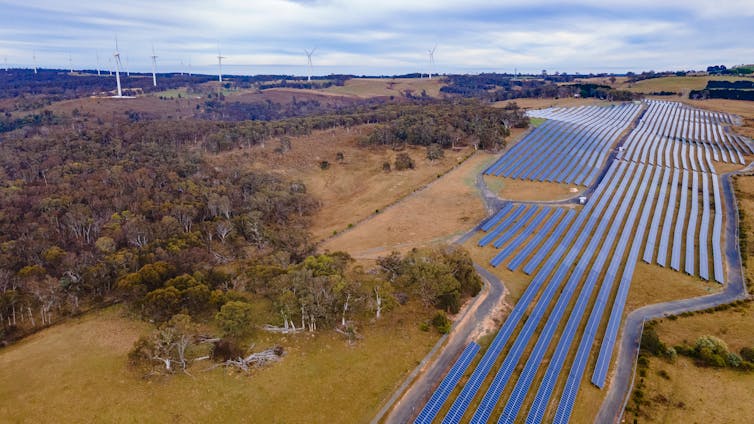
Nationals Senate leader Bridget McKenzie last week said her party was concerned that renewable energy targets are “impacting rural and regional communities”. The party has long voiced concern about the impact of large-scale wind and solar projects in the bush.
However, many farmers and other rural landowners benefit financially from hosting solar and wind farms, which, in many cases, do not prevent the land from also being used for farming.
Concerns that wind farms and solar panels might slash the value of neighbouring properties have been shown to be ill-founded.
And importantly, the increasing frequency of extreme climate events is already a challenge to Australia’s agriculture sector and will become more difficult. Tackling the problem is in regional Australia’s interests.
The Nationals’ hostility to renewable energy comes at a cost to rural and regional Australians. But Littleproud clearly could not balance competing views within the Nationals on energy policy while inking a deal with the Liberals. Instead, the party will now go it alone.
 John Quiggin
Not sure who the Nationals think they’re fooling. If in the next election Liberals + Nationals had more votes than Labor, then the coalition agreement would be back on in a microsecond, no matter any disagreements with the Liberals. Power is more important than principles.
I suspect they are trying to put pressure on Ley not to pivot leftwards towards the Teals’ position to save what’s left of the Liberal party (that and good old-fashioned sexism). Ley should respond with, “Well, I guess three-cornered contests are back on – have a nice day”.
Right now the hard right warhorses in the Nationals benefit from the inertia of not facing challenges from the center-right, only the likes of One Nation, the Katters, and Palmers who are even more looney right-wing. Threaten to take their safe seats away from them and watch them squeal.
I attended an Oberon against Wind Towers hosted meeting at the Oberon RSL on 20 Mar 2025, where Andrew Gee MP, the Federal Member for Calare, and the Nationals’ 2025 candidate for Calare, were available for a Q&A session. There were hundreds of people attending. I was the last person in the formal Q&A session to put the following questions (recalling words to the effect):
To Andrew Gee MP: If you maintained your Calare seat after the next federal election, and legislation was put before you to repeal the federal ban on nuclear power plants in Australia, would you vote for or against the repeal? Would you support a nuclear power station being built and operated at the proposed Mt Piper PowerStation site?
To Sam Farraway: Where does the Coalition’s promise that a nuclear power plant could be operational in Australia within 10-12 years come from? Can you please name any specific civil nuclear power generator units anywhere in the world that have DEMONSTRATED they have been up-and-running from scratch within that promised time frame? I can’t see any first-on-site examples anywhere that have demonstrated this.
I was heckled by a few people in the audience making claims nuclear power stations could be built in 5-6 years.
IMO, Andrew Gee didn’t answer my question, but instead suggested Australia has a nuclear research reactor that makes radioisotopes for medical purposes to fight against cancer, so he was not ideologically against nuclear technologies, and he needed more information about the nuclear power station proposal. I think that’s an example of fence-sitting. I don’t think that’s acceptable for a candidate because I’d suggest people need to know where their candidates stand on critical issues like the nuclear proposal from the Coalition.
And IMO Sam Farraway also didn’t answer my question. I’ve come to the conclusion from my personal engagements to date with Sam Farraway that he doesn’t have a clue about what he is spruiking – it seems it’s all blind faith in the Coalition’s nuclear policy.
After the meeting concluded, someone from the audience approached me, making the claim that nuclear power stations can be up-and-running in 5-6 years. I asked him if he could please name these specific units that have demonstrated his claims. He said to me he couldn’t and didn’t know any specific examples. He said to me he is basing his claim on what a friend/associate was telling him. I suggested he take a look at my Submission (#066) to the Australian Parliament House of Representatives Select Committee on Nuclear Energy. He said he didn’t have access to the internet. Despite his apparent lack of knowledge on this subject, he was adamant that he knew better than me. IMO, this is an example of gross ignorance within the local community, I’d suggest, thanks to the general incompetence of most of the media NOT adequately informing the Australian people.
Unless there is bipartisan political support, a civil nuclear POWER industry has virtually no chance of being developed in Australia. There’s no chance of the ALP changing its position.
While ever the Nationals continue to pursue their nuclear fantasy they will remain in the opposition wilderness. The Libs & Nats are now likely to remain in opposition for at least two parliamentary terms, and with nuclear power generator units being 20+ years away, that means Australia wouldn’t see the FIRST operating unit until at least the early 2050s. What would keep keep the ‘lights on’ until then?
After retiring from politics, thereby avoiding losing an election, Lib MP Bob Baldwin became a keen fisher spokesman and joined The Australian Fishing Trade Association (AFTA). I suspect that this mob is a shell organisation as The Australian Recreation Fishing Foundation (ARFF) claims to be the peak body. Baldwin is also a director of Newcastle-Port Stephens Game Fishing Association (NPSGFC).
AFTA have campaigned strongly against offshore wind farms and Bob Baldwin has been forefront in these protests. NPSGFC have also campaigned against the wind farms, drawing large crowds with the result that Dutton promised that if elected the project would be terminated.
As it happened, the seat was retained by Labor with a large swing against the Liberals.
David Littleproud has misread his constituency. Solar uptake is substantially higher in regional and rural Australia than it is in the cities. Where I live in regional Australia approximately 75% of houses have solar. If you buy panels and a battery you can substantially decouple from your electricity provider. What could be more Australian than that?
Uniquerhys, three corners? Why not just one as in vote [1]?
Rammed through at the last moment of the last parliament, like so much it does with malevolent intent and timing, the unaparty, liblab, made considerable electoral act changes to be effective at the next election. Changes highly favourable to it, its candidates, its taxpayer funding, and unfavourable in all ways to others.
Now it would seem that at that next election “Just vote 1” would mostly favour fakelabour, independents of the Teal sort, and the Greens. With the Greens onboard, timing it for the last moment before proroguing parliament would be easy and catch out gina’s Fakeliberal and Fakefarmer factions.
But will Woodside et al (inclusive of gina) allow Fakelabour to do this?
A recent article names Tony Abbott and Peta Credlin as being the source of the disharmony and policy failures of the Libs and suggests that revenge for losing both his position and seat as being the prime motive. Abbott always hated renewables and his view on climate change is well known. Abbott blames everybody else for his demise and can’t accept that he was his own worst enemy.
The unstoppable revolution
Victory dance from Aussie energy expert Professor Andrew Blakers. None of it will be news to anybody who’s been paying attention, including you if you follow my posts, but a surprising number of pundits (eg Tony Blair) are stuck in the doubts and false dilemmas of the past. I have a few niggles of my own and will follow up on them, but in the meantime, enjoy.
https://www.pv-magazine.com/2025/05/29/solar-puts-australia-in-fast-lane-to-100-renewables/