This is one of the most depressing Australia Days I can remember. We are still recovering from the horror of the Bondi massacre and the disgraceful jostling for political advantage that followed it. Meanwhile, the news is that opposition is hardening on changing the date to one less offensive to First Nations people. The actual shifts aren’t that great in statistical terms, but there’s no doubt that this shift, along with the rise of One Nation reflects something real.
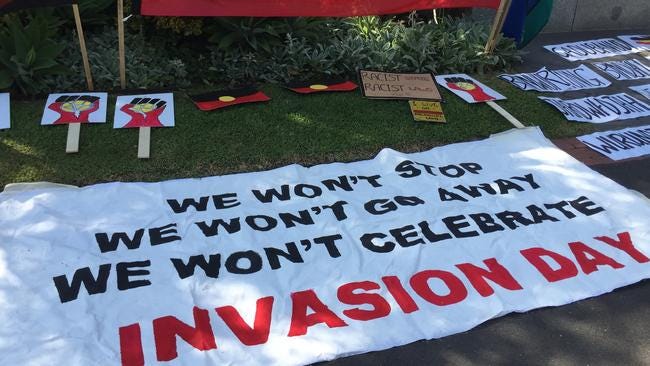
In part what we are seeing is the global collapse of the “centre-right” and the ideology I’ve called “hard neoliberalism”, a combination of privatisation, pro-rich tax cuts and attacks on workers rights. For decades, hard neoliberals relied on the votes of the 20-30 per cent of the population who are consistently racist, but delivered little more than gestures. Now, with the failure of neoliberalism evident to all, the boot is on the foot. The racist right now dictates terms to the remaining neoliberals. We see this most obviously with Trump, but it’s happening in much of Europe as well. Germany is one of the few places where the mainstream right has (so far) held the line against doing deals with parties like AfD.
In Australia, the former coalition made their deal with the devil when they decided to preference One Nation ahead of Labor. Now they are paying the price. The Nationals will either be wiped out by One Nation or forced to merge with them. Either way, and assuming Labor wins again, the opposition in the next parliament will be dominated by overt racists.
Coming to Australia Day specifically, it’s unsurprising that the right is hardening its position. The bigger problem, as usual, is the failure of leadership from Labor and, more specifically Anthony Albanese. Having bungled the Voice referendum, he has walked away from any serious efforts at reconciliation with First Nations and from any attempt to redefine Australia’s position in the radically changed world brought about by Trump.
I can’t see any good outcomes here, at least in the short term. Until Albanese and Marles are gone, we will have no leadership from this government. That’s not going to happen soon, even if Albanese’s popularity continues to decline. And while Chalmers seems more aware of what is going on, there’s no guarantee he would be radically different. Plibersek could once have been an alternative but she has been fatally compromised by her stint as minister for environmental destruction. The same is true of Wong, leaving aside the problem that she is a senator.
The only consolation, looking at the world scene, is that things could be a lot worse. This is still a great country, even if our political class does not reflect the fact.
 John Quiggin
I’m not sure I understand what changing the date would do. If you’re celebrating Australia, aren’t you celebrating the history to some degree – regardless of the day you pick? (I saw a BBC piece just now, which discussed people bringing an Indigenous perspective to the events. That seems to make sense?) If it’s on a different day, my guess is that the whole “invasion” thing is still going to be mentioned.
We have all these same problems here, of course. I’m sure we deal with them much less functionally. Especially now!
Perhaps we should change what we publicly celebrate and commemorate. We need to change our thinking from past-oriented thinking to present and future-oriented thinking. Celebrating and commemorating the past is in many ways pointless. The past cannot be changed. Remembering the past is important, certainly, especially remembering mistakes and injustices so that we do not make them again. So remembrance of the past as commemoration should the sombre mourning of past grievous mistakes and losses, the acceptance of fault where due and the vow to not repeat such actions and histories.
Public celebrating should only occur after worthwhile goals are achieved. Publicly celebrating anniversaries of any kind is worthless, indulgent and wasteful. Of course, privately celebrating birthdays and anniversaries, moderately, is fine. For public celebrations, we should set national goals and milestones and only celebrate them if they are achieved.
So, New Year’s Day celebrations and Australia Day celebrations and the days themselves should be out. But Ecology Day should be in but only celebrated if a clear decarbonisation milestone was reached for the previous year. No goal reached, no publicly funded celebrations. Instead, as foreshadowed in policy, taxes on polluting activities would be increased for each failure.
The trouble is today everyone is acting like life is and should be an endless party of celebrations and events. It has all become completely over the top and very plainly environment destroying.
The date is significant, it is the day that an armed force landed in this country with the purpose of establishing dominance and seizing assets. People like to think that Australia’s history started with that landing and that the process of dispossession was necessary to value add those assets.
The continuation of Australia Day is a symptom of arrested development, as a nation we will always be a colonial outpost, with some nice beaches.
The presence of a vial of variolous matter, that is smallpox pus, on the First Fleet is certainly a matter of historical concern. Later, a “mysterious” outbreak of smallpox occurred among local indigenous people and spread far and wide. Occam’s razor (simplest, most likely explanation) suggests that this material was used in some manner and was the source of the outbreak. This alone completely tarnishes Jan 26, as if it was not already tarnished.
https://www.abc.net.au/news/2020-03-29/coronavirus-and-australias-first-pandemic-caused-by-smallpox/12099430
Australia should vacate the day as it were and leave January 26th officially uncelebrated. As to having an Australia Day as such on any date, I think it is unnecessary. These “celebrations” are used by the elites to promote jingoism for their own manipulative and nefarious purposes.
National and cultural solidarity are best promoted by policies, actions and outcomes of equality and inclusion. When people experience and feel like they have acceptance, a place and a stake in society then the great majority will act positively and cooperatively accordingly.
Change the country’s name to Babakiueria and all shall be forgiven