Ever since it became evident that Trump was likely to be re-elected, I’ve been among the most pessimistic of commentators on the likely course of US politics (most recently here for example). I’ve also been nowhere near pessimistic enough. I assumed that Trump would follow the course of dictators like Putin and Orban, gradually eroding freedom and making his own power permanent. Instead, he’s gone most of the way inside a year.
He started by blackmailing corporations, law firms and universities. Amazingly, while the corporations and law firms buckled (or collaborated) immediately, at least some universities have resisted as best they could.
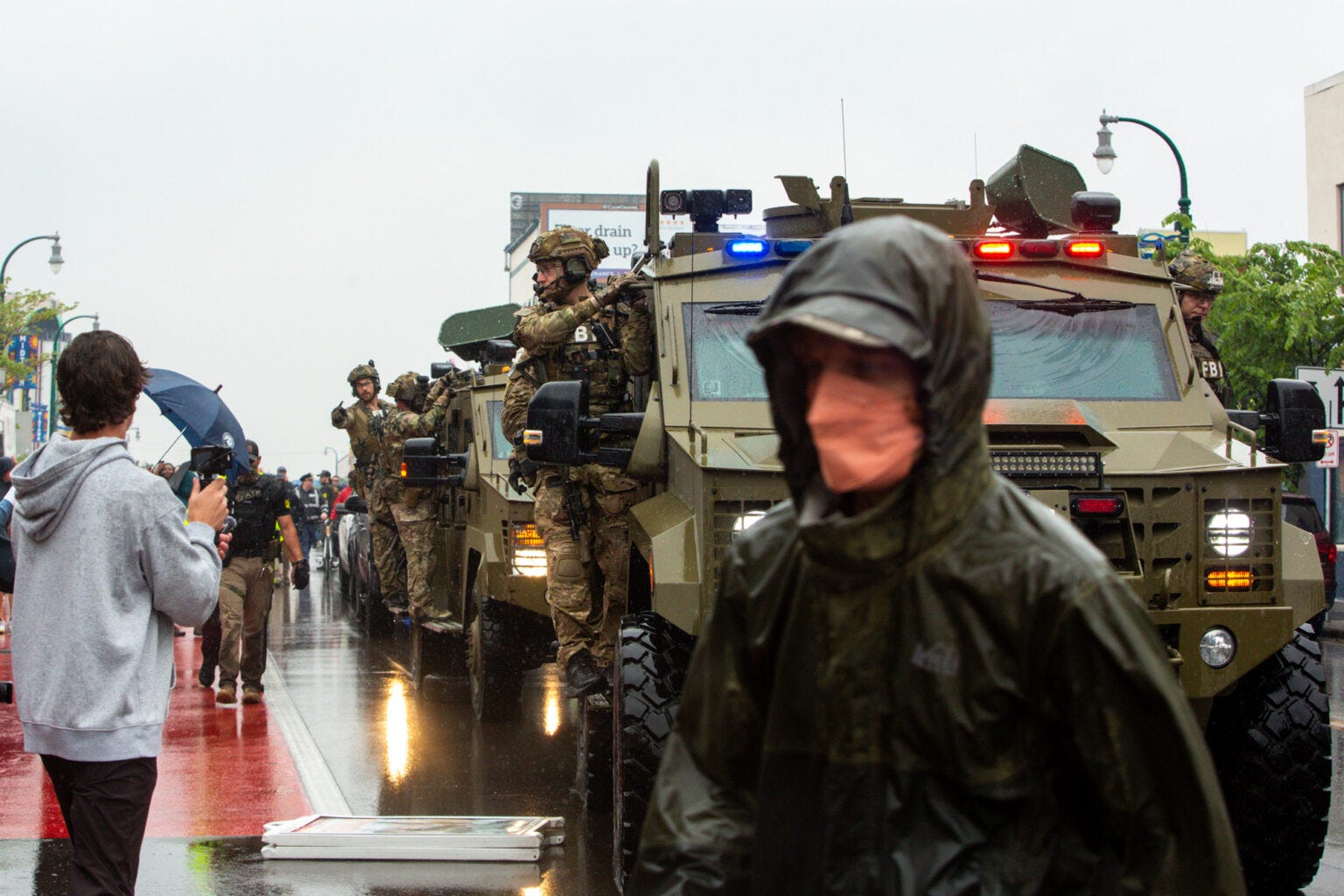
And while predictions of mass deportations, concentration camps and troops on the streets, were derided in 2024, they are now an established reality. The only surprise here is that Trump has not yet invoked the Insurrection Act.
Trump’s run for a third term has already been announced, as has the necessary previous step, the cancellation of the 2026 mid-term elections. All done in the usual “joking, not joking” fashion in which he announced his intention to be a dictator immediately after the 2024 election, and which fools the US commentariat every time.
And throughout all this, he has retained the overwhelming support of Republicans, both politicians and voters. His declining poll numbers (parallel to his first term) reflect his failure to lower the price of eggs, not any hint that his base supporters (about 40 per cent of all Americans and a majority of white American men) are repelled by his corruption, fascism and general evil.
All through 2025, there was little sign of effective resistance. The Democrats were useless as usual. And whereas the situation called for continuous mass protest, there were just a couple of well-attended but ineffectual “No Kings” rallies.
Despite all this, I’m feeling more hopeful today than I have for some time. Trump’s humiliation at Davos and the rejection of his absurd Board of Peace ( as I read somewhere, made up of dictators, monarchs and wanted criminals) shows that the free world (still a meaningful term) is writing him off, and is preparing to do without the US. In particular, the success of Europe, including Ukraine, in holding Russia at bay without US help means that the threat of leaving NATO no longer scares anybody as it used to (except of course Mark Rutte, whose job is on the line).
Even more importantly, the heroic resistance of the people of Minneapolis to Trump’s murderous secret police provides a basis for future action, and seems likely to ensure that the situation will reach crisis point well before the scheduled date for the mid-terms. The Democrats have finally been shamed into action, and may perhaps stand firm this time. There’s even some chance that the invisible group of decent Republicans, on whom so much reliance has been placed, will finally emerge from hiding and break with Trump.
The odds against saving US democracy remain long. And the international position of the US is gone for good, even if Trump is defeated for now. Only a wholesale repudiation of the Republican party by a durable majority can begin to undo the damage done in a single year. Perhaps in a reversion to my normal over-optimism, I’m starting to hope that might happen.
 John Quiggin
I veer to the “incompetence of evil” theory. Sadly, that is almost counter-balanced at times by the nearly equal incompetence of good intentions. There is also, in my view, a great deal of vanity and self-delusion involved in most people’s self-assessment that they are basically good and righteous.
Hanlon’s Razor suggests that we should “never attribute to malice that which is adequately explained by stupidity.” Hanlon’s razor is popular with people who don’t want to believe that humans are “that bad”. It is quite frightening to live in this world if you do see people as that bad. And people don’t want to believe that they personally could be that bad. The evil is always the other.
Grey’s Law suggests: “If an action causes enough harm, the distinction between whether it was “meant” or just “botched” becomes irrelevant.” But I would argue that “evil” is a combination of malice and incompetence. That certainly seems to sum up Trump and his supporters.
Where there is some hope is in the theory of the:
“Self-Destructive Nature of Evil: In literature (e.g., Tolkien), evil is often framed as inherently self-sabotaging. Because evil is rooted in selfishness and paranoia, it cannot sustain the cooperation required for long-term success.” – Google AI.
But after all, “evil” is the wrong word. “Malice” is a better word. Much of malice circles about sadism and the vindictiveness of “if I can’t have it, then you can’t have it either”.
As with all human phenomena we should be looking for evolutionary reasons for its (malice and sadism) existence. I will draw a long bow here and suggest that sociopathy and functional psychopathy have been more selected for since the advent of civilization. I would go even further and suggest they have been even more selected for since the invention of modern money, finance and capitalism. Our social systems over time can certainly affect human evolution: a phenomenon often described as gene-culture coevolution.
https://www.project2025.observer/en