The South Australian election is done, and the results were very close to the predictions of the polls. Labor won a crushing victory, while One Nation [international readers, see note below] got more votes than the Liberals, though probably only one or two seats. Rather to my surprise, Labor finished third in lots of regional seats, and their preferences will push the Liberals over the line.
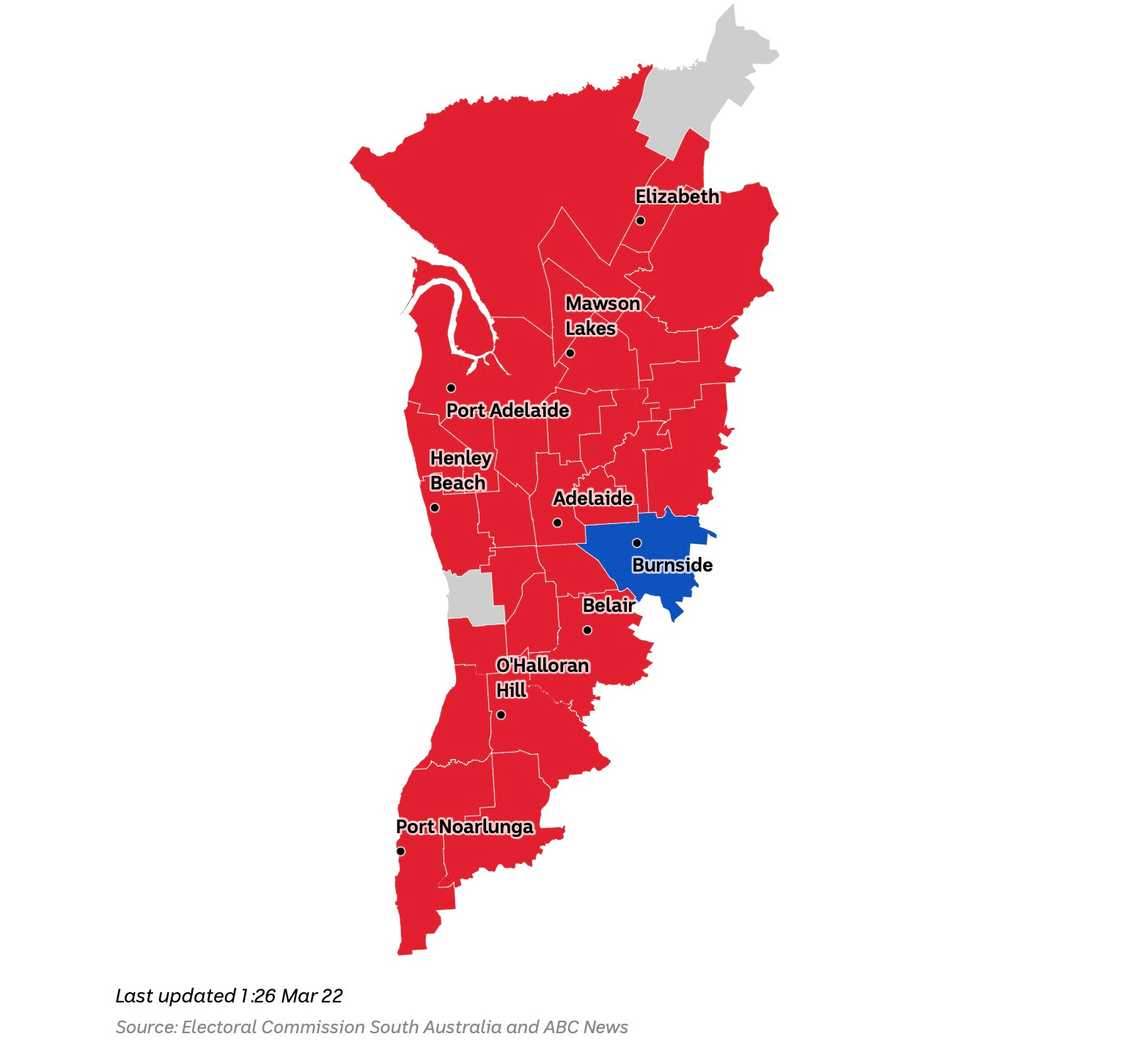
Meanwhile, the Liberals were wiped out almost completely in metropolitan Adelaide, commonly finishing fourth behind Labor, One Nation and Greens. For a party that was in government only four years ago, and won the two-party vote several times this century, this is a truly appalling result.
Despite much confused talk about “left behind” voters, the rise of One Nation, reflected in the South Australian election represents, quite simply, a split in the Liberal Party. Although it is not always safe to interpret changes in total party votes as shifts from one party to another, the evidence in the South Australian case is overwhelming. In almost every electorate, the rise in One Nation in support is exactly matched by a decline for the Liberals, while Labor and Greens are largely unchanged.
This is part of the broader global decline of rightwing “hard neoliberalism” which I first analysed back in 2016. Throughout the period of neoliberal dominance, the mainstream right relied on the votes of people who didn’t care much for free markets, but cared a lot about being the dominant identity in society. Since the GFC, the power balance has reversed, and dominant identity politics is in the ascendant. The archetypal representative of this group (emerging just after I first wrote the piece) is Donald Trump.
Most of these identity voters have not been “left behind” in an economic sense. On the contrary, One Nation gets its strongest support (above 30 per cent) from voters over 65, who are largely insulated from the economic shocks that affect those in insecure employment. Age pensions are indexed to the higher of CPI and wages, and are much more generous than unemployment benefits. Those with superannuation benefit from strong returns to capital. The only group of old people with significant exposure to economic shocks are the minority who don’t own their own home, and have no income besides the pension.
One Nation’s voters are people who in Andrew Hastie’s words, don’t recognise Australia as the country they grew up in. Like Tony Abbott, they are nostalgic for the days of the White Australia policy, when such anti-migrant prejudice as existed was directed against Italians and Greeks.
And Hastie’s comment reveals the fact that there is now no significant policy gap, between One Nation and the now-dominant right wing of the Liberal-National coalition. Both want (mostly unspecified) cuts in immigration, oppose any kind of action on climate, and trade in anti-Islamic rhetoric. But One Nation is loud and offensive, while the LNP tends to trade in euphemisms.
The convergence has been accelerated by the rise of community independents (“teals”) in formerly conservative areas. As well as replacing much of the moderate section of the Liberal party this trend has resulted in the Liberals adopting increasingly anti-urban rhetoric, once confined to complaints about the “inner city”.
The Liberal shift to the right is particularly evident in South Australia where the Christian nationalist faction led by Senator Alex Antic has crushed what remained of the moderate liberal tendency going back to Steele Hall and (in his way) Sir Thomas Playford. By contrast with this group, One Nation looks positively leftwing, advocating medicinal cannabis and having little interest in the Christianist agenda on abortion, voluntary assisted dying etc.
The big disappointment so far has been the absence of a comparable upsurge on the left. The Greens have held and slightly increased their share of votes (around 12 per cent) while others disillusioned with the major parties have gone for community independents.
In part, this reflects the responses of the incumbent parties to challengers. The Liberals have normalised One Nation, and shifted policies closer, effectively giving their own voters permission to switch. By contrast, Labor has ruthlessly demonised Greens, and has made as few concessions as possible, even though Greens policies are those put forward by Labor until recently. It’s clear which of these is working better politically.
I’ll write more about how the Greens should change their approach. But for the moment, I’ll just enjoy some quiet schadenfreude/
What is One Nation ?
Officially named Pauline Hanson’s One Nation, the party has a lot of similarities to Geert Wilder’s Party for Freedom in the Netherlands. Like Wilders, Hanson was originally a member of the main Australian conservative party (confusingly called the Liberals). She was expelled in the late 1990s for her racist views, and formed her own party, with great initial success. Also, both parties have been run by their founders, with no real party structure. Under current rules, Hanson is party President until she chooses to resign, and to choose her successor, who may also continue until resignation. The result has been a long series of splits and defections, with members elected on the One Nation ticket departing to become independents or else to form short-lived micro-parties.
 John Quiggin
I owe to Charles Richardson the information that there were some parts of Adelaide where the votes for both Liberal and Labor were down while the votes for One Nation were up:
https://worldisnotenough.org/2026/03/23/south-australia-answers-the-question/
So it seems likely that at least in some areas there was a significant movement from Labor to One Nation, although this isn’t a reason to doubt that by far the largest Statewide shift was from Liberal to One Nation.