TL;DR Not good. Taking account of economic failure, nothing Trump has done – rape, war crimes, corruption, insurrection, ICE or trashing the constitution – has cost him a single vote on balance.
In a flowchart prepared before the 2024 election, I gave US democracy a 30 per cent chance of surviving a Trump election win. This was broken down as 10 per cent that Trump would govern constitutionally, 10 per cent that the Supreme Court would stop him and 10 per cent that he would face effective popular resistance. Obviously, the first of these didn’t happen. And while the Supreme Court has occasionally ruled against Trump, it has more helped him by overturning lower court judgements.
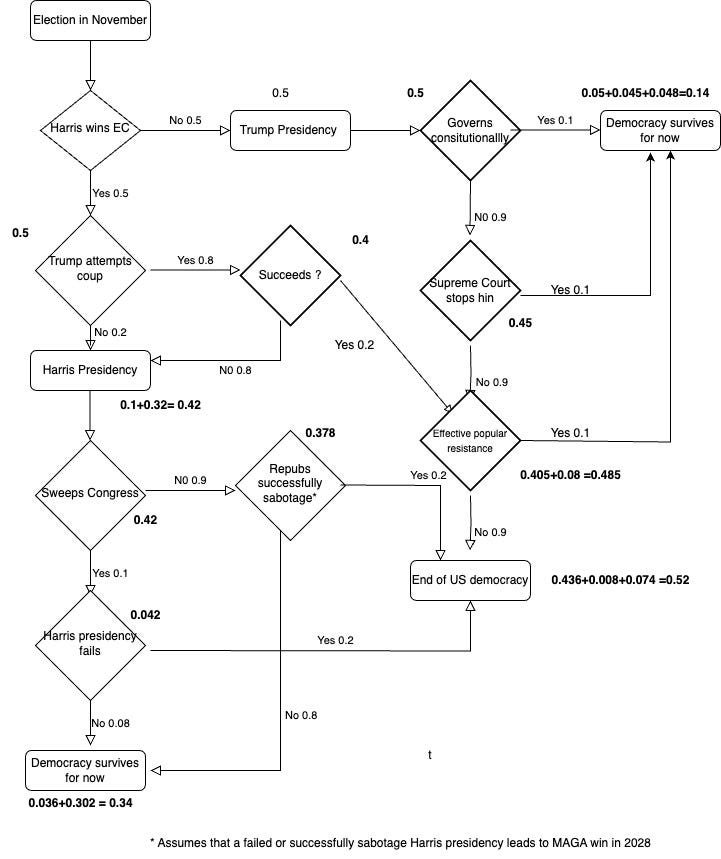
That leaves popular resistance, including both the public as a whole and institutions like the media, law firms, big business and universities. The level of acquiescence, or outright collaboration from the institutions, with the partial exception of universities, has exceeded my most pessimistic expectations. For me, as a lifelong Apple fan, the sight of CEO Tim Cook fawning over Trump while he handed over protection money was particularly galling, but Wall Street and Big Law have been just as bad
As regards the public at large, optimists have taken heart from the fact that Trump’s popularity has dropped sharply from the 49 per cent he won at the 2025 election. But the drop is about what would be expected for a president of either party who ran on a promise of lower prices and failed to deliver. Trump’s decline almost exactly parallels Joe Biden’s, as well as Trump’s own first term
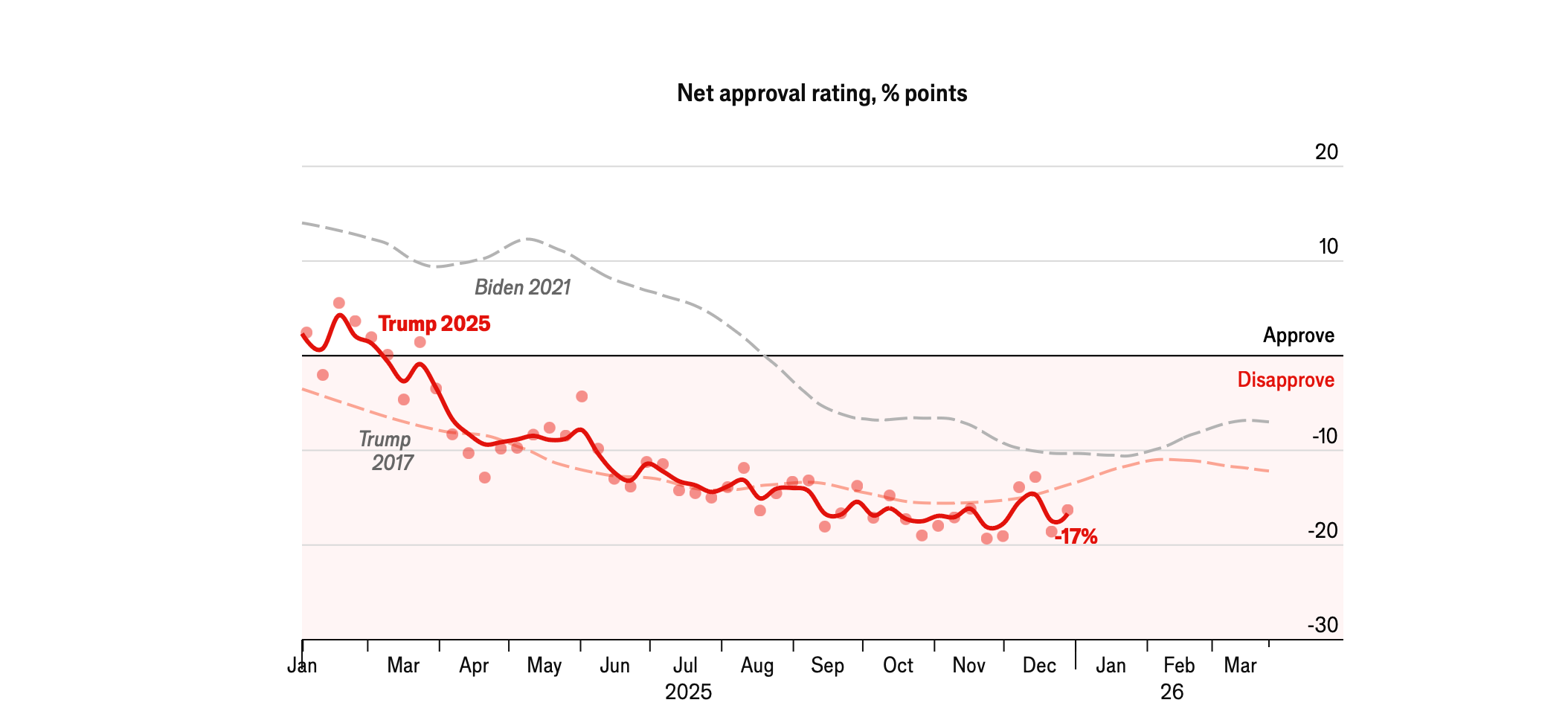
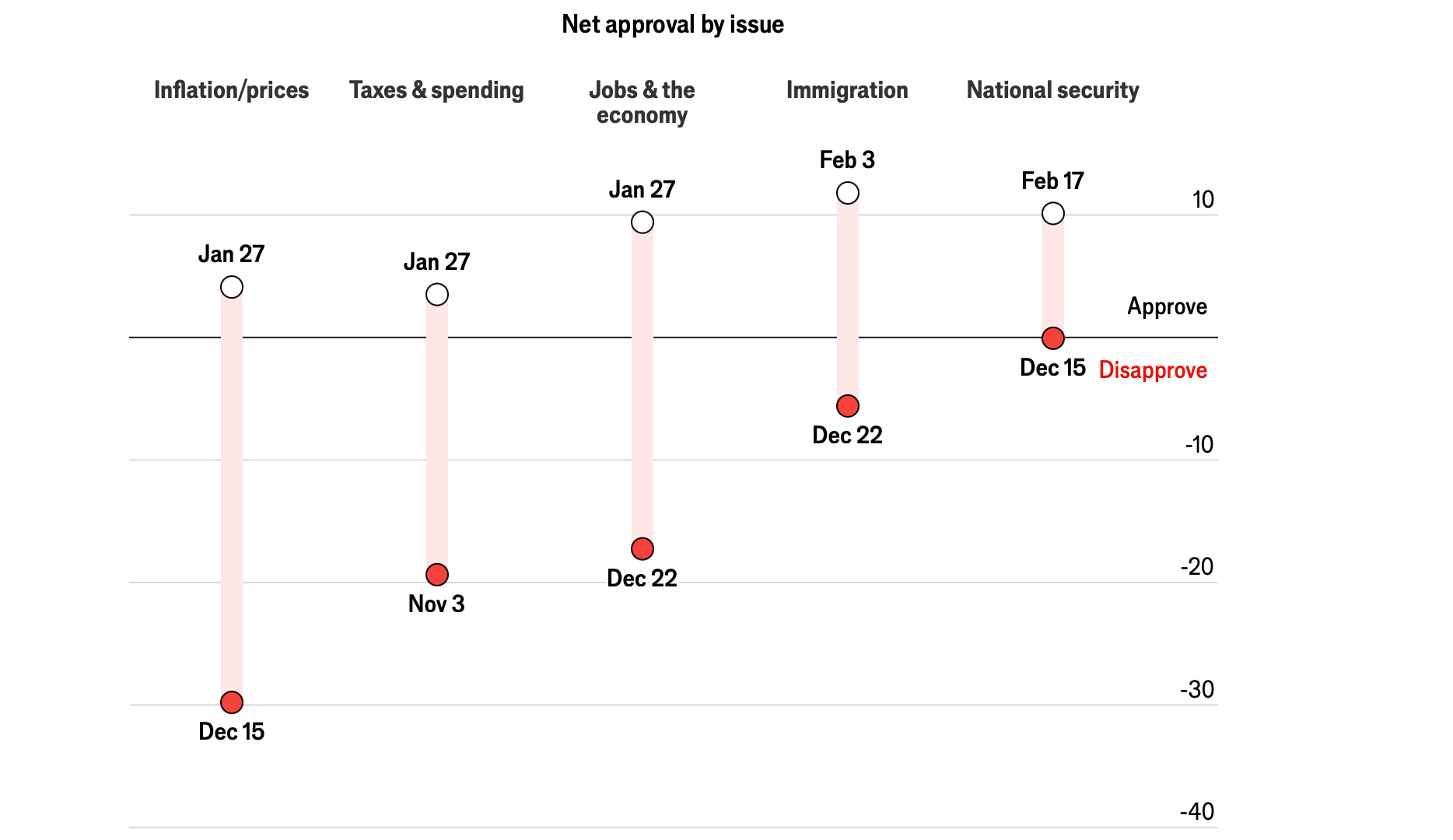
Putting this as sharply as possible, once you take account of economic performance, nothing else Trump has done – rape, war crimes, corruption, insurrection, megalomania, secret police or trashing the constitution – has cost him a single vote on balance. An issue-by-issue analysis for The Economist supports this. Trump is deep underwater on the issue of inflation, but has barely lost any ground on national security and immigration since the election. And his support among Republicans remains rock solid.
The big problem Trump faces in 2026 is that of the mid-term elections to be held in November. Under normal circumstances, the party of a relatively unpopular incumbent would lose. And this would set the stage for the successor to a term-limited incumbent to be defeated in the subsequent presidential election. The incumbent would then retire to write his memoirs, give speaking tours etc.
But it’s obvious that a Democratic presidency with control of Congress would put Trump and his cronies in grave danger. Even if Trump could not be criminally prosecuted, and even with liberal use of the pardon power, he would surely be subject to civil actions of all kinds and state-level prosecutions which (hopefully) would not be bungled. The problems for cronies would be even greater.
For that reason, it’s highly unlikely that Trump will willingly accept a mid-term defeat. Can he prevent it? His first attempt to stop the outcome, taking gerrymandering to extremes, proved counterproductive when California Democrats responded in kind. And it’s unlikely that the usual long-standing forms of voter discouragement will be enough to change the outcome. That leaves two possibilities: forcible suppression using ICE or military forces, and annulment of results.
Trump somewhat botched the first option with his order of troops into US cities, which achieved nothing and undercut any basis for invoking the Insurrection Act. Even the Supreme Court rejected his attempts to establish control over state-level national guards against the wishes of governors. But there are still plenty of possibilities. For example, ICE could be mobilised to arrest Hispanic voters on the suspicion of being illegal immigrants and detaining them long enough to stop votes being cast. Or mail-in ballots could be seized and destroyed on some pretext or other.
Alternatively, Trump could direct Republican officials to “find” the necessary votes to deliver the desired outcome in close contests, as he tried to do in Georgia in 2020. While Secretary of State Brad Raffensperger resisted that time, it’s doubtful that many Republican officials would do so now.
Finally, the current speaker Mike Johnson could seat Republican losers in place of elected Democrats. The only limit here is the willingness of the House of Representatives to countenance such an action. With a slim majority in the existing House, there would be a risk of defection.
Looking at this, it struck me that Trump could make Johnson’s task easier by detaining enough Democrats to ensure the vote went the right way. When I searched on whether this was possible, I received the reassuring answer that members of Congress are protected by privilege and that arresting them would be a felony, “except in cases of treason, felony or breach of the peace”. The last of these exceptions seems broad enough to drive a truck through. And, when I asked what remedy was available, the first answer was “impeachment”, which was grimly amusing. More promising options are actions under habeas corpus, but as recent cases of arbitrary arrest have shown, the government can drag its feet over such actions for a long time.
Successful suppression of the voters’ will in the mid-terms would clearly mark the transition of the US from democracy to dictatorship. A “normal” election or successful resistance to suppression would allow some breathing space, but would still imply an uphill battle for the remainder of Trump’s (current) term.
Overall, I’d say that the probability of US democracy surviving past 2028 is a little better than the 10 per cent implied by by my 2024 flowchart, but still well below 50-50.
Best wishes for the New Year
 John Quiggin
Another aspect of Trump’s Venezuelan SMO is the attack on the UN rules based charter – under Trump the respect for sovereign nations has been diminished even further.
That may well be BAU for republicans but that they bypassed Congress has all the fingerprints of the dismissal of the US democratic process by the executive branch.
Trump is the thermometer not the ambient temperature. If you ask Google AI what is meant by this sentence (which I thought had an original idea and expression of it), it gets the answer right. It is perhaps interesting that LLM “AI”, when asked what a metaphorical and allusive statement means, can get it right. Of course, this test is a sample of 1.
My “creative” expression was not original at all. I quickly discovered that Martin Luther King wrote and said:
“I’m sure that many of you have had the experience of dealing with thermometers and thermostats. The thermometer merely records the temperature. If it is 70 or 80 degrees it registers that and that is all. On the other hand the thermostat changes the temperature. If it is too cool in the house you simply push the thermostat up a little and it makes it warmer. And so the Christian is called upon not to be like a thermometer conforming to the temperature of his society, but he must be like a thermostat serving to transform the temperature of his society.” – Transformed Nonconformist- MLK.
King had the same thought much earlier and took it further. Each person needs to be a thermostat that turns down the temperature of their society a bit; temperature, rather clearly, being a metaphor for anger and violence.
This (sample of 1) kind of suggests to me that LLMs are good at translating metaphorical and allusive language. Why? I have some ideas but this gets us off topic. Suffice it to say, that “hallucinating” answers in the AI way may be partly related to things like metaphor and allusion and their preponderance in the language LLMs sample. Just a thought.
But Trump isn’t just a thermometer, he is also the match, the petrol poured on the fire and so on. In a feedback sense, he is the resonator and amplifier, to really mix our metaphors.
The bottom line is that Trump couldn’t be in the process of becoming a fully enabled malignant-narcissist dictator if the psychopathy he is resonating with and amplifying did not already exist powerfully in a significant proportion of the US population. The real issue is the origins of this cultural psychopathy and the chances for at least a partial cure in the future. I think the chances are low. It looks incurable to me.
I don’t know what will happen, and I don’t blame people for being upset – everyone I know is upset, pretty much, one way or the other – however, reports of our demise are premature imo.
We have an s-ton of lawyers, and as a people, we are argumentative and stubborn. (Also, as a group, not particularly bright, if I may say so. But brains are overrated!) Voldemort has had unparalleled success in keeping his weirdo base together so far … but I think he is on the downward slope of power by now. The Supremes finally stood up to him. The weirdos are, I hear, very upset about Epstein. He has had a hard time changing the subject – and, I’m not sure the kidnapping even worked.
So, with luck, I hope we’ll skate.
To Iko’s point, I tend to agree – this whole misadventure has painfully shown the world what many of us here already knew – there is just a large proportion of yahoos here. I love my country, even though we are not all that bright, in practical terms (it is not an actual IQ problem imo), and we are deeeeeply immature.
But we aren’t all bad. What Winston Churchill said about us stands.
Please do keep us in your prayers, if possible. It is okay that we aren’t on the top of the list. That’s understood.
John, you know very well that the Democrats are not going to ‘go after’ T rump and co in any serious way. I would like to be wrong about that.
Trump recently said that the only constraint on his unlimited power is his morality.
Even MAGA should be concerned.
He also recently said that he believes in elections and will respect their results, but elections in the US are rigged.
The Minnesota shooting and the subsequent commentary from the executive, along with the Maduro kidnapping and the planned Greenland invasion all point to a govt that doesn’t fear retribution through the political process.