The latest Quarterly Essay has just come out, including my response to Sean Kelly’s The Good Fight which asks the question: What does Labor stand for? My somewhat despondent answer “Labor stands for itself. For the moment, that seems to be enough.”
Reading Sean Kelly’s The Good Fight, I was struck by an observation attributed to John Howard: “in the 1960s, he said, 40 per cent reliably voted Labor, 40 per cent Liberal, with 20 per cent in the centre. The proportion of swing voters, he said, had doubled since then.”
As regards the 1960s, Howard was broadly accurate, except for omitting the role of the Democratic Labour Party, which eventually served as a waystation for conservative Catholics moving from Labor to the Liberals. At the time, a lot of commentary treated the swinging voters as making considered decisions and compared them favourably to those who always voted the same way. But more careful analysis undertaken by Rod Cameron for Labor in the 1980s and cited by Stephen Mills in The New Machine Menshowed that swing voters did not carefully reason their way to a vote. Rather, “They are basically ignorant and indifferent about politics, voting for … superficial, ill-informed and generally selfish reasons.” On the other hand, as Associate Professor Sally Young wrote in 2013, “those who know the most about politics and are most interested in it, are usually partisan. Much like sports fans, they’ve picked a side.”
Back in the 1960s, the “sports fan” analogy told part of the story, but only part. The parties weren’t just competing teams (routine use of this term to describe a party’s representatives came much later). Rather, the parties embodied different views of which voters were truly representative of Australia and advocated very different policies as a result. For Labor, the representative group was the working class, epitomised by unionised manual workers. For the anti-Labor parties, it was Menzies’ “forgotten people” (educated professionals and small business owners), along with the rural voters represented by the Country Party (now the Nationals).
So the archetypal voter for each party not only identified with that party but saw themselves reflected in the party’s rhetoric and policies. In particular, Labor favoured pro-union industrial relations policies, progressive taxation, public ownership and expanded public services. Since this was the direction in which policies were moving, Labor was seen as the party of initiative (in the original phrasing by W.K. Hancock, the “party of movement”). By contrast, while the Liberals went with the general flow, they were the party of resistance, seeking to slow change and protect the interests of their own base in lower taxation and small government.
Since neither party could command a reliable majority, it was necessary to campaign on policies that attracted swinging voters. This encouraged convergence to the political centre but not enough to obscure the differences between the parties.
The economic chaos of the 1970s reversed the steady flow towards the left that had characterised politics since Federation. The Hawke–Keating government adopted, willingly or otherwise, the policy package then called “economic rationalism” and now generally described as “neoliberalism.” However, policies like Medicare and the Accord with the trade unions produced a “soft” version of neoliberalism, contrasting with the hard neoliberalism of Thatcher in the UK and Howard in Australia.
Labor received 49.5 per cent of the primary vote in 1983, but this achievement would never be repeated. Labor voters drifted off, first to the Australian Democrats and then to the Greens. At the same time, the economic and social changes associated with economic rationalism eroded Labor’s traditional base to the point of insignificance. In the 1960s, most workers were in blue-collar jobs, and the great majority were union members (not always willingly). Labor could win elections simply by securing solid support from this group, particularly on the (then standard) assumption that wives would vote like their husbands. In practice, however, conservative parties gained enough working-class support to remain electorally dominant.
The shift to a service economy, along with legislation abolishing “closed shops” and conversion of employees to notionally independent contractors, has changed the picture radically. The three biggest blue-collar unions (the CFMEU, AMWU and AWU) have about 200,000 members between them, barely more than 1 per cent of the electorate. The entire group of wage workers in trades and labouring occupations accounts for a little under 20 per cent of the workforce and perhaps 13 per cent of the electorate, not all of whom vote Labor. The group commonly identified as Labor’s “base” amounts to about 10 per cent of voters.
Given that Labor currently secures about 35 per cent of first-preference votes, what drives the decisions of the 25 per cent of the population who don’t fit the “base” model?
First, there is a group with a “football team” identification with Labor, perhaps inherited from their parents. Albanese himself fits this model, almost to the point of caricature. Kelly’s reference to Albanese’s “three great faiths – Labor, the Rabbitohs and the Catholic Church” – is central here. Albanese’s identification with the Catholic Church does not imply belief in its doctrines, any more than his support for the Rabbitohs during their forty years in the rugby league wilderness reflected admiration of their playing strategies. In both cases, the strongest passion is that of not being on the other side: that of the Anglican establishment or the (silvertail) Sydney Roosters. As Kelly astutely observes, “Above all else, [Albanese] is not a Liberal,” even if his policies consist mainly of marginal adjustments to the settings he inherited after nine years of Liberal government.
Closely related to this kind of identification is an uncritical acceptance of the two-party system. Lots of voters don’t fully understand preferential voting (indeed, until very recently, lots of political journalists didn’t) and assume that a vote for Labor is the most effective way of expressing a preference for a Labor, rather than LNP, government. Many are misled by phrases such as “hung parliament,” implying, contrary to actual experience, that a minority government is likely to be unstable and ineffective.
Finally, there is a segment of the electorate who are, like the idealised swinging voters of the past, voting Labor because they prefer Labor’s policy offering, pitched marginally to the left of the Morrison-era LNP, to that of any alternative. The most promising positive elements of the 2022 policy package (the Indigenous Voice to Parliament, the National Anti-Corruption Commission and the Housing Australia Future Fund) have been either failures or disappointments. But as the LNP has shifted further into pointless culture war, centrist and centre-right voters have nowhere else to go.
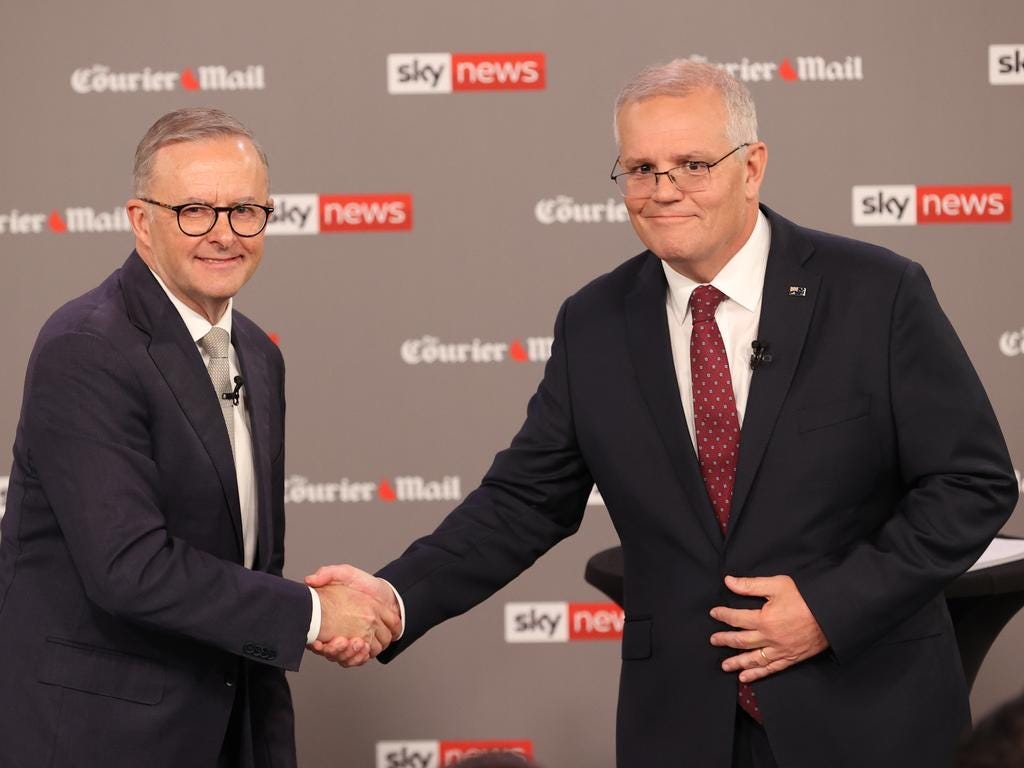
The result is that Albanese has succeeded in his goal of establishing Labor as the natural party of government. Even if some accident hands the Coalition an election win, they will remain the B team, holding office only intermittently until the natural order is restored. And with the Coalition routinely preferencing the Greens last, Labor’s left flank is also secure, at least in the House of Representatives.
The price of this success is that Labor is no longer the party of initiative. The idea that a slow and steady first term in government would lay the basis for real change in the second and third is now forgotten, about as relevant as the party’s socialist objective (still part of its official constitution).
Coming back to the title of Kelly’s essay, the analysis here suggests a simple answer to the question “What does Labor stand for?”
Labor stands for itself. For the moment, that seems to be enough.


I’m not clear what you mean John by saying ‘For the moment, that seems to be enough’.
I can’t imagine you meaning that you approve that ‘Labor stands for itself’. Are you meaning that Labor’s position is enough to win the next election, or do you mean something else?
The broader observation, I guess, is that our entire party political class stands for itself (and the vested interests, big capital and big corporate, that they solely represent). Some independents might stand for the majority of the people they represent, a bit.
Perhaps the way forward is to vote for independents only. This would only be possible in a seat (and a state for the senate) where there was or were multi-issue, not single issue, independent(s) who appeared to have the greatest good of the greatest number in mind plus acceptable stands on climate action, sustainability and renewables, to name some key issues.
Labor standing for itself gives distance to the LP, NP, PHON et al, who are all beholden to their sponsors and the ensuing nonsensical culture wars.
You cant spin an ideological flag onto the ALP donkey, that’s their edge.
I notice John that your bio in the Quarterly Essay describes you as presenting ‘commentary from a social-democratic viewpoint’. Whereas you clearly say in the heading of your blog ‘Commentary ….from a socialist and democratic viewpoint’.
Even the left media get the framing wrong.