Plan B

Now that the Senate has rejected Pyne’s university deregulation plan, the obvious question is, what is Plan B? The first, negative answer: there is no acceptable plan that will deliver what the advocates of deregulation wanted, namely a highly stratified system, catering to a smaller minority of the population than at present, and topped by high-status institutions comparable to Yale and Harvard. That’s the US model and, as a system for educating young people, as opposed to generating research and reproducing a tiny elite, it’s been a miserable failure.

The correct way to think about this is to begin with the core objective of the process: to provide young Australians with post-school education that fits them for work in a modern economy and life in a modern society. That leads to two main principles

* A single system encompassing both universities and post-school technical education with easy flow between the two
* Uncapped access with an objective of (near) universal participation in some form of post-school education
* As with school education, the aim should not be stratification by quality, but the provision of a high-quality education for all, with resource allocation based on educational needs, not institutional history or individual wealth

I’ll leave aside, for the moment, the problems of the TAFE sector, though these are, I think, more urgent and difficult than those of the universities.

The big problem with what I’m proposing is that it will require more money for undergraduate education. That’s because the existing system relies on a mixture of student payments (through HECS), government funding and a cross-subsidy from fee-paying overseas students. There’s no substantial scope to get more money from overseas students, so the more domestic students the more thinly that cross-subsidy is spread. Similarly, although more government funding is merited, maintaining existing funding on a per-student basis while expanding numbers is probably too much to hope for. However, a clear focus on the core goal of universal post-school education would help a lot, though it necessarily poses some tough choices.

Broadly speaking, the goal I’m thinking about is to maintain existing teaching resources per student, while expanding access to cover a steadily increasing proportion of the population.

Some ideas are listed below (over the fold)
Read More »

Neither up nor down

I’ve had the unusual experience of being cited as an authoritative expert* by both the Oz and AFR this week. Unfortunately, the Oz got the story wrong, and the AFR report, while correct on a careful reading, is misleading. The issue is the impact of electricity privatisation on power prices.

Direct comparisons suggest that consumer prices don’t differ much between NSW and Queensland (with public ownership) and SA and Vic (with privatisation), though SA is highest.

The advocates of privatisation have focused on distribution charges, showing in the process that they don’t understand the National Electricity Market reforms they and their ideological allies pushed through in the 1990s. Under the system of regulation, distributors are allowed to charge a price sufficient to cover their “efficient costs”, which are determined in large measure by benchmarking against other distributors. So, if private firms are more efficient than public firms, that should have no effect on regulated distribution charges, only on relative profitability. **

As the AFR and Oz both gleefully pointed out, that analysis contradicts what they called Luke Foley’s “great lie”, that prices will rise if privatisation takes place. Unfortunately, it also contradicts the equal and opposite lie, that prices will fall if privatisation takes place. The AFR gives a misleading headline, but is correct in the body of its report, saying “The prices charged by the government-owned NSW network companies will go down – not up – whether or not they are leased out to private operators.” That contradicts Foley’s claims, but also the opposite claims made by the Liberals.

I look forward to the AFR and Oz correcting this error and presenting the correct analysis (only joking!).

More seriously, I’m hoping to do a proper analysis of electricity prices and why they have risen so much under the NEM, contrary to the predictions of the micro reform lobby of which both the Oz and the Fin are part.

* Of course, I was cited in an “even the liberal New Republic …” way. The AFR noted, reasonably enough, that I was opposed to privatisation. The Oz went full-on as only the Oz can do, reprinting some of Michael Stutchbury’s hit piece, written for them before he jumped ship to the Fin. Since this piece earned me a very nice write up in the New York Times, I guess I can’t complain.

** Disclosure: I was for some years, a member of the Queensland Competition Authority, which regulated distribution charges. I’ll write more about this, if I get time.

The US government didn’t lose the War on Poverty: it changed sides

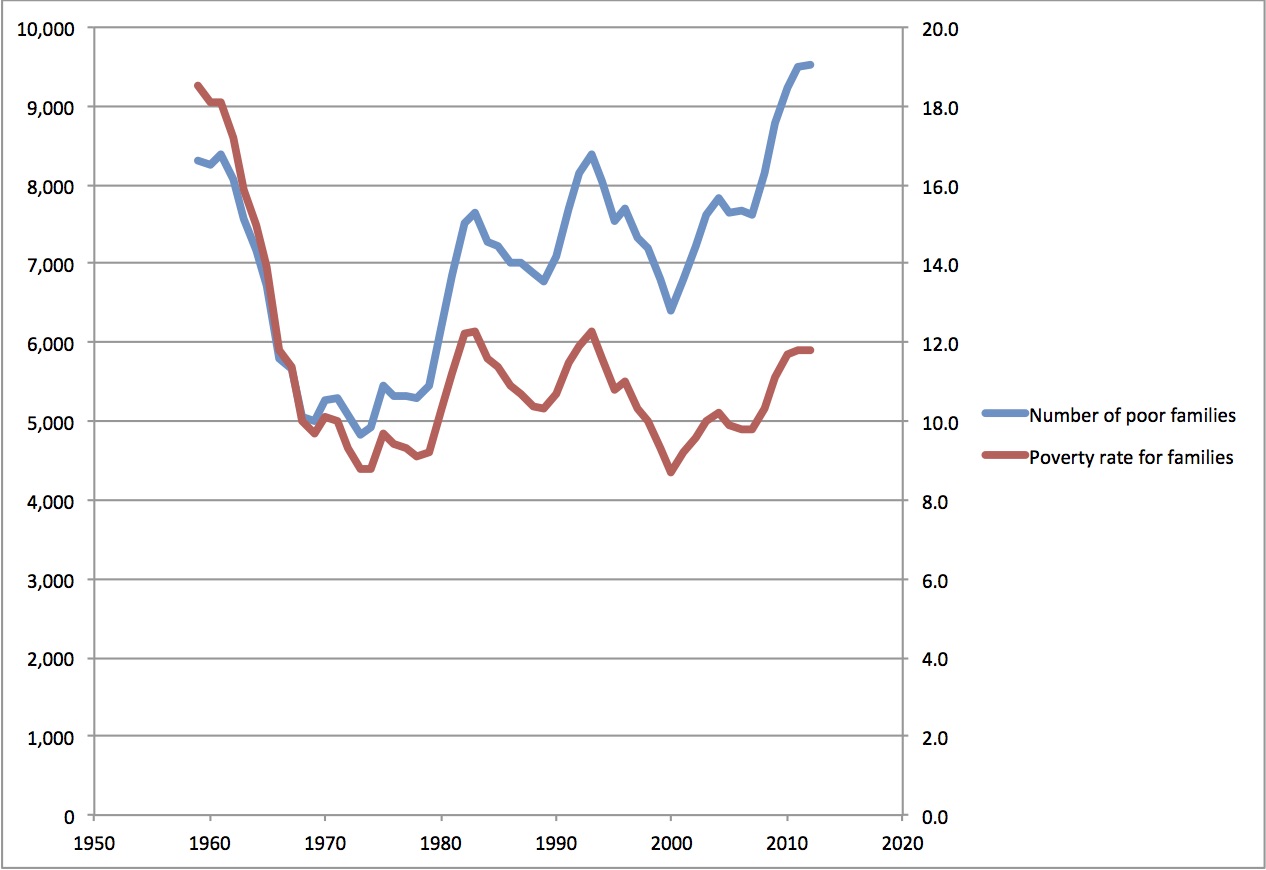
I made this observation in comments on a Crooked Timber post, and got some pushback, so I thought I’d take a look back at the data

US Households in Poverty, 1959-2013

Both the number and the percentage of families in poverty dropped sharply during the 1960s when the “War on Poverty” was being waged actively, and remained near their all-time lows through the Nixon and Carter years until 1979, when the Volcker recession hit, followed by the election of Ronald Reagan. These events can reasonably be said to mark the point at which the government unequivocally changed sides.

The number of households in poverty has risen steadily since then and is now higher than in 1959, the year for which the poverty level was first defined by Mollie Orshansky. The poverty rate has remained consistently higher than in the 1970s, except for a brief deep at the peak of the late-1990s boom.
Read More »

A life expectancy of 95 by 2050? This does not mean what you think it means

Among the scary numbers in the Intergenerational Report was the estimate that, by 2050, life expectancy would have risen to 95/96 years, which would seem to imply a huge increase in the number of years spent in retirement. I checked and found that the report gave current life expectancy as 92/93 years, far higher than the 80 or so that is usually quoted. The reason, it turns out is that the standard estimate is done on a “period” basis, using the age-specific mortality rates of the present. The higher estimate is done on a “cohort” basis, taking account of expected future reductions in mortality. More on this here.

A few observations on this point.

* An increase of four years is neither surprising nor alarming. This is doubtless why this comparison ins not made in the IGR.

* In my last post, I noted the use of the obsolete 15-64 category to estimate the working-age population. One possible defence was that this was done in consistency with past practice. But clearly this can’t apply to the (unannounced) shift from the standard period basis to a cohort basis

* More importantly, the 95-year figure is an estimate of the likely life expectancy of children born in 2050, who would reach retiring age some time after 2115. Even the current birth cohort won’t be of pensionable age until near the end of this century.

A cohort measure of life expectancy is more relevant to projections of future pension expenditure than a period measure, though it requires the use of estimates of future mortality. But the relevant cohorts for the purpose of the IGR are those born before 1983 who will be 67 and over in 2050 and will then (assuming no policy change) be eligible for the age pension.

Who blinked ?

So, the latest round of the Greek debt crisis has ended in a typical European combination of delay and compromise, much as Yanis Varoufakis predicted a week ago. But in view of the obvious incompatibility of the positions put forward, someone must have given a fair bit of ground. The Greeks wanted continued EU support, and an end to the Troika’s austerity program. The Troika (at least as represented by German Finance Minister Schauble) wanted Syriza to abandon its election program and continue with the existing ND/Pasok policy of capitulation to the Troika.

Put that way, I think it’s clear that the Troika blinked. The new agreement allows Syriza to replace the Troika’s austerity program with a set of reforms of its choice, focusing on things like tax evasion. Most of Syriza’s election platform remains intact. Of course, it’s only for four months, and none of the big issues has been resolved. But four months takes us most of the way to the next Spanish election campaign, hardly an opportune time to contemplate expelling a debtor country from the eurozone with utterly unpredictable consequences.

If the negotations were a win for Greece (feel free to disagree!) how did it happen?

Read More »

Tax dodgers project alarming revenue shortfall #Newscorpfail

The Murdoch press is touting a report from Price Waterhouse Coopers, predicting all manner of disaster for Australia if we do not mend our debt ridden ways. A typical example is a projection of $1 trillion in debt by (IIRC) 2037. There’s no link in the stories I’ve read, and nothing obvious on the PwC website, so I’ll make some more general observations.

* It’s startling to read this kind of sermonizing from an outfit like PwC, recently described by the British Parliamentary Public Accounts Committee as ‘promoting tax avoidance on an industrial scale’. If we are facing a fiscal crisis, shutting down firms like PwC seems like an obvious prerequisite to achieving a solution

* Even on the hypothesis that this was in fact a serious effort at assessing our fiscal condition, why would anyone give any credence to one of the accounting firms that gave us the Global Financial Crisis

* The projections are highly implausible, though without access to the report I can’t point to the specific dodgy assumptions used to derive them.

* The same issues are regularly examined by the Commonwealth Treasury in its Intergenerational Report. The 2015 report was legally required to be published on 3 February but has not appeared. Now instead of the IGR, the government’s media arm comes out with this piece of tripe. Was the IGR not alarmist enough for Hockey?

Update My point about the IGR was pure conjecture when I wrote it. But on TV last night I saw Hockey pushing the PwC “report” (still vaporware, AFAICT), even though he is supposedly too busy to fulfil his legal obligation to release the IGR.

Further update Commenters Megan and Liam have dug up a link to a two-page paper from a talk given a few days ago. This in turn links to publications from 2013 and 2014, drawing on estimates published in 2012 which (I imagine) rely on data going back even earlier. The same alarming projections appear, but still without any basis for the calculations. To sum up, this is a total beat-up.

Asset sales and interest rates (wonkish)

One of the most politically effective arguments made for selling publicly owned assets, such as government owned corporations is that, by reducing debt, it will reduce the interest rate on government bonds. This is plausible enough, and not by itself a conclusive argument. The interest saving (including the benefit of lower rates on remaining debt) needs to be set against the loss of earnings. But it would be nice to know how large this saving might be.

The Queensland state election, just passed, provides something of a natural experiment. The LNP government proposed to sell $37 billion in public assets and repay $25 billion in debt ($18 billion associated with the enterprises to be sold, and $7 billion in general government debt). Going in with 73 of 89 seats, the LNP was almost universally expected to be returned. Instead, they lost their majority and will probably lose office. Although the result is not yet final, everyone is now agreed that asset sales are off the table.

So, we should be able to look at the secondary market for QTC bonds to see how much this surprise changed the interest rate demanded by bondholders (this is what’s called an “event study” in the jargon of academic finance). You can get the data from https://www.qtc.qld.gov.au/qtc/public/web/individual-investors/rates/interactive%20rate%20finder/!ut/p/a0/04_Sj9CPykssy0xPLMnMz0vMAfGjzOLdnX2DLZwMHQ383QwtDDy9DUIsPTwDDA2NTPULsh0VAVfZvz4!/

and I’ve included it over the fold (a bit of a mess as I can’t do HTML tables)

The data shows that interest rates have generally been tending downwards, as you would expect given the Reserve Bank’s much-anticipated cut. On the trading day after the election, rates on longer term bonds rose by between 0.05 and 0.1 percentage points (or, in the market jargon 5 and 10 basis) points. But all of that increase, and more, was wiped out the next day when the RBA confirmed its cut. Overall rates on QTC debt have fallen by around 0.25 percentage points since Newman called, and then lost, his snap election.

To sum up, the surprise abandonment of one of the largest proposed asset sales in Australian history caused only a momentary blip in interest rates on Queensland government debt, immediately wiped out by a modest adjustment in monetary policy at the national level.

Read More »