The Coal Cartel ? Why Adani’s prospects haven’t improved

In my recent piece in The Guardian, mostly about Adani, I observed

The paradoxes of Adani are mirrored in the global coal market. Despite a small increase in 2017, global coal production is below its 2013 peak. Yet prices have recovered strongly, yielding big profits to existing miners and offering a seemingly tempting prospect for new mines.

It turns out that this isn’t quite right. The benchmark Newcastle price, for low-ash coal with a heat content of 6000kcal/kg has risen strongly, to the great benefit of companies like Yancoal, Glencore and Whitehaven. It turns out, however, that this increase isn’t representative of the broader market. Prices for lower quality coal with lower heat content and higher ash content haven’t moved at all, with the result that the premium between higher and lower grades has grown dramatically.
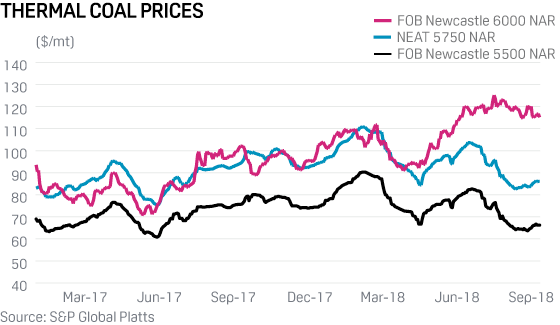
What’s going on here? One possible explanation is that Yancoal and Glencore, who produce the majority of Australia’s high-grade coal, have engaged in successful cartel behavior. Another is that the premium reflects shifts in demand (with China and India increasingly rejecting high ash coal, while Japan continues to demand high grade coal) and supply (few new mines are opening, and this has a bigger effect on the smaller market for high grade coal).

Whatever the explanation, most analysts agree that it is more likely to be resolved by a decline in the price of high-grade coal rather than an increase in the price of low-grade coal.

Where does Adani fit into all this. Most of the discussion I’ve found focuses on the premium between 6000kcal/kg and 5500 kcal/kg. Coal extracted from the Carmichael mine would be much lower quality, below 5000 kcal/kg.

The Business Council thinks the left has no plan? …

… That’s a bit rich

That’s the headline for my latest piece in The Guardian. Final paras

unlike the BCA, its opponents have been willing to specify the measures needed to pay for these desirable outcomes. Eschewing the small target strategy routinely recommended for opposition parties seeking office, Labor has announced a range of revenue measures that would finance a substantial expenditure program, combined with some tax relief for low and middle income households. These include scaling back negative gearing, crackdowns on tax evasion and avoidance, and a restoration of the 2% levy on top incomes.

The Business Council has long been a weak and ineffectual participant in Australian policy debate. If it is to be taken seriously, it needs more than astroturf front groups and websites. The Council needs to take on some of its members, both in relation to their corporate behavior and in their resistance to any tax reform that might cause them any pain. Until then, Jennifer Westacott should be more cautious in asserting that others lack a plan and believe in “fairies at the bottom of the garden

Read More »

The centre cannot hold

Lachlan Harris and Andrew Charlton have a piece in the Fairfax press decrying the collapse of centrism in Australia.

There are some problems with their data. As William Bowe has pointed out, the change in voter attitudes described by Harris and Charlton as “polarisation” looks more like a straighforward increase in support for the left, rising from 19.5 per cent to 31.4 per cent over the period 1996 to 2016. Measures of voter disaffection show no consistent trend over the period except for a sharp uptick in 2016.

Regardless of the data, there’s no reason to dispute the central claim that Australian politics is more polarised than at any time in the past twenty years.

The big problem with the piece, and the besetting sin of centrist analysis, is the near-complete absence of discussion of actual policy. The assumption is simply that whoever is in the middle must be right.
Read More »

Government report cheers for wage cuts

There’s been a lot of discussion recently about stagnation in real wages and the decline of the labour share of national income. In a recent Senate Submission, I made the point that there is nothing surprising about this

For the last 40 years, changes in labour market regulation have been almost uniformly anti-union and anti-worker, while public policy has been premised on the desirability of reducing wages.

I saw an interesting (and, I suspect, largely unconscious) illustration of this in a recent report from the grandly-titled Office of the Chief Economists. Among the many benefits of economic reform, the report cited the following

How does this relate to the wage share? When real wages are growing faster than GDP per person (and assuming a constant employment/population ratio, which is reasonably accurate), the wage share of GDP is rising. When real wages are growing more slowly than GDP per person, as they have done for the past 25 years or so, the wage share is falling. Looking at the beginning and end points we can see that wage growth has been slower than GDP growth over the period as a whole So, we can restate the conclusion as

Under the labour market institutions that prevailed between 1951 and 1981, the labour share of income increased. Since then, thanks to the adoption of market based approaches, workers have lost all the ground that they gained in the postwar decades, and then some.

Economics in Two Lessons, Chapter 5

Thanks to everyone who the first four chapters of my book, Economics in Two Lessons. I’m continuing with policy applications of Lesson 1: Market prices reflect and determine opportunity costs faced by consumers and producers.
That will be followed by Lesson 2: Market prices don’t reflect all the opportunity costs we face as a society.

Now here’s the draft of Chapter 5. Again, I welcome comments, criticism and encouragement.
Read More »

Economics in Two Lessons: Chapter 4

Thanks to everyone who the first three chapters of my book, Economics in Two Lessons. I’ve learned a lot from the comments and made changes in response to some of them. These chapters have been a bit abstract, but now I’m moving on to some applications, which might be more interesting for some readers. Here’s the introduction to Part II

Lesson 1, Part II: Applications

The economic analysis showing how market equilibrium prices reflect the opportunity costs facing producers and consumers is elegant and, for a certain kind of mind, convincing.

For most of us, however, it’s more useful to see how the logic of prices and opportunity costs works in particular cases, sometimes in ways that conflict with strongly held intuitions. This will also give us more insight into the ways in which prices can fail to reflect opportunity costs for society as a whole, some of which we will examine in Lesson 2.
end

Now here’s the draft of Chapter 4:Lesson 1: Applications. Again, I welcome comments, criticism and encouragement.
Read More »