A question that comes up at CT quite a bit is: who has benefited from the massive increase in US income inequality over recent decades. I finally got around to chasing down Congressional Budget Office data (derived from tax records for the period 1979 to 2005), and the answer, in short is:
- The top 1 per cent roughly doubled their share of both pre-tax income (9 per cent to 18 percent) and after-tax income (7.5 per cent to 15 per cent)
- The rest of the top 10 per cent slightly increased their share (from about 20 to about 22 per cent)
- The next 10 per cent held their share (about 15 percent)
- The remaining 80 per cent of households saw their share drop (from 58 per cent to 48 per cent of post-tax income, with the biggest drops coming at the bottom. The bottom 40 per cent of households now get a smaller share of post tax income (14 per cent, down from 19) than the top 1 per cent.
A couple of observations on this.First, to answer the question “who gained from the inequality boom” we need a counterfactual. If, as is commonly claimed, pro-rich policies raised the average rate of growth of income, people in the top 20 per cent of the income distribution were better off, since they had a constant share of a bigger cake. The effects are ambiguous for everyone else, and, on any plausible numbers, everyone below the median is worse off than they would have been with moderately slower, but equitably distributed growth. On the other hand, if pro-rich policies contributed to the slowdown in economic growth for the period since the 1970s, compared to the postwar boom, then the only net beneficiaries are those in the top 1 per cent of the income distribution.
Second, the picture would probably change a bit if benefits (particularly employment-related health benefits) were taken into account. My guess is that this would probably improve the outcome for the top quintile (since this group mostly held on to benefits which increased faster than wages) and worsen it for those below the median (who have lost access to benefits over time).
Finally, it’s striking that, on the CBO figures, the tax system is almost exactly proportional: that is, it has no net redistributive effect at all. The top 1 per cent have a somewhat smaller share of post-tax income than of (measured) pre-tax income, but that almost certainly reflects their capacity to hide income from the tax system.
Category: Economics – General
Cover design for the living dead
The choice of cover design for a book is always a tricky process, at least for authors like me who are more comfortable with text than images. A while back Eszter at CT dealt with the problem by crowdsourcing the cover for her book Research Confidential.
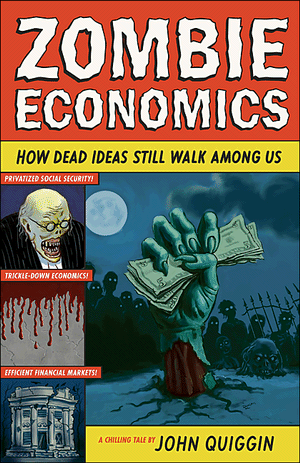
I got lots of input from readers here on the text and title of Zombie Economics, but I left the cover design to the professionals, and I’m glad I did. Here’s the cover, based on a horror comic and here,at the Princeton University Press blog, is a discussion of how it came about.
There was one anxious moment when we discovered that the design included a reference to a chapter (on central bank independence) that I’d deleted at a late stage in the process. But the designer came up with a clever tweak that changed the reference (to refer to financial markets) without affecting the impact of the design.
This is the first book I’ve done since I took up blogging (I use to say blogs kill books, but this book grew out of the blog) and the process has left me with renewed respect for the range of skills that are involved in turning an idea and a rough draft into a book.
Support John Abraham
Potty peer Christopher Monckton has stepped up his campaign to shut down John Abraham’s debunking of one of his talks last year, by asking supporters to flood Abraham’s university with emails demanding it start a disciplinary inquiry.
I can only endorse this comment on Monckton and the lunacy of a world in which someone like this is taken seriously.
Update I thought Posterous would include the link automagically but apparently not. Here’s Garth Renowden’s site where you can support Abraham and/or bag Monckton.
Economists and climate change
Ross Gittins repeats the criticism he, Ken Henry and Martin Parkinson, have put forward previously, that economists were either missing in action or actively unhelpful in the climate change debate. I disagree – I think academic economists as a group look a lot better on this issue than do economic columnists, and (on the limited available evidence) at least as good as public servants.
The crisis of 2011? — Crooked Timber
I’ve been too absorbed by my book projects and by Australian politics (of which more soon) to pay a lot of attention to the forthcoming US elections, but it seems to be widely projected that the Republicans could regain control of the House of Representatives. What surprises me is that no-one has drawn the obvious inference as to what will follow, namely a shutdown of the US government.
It seems obvious to me that a shutdown will happen – the Republicans of today are both more extreme and more disciplined than last time they were in a position to shut down the government, and they did it then. And they hate Obama at least as much now as they hated Clinton in 1995 (maybe not quite as much as they hated him by 2000, but they are getting there faster this time).The obvious question is how a shutdown will be resolved. It seems to me that it will be a lot harder for Obama to induce the Republicans to back down than it was for Clinton. IIRC, no piece of legislation proposed by Obama has received more than a handful of votes in the House, and (unlike the case with Bob Dole in 1995) no aspiring Republican presidential candidate will have an interest in resolving the problem – the base would be furious. On the other hand, the price
Obama would have to pay if he capitulatedthe Republicans would demand from Obama in a capitulation would be huge, certainly enough to end his presidency at one term. So, I anticipate a lengthy shutdown, and some desperate expedients to keep things running.As far as I can tell, there is no mechanism for resolving this kind of deadlock – the House can’t be dissolved early as would happen in a parliamentary system. I think the Founders probably envisaged the House as having a “power of the purse” comparable to that of the British Commons. Whether they did or not, I’m sure this argument will be made, probably by people who have argued, until very recently, that the power of the Executive is essentially unlimited.
But, my understanding is limited and I’d be keen to hear what others think about this.
[1] I’ve tried to clarify my point about capitulation, which was poorly expressed the first time.
The crisis of 2011? — Crooked Timber
I’m not a big fan of Obama either, but Bob McManus’s ipse dixit about what would happen strikes me as wildly eccentric. But at any rate, it seems to me that in any showdown Obama is bound to win. The Republicans don’t have a party leader, as Obama is the de facto leader of the Democrats. And nobody can get more media attention than the President of the United States. So in terms of “messaging,” Obama easily comes out ahead; he will win any public relations war. Also, keep in mind that Republicans in Congress now take pride in being—- and more importantly, are publicly identified as—- the Party of No (forgive the shopworn phrase). The Republican base sees this as good; Democrats see it as bad; and the rest of public is mostly somewhere in between. But the point is that they are publicly identified as reflexively obstructionist. If a shutdown comes, then, the Republicans will naturally be seen as the cause, rather than Obama.
Those are my two cents, but the only special insight I have is American citizenship, nothing more.
How Obama caused the recession — Crooked Timber
The idea that Obama (or rather, the wisdom of crowds in anticipating the election of a socialist-Islamist Obama administration) caused the recession is getting another run, this time from Nobel[1] prizewinner Ed Prescott. I haven’t been able to track down more than a precis of Prescott’s argument, but I assume it’s similar to the version put forward by Casey Mulligan. I had a go at this in my Zombie economics book [2], and here on CT, so, I thought I would link to it here, to give a bit of context to the current flap.
[1] Yes, yes, I know about the Sverige Riksbank. And winners of the economics prize aren’t the only ones to say silly things later on.
[2] Still on track for Halloween, and already taking pre-orders! Join the Facebook group here.
What I wrote on Budget day: International
My response to the Budget’s international outlook
Some thoughts on Resource Rent Tax (updated)
I’m going to be in the Budget lockup tomorrow, so I probably won’t be posting much after this. So, rather than polish it up, I’m going to bang out some thoughts on the Resource Rent Tax proposal, the main element of the Henry Review adopted by the government. The shorter version: the Tax is a good idea, and the criticisms we have seen are what you would expect from rent-seekers seeking to protect their rents.
The central arguments in favor of the RRT proposal are intertwined, and I’ll try to put them together in coherent way
* The basic efficiency argument: Since mineral deposits yield super-normal profits to those who have the right to exploit them, a tax on those profits will not lead to less investment – the profit will still be enough to induce investment
* The economic equity argument. Compared to almost any other tax we could impose, the burden of the RRT falls least on low-income Australians and most on high-income investors, many of whom are foreigners
* The legal equity argument. In Australia, mineral resources are, and always have been, owned by the state, representing all Australians, and not by individuals. So we should seek to maximize the return on our own assets.
* The political economy argument. Ever since I can remember, and probably before that, mining companies have been threatening to pack their bags and go overseas. They’ve made these threats when they were upset about tax policy, about environmental restrictions, about Aboriginal land rights, about union wage demands and work practices and when they were in a bad mood for no particular reason. But, even though lots of Australian industries have disappeared, or contracted drastically for a range of reasons, the miners are still here. The reason is obvious. They can leave, but they can’t take the minerals with them. It’s precisely this immobility that underlies the case for RRT
Read More »
The Oregon Petition: A case study in agnotology
One problem with the recent discussion of epistemic closure (or, in my preferred terminology) agnotology ( (that is, the manufacture and maintenance of ignorance) on the US[1] political right is that a lot of it has been discussed in fairly abstract terms. However, there is a fair bit of agreement that climate change is both a key example, and that the rightwing construction of a counternarrative to mainstream science on this issue marks both an important example, and a major step in the journey towards a completely closed parallel universe of discourse.
Climate change as a whole is too big and complicated to be useful in understanding what is going on, so it is useful to focus on one particular example, which does not require any special knowledge of climate science or statistics. The Oregon Petition, commonly quoted as showing that “31000 scientists reject global warming” not only fits the bill perfectly but was raised by Jim Manzi in his critique of Mark Levin.
So, it provides a useful test case for understanding the agnotology of the right.
 John Quiggin