Adventures with Deep Research

How my AI report on housework started well, then went off the rails

I’ve long been interested in the topic of housework, as you can see from this Crooked Timber post, which produced a long and unusually productive discussion thread [fn1]. The issue came up again in relation to the prospects for humanoid robots. It’s also at the edge of bunch of debates going on (mostly on Substack) about living standards and birth rates.

I’m also interested (like nearly everyone, one way or another) in “Artificial Intelligence” (scare quotes intentional). My current position is, broadly, that it’s what Google should have become instead of being steadily enshittified in the pursuit of advertising dollars. But I’m alert to other possibilities, including that more investment will deliver something that genuinely justifies the name AI. And I think a lot of the concerns about power and water use, the spread of AI slop and so on are either overstated or (as with deepfakes) are mostly new iterations of concerns that always arise with new IT and communications technology, and can be addressed with existing conceptual and legal tools.

With this background, I thought it would be interesting to try out ChatGPTs Deep Research (DR) on the question of what has happened to housework and why. As I may have mentioned before, I’ve trained DR on a big volume of my own writing. That produces a passable imitation of my style, and means I don’t worry about the ethical issues of plagiarising the writing style of others (of course, standard norms of citation and attribution still apply).

I decided to focus on single-person households, to abstract away from the issues of child-raising (which I want to look at separately) and the allocation of work between partners (about which there is a vast literature to which I can’t add anything new).

Everything went really well to start with. I prompted DR for time use data, then pushed further on with more detailed questions like the impact of air fryers on male cooking habits (I was given one recently and was impressed enough that I promptly bought a second). I asked for a literature search and got references to Judy Wajcman and Michael Bittman, both of whom I knew and a couple of people I didn’t. DR missed Ruth Schwartz Cowan’s classic More Work for Mother.

On the other hand, I wasn’t aware of Wajcman’s recent Pressed for Time and hadn’t thought about the broader issue of life administration, which DR pointed out. I gave it a more economistic take, trying to divide labour-saving innovation (electronic bill paying) from the labour costs of more digital consumption (retrieving passwords for streaming services etc).

I got DR to produce a LaTeX file, and was nearly ready to go to digital press when I noticed that the references were incomplete. At this stage, the whole process spiralled into disaster. Every draft seemed to lose more material, and to be worse written. Finally, I demanded an explanation\

Source: Enkiai. com

DR graciously explained that this is the way it does things. Here’s its response with original formatting (more detailed version here)


Why Deep Research Fails

The core issue: The “illusion of continuity” in long-context LLMs

Large-context models appear to preserve every part of the conversation, but in reality:

They do not reliably retain or retrieve long-form outputs they themselves generated.

Even though the conversation window may be large, the model often cannot:

  • accurately locate the version you consider the “full text,”
  • reliably differentiate between multiple drafts (short, medium, long) created earlier,
  • or accurately regenerate from earlier output unless it is verbatim re-supplied by the user.

This is because the internal contextual representation compresses earlier tokens. Information is not stored sequentially; it is represented in a latent space, which cannot always reconstruct past outputs faithfully.


Fortunately, my LaTeX program took continuous backups, so I’ve been able to retrieve the last good version, but I’m going to keep it away from DR for now.

I was going to go on with more detail about the actual report, but my op-ed training leads me to feel that a post should have 700 words, and I am at 675 as I type this. 

fn1. I can take a victory lap on my jihad/crusade against ironing, which has disappeared almost entirely, contradicting the expectations of many commenters.

Will fewer kids mean fewer scientists

I’ve been seeing more and more alarmism about the idea that, on current demographic trends, the world’s population might shrink to a billion in a century or two. That distant prospect is producing lots of advocacy for policies to increase birth rates right now.

One of the big claims is that a smaller population will reduce the rate of scientific progress I’ve criticised this in the past, pointing out that billions of young people today, particularly girls, don’t get the education they need to have any serious chance of realising their potential. But it seems as if I need to repeat myself, so I will do so, trying a slightly different tack

It’s surprisingly difficult to get an estimate of the number of researchers in the world, but Google scholar gives us a rough idea. Google Scholar indexes research across all academic disciplines, including social sciences and humanities. No exact count is available, but I’ve seen an estimate that 1.5 million people have Google scholar profiles. I’d guess that this would account for at least half of all active researchers, for a total of 3 million.

www.isaaa.org Licensed underBY-NC-ND

Read More »

Musk’s last grift

The US is one big grift these days: the Trump Administration, traditional and social media, corporations, crypto, financial markets are all selling some kind of spurious promise. It’s hard to pick the most egregious example. But for me, it’s hard to go past Tesla. Having lost its dominant position in the electric car market, the company ought to be on the edge of delisting. Instead, its current market capitalisation is $US1.33 trillion ($A 2 trillion). Shareholders have just agreed on an incentive deal with Elon Musk, premised on the claim that he can take that number to $8.5 trillion.

Having failed with the Cybertruck and robotaxis, Tesla’s value depends almost entirely on the projected success of the Optimus humanoid robot. There’s a strong case that Optimus will be outperformed by rivals like Unitree But the bigger question is: why build a humanoid robot at all?

Read More »

Armistice Day

107 years ago*, the guns fell silent on the Western Front, marking a temporary and partial end to the Great War which began in 1914, and has continued, in one form or another, ever since. I once hoped that I would live to see a peaceful world, but that hope has faded away.

  • fixed my arithmetic error, noted by several readers – I seem to be getting worse at this. Also, the date is 11/11 in Australia, where I’m writing.

What are “rusted-on” Labor voters thinking ?

And will they stay loyal?

When I first started following politics, in the dying days of the McMahon LNP government, most people voted consistently for one or other of the two major parties, Labor and Liberal/Country. The only important exception, the DLP, was just about to disappear. At that time, the common view was that consistent party voters were acting out of habit or class/cultural identity, while “swinging” voters made a considered choice, based on policies, candidates and so on. Since both major parties got close to 50 per cent most of the time, appealing to these swinging voters was seen as the crucial task.

Once political scientists started looking however, they found out that swinging voters were typically the least engaged group, paying little attention to politics or policies and making late choices based on frivolous issues or just “vibes”. The lesson drawn by party “hardheads” (a term I routinely deride) was that the best strategy was to off attractive goodies that would tempt these voters. A better response, though, was to convert consistent voters from the other side. Labor managed more or less the opposite of that with the 1956 split, losing supporters to the DLP who mostly ended up voting Liberal when the hope of (re)gaining control of the ALP was abandoned.

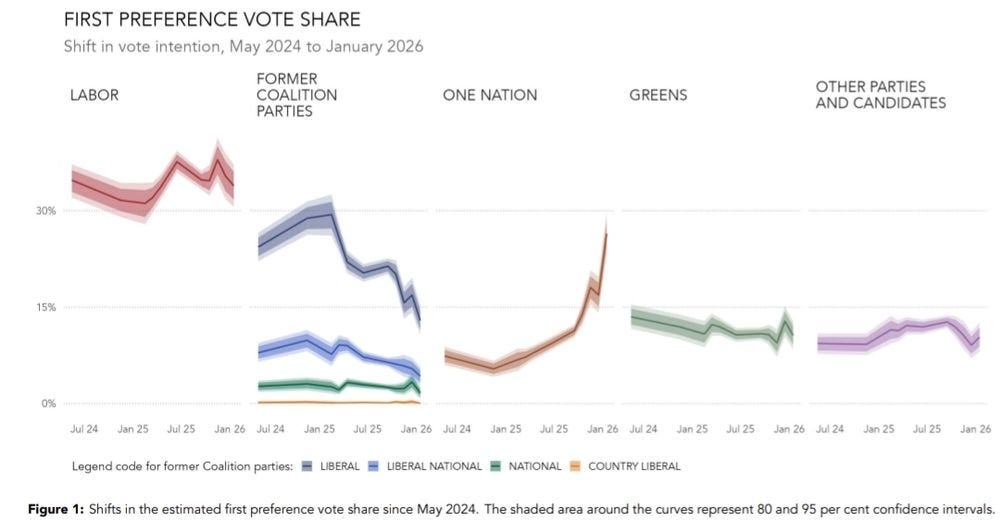
That was then. Now with the combined vote of the majors down to 60 per cent in the latest Newspoll, the dissident 40 per cent is very different from the swinging voters of yesteryear. But what about the “rusted-ons”? It looks as though the LNP has just about lost its core base, going either to One Nation and other far-right parties or to centrist independents. But Labor still gets the support of more than 30 per cent of voters nearly all the time (the low point, I think, was 25.5 for the utter trainwreck of NSW Labor in 2011).

What are they thinking about and will they keep thinking the same way? Thinking about why someone might choose to vote Labor consistently, there are a few possibilities.

First, there are voters for whom Labor’s policies have been and remain closer to their own preferences than any other option (LNP, Greens, independents). Given Labor’s shift to the right on most issues, that would include voters who were always on Labor’s right flank. Another group would be voters focused on the relatively few issues, such as union rights, where Labor has sustained a relatively strong position, along with a historical record. But it’s hard to see this group as being very large.

Next there are those for whom voting Labor is a matter of personal/cultural identity, similar to cheering for (to pick an example not exactly at random) South Sydney in the NRL. No one backs the Rabbitohs because they approve of the current coach’s preferred style of play, and very few because they like particular players. It’s just something you are born with, or pick up along the way. To the extent that this is a view formed by growing up a traditionally working class environment where voting Labor is taken for granted, it’s eroding over time.

Third are those who don’t consider any alternative to voting for a major party. In large measure this reflects misunderstandings about the nature of preferential voting, misconceptions shared by a surprising number of political commentators and very much encouraged by Labor. In 2022, for example, Labor ran with the (totally false) claim “voting 1 for Labor is the only way to get rid of Morrison”.

A variation, relevant with a large crossbench, is a belief that minority governments are problematic and unstable. This remains the default position of the commentariat, who have built their careers in a two-party system, and don’t know how to handle anything else. But as minority governments become more common, and function fairly effectively, this belief can’t be sustained indefinitely.

As I’ve argued in previous posts, Labor’s positioning on the centre-right makes it the natural party of government as long as the main opposition comes from a fragmented right and centre right. In the short medium term (say the next 5-10 years), this is a “hardhead” strategy. But it has already alienated most people who actually care about positive policy outcomes, and is making Labor identity more and more difficult to sustain. Sooner or later, Labor’s base will contract to a point where it can no longer sustain the idea of a binary choice. At that point, the party will have little left to offer to anyone.

Labor as the party of resistance: A historical role reversal

As I said last time, Anthony Albanese has succeeded in making Labor the natural party of government in Australia, relegating the rightwing opposition to the role of “B team” and marginalizing the Greens and progressive independents. The cost has been the abandonment of Labor’s historic role as the “party of initiative”, pushing against the conservative “party of resistance”. Indeed, the reverse is now closer to the truth

The characterisation of Labor as the party of initiative goes back to WK Hancock’s 1930 classic Australia (though he used the phrase “party of movement”) and was broadly accurate both as a description of his own time (when the Labor party was only 40 years old) and for nearly a century afterwards. Hancock wrote at a bleak time for Labor. Having achieved many of its early goals, such as union recognition, workers compensation and the expansion of public enterprise, Labor had split bitterly over conscription in the Great War of 1914-18 and was in the process of splitting again over policy responses to the Great Depression.

But these setbacks proved temporary. The Curtin-Chifley and Whitlam governments were responsible for most of the policy innovations of the post-1945 era. Curtin and Chifley secured legislative independence by adopting the Statute of Westminster in 1942 introduced uniform federal income tax upheld by the High Court’s First Uniform Tax case in July 1942,expanded social security and launched a mass immigration program under Calwell that reshaped the population, Labor founded key institutions including the ANU, national airlines and research bodies), and capped the program with the Snowy Mountains Hydro-Electric Scheme in 1949.

Most importantly, Labor committed the Commonwealth to full employment in the 1945 White Paper on Full Employment. The central role of the national government in ensuring full employment legitimised a wide range of interventions in the economy.

Even in opposition from 1949 to 1972 , Labor continued to set the policy agenda. With limited exceptions, the Menzies and his successors preserved\ the foundations laid by Curtin and Chifley, and responded, grudgingly, to pressure from Labor and its intellectual allies

The high point of Labor as the party of initiative came after Whitlam’s election victory 1972. In his first few weeks in office, Whitlam did more than we have seen in the lifetime of the current government: including ending conscription, withdrawing Australian troops from Vietnam, and abolishing tertiary education fees. His government established Medibank (the precursor to Medicare), introduced the Racial Discrimination Act that finally ended the White Australia policy, created legal aid, established land rights for Indigenous Australians, introduced no-fault divorce, legislated equal pay for women, and dramatically expanded federal funding for schools and universities. The Fraser conservative government managed to wind back some of these measures (Medicare was almost eliminated, for example) but not many.

The Hawke-Keating government, gaining office as the neo-liberal counter-revolution become dominant, reversed the work of previous Labor governments in some areas, such as privatisation and deregulation Butit carried on the progressive agend in other areas, including the establishment of Medicare on a permanent footing, the extension of superannuation to the entire workforce, and reconciliation with indigenous Australian. Whatever the direction of movement, there was no doubt that Labor continued to see itself as the party of initiative. Nearly thirty years after its defeat, the Hawke-Keating era is still seen by many as the classic period of reforming government.

Even during the chaotic Rudd-Gillard years (2007-2013), Labor achieved transformative reforms Rudd’s achievements were both symbolic (the National Apology to the Stolen Generations) and practical (the GFC stimulus and the National Broadband Network). Gillard’s government introduced the National Disability Insurance Scheme, perhaps Labor’s greatest social reform since Medicare. legislated carbon pricing, implemented the Gonski education funding reforms, established Australia’s first paid parental leave scheme, introduced plain packaging for cigarettes, and launched the royal commission into institutional child abuse.

In opposition after the disastrous defeat of 2013, Labor continued to drive the policy debate. Bill Shorten’s campaigns in 2016 and 2019 offered substantive progressive platforms. His proposals to reform negative gearing and franking credits directly addressed housing affordability and tax fairness, threatening entrenched interests. He campaigned on ambitious climate targets and a genuine transition to renewable energy. His tax reform agenda sought to make Australia’s system more progressive and equitable.

Labor drew the lesson that bold reform loses elections. But this conclusion reflected a fundamental misreading of Shorten’s defeats. His policies were economically sound and addressed real problems. The narrow loss stemmed from Shorten’s personal unpopularity, poor campaign execution, and Queensland’s particular hostility to change, exacerbated by the disastrous intervention of Bob Brown’s Stop Adani convoy (has there even been a “convoy” protest that’s been other than counterproductive?). The fact that all the polls herded together with a prediction of a narrow win increased the shock of arising from a narrow less. The tragedy is that Labor abandoned policy ambition altogether rather than ditching a few unpopular policies and trying again..

The personal role of Anthony Albanese was crucial here and remains central to our understanding of the issues. Even before the 2019 election, Albanese was positioning himself as the rightwing alternative to Shorten. His factional history as the leader of the NSW “Hard Left” in the 1990s gave him the cover he needed here.His [dominance over Labor’s factions](https://theconversation.com/albaneses-small-target-strategy-may-give-labor-a-remarkable-victory-or-yet-more-heartbreak-166752) reflects this calculation: the Left has been neutered by their own leader’s rightward stance, while the Right has been co-opted by a leader who governs like them while retaining Left credentials. A different leader, like Jim Chalmers, might do a bit more, but that remains to be seen.

Labor’s record in office since 2022 speaks for itself, or rather, its silence speaks volumes. With a handful of exceptions, the Albanese government has done little more than implement, with tweaks the appallingly bad policies inherited from nine years of LNP government, several of which were yet to be implemented when Labor took office. Labor’s defence policy is centred on Morrison’s AUKUS agreement, its tax policy a slightly modified version of Morrison’s three-stage program, its climate policy a modification of Abbott’s Safeguard Mechanism, its higher education policy the consolidation of Tehan’s appalling “Job Ready Graduates” system.

The thin record of Labor’s own policies is also instructive. Before the 2022 election, the promises that most excited its supporters were the Housing Australia Future Fund (HAFF), the National Anti-Corruption Commission and the Voice to Parliament, a revived and reformed ATSIC which would be entrenched in the Constitution. HAFF was, and remains, a jury-rigged mess, yet to construct a single house. The NACC has been notable only for its own scandals.

The Voice referendum, always facing long odds, was doomed by Albanese’s refusal to explain how it would work (the infamous “details”). The reason, I believe, was that Albanese was unwilling to admit that it would fill much the same role as ATSIC, and would face the same rightwing attacks, as indeed it did.

On the original “three-term” theory put forward by Albanese’s advocates, the caution of the first term in office was supposed to cement Labor’s hold on office, laying the ground for transformative change in the second and third terms. The 2025 election did more than cement Labor’s position, it buried the opposition under thick layers of concrete. But the glacial pace of reform seen in the first time has now frozen into solid immobility. Even broadly popular proposals like a ban on gambling ads have been forgotten.

And even where action can’t be avoided, Labor is still deferring to the LNP. Rather than reach an agreement with the Greens, correctly recognised as Labor’s true enemy, the preferred approach for legisation is to reach a “bipartisan” agreement with the LNP. From an initially centrist position, the result is a centre-right legislative program.

Nothing lasts forever. As Wayne Swan recently conceded, Labor’s win in 2025 was “wide but shallow”. Not only was the primary vote low, but enthusiasm among its supporters has dwindled to nothing. Swan’s closing reference to the need for Labor to mobilise “Activists, organisers and agitators who are active and more engaged with their local communities” is an implicit concession that activists and organisers no longer see the Labor party as a vehicle for positive change. https://www.smh.com.au/politics/federal/albanese-s-election-win-wide-but-shallow-labor-president-s-frank-admission-20250921-p5mwqh.html

Returning to Hancock’s characterisation of Australian politics, Labor is now, above all, the party of resistance, fighting off both the populist right and its former activist base, now to be found with the Greens and community independents. The parties of resistance have held office most of the time since Australian federation, but their adherents can point to little in their history of which they can be particularly proud.

A couple of notes on this piece

1. Back in the paleolithic era of blogging (circa 2003), I used to call Tim Dunlop my “blogtwin” since he and I regularly posted similar ideas. That’s continued into the Substack era, as you can see in this excellent piece

Labor as the party of resistance2. I’ve experimented with  Genspark AI in preparing this piece. I first set up an agent trained on my own work to write in an approximation of my own style. Then I told it to write a draft – this part of the package appears to be a front end to OpenAI’s Deep Research. The “John Quiggin agent” did an OK job, better than most of the political commentariat, but I didn’t use much of what it produced. OTOH, I got some useful lists of policy actions and some links I hadn’t seen.

The natural party of government

Labor looks like becoming the “natural party of government”, but in doing so, it is abandoning its traditional role as the party of initiative. In this post, I’ll discuss the first of these points

Labor as the natural party of government

Prediction in politics is always tricky, but it seems fair to say that Anthony Albanese is well on the way to realising his stated goal of making Labor the “natural party of government” in Australia. Assuming a continuation of the current party system, that leaves the LNP as a party of protest, the B-team which is elected only when Labor has been in too long, or stumbles really badly.

Indeed, this has arguably been the case for some time at the state level. The LNP has been out of office almost continuously since 2000 in Queensland, South Australia,Victoria, and the ACT. It took the truly spectacular corruption and incompetence of NSW Labor to give the LNP three terms there. In WA, they managed two terms on the back of Alan Carpenter’s bizarre decision to readmit allies of the notorious Brian Burke to the ministry.

Federally, however, the Liberals have been competitive until recently. Although it never seemed likely that they could win a majority at the 2025 election, a minority LNP government seemed possible until quite near election day. The disastrous outcome reflected two main factors. First, having campaigned against Albanese’s Voice referendum on the content-free but almost invariably successful slogan “If you don’t know, vote NO’, the LNP convinced themselves they had tapped the support of a silent majority of anti-woke Australians. Then, the horrific advent of the Trump regime made support for Trumpist policies untenable, a fact that was only realised too late.

But the result has only reinforced the shift that was already underway from rightwing neoliberalism to Trumpism. Neoliberalism in the Liberal Party was represented almost entirely by representatives of and candidates for metropolitan seats, nearly all of which have been lost to Labor and independent candidates. The result is a party whose members typical voters increasingly resemble those of One Nation – aggrieved low education voters from peri-urban and regional Australia. Having gained control of the party, it seems unlikely that they will hand it back to the urban upper-middle class that previously dominated it. That leaves the Liberals and Nationals fighting with One Nation and other rightwing parties for perhaps 40 per cent of the electorate.

Labor hasn’t gained the support of the remaining 60 per cent, but it doesn’t need to. The distance between the Greens (and, to a lesser extent, progressive independents) on one side and LNP/ONP on the other is such that Labor will usually get second preferences from both. So Labor will win unless its candidate finishes third in the first preference count or else so far behind that that the inevitable leakage of preferences is enough to produce a majority for the initial leader (or of course, where a non-Labor candidate wins a first-round majority, but that’s rare these days.

In the context of a single-member electorate, the usual outcome is the best reflection of the preferences of voters. If a Labor candidate beats, the LNP on preferences, that’s because a majority of voters preferred Labor to the LNP. And since the LNP candidate’s preferences would also have flowed to Labor, a different majority would have preferred Labor to Greens in a two-candidate race. In the jargon of voting theory, Labor is the Condorcet winner.

The difficulties arise when this outcome is repeated over many electorates. The effect of a single-member system is to magnify majorities, producing parliaments that are quite unrepresentative of the voters.

As we have seen, Labor can win a comfortable House of Representatives majority with 35 per cent first preference support, and could probably form a government even with a vote as low as 30 per cent, and the support of a few independents.

Fortunately for Australian democracy, the Senate is elected on a proportional representation basis, meaning that Labor can’t just push legislation through regardless of the merits. A shift to PR in the House of Representatives would be highly desirable, but it won’t happened until Labor loses its majority and (given that independents depend on localised support) probably not even then.

Paper reactors and paper tigers

From Pearls and Irritations

The culmination of Donald Trump’s state visit to the UK was a press conference at which both American and British leaders waved pieces of paper, containing an agreement that US firms would invest billions of dollars in Britain.

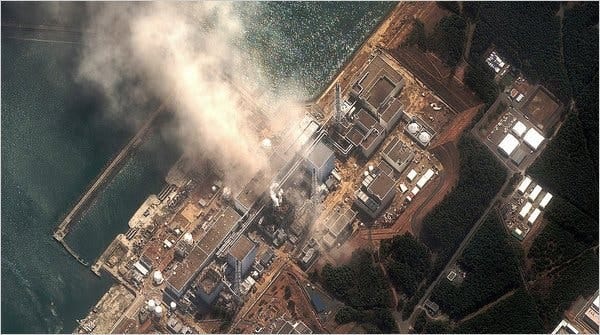
The symbolism was appropriate, since a central element of the proposed investment bonanza was the construction of large numbers of nuclear reactors, of a kind which can appropriately be described as “paper reactors”.

The term was coined by US Admiral Hyman Rickover, who directed the original development of nuclear powered submarines.

Hyman described their characteristics as follows:

1. It is simple.

2. It is small.

3. It is cheap.

4. It is light.

5. It can be built very quickly.

6. It is very flexible in purpose (“omnibus reactor”)

7. Very little development is required. It will use mostly “off-the-shelf” components.

8. The reactor is in the study phase. It is not being built now.

But these characteristics were needed by Starmer and Trump, whose goal was precisely to have a piece of paper to wave at their meeting.

The actual experience of nuclear power in the US and UK has been an extreme illustration of the difficulties Rickover described with “practical” reactors. These are plants distinguished by the following characteristics:

1. It is being built now.

2. It is behind schedule

3. It requires an immense amount of development on apparently trivial items. Corrosion, in particular, is a problem.

4. It is very expensive.

5. It takes a long time to build because of the engineering development problems.

6. It is large.

7. It is heavy.

8. It is complicated.

The most recent examples of nuclear plants in the US and UK are the Vogtle plant in the US (completed in 2024, seven years behind schedule and way over budget) and the Hinkley C in the UK (still under construction, years after consumers were promised that that they would be using its power to roast their Christmas turkeys in 2017). Before that, the VC Summer project in North Carolina was abandoned, writing off billions of dollars in wasted investment.

The disastrous cost overruns and delays of the Hinkley C project have meant that practical reactor designs have lost their appeal. Future plans for large-scale nuclear in the UK are confined to the proposed Sizewell B project, two 1600 MW reactors that will require massive subsidies if anyone can be found to invest in them at all. In the US, despite bipartisan support for nuclear, no serious proposals for large-scale nuclear plants are currently active. Even suggestions to resume work on the half-finished VC Summer plant have gone nowhere.

Hope has therefore turned to Small Modular Reactors. Despite a proliferation of announcements and proposals, this term is poorly understood.

The first point to observe is that SMRs don’t actually exist. Strictly speaking, the description applies to designs like that of NuScale, a company that proposes to build small reactors with an output less than 100 MW (the modules) in a factory, and ship them to a site where they can be installed in whatever number desired. The hope is that the savings from factory construction and flexibility will offset the loss of size economies inherent in a smaller boiler (all power reactors, like thermal power stations, are essentially heat sources to boil water). Nuscale’s plans to build six such reactors in the US state of Utah were abandoned due to cost overruns, but the company is still pursuing deals in Europe.

Most of the designs being sold as SMRs are not like this at all. Rather, they are cut-down versions of existing reactor designs, typically reduced from 1000MW to 300 MW. They are modular only in the sense that all modern reactors (including traditional large reactors) seek to produce components off-site. It is these components, rather than the reactors, that are modular. For clarity, I’ll call these smallish semi-modular reactors (SSMRs). Because of the loss of size economies, SMRs are inevitably more expensive per MW of power than the large designs on which they are based.

Over the last couple of years, the UK Department of Energy has run a competition to select a design for funding. The short-list consisted of four SSMR designs, three from US firms, and one from Rolls-Royce offering a 470MW output. A couple of months before Trump’s visit, Rolls-Royce was announced as the winner. This leaves the US bidders out in the cold.

So, where will the big US investments in SMRs for the UK come from? There have been a “raft” of announcements promising that US firms will build SMRs on a variety of sites without any requirement for subsidy. The most ambitious is from Amazon-owned X-energy, which is suggesting up to a dozen “pebble bed” reactors. The “pebbles” are mixtures of graphite (which moderates the nuclear reaction) and TRISO particles (uranium-235 coated in silicon carbon), and the reactor is cooled by a gas such as nitrogen.

Pebble-bed reactor designs have a long and discouraging history dating back to the 1940s. The first demonstration reactor was built in Germany in the 1960s and ran for 21 years, but German engineering skills weren’t enough to produce a commercially viable design. South Africa started a project in 1994 and persevered until 2010, when the idea was abandoned..Some of the employees went on to join the fledgling X-energy, founded in 2009. As of 2025, the company is seeking regulatory approval for a couple of demonstrator projects in the US.

Meanwhile, China completed a 10MW prototype in 2003 and a 250MW demonstration reactor, called HTR-PM in 2021. Although HTR-PM100 is connected to the grid, it has been an operational failure with availability rates below 25%. A 600MW version has been announced, but construction has apparently not started.

When this development process started in the early 20th century, China’s solar power industry was non-existent. China now has more than 1000 Gigawatts of solar power installed. New installations are running at about 300 GW a year, with an equal volume being produced for export. In this context, the HTR-PM is a mere curiosity.

This contrast deepens the irony of the pieces of paper waved by Trump and Starmer. Like the supposed special relationship between the US and UK, the paper reactors that have supposedly been agreed on are a relic of the past. In the unlikely event that they are built, they will remain a sideshow in an electricity system dominated by wind, solar and battery storage.

Optus’s triple zero debacle is further proof of the failure of the neoliberal experiment

My latest in The Guardian

The Optus triple zero disaster was a classic failure of neoliberal reform. In place of the single emergency call system that worked in the period before privatisation and liberalisation, we now have multiple networks, which are supposed to connect their calls to Telstra. Optus lobbying earlier this year successfully delayed a proposal(introduced in response to an earlier outage in 2023) for real-time information sharing on such outages.

Instead, calls reporting the most recent failure were directed to offshore call centres, where the operators failed to “escalate” them properly. The days-long delays in working out the extent of the problem reflect a corporate culture where triple zero calls are seen as an inconvenient cost burden rather than a vital community service. It’s the same culture that has seen Optus fined heavily for misleading consumers.

But until the recent spate of failures, telecommunications was seen as one of the increasingly rare sectors where privatisation and competition had produced improved outcomes for consumers. During the era of neoliberalism, the cost of telecommunications has plummeted, while the range of services has expanded massively. Whereas an international phone call cost more than a dollar a minute when telecoms were deregulated in the 1990s, they now cost only a cent or two per minute even on those plans that don’t include unlimited calls. As a result, telecommunications is regularly cited as an area where neoliberal reform has been successful.

A closer look at the record tells a different story. Technological progress in telecommunications produced a steady reduction in prices throughout the 20th century, taking place around the world and regardless of the organisational structure. The shift from analog to digital telecommunications accelerated the process. Telecom Australia, the statutory authority that became Telstra, recorded total factor productivity growth rates as high as 10% per year, remaining profitable while steadily reducing prices.

Optus logo on a corporate building. Optus has faced major scrutiny after multiple deaths occurred during the telco’s triple zero outage last week
Optus claimed live updates on triple-zero outages would impose ‘huge burden’ months before outage

But for the advocates of neoliberal microeconomic reform, this wasn’t enough. They hoped, or rather assumed, that competition would produce both better outcomes for consumers and a more efficient rollout of physical infrastructure. Optus was an artificial creation of the reform process. In return for acquiring the publicly owned satellite network Aussat, Optus was given a regulatory head-start of six years, during which it was the only competitor to Telstra.

The failures emerged early. Seeking to cement their positions before the advent of open competition, Telstra and Optus spent billions rolling out fibre-optic cable networks. But rather than seeking to maximise total coverage, the two networks were virtually parallel, a result that is a standard prediction of economic theory. The rollout stopped when the market was fully opened in 1997, leaving parts of urban Australia with two redundant fibre networks and the rest of the country with none.

The next failure came with the rollout of broadband. Under public ownership, this would have been a relatively straightforward matter. But the newly privatised Telstra played hardball, demanding a system that would cement its monopoly position in fixed-line infrastructure. The end result was the need to return to public ownership with the national broadband network, while paying Telstra handsomely for access to ducts and wires that the public had owned until a few years previously.

Meanwhile the hoped-for competition in mobile telephony has failed to emerge. The near-duopoly created in 1991, with Telstra as the dominant player and Optus playing second fiddle, has endured for more than 30 years. The 2020 decision to allow a merger between the remaining serious competitors, TPG and Vodafone, was an effective admission that no more than three firms could survive. Unsurprisingly, prices have increased significantly since then.

And in crucial respects, three will soon become two. Optus and TPG now share their regional networks, a recognition of the fact that telecommunications infrastructure is a natural monopoly, and that the idea of “facilities-based competition” is an absurdity. If we are to have competition, the best model is that of the NBN. That is, a single wholesale “common carrier”, which allows retailers using its network to compete for customers.

But as we’ve learned with privatised electricity distribution businesses, privately owned monopolies are always looking for ways to increase profits at the expense of consumers. Regulation has proved ineffective, a fact that is unsurprising given the massive imbalance of resources between regulators and the companies they oversee.

The likely outcome of the triple zero disaster will be the addition of some new patches in the regulatory quilt and the ritual defenestration of some senior executives. But what we actually need is a reassessment of the whole neoliberal experiment and an acceleration of the return to public ownership of infrastructure that is already under way.

Billion dollar boondoggle

The Tasmania Plannning Commission has recommended against the proposed Hobart AFL stadium, with a relentless demolition of the economic case put forward by the proponents and their consultant KPMG. You can read their report here , or my own earlier analysis below

A couple of observations on this.

First, this would be a huge opportunity for the Tasmanian Labor party to escape from its self-inflicted wounds and achieve a good policy outcome at the same time. A vote against the stadium would create huge problems for Liberal Premier Rockliff. Potentially, it would create a path to a Labor minority government. This would require willing to dump the absurd refusal of former leader Dean Winter (and the troglodytes in the party machine) to “do deals”. It ought to be obvious by now that, Labor will never again win a majority or find Green and independent willing to give them unconditional support.

Second, a point I’ve made before. If KPMG (or PwC Deloittes or Accenture) is willing to put their name to economically illiterate rubbish like the stadium business case, why should anyone believe them about anything?

Read More »