Fifteen years after Fukushima

It’s the 15th anniversary of the Fukushima nuclear disaster, and any lessons from that event seem to have been forgotten by most. Political leaders of all stripes, from centre-left to far right have been keen to promote nuclear power as at least a partial solution to the problem of replacing coal and gas. The peak of enthusiasm was reached at COP 28 when Joe Biden, Emmanuel Macron and Rishi Sunak signed a pledge to triple nuclear power generation by 2050.
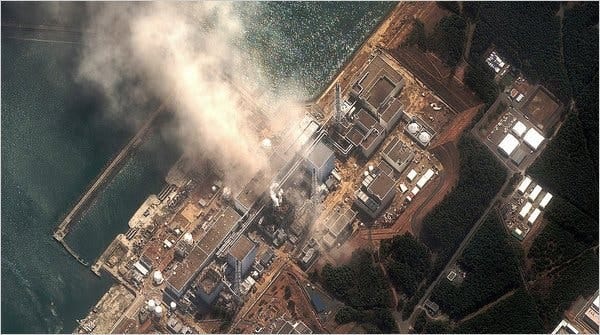
To call this pledge ambitious would be an understatement. No nuclear plant has started in construction (as defined by first nuclear concrete) in Europe or North America since the disastrous Hinkley C project in 2017. And the future is not much better. The UK will presumably go ahead with the Sizewell C project, duplicating Hinkley, but that will only replace retirements of existing plants. In France, sites for six reactors have been identified, but no investment decision has been made. And in the US, even the announced restart of reactors closed as uneconomic in recent years is looking doubtful.

Actually existing nuclear power programs around the world are similarly limited. China has an established industry which starts construction around 10 new plants every year, and typically connects them 5 to 6 years later. Russia builds about one per year, mainly to replace old RMBK (Chernobyl style) plants.

Russia’s nuclear firm Rosatom also has an export business. The typical pattern is a generously financed project, building two to four reactors in a middle-income country that wants the prestige of having nuclear power. South Korea has completed one such project (Barakah in UAE, which took about 15 years) and has a contract for another with the Czech Republic. Because nuclear power is uneconomic even with subsidies, these deals are typically “one and done”. Having shown that they can generate nuclear power, few countries have been willing to strain their budgets for a second vanity project.

The great remaining hope is Small Modular Reactors (SMRs).

This term is commonly used to refer to reactors small enough to be built in a factory and modular in the sense that they can be shipped to a site in the numbers required to meet the power needs of the installation. It is also used more loosely to refer to reactors generating less then 500 MW of electricity, compared to the 1000-1400 MW that have been standard in recent decades.

SMRs of the first kind don’t exist and probably never will. All the early proponents, with one exception have given up. The only surviving firm, Nuscale, had to abandon its initial plan to construct plants in the US because of cost over-runs. A contract has supposedly been signed with Romania, but the Romanian PM sounded distinctly unenthusiastic in a recent interview.

“As I remember it is a fairly big sum, USD6-USD$7 billion and the business plan must also account for how the energy will be consumed. The investment will be made once a funding formula will be found. Given the very large amount of money, the complexity of such projects and the technology being in early days, I estimate we will not see the investment immediately.”

For reference, given a capacity of 462 MW (6 units of 77MW), the implied unit cost is $US13-15 billion per GW or $A20-23 billion. This is well above the much-criticised CSIRO GenCost estimates.

There are quite a few small but non-modular reactors around. Unfortunately most of these are relics from the early days of nuclear power (Gen II in the jargon). There are only two recent prototypes, one in China and one in Russia. Quite a few others have been announced, but they have no real advantage over the larger designs from which they are derived. Even if a handful get built, they are irrelevant to the future of energy.

In summary, nuclear power is a technology of the past. The only routes to a clean energy system are renewables and energy efficiency.

Every child should be wanted

It’s a truism that every child should be wanted. While there are plenty of exceptions, the birth of an unwanted child often turns out badly for both mother and child (and father, if they are present). Sometimes, once a child is born, the fact that they were initially unwanted fades into irrelevance, and the bond between parents and child is as strong as with a planned birth. But this isn’t true on average: children born after their mother was denied an abortion (due to time limits) experience, on average, more poverty and poorer maternal bonding The extreme case is that of Ceausescu’s Romania, where abortions were banned, and the resuling unwanted children received miserable upbringings in orphanages.

The birth of an unwanted child can be an economic as well as a personal catastrophe. This is crucial to understand when we are assessing claims that “the economy” would benefit if families had more children than they currently choose.

Read More »

Coles’ shameless ‘Down Down’ promotions have been exposed. So why aren’t they even trying to rebuild trust?

My latest in The Guardian

Like millions of Australians, I shop at Coles. I’m not as careful as I should be, but I try to buy things advertised as being discounted, or on special. But after following a recent case before the federal court, I’ll be checking my old receipts before accepting such claims. In particular, I’ll be avoiding “Down Down” promotions. On the evidence before the court, such promotions are routinely used as a way of implementing price increases.

The facts of the case are simple and apparently uncontested. One example is particularly striking. Over a period of nearly a year, Coles offered a 1.2kg loaf of Nature’s Gift wet dog food for $4. Then, for seven days, the price rose by 50% to $6. On the eighth day the price was set at $4.50, more than customers had been paying for all but seven of the previous 303 days, with Coles labelling the product “Down Down”.

The only unusual feature of this path to higher prices was the short duration of the large increase. According to Coles’ lawyers, the more common pattern was to raise the price for six to 12 weeks, then partially reverse the increase and advertise “Down Down”. As the evidence regarding deals with Arnott’s makes clear, this strategy is planned in advance as a way of raising prices without upsetting consumers. In their defence, Coles claimed that Woolworths’ “Prices Dropped” program (the subject of a separate ACCC case) was even worse.

More broadly the defence was that consumers were incapable of understanding the many complexities of pricing decisions. But most of us are capable of understanding the idea that taking prices two steps up then moving them one step down still leaves them higher. Whatever the outcome of the court case, it’s hard to believe that Coles will be able to get away with “Down, Down” promotions in future, even if they are genuinely reducing prices.

A shopper looks at items displayed on a shelf at at Coles supermarket in Sydney
Coles tells court its Down Down promotions were ‘fair dinkum’ and did not mislead shoppers

In the long run, then, it seems as if this kind of sharp practice should be self-defeating. The banks, for example, have spent years trying to shake off the bad reputation they built up for hidden fees and charges in the years leading up to the financial services royal commission.

Woolworths and Coles are big companies that plan to stay around for a long time. Could not one or both of them commit to a policy of truthful advertising and stand by it long enough to establish a reputation that customers could trust?

This hasn’t happened – with supermarkets, or telecoms, or banks or anywhere else, at least in the absence of comprehensive public shaming driven by government action. But why not?

One explanation, apparent from the evidence in the Coles case, is that no one wants to be the first to move. Given the short-term pressure that decision-makers are under, it’s easy to imagine that any proposal of this kind will be put in the too-hard basket and left there.

Another possibility is that distrust is so widespread that no single company can break the pattern. The era of neoliberalism has certainly strengthened this distrust. There was a time when used car dealers were famously untrustworthy but financial institutions were pillars of probity. Today, when buying a second-hand car, the biggest risk is not that the speedo will be wound back but that you will be sold a loan with deceptively high interest. In this context, you just assume everyone is lying.

The final, gloomy, hypothesis is that Coles’ lawyers are right, and that we are proving the wisdom of HL Mencken’s observation that “No one in this world, so far as I know … has ever lost money by underestimating the intelligence of the great masses of the plain people” (put more succinctly by PT Barnum as “there’s a sucker born every minute”).

Perhaps we are simply incapable of resisting an apparent bargain, even when we know there’s bound to be a catch. For years, we all fell for the illusion of items priced at $9.99 or similar, rather than the honest price of $10. Partly because of the digital economy, this particular trick seems to have faded away.

But the same digital economy has far nastier tricks in mind for us. The trickery of “Down Down” seems childish compared to the wonders of personalised pricing, where sellers set a price specifically aimed at being the maximum you are willing to pay, and precisely when you are primed to buy. The only solution, it appears, is to build your own AI agents, to trick the company algorithm into seeing you as a desirable customer

Sleepless in Suburbia

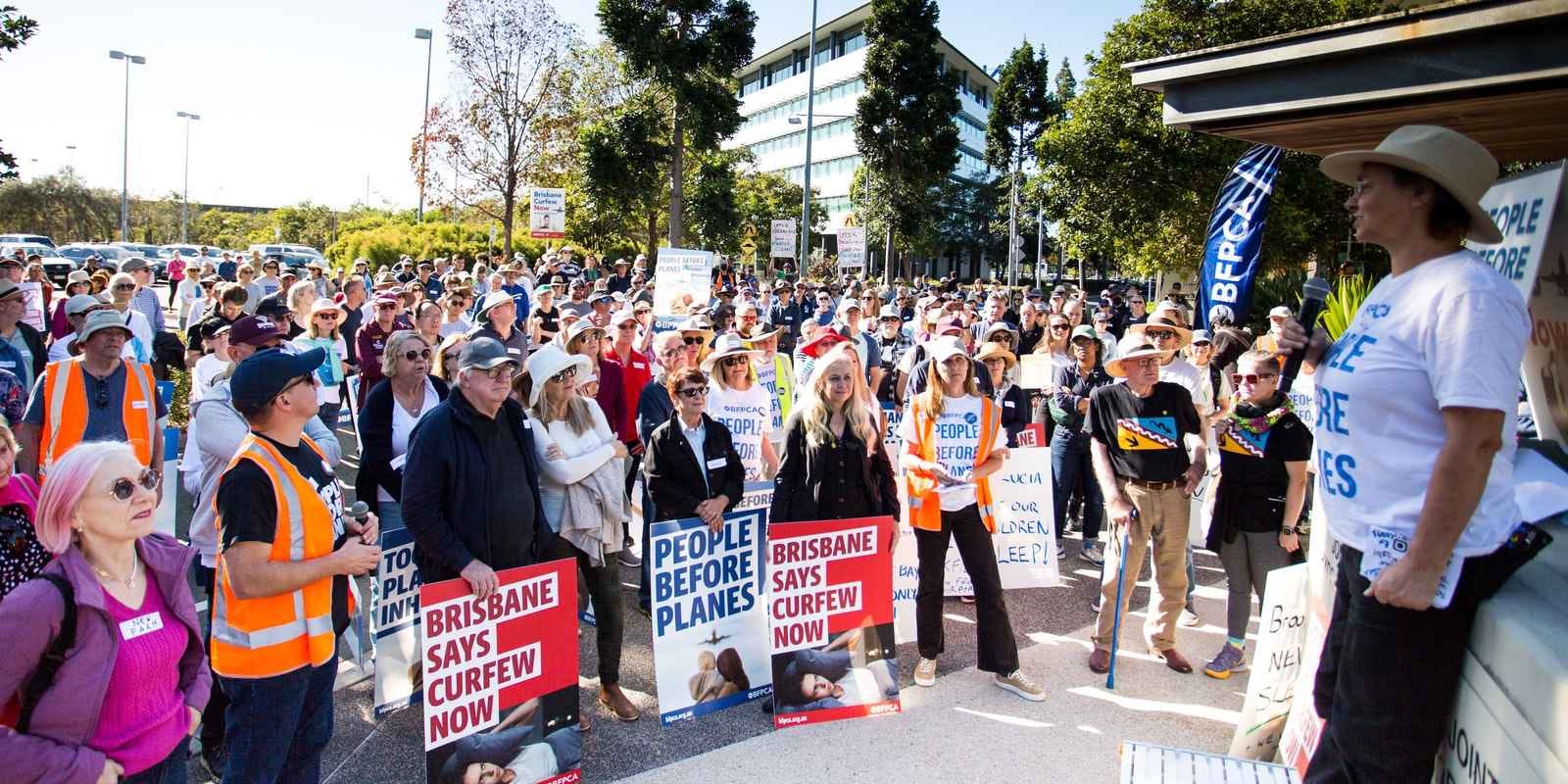
I spoke last week at a meeting organised by the Brisbane Flight Paths Community Association to demand a curfew on planes flying over Brisbane. These are mostly either international flights (subsidised by the state government) to promote tourism) or overnight freight, for which there is a fairly modest convenience benefit

By contrast, the adverse health effects and sleep disruption associated with night-time airport noise have huge costs, running into the billions, whether you estimate these directly or via effects on land values.

Banner image for BFPCA Community Town Hall 2026

Unfortunately, this cuts very little ice with our political class, most of whom are frequent fliers and only a few of whom are among the hundreds of thousands of Brisbane residents affected by noise. Only the Greens have stood on the side of residents, and only when voters desert Labor en masse will they win enough seats to influence policy here.

You can see my report for BFPCA here, and my slides here.

The US state has proved itself dispensable

Not long after Trump took office, I observed that the status of the US as the “indispensable nation” could not be sustained. A year later, the US, considered strictly as a state actor, is already dispensable and has, in fact, been largely dispensed with, by Europe in particular. The standing ovation given to Rubio in Munich recently (made almost unavoidable when his retinue jumped to their feet in Stalinesque fashion) should not obscure the fact that almost no one interpreted it as anything more than a politer restatement of Vance’s tirade a year ago. At that time, Europe needed to keep Trump on-side to prevent a sudden collapse in support for Ukraine and to avoid an all-out trade war.

None of that is particularly relevant now. Europe (include Ukraine) has held Russia to a standstill for a year despite the complete cessation of US military aid. The US is still relevant as an arms exporter and as a patchy supporter of sanctions against Russia, but that’s about it. Trump has turned his attention to his desire to rule the Americas from Nunavut to Tierra del Fuego, as well as returning to the forever wars of the Middle East.

Headstone with Flag - Free Stock Photo by Katharine Sparrow on  Stockvault.net

Read More »

Liberals polling in single digits: as the right splinters, it’s a real possibility

One of the strangest features of the Australian political system over the last 80 years or so has been the permanent coalition between the Liberal and National (formerly Country) parties. It sometimes puzzles foreigners – I remember an American observer saying that the prevalence of coalition governments here was an indicator or political instability. And it takes different forms in different places. At the national level, until two weeks ago, there was a standing coalition agreement even when in opposition (this dates back to the 1970s, I think). There’s a similar arrangement in NSW and Victoria, but in WA the two parties operate independently. At the other extreme are merged parties – the LNP in Queensland [1] and the CLP in the NT. In SA, Tasmania and the ACT there’s no separate country party.

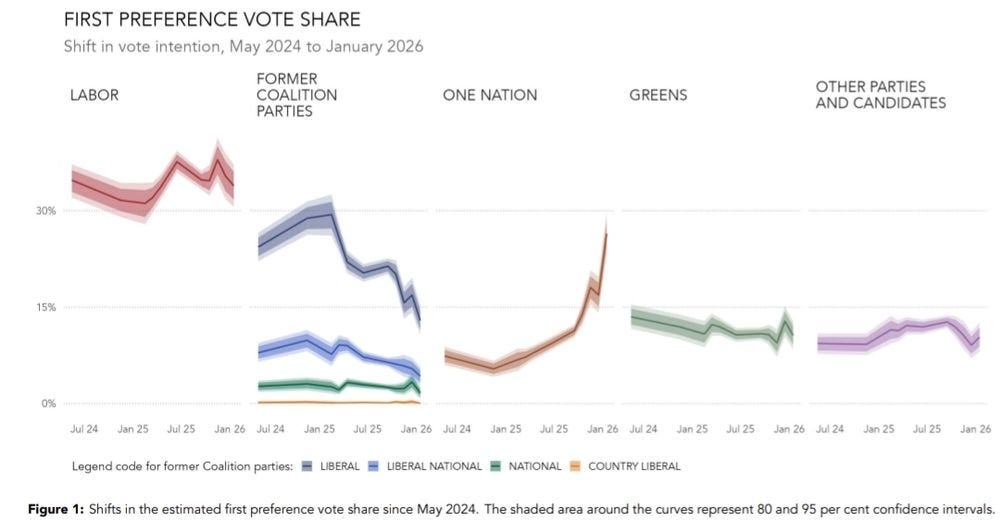
Until now, the usual convention in reporting polling results has been to aggregate these parties into a single grouping reported as “LNP” or “Coalition”. But the breakup of the federal coalition means it is better to report them separately as four groups: Liberals, Nationals, LNP and CLP. Combined with the resurgence of One Nation this yields the starting possibility that the Liberals (as well as the other three) may soon have polling support below 10 per cent.

bafkreigcwp7dfxzizxvtku5bhcttr4bd5uke7dlca7qwnrpg6qnncbi5re@jpeg.jpg

This graph from Redbridge (kindly provide by Ben Messenger) illustrates the point. The Liberals alone were polling at nearly 30 per cent a year ago, before the 2025 election disaster, but are now barely in double digits

Regardless of the precise number, these results have dire implications for the project of a moderate centre-right urban Liberal party, split off from the rightwing and far-right majority and aiming to making some kind of common cause with community independents. Such a party would command less than half of the Liberal party’s supporters or maybe 5 per cent of the population (plus whatever it could draw from the Queensland LNP). It would start with seven or eight members in the House of Representatives, along with some Senators who would be unlikely to get a quota in a Senate election.

Of course, just about anything could come out of the current chaos. For example, a merger of One Nation and the Nationals could easily become the main opposition party. But on Hanson’s track record it probably wouldn’t last long. And even if it endured, the chance of such a party actually winning would be small. Hanson’s permanent support base (embittered middle-aged and older low-education regional voters) is not only small, but so different from the actual majority of Australians to whom they refer as “inner-city elites”.

More likely is continued division on the right, with the remaining urban seats being picked off by Labor and the independents. The dreary implication is that Labor will continue to roll up big majorities even as its primary vote falls to 30 per cent or less. And as long as Albanese is leader, those majorities will not produce any significant policy change, let alone the radical transformation this country needs to respond to the challenges of global heating, Trumpism and the information economy.

fn1. I got in trouble 20 years ago or so for a jokey post predicting that there would be no more Liberal PMs because the Libs and Nats had to merge. Happened in Queensland, but not nationally.

False Alarm

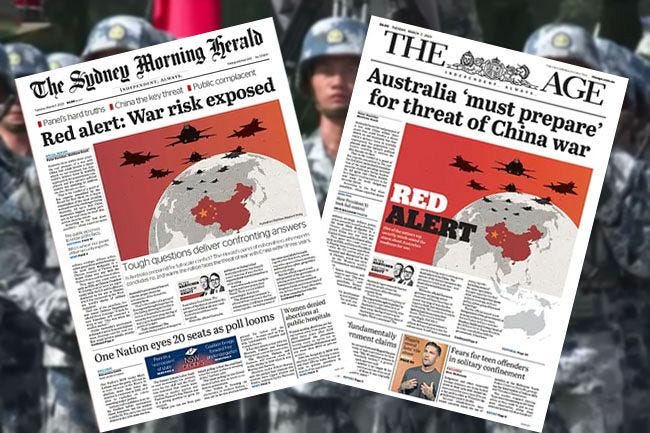
Back in March 2023, the Nine Papers ran a series of articles, entitled Red Alert, based on the claim of an “expert panel” that we should be ready to fight a war with China, within three years. With only a few weeks to go before the third anniversary of the series, the prediction is not looking good. Not only has there been no war, but relations between Australia and China are friendlier than they have been for years, going back at least as far as Turnbull’s prime ministership.

Where did Nine go wrong, and what lessons can we learn? The first, and most important error was the assumption that the PRC government could, if it chose, launch an invasion of Taiwan which would succeed in the absence of intervention by the US and its allies.

This claim was widely accepted in the US at the time, at least until analysts absorbed the lessons of Russia’s invasion of Ukraine. The most commonly proposed date was 2027, the “Davidson window” based on unverified claims that Xi Jinping wanted an invasion, or at least the capacity to undertake one, by then.

But as I argued at the time , the claim disregarded the history of seaborne invasions, which is mostly one of failure. The one success on a comparable scale, the D-Day landings in Normandy, required a preponderance of forces massively greater than that available to the the PRC.

This historical analysis was reinforced by the crushing defeat of Russia’s much-feared (before 2022) Black Sea Fleet. The anticipated assaults on ports like Odesa not take place, and the Fleet played almost no role in the grinding and brutal battle for Mariupol. Worse, beginning with the sinking of the Moskva early in the War, Ukraine, with no naval forces at all, drove Russia’s Navy off the sea entirely, forcing it to seek shelter in faraway Russian ports, but not safe even there.

All of this evidence was available at the time Red Alert was published. The authors could also have looked at China’s failure to undertake any serious preparation for a seaborne landing. China has only a dozen or so modern amphibious assault ships with a combined capacity of perhaps 10 000 troops. And, despite a massive buildup of naval forces generally, the PLA Navy is only adding one or two such ships every year. The supposed backup, dual use civilian ferries, is also proceeding slowly. A recent exercise involving twelve such ships falls far short of what is required for a serious threat

Meanwhile Taiwan is learning the lessons of the Ukraine war. Despite the resistance of the defence establishment (and particularly the navy), Taiwan is shifting expenditure towards the acquisition of missile and drone defences that would make any invasion attempt a catastrophic risk. Taiwan is shifting from reliance on imported US anti-ship missiles, such as the Harpoon to the domestically produced Hsiung Feng III with a range of 400km (considerably more the the width of the Taiwan strait).

As a result of these developments, most analysts (though not the Nine papers) have given up on the Davidson window and started talking about alternatives to invasion, such as a blockade or the more nebulous “quarantine” [1]. These won’t work but have kept the idea of imminent conflict going.

The big unforeseen development since 2023 was the re-election of Donald Trump and his shift in focus to plans to dominate the Americas (the “Donroe doctrine”). It is now pretty clear that Trump would be unwilling to commit US forces to defend Taiwan. China’s military and naval buildup, while not very useful for an invasion of Taiwan, has made such a commitment very risky.

For Australia, the withdrawal of a US commitment to defend Taiwan makes the prospect of war with China even more remote. The operating assumption, and the basis for AUKUS, has been the idea that Australian forces would serve under US command. In the absence of US participation, all we could offer Taiwan in the (remote) event of a war with China is the kind of assistance we’ve given Ukraine – thoughts, prayers and some surplus military equipment.

The UK has drawn the same lesson, scaling back the Indo-Pacific operations (the so-called “tilt the Asia Pacific) which provided the strategic rationale for its role in AUKUS, and abandoning it last permanent base ”east of Suez”. . At this point the only UK interest in AUKUS is to get as much Australian money as possible to support its submarine industry.

I will be surprised and impressed if Nine revisits this failed forecast, and even more so if the result is a change in the coverage of our relations with China and the US.

fn1. What I’ve called the Clayton’s version – the blockade you have when you’re not having a blockade.

A New Hope

Ever since it became evident that Trump was likely to be re-elected, I’ve been among the most pessimistic of commentators on the likely course of US politics (most recently here for example). I’ve also been nowhere near pessimistic enough. I assumed that Trump would follow the course of dictators like Putin and Orban, gradually eroding freedom and making his own power permanent. Instead, he’s gone most of the way inside a year.

Read More »

A sad Day for Australia

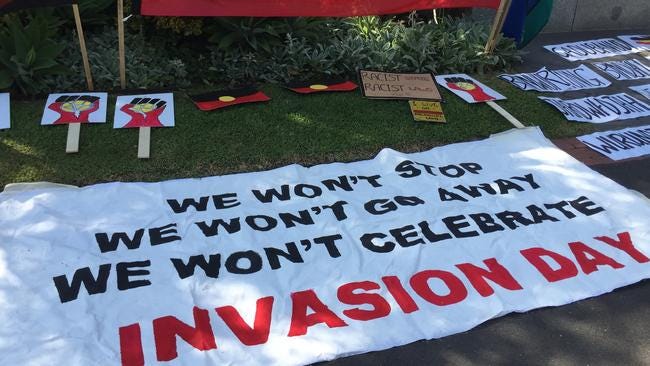
This is one of the most depressing Australia Days I can remember. We are still recovering from the horror of the Bondi massacre and the disgraceful jostling for political advantage that followed it. Meanwhile, the news is that opposition is hardening on changing the date to one less offensive to First Nations people. The actual shifts aren’t that great in statistical terms, but there’s no doubt that this shift, along with the rise of One Nation reflects something real.

In part what we are seeing is the global collapse of the “centre-right” and the ideology I’ve called “hard neoliberalism”, a combination of privatisation, pro-rich tax cuts and attacks on workers rights. For decades, hard neoliberals relied on the votes of the 20-30 per cent of the population who are consistently racist, but delivered little more than gestures. Now, with the failure of neoliberalism evident to all, the boot is on the foot. The racist right now dictates terms to the remaining neoliberals. We see this most obviously with Trump, but it’s happening in much of Europe as well. Germany is one of the few places where the mainstream right has (so far) held the line against doing deals with parties like AfD.

In Australia, the former coalition made their deal with the devil when they decided to preference One Nation ahead of Labor. Now they are paying the price. The Nationals will either be wiped out by One Nation or forced to merge with them. Either way, and assuming Labor wins again, the opposition in the next parliament will be dominated by overt racists.

Coming to Australia Day specifically, it’s unsurprising that the right is hardening its position. The bigger problem, as usual, is the failure of leadership from Labor and, more specifically Anthony Albanese. Having bungled the Voice referendum, he has walked away from any serious efforts at reconciliation with First Nations and from any attempt to redefine Australia’s position in the radically changed world brought about by Trump.

I can’t see any good outcomes here, at least in the short term. Until Albanese and Marles are gone, we will have no leadership from this government. That’s not going to happen soon, even if Albanese’s popularity continues to decline. And while Chalmers seems more aware of what is going on, there’s no guarantee he would be radically different. Plibersek could once have been an alternative but she has been fatally compromised by her stint as minister for environmental destruction. The same is true of Wong, leaving aside the problem that she is a senator.

The only consolation, looking at the world scene, is that things could be a lot worse. This is still a great country, even if our political class does not reflect the fact.

The social media ban that wasn’t

The Australian government’s legislation seeking to ban access to social media for people under 16 has received plenty of attention in International media, mostly leading with the government’s that 4.7 million accounts were banned or deactivated when the legislation came into effect. Rather less attention has been paid to discussion of the outcome within Australia, where the consensus is that there has been very little effect for most. With most kids still active, the minority who have been caught by the ban have suffered feelings of ostracism and exclusion When discussing the issue on my own social media (which had few if any teenage readers to begin with) I’ve only had one parent report their kids being thrown off.

Read More »