We’re in another round of concern about the “death of the book”, and, in particular, the claimed inability or unwillingness of young people to read full-length books. I’m not going to push too far on the argument that this complaint is ancient, but I can’t resist mentioning the response of my younger brother, who, when asked if he wanted a book for Christmas, answered “thanks, but I already have one”). That was around 50 years ago, and he went on to a very successful legal career.
Fifty years ago, the main competitors for books were TV and radio. Critics at the time decried the passive mode of consuming these broadcast media, compared to the active engagement required by reading. Now, in many respects, the complaint is the opposite. The various services available on the Internet are interactive, and engrossing, finely tuned to keep our attention.
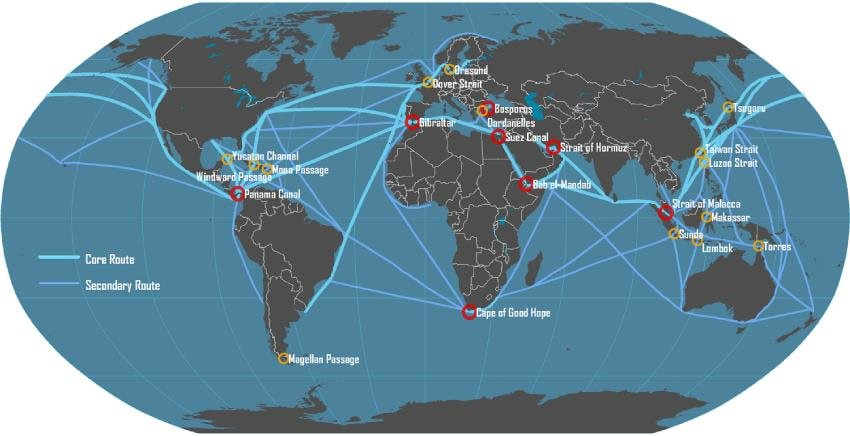
Over the eight decades following the end of World War II, the US has taken part in dozens of land wars, large and small. The outcomes have ranged from comprehensive victory to humiliating defeat, but all have received extensive coverage. By contrast, the US Navy’s admission of defeat in its longest and most significant campaign in many decades, has received almost no attention. Yet the failure of attempts to reopen the Suez Canal to shipping has fundamental implications for the entire rationale of maintaining a navy.
Operation Prosperity Guardian was launched in December 2023, following a series of attacks on shipping undertaken by Houthi rebels. The US dispatched a carrier strike group, led by USS Dwight D. Eisenhower, and supported by ships from the Royal Navy and other European forces. Despite intensive bombardment of Houthi positions, attacks on shipping continued and traffic through the Suez canal fell by 70 per cent.
John Quiggin’s Blogstack is a reader-supported publication. To receive new posts and support my work, consider becoming a free or paid subscriber.
Subscribed
In July, the Dwight D. Eisenhower quietly returned to returned to Norfolk, after what the Navy correctly described as “a historic nine-month combat deployment” but not historic in a good way. The strike force without achieving any of its goals. And then, in late August, came the official admission of defeat As reported by Voice of America:
Vice Admiral George Wikoff, who heads the U.S. naval efforts in the Middle East said that not only have U.S. strikes and defensive efforts done little to change the Houthis’ behavior, it now appears unlikely the group will be swayed by military force.
“The solution is not going to come at the end of a weapon system,” Wikoff told an audience in Washington, speaking via video from U.S. 5th Fleet headquarters in Bahrain.
“We have certainly degraded their capability. There’s no doubt about that. We’ve degraded their ability,” he said. “However, have we stopped them? No.”
Why has this failure attracted so little attention? Why, for example, has it not even been mentioned by either side in the course of the Presidential election campaign? The answer, quite simply, is that the strategic rationale for the mission turned out to be spurious. “Vital shipping lanes” are not actually vital at all.
The closure of the Suez canal has, indeed imposed higher insurance costs on shippers using the canal, and has led much of the traffic to be diverted to the longer route around the Cape of Good Hope. But the overall impact on freight rates has been modest, and any effect on global economic activity has been too small to be observable.
There shouldn’t have been any surprise here. Despite some hyperbolic claims at the time, the six-day blockage of the Canal in 2019 (due to the grounding of the Ever Given) caused only modest disruptions, with massive insurance claims being quietly settled for much smaller amounts
And what is true of the Suez Canal is just as true of other “vital shipping routes”, such as the Straits of Malacca. It’s almost always better to take the long way around (for example through the Sunda straits or even through Australian waters in the Southern Ocean) than to fight a war to keep a short cut open.
On the other side of the coin, the failure of Russian attempts to block Ukraine’s exports of wheat and grain provides further lessons on the limits of naval power. Ukraine’s tiny navy was wiped out on the first day of the 2022 invasion. But Russia’s much-touted Black Sea Fleet has fared little better, being driven from its Sevastopol base to ports in Russia, out of reach of Ukrainian missiles. By sailing close to the western coast of the Black Sea, ships carrying Ukrainian grain can be protected by land-based defences, while sailing in waters too shallow to permit attack by submarines.
In summary, as a recent commentary put it, the failure of Prosperity Guardian poses an “existential threat” However, the threat is not to the world economy but to the US navy and, indeed, all the navies of the world. If keeping “vital trade routes” open is neither militarily feasible nor economically important, a large part of the rationale for surface navies disappears.
It’s unlikely that defeat by the Houthis will have much effect on perceptions of the US Navy in the short run. But with so many other demands on the defense budget, the rationale for maintaining a massive, but largely ineffectual, surface fleet, must eventually be questioned.
I haven’t discussed the broader horror of the various Middle East wars, which gave rise to the Houthi attacks. My long-standing view is that the US can do nothing useful and, beyond humanitarian aid, should do nothing to help any party. Please don’t derail discussion by talking about this.
I’ve been consistently critical of the Labor party since Anthony Albanese became leader after Labor’s narrow but unexpected loss in 2019. It’s always easy to fall prey to confirmation bias in this kind of thing, making much of the bad and ignoring the good. To check my beliefs, I’m taking a widely circulated list of Labor’s claimed achievements, and giving my own responses. This is by no means a complete list of the governments achievements, and of course it doesn’t mention failures, but I’m confining myself to the list for now. Readers can judge whether I’m being fair.
Claims are in bold, my responses in italic
*Establishing National anti-corruption Commission
No significant prosecutions yet, decision not to pursue robodebt
*Cheaper child care
Genuine, but partially eroded by fee increases
*Pay rise for aged care workers
A special case, amid real wage reductions for most workers
*Tripling the bulk billing incentive
Not sufficient to prevent a decline in bulk billing
*Single parent payment extended to age 14 (57,000 single carers will receive an extra $176.90 p/n)
Good. Reversal of change made by Howard and accelerated under Gillard
*$500 electricity rebate for all concession card holders
A once-off handout
*Savings on PBS subsidised meds
$12.50 per script Small but worthwhile
*60 Day dispensing halving the cost of medications
Overstated, but still worthwhile
*Paid domestic violence carers leave
Up to 10 days, small but worthwhile
*Increase to Jobseeker and Rent Assistance (biggest increase to rent assistance in three decades)
Jobseeker increase of $20 above indexation (Morrison gave $50 increase). Still way below poverty line. Rent assistance just kept pace with rising rents
*Cybersecurity developments
No idea what this is
*The Housing Australia Future Fund
A half-baked idea, still to produce any actual houses. Greens pressure drove much stronger action.
*Robodebt Royal Commission
No consequences for those responsible, no systemic reforms
*180,000 fee free TAFE places
Good. Probably the most significant expenditure initiative of this government
*NDIS sustainability
These are cuts. Arguably necessary but misleadingly described
*Largest increase ever for cancer nurses
Small but worthwhile
*Review into Australia’s visa system
If there is one thing this government does, it’s review
*Reopening trade to China
Overstated – China’s sanctions were largely symbolic and never affected our major export, iron ore
* Triple incentives for GPs
Repeated from above – not enough to stop decline in bulk billing
*58 Urgent Care Clinics
Worthwhile but small, and far too little to fix problems in emergency wards
* Fairer conditions for workers
Working conditions one of the positives for this government, but real wages have fallen
* Fixing a one-sided tax change
More hide than Jessie the Elephant. The one-sided tax change was their own election commitment, matching the LNP. Even after the fix, most middle income earners paid higher taxes than when the government was elected because of the scrapping of LMITO
* Two Surpluses (Two more than the LNP)
Who cares
* Aged care reforms
Marginal tweaks
* Halving of the inflation rate since coming into office.
If Labor wants credit for this, should be blamed for increase in unemployment rate and reduction in real wages
Announcements from major employers, including Amazon and Tabcorp, that workers will be required to return to the office five days a week have a familiar ring. There has been a steady flow of such directives. The Commonwealth Bank CEO, Matt Comyn, attracted a lot of attention with an announcement that workers would be required to attend the office for a minimum of 50% of the time, while the NSW public service was recently asked to return to the office at least three days a week.
But, like new year resolutions, these announcements are honoured more in the breach than the observance. The rate of remote work has barely changed since lockdowns ended three years ago. And many loudly trumpeted announcements have been quietly withdrawn. The CBA website has returned to a statement that attracts potential hires with the promise, “Our goal is to ensure the majority of our roles can be flexible so that our people can work where and how they choose.”
The minority of corporations that have managed to enforce full-time office attendance fall into two main categories. First, there are those, like Goldman Sachs, that are profitable enough to pay salaries that more than offset the cost and inconvenience of commuting to work, whether or not they gain extra productivity as a result. Second, there are companies like Grindr and Twitter (now X) that are looking for massive staff reductions and don’t care much whether the staff they lose are good or bad.
Typically, as in these two cases, such companies are engaged in the process Cory Doctorow has christened enshittification, changing the rules on their customers in an effort to squeeze as much as possible out of them before time runs out.
We might be tempted to dismiss these as isolated cases. But a recent KPMG survey found that 83% of CEOs expected a full return to the office within three years. Such a finding raises serious questions, not so much about remote work but about whether CEOs deserve the power they currently hold and the pay they currently receive.
Like most academics these days, I spend a lot of time filling in online forms. Mostly, this is just an annoyance but occasionally I get something out of it. A recent survey in which the higher-ups tried to get an idea of how the workforce was feeling, asked the question “Do you think of the University as We or They?”.
In today’s AFR. It’s paywalled and I don’t have access (I’ve been promised a PDF) so here’s what I submitted, which may not be final.
Six months ago, Federal Treasurer Jim Chalmers was planning legislation to remove his own power (never used, but always available until now) to over-ride decisions of the Reserve Bank. Now, he has not only decided to retain this power, but has openly criticised the Bank’s interest rate decisions as “smashing the economy”.
It’s easy enough to understand Chalmer’s criticism in terms of the political interests of a government seeking to survive and retain power. The government is focused, to the point of obsession, on the “cost of living”, a nebulous term that can best be interpreted as “the reduced purchasing power of household disposable income”.
This study showing that US academic faculty members are 25 times more likely than Americans in general to have a parent with a PhD or Masters degree has attracted a lot of attention, and comments suggesting that this is unusual and unsatisfactory. But is it? For various reasons, I’ve interacted quite a bit with farmers, and most of them come from farm families. And historically it was very much the norm for men to follow their fathers’ trade and for women to follow their mothers in working at home.
So, I decided to look for some statistical evidence. I used Kagi’s AI Search, which, unlike lots of AI products is very useful, producing a report with links to (usually reliable) sources. That took me to a report by the Richmond Federal Reserve which had a table from a paper about political dynasties.
The latest massive $1.1bn profit reported by Coles will doubtless produce a new round of hand-wringing about the “cost of living”. Governments will produce initiatives aimed at capping or reducing prices. Pundits will use a variety of measures to argue as to whether such measures are inflationary. Then there will be debates about whether splitting up Coles and Woolworths into smaller chains would enhance competition. And the Reserve Bank will be encouraged to push even harder to return inflation to its target range.
But these responses, focused on the cost of goods, miss the point. Coles and Woolworths have increased their margins, yes – but prices for groceries have increased broadly in line with other goods. The real driver of supermarket profits is their ability to drive down the prices they pay to suppliers.
But the input that matters here is labour and it is here that the supermarkets are making big gains at the expense of their workers. Across the board, wages have failed to keep pace with prices over the last five years or more.
At least for the supermarkets, this won’t change any time soon.
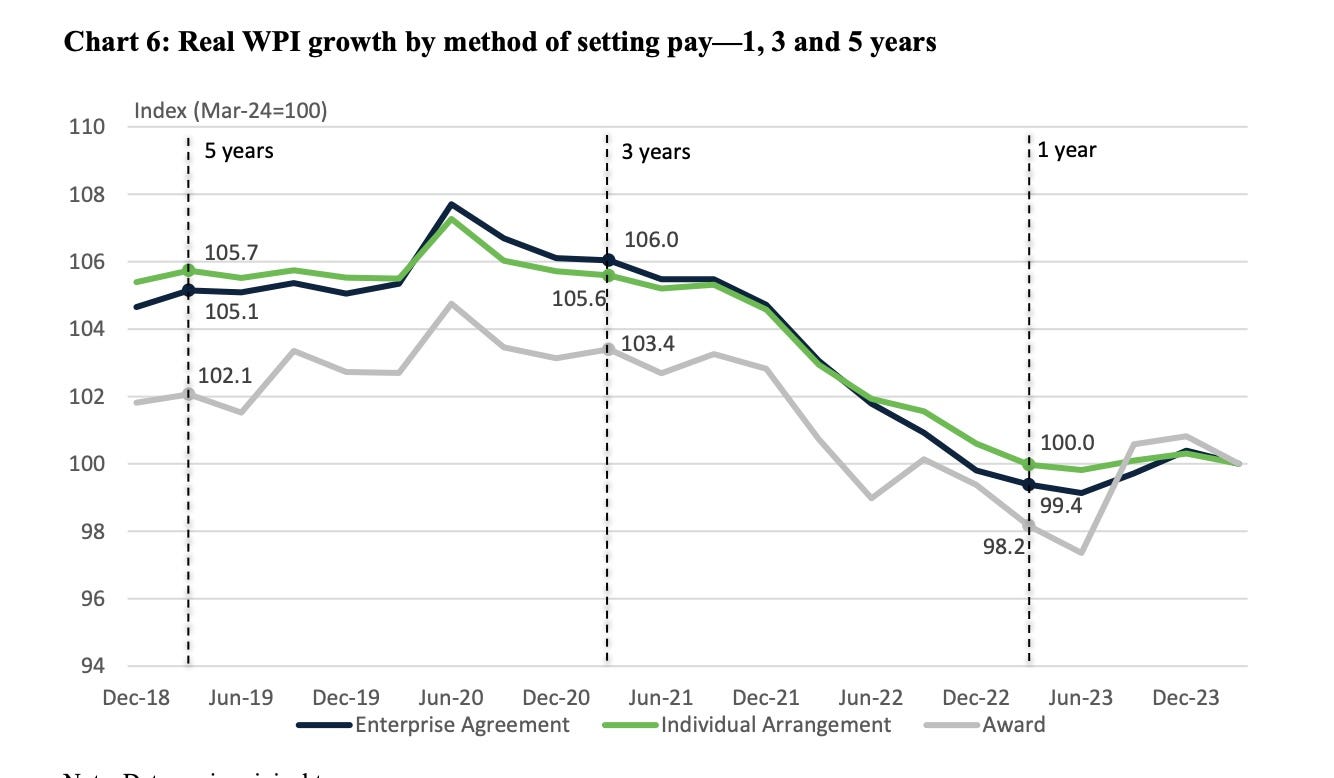
Yet again, the FWC declined to do anything about the fall in real wages that has taken place since the arrival of the pandemic, compounding a long period of stagnation before that. As it noted: “Despite the increase of 5.75 per cent to modern award minimum wage rates in the AWR 2023 decision, the position remains that real wages for modern award-reliant employees are lower than they were five years ago.”
Real WPI growth by method of setting pay – 1, 3 and 5 years. Photograph: FairWork Commission
There is no cost of living crisis for those whose income derives from profits. Those at the top end of town have seen their incomes soar. But even more modestly wealthy recipients of capital income are doing well, a fact reflected in their spending patterns.
To be sure, old people, such as self-funded retirees, are more likely to be receiving capital income and less likely to be reliant on wages to pay mortgage interest. But this is by no means universal. Plenty of baby boomers are still in the workforce, while some of our most prominent property owners (such as Tim “avocado toast” Gurner) are much younger. Focusing on age merely confuses a debate that is already complicated enough.
The policies of the Reserve Bank make matters even more thorny. The problems here start with a dogmatic adherence to a 2% to 3% inflation target. The rationale for inflation targeting is thin, and the choice of target range is entirely arbitrary, arising from an ad hoc decision by a right-wing New Zealand finance minister in the early 1990s, one which was followed by a long period of economic decline in that country.
The dangers of using high interest rates to achieve rapid reductions in inflation, evident from the “credit squeezes” of the 1970s and 1980s, are now becoming apparent, as the drive to reduce inflation is reflected in a push to squeeze demand and prevent any recovery in real wages.
There is little hope that all of this will change any time soon. The concept of “cost of living” is simple and intuitive, even if it is highly misleading. What really matters is the purchasing power of people’s disposable incomes. But that’s a bit too hard for our political class to think about, let alone explain to the public.
A striking feature of the age of billionaires in which we now live is that billionaires are more and more inclined to give us the benefit of their opinions. In the past year alone, we’ve had Marc Andreessen’s retro-futurist “Techno-optimist manifesto”, Mark Zuckerberg’s pronouncements on the future of media, and, most recently, a cosy chat between Elon Musk and Donald Trump (whose billionaire status is often touted but remains questionable). In most cases, the main effect has been to demonstrate that, however good they are at making money, billionaires are no smarter than the rest of us when it comes to politics or the ordinary business of life.
Australia’s richest billionaire by far is Gina Rinehart, who has massively multiplied the already substantial fortune she inherited from her father, the late Lang Hancock (Rinehart claims she inherited more debts than assets). Like Hancock, who spent decades on the rightwing fringe of Australian politics, Rinehart has never been shy about expressing her opinions.
A look at those opinions suggests that, taken as a whole, they would pass the “pub test”, in that they are about as sophisticated and intellectually consistent as you might expect to hear in the evening at a public bar. In common with many opinionators, Rinehart disdains the constraints of arithmetic, simultaneously demanding lower taxes, more public spending and lower deficits, all to be paid for by eliminating unspecified waste, fraud and duplication.
A recent piece in the Daily Telegraph, published as part of a News Corp “Bush summit” series, illustrates this point. Hancock begins with a familiar litany of woes about the high costs faced by farmers and the burden of (unspecified) red tape, forcing them off the land. This part of her article could have been (and has been) written any time in the past 50 years or more.
No one reading this sad tale would be aware that farm incomes have been at record highs last year, an outcome reflected in strongly increased land prices. The executive director of the Australian Bureau of Agricultural and Resource Economics and Sciences,noted at the time: “When you look at the cropping sector in particular, average farm incomes are about 75% above the 10-year average – about $665,000 – up slightly from last year.”
Farming is a risky business and these outcomes depended in part on a string of good seasons that came to an end this year, with farm incomes now back to where they were three years ago. But a rebound seems likely, making Rinehart’s gloomy pronouncements seem overstated, to say the least.
Turning to remedies, Rinehart wants a string of tax reductions, including the abolition of payroll tax and stamp duties along with reductions in excise tax on fuel. A striking feature of this wishlist is that most of the benefits would go to city dwellers. Few farm businesses are large enough to reach the threshold for payroll tax. Family-owned farm businesses are exempt from stamp duty on intra-family transfers, while city dwellers routinely pay tens of thousands of dollars as a cost of moving house. Finally, no excise tax is paid for on-farm (or mining) use of fuel.
These proposals aren’t matched by a willingness to accept reduced public services. After acknowledging the need for “nurses, police, hospitals, health care, our increasing numbers of elderly, emergency services and veterans (And much more)”, Rinehart goes on to demand a massive increase in provision of these services to rural areas, saying that “the Pilbara in Western Australia should have some of the best hospitals and infrastructure in the world, plus some of the best playgrounds and sports facilities”.
Some areas of public expenditure didn’t make it on to her list, but Rinehart has covered many of them elsewhere. She has been a keen proponent of publicly subsidised dams, relaxing means tests on pensions and more spending on defence (apparently to be financed by selling off the defence department’s “pot plants, paintings and sculptures”).
The closest Rinehart comes to suggesting a cut in public expenditure is a nebulous reference to handouts of “another $500m here, another $500m there”, most of which is apparently spent within the Canberra bureaucracy. Doing away with these would supposedly cover the tens of billions of dollars of reduced revenue and higher spending implied by her lengthy wish list.
There’s nothing particularly unusual about Rinehart’s grab-bag of opinions. You can hear similar thoughts in any public bar (or, with minor variations, any inner-city coffee shop). But as a contribution to discussion of public policy, they are best left there.
The fact that conservatives are thin in the humanities and social sciences departments of US college campuses is well known. A natural question, raised by Steven Teles, is whether the rarity of conservative professors in these fields reflects some form of direct or structural discrimination.
But the disparities are even greater in the natural sciences. In 2009, a Pew survey of members of the AAAS found that only 6 per cent identified as Republicans and there is no reason to think this has changed in the subsequent 15 years. One obvious reason for this is that Republicans are openly anti-science on a wide range of issues, notably including climate science, evolution and vaccination.
The absence of Republican scientists creates a couple of problems for Teles. First, Teles’ proposed solution of affirmative action is particularly problematic here. Around 97 per cent of all papers related to climate change support, or at least are consistent with, the mainstream view that the world is warming primarily as a result of human action. The view, predominant among conservative Americans, that global warming is either not happening or is not due to human action, is massively under-represented.
The same is true across an ever expanding range of issues that have been engulfed by the culture wars. It seems unlikely that Teles would advocate enforcing a spread of opinion matching that of the US public in these cases.
Second, it is hard to see how discrimination is supposed to work here. By contrast with large areas of the social sciences and humanities, it is difficult to infer much about a natural scientists’ political views from their published work, except to the extent that anyone working in fields like biology, climate science works on the basis of assumptions rejected by most Republicans. A Republican chemist or materials scientist would have no need to reveal their political views to potentially hostile colleagues.
Economics is exempted from Teles’ criticism, but the difficulties are equally great here, though they do not fall on neatly partisan lines of conservative vs liberal. Although there are a range of views among economists on trade policy, there are almost none (with the exception of Trump’s adviser Peter Navarro) who are as sympathetic to tariff protection as the median American voter. Achieving a balance of opinion on trade policy among academic economists similar to that of the American public would require affirmative on a scale that would make Ibram X Kendi look like a piker.
But what of the social sciences and humanities? Implicitly, Teles is rejecting the view that the views of American conservatives in these fields could be wrong in the same way that scientific creationism and folk economics are wrong. If, for example, a scholar of international relations agrees with George W. Bush and the majority of Republicans that the United States is “chosen by God and commissioned by history to be a model to the world”, that should not be problem for a selection committee on Teles’ account.
The ever-expanding culture wars have contracted the areas where academic work has no direct political implications. Nevertheless, there are enough such fields that the low representation of political conservatives needs some further explanation.
Explaining the shortage of Republican scientists (and academics more generally) does not require a complex story about anticipated discrimination, like the one offered by Teles. Careers in academia require a high level of education and offer relatively modest incomes. Both of these characteristics are negatively correlated with political conservatism. The outcome is no more surprising than the fact that Democrats are under-represented among groups with the opposite characteristics, such as business owners without college degrees.
Teles caricatures such explanations as saying that “conservatives are stupid”. But he would presumably agree that an academic appointment normally requires a PhD. But PhD graduates are overwhelmingly liberal According to Pew, only 12 per cent of Americans with a postgraduate degree hold “consistently conservative” and another 14 per cent are mostly conservative. Once lawyers (JD holders) and doctors (MD holders) are excluded, there’s no reason to think that American academics are significantly more liberal that PhD graduates in general.
If so, there’s no need to invoke personal discrimination in the hiring process as an explanation for the paucity of conservatives. Rather, as Teles suggests, it seems that conservatives do not pursue academic careers in the first place.
Fear of discrimination is one possible explanation here. But a much simpler structural explanation is at hand. Compared to other high-education workers, professors have relatively modest earnings (economics, where the outside options are lucrative, is a partial exception). And controlling for education, income is strongly correlated with Republican voting. So, a plausible explanation is that intelligent young conservatives pursue careers with high earning potential in business or finance, rather than academia.
Support for this hypothesis comes from a surprising source, the medical profession. Aspiring doctors face a choice between specialisations with high economic returns (such as dermatology) and others which may yield more personal satisfaction or contribute more to public good (pediatrics).
As a New York times article about the voting patterns of doctors shows, these choices are highly correlated with voting patterns. Doctors in low-income specialisations are much more likely to be Democrats
All medical specialisations yield higher incomes than that of the average professor. But extrapolating beyond the range of the data to $75k (the average salary for full-time faculty in US universities and colleges according to Wikipedia), the predicted proportion of Republicans would be around 10 per cent, which is what’s observed in the data. A cynical interpretation is that, if Republican legislators want more conservative professors, they should pay them higher salaries, pushing them into the top tax brackets populated by corporate lawyers and orthopaedic surgeons.
As Teles observes, the disparity between the views of academics and those of the legislators who ultimately fund them is a major problem for US higher education, and ultimately for the US. But this is ultimately a reflection of the fact that conservatism, in the form it currently takes in the US, involves rejection of the intellectual values of a university.


 John Quiggin