Another Monday Message Board. Post comments on any topic. Civil discussion and no coarse language please. Side discussions and idees fixes to the sandpits, please.
Another Monday Message Board. Post comments on any topic. Civil discussion and no coarse language please. Side discussions and idees fixes to the sandpits, please.
My latest piece in The Conversation is one of six looking at changes in various aspects of Australian life since the turn of the century. Most of it is a recounting of the history, but I have a few things to say at the end about the information economy
The most striking feature of the Australian economy in the 21st century has been the exceptionally long period of fairly steady, though not rapid, economic growth.
The deep recession of 1989–91, and the painfully slow recovery that followed, led most observers to assume another recession was inevitable sooner or later.
And nearly everywhere in the developed world, the Global Financial Crisis of 2007–08 did lead to recessions comparable in length and severity to the Great Depression of the 1930s.
Through a combination of good luck and good management, Australia avoided recession, at least as measured by the commonly used criterion of two successive quarters of negative GDP growth.
Recessions cause unemployment to rise in the short run. Even after recessions end, the economy often remains on a permanently lower growth path.
Good management – and good luck
The crucial example of good management was the use of expansionary fiscal policy in response to both the financial crisis and the COVID pandemic. Governments supported households with cash payments as well as increasing their own spending.
The most important piece of good luck was the rise of China and its appetite for Australian mineral exports, most notably iron ore.
This demand removed the concerns about trade deficits that had driven policy in the 1990s, and has continued to provide an important source of export income. Mining is also an important source of government revenue, though this is often overstated.
Still more fortunately, the Chinese response to the Global Financial Crisis, like that in Australia, was one of massive fiscal stimulus. The result was that both domestic demand and export demand were sustained through the crisis.
The shift to an information economy
The other big change, shared with other developed countries, has been the replacement of the 20th century industrial economy with an economy dominated by information and information-intensive services.
The change in the industrial makeup of the economy can be seen in occupational data.
In the 20th century, professional and managerial workers were a rarefied elite. Now they are the largest single occupational group at nearly 40% of all workers. Clerical, sales and other service workers account for 33% and manual workers (trades, labourers, drivers and so on) for only 28%.
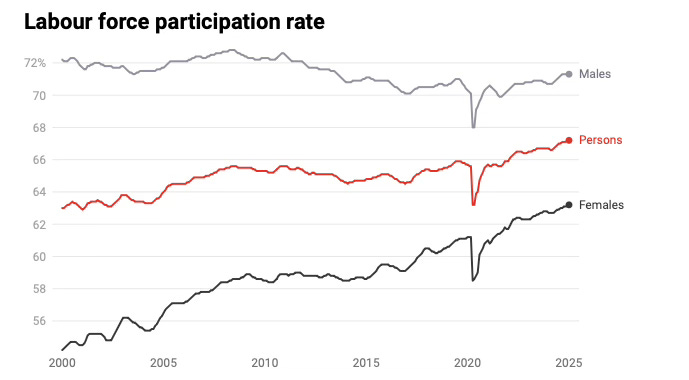
The results are evident in the labour market. First, the decline in the relative share of the male-dominated manual occupations has been reflected in a gradual convergence in the labour force participation rates of men (declining) and women (increasing).
Suddenly, work from home was possible
Much more striking than this gradual trend was the (literally) overnight shift to remote work that took place with the arrival of COVID lockdowns.
Despite the absence of any preparation, it turned out the great majority of information work could be done anywhere workers could find a desk and an internet connection.
Despite strenuous efforts by managers, remote or hybrid work has remained common among information workers.
CEOs regularly demand a return to full-time office work. But few if any have been prepared to pay the wage premium that would be required to retain their most valuable (and mobile) employees without the flexibility of hybrid or remote work.
The employment miracle
The confluence of all these trends has produced an outcome that seemed unimaginable in the year 2000: a sustained period of near-full employment. That is defined by a situation in which almost anyone who wants a job can get one.
The unemployment rate has dropped from 6.8% in 2000 to around 4%. While this is higher than in the post-war boom of the 1950s and 1960s, this is probably inevitable given the greater diversity of both the workforce and the range of jobs available.
Matching workers to jobs was relatively easy in an industrial economy where large factories employed thousands of workers. It’s much harder in an information economy where job categories include “Instagram influencer” and “search engine optimiser”.
As we progress through 2025, it is possible all this may change rapidly, for better or for worse.
The chaos injected into the global economy by the Trump Administration will radically reshape patterns of trade.
Meanwhile the rise of artificial intelligence holds out the promise of greatly increased productivity – but also the threat of massive job destruction. Economists, at least, will be busy for quite a while to come.
It’s been evident since Trump’s inauguration that the US, as we knew it, is over. I’ve been looking at some of the US-centred organisations and economic dependencies that will need to be rebuilt. But I hadn’t given much thought to the university sector, where I work, until I got an urgent email asking everyone at the University of Queensland to advise the uni admin if we had any projects involving US funding.
It turns out that Australian participants in such projects had received demands from the US to respond, at short notice, to a questionnaire asking if anything they were doing violated any of the long list of Trump taboos: contacts with China, transgender issues, persecution of Christians and so on.
Taken in the broader context of the Trump dictatorship, this means the end of international research collaboration involving the US. That will be a huge blow to global research of all kinds. Faced with this prospect, I would have expected our response to start with denial, before working through the other stages of grief.
And that’s exactly what we got from our Education Minister Jason Clare, who put out a waffly statement ending with “We look forward to working with US counterparts to demonstrate the benefits of collaborative research to both US and Australia’s interests.”
But, amazingly, the Group of 8, representing the management of the leading research universities seems to have moved on to acceptance, calling for a turn to Europe saying “Australia must double down on getting a seat at the table to access the world’s largest research fund, Horizon Europe,”
Research funding is only the first stage in the story. As Trump closes off travel from much of the world, holding major conferences in the US will become intellectually indefensible, if not physically impossible. In my own field of economics, the central role in the job market played by American meetings will need to end. The central role of US journals will last a bit longer, but can’t be tolerated indefinitely.
In the longer term. Trump is setting out to destroy US universities as centres of intellectual inquiry. That will take a while, and the US will continue to be central in many fields of research for some time to come. But the axe is already falling on the humanities, biomedical research and climate science among other fields. Work in these topics will have to move elsewhere, as will researchers who value their independence.
Another Monday Message Board. Post comments on any topic. Civil discussion and no coarse language please. Side discussions and idees fixes to the sandpits, please.
Another Monday Message Board. Post comments on any topic. Civil discussion and no coarse language please. Side discussions and idees fixes to the sandpits, please.
Another Monday Message Board. Post comments on any topic. Civil discussion and no coarse language please. Side discussions and idees fixes to the sandpits, please.
As I type this, Trump is threatening tariffs on anyone who challenges the interests of America’s technology oligarchs, all of whom are now paying obeisance at this court. Technology is the US biggest weapon against the free world of which it was formerly part, and the right place to fight back. But what can be done?
Quick quiz. Suppose you read a headline in the online version of the Wall Street Journal (or NY Times etc) stating that, from now on, US Treasury bonds would be redeemed in crypto. Would your response be
(i) That’s absurd. Either it’s April Fools Day or someone has hacked the website
(ii) That’s unlikely. Surely [1] Wall Street will be able to kill this crazy idea
(iii) That will be tricky. Which cryptocurrencies will be included and what will be the exchange rates?
If your answer was (i) you can stop reading here (and don’t bother commenting to justify your position). This answer assumes that, despite Trump’s bluster, nothing has fundamentally changed. You’re still in the denial stage, with six more to come..
If you’re answer is (ii) or (iii) you are paying at least some attention. I’ll point to some evidence suggesting (iii) is a plausible answer, and look at what that implies for the global financial system.
Another Monday Message Board. Post comments on any topic. Civil discussion and no coarse language please. Side discussions and idees fixes to the sandpits, please.


 John Quiggin