The publication date for my new book, Economics in Two Lessons, is set for May 2019. Until then, I’m putting extracts up on a Facebook page I’ve set up. Here’s the first one, part of the Introduction.
The Coal Cartel ? Why Adani’s prospects haven’t improved
In my recent piece in The Guardian, mostly about Adani, I observed
The paradoxes of Adani are mirrored in the global coal market. Despite a small increase in 2017, global coal production is below its 2013 peak. Yet prices have recovered strongly, yielding big profits to existing miners and offering a seemingly tempting prospect for new mines.
It turns out that this isn’t quite right. The benchmark Newcastle price, for low-ash coal with a heat content of 6000kcal/kg has risen strongly, to the great benefit of companies like Yancoal, Glencore and Whitehaven. It turns out, however, that this increase isn’t representative of the broader market. Prices for lower quality coal with lower heat content and higher ash content haven’t moved at all, with the result that the premium between higher and lower grades has grown dramatically.
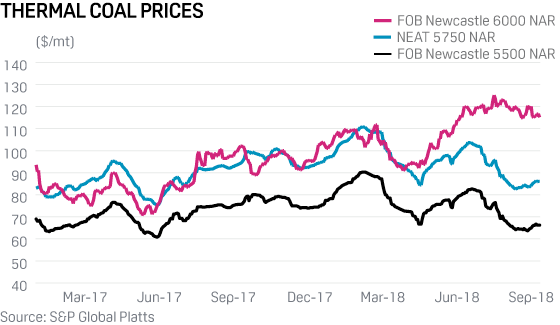
What’s going on here? One possible explanation is that Yancoal and Glencore, who produce the majority of Australia’s high-grade coal, have engaged in successful cartel behavior. Another is that the premium reflects shifts in demand (with China and India increasingly rejecting high ash coal, while Japan continues to demand high grade coal) and supply (few new mines are opening, and this has a bigger effect on the smaller market for high grade coal).
Whatever the explanation, most analysts agree that it is more likely to be resolved by a decline in the price of high-grade coal rather than an increase in the price of low-grade coal.
Where does Adani fit into all this. Most of the discussion I’ve found focuses on the premium between 6000kcal/kg and 5500 kcal/kg. Coal extracted from the Carmichael mine would be much lower quality, below 5000 kcal/kg.
Adani on life support
I have a piece in The Guardian under the headline Adani’s rail line cut shows project is on life support but still a threat to climate, starting with the observation
The recent announcement by Adani that it will halve the costs of its rail line to the proposed Carmichael coalmine by building a shorter, narrow-gauge line raises an obvious question: if such a massive cost-saving is feasible, why didn’t Adani go that way in the first place?
I also address the broader question
If coal is doomed, why has the price recoverd
Sandpit
A new sandpit for long side discussions, conspiracy theories, idees fixes and so on.
Monday Message Board
Another Monday Message Board. Post comments on any topic. Civil discussion and no coarse language please. Side discussions and idees fixes to the sandpits, please.
If you would like to receive my (hopefully) regular email news, please sign up using the following link
Failing upwards
I’ve been busy finishing the manuscript of my book, and dealing with policy issues as they came up, so I haven’t paid a lot of attention to the Liberal leadership saga. One thing that strikes me is that Josh Frydenberg has had exceptionally favorable coverage, apparently on the basis that he’s likable and popular. That’s fine, but if you’re going to appoint someone as Treasurer, shouldn’t a successful track record be a necessary (though not sufficient) condition? Morrison, for example, had a political success in stopping the boats (whatever the morality of the policy) and was generally seen as a successful Social Services minister (unlike his successor, who messed up the robodebt program). He didn’t impress as Treasurer, but at least his previous career justified giving him a go. And while he looks underqualified as PM, the alternatives were even worse[1].
Frydenberg has essentially had one ministerial job, covering environment and energy (though with various titles and temporary add-ons like Northern Australia). In this capacity, his big contribution was the National Energy Guarantee. It was a terrible policy, made necessary by the failure of Turnbull and Frydenberg to face down the denialists in the government. Designed to be all things to all people, it ended up being nothing to nobody. Frydenberg’s failure to secure agreement on the NEG was the proximate cause of Turnbull’s downfall as PM, and the policy was promptly abandoned the moment Morrison took over. In what possible world is this a basis for promotion?
fn1. Bishop was ruled out on tribal grounds. Her weakness as Treasury spokesman years ago was also held against her, even though she wasn’t obviously worse (in retrospect) than Morrison, and much better than Hockey. About Dutton, the less said the better. After that, it’s daylight.
A deliberative Parliament in NSW
Talk about “hung parliaments” always presses my hot buttons. It’s coming up in relation to the NSW elections due in March, and will doubtless re-emerge when the next national election is called, unless it looks like an obvious walkover. As I’ve said many times, the term, derived by analogy from “hung jury” rests on the presumption that a Parliament without a majority for either Labor or the L-NP coalition is incapable of governing properly. Experience suggests the opposite. A majority government is effectively at the command of the PM or Premier, and the only remedy, between elections, is the one we have just seen applied by Turnbull. Governments forced to negotiate passage of legislation with independents or minor parties have generally behaved better.
In the specific case of NSW, the silliness is amplified because the outcome can be predicted, fairly safely, in advance. There are currently three Greens, a left-leaning independent, a Shooter, and two conservative independents. If Labor wins more seats than the LNP, they will form a government with the support of the Greens and (if needed) the left independent. If The LNP win more they can almost certainly cut a deal with the Shooters and rely on the conservative independents (possibly putting one up as Speaker). Readers won’t be surprised to learn that the best outcome from my point of view would be a Labor government with Green support.
Reality, not greenies, the enemy of irrigation expansion
That’s the title of my latest piece in The Guardian, responding to a Matt Canavan spray against critics of a recent CSIRO report canvassing options for expanded irrigation in Northern Australia. Interestingly, although Canavan comes across as a typical North Queensland developmentalist (for whom I would have some sympathy) he’s actually from the South-East corner, a UQ economics graduate and a former senior official of the Productivity Commission. Ten years ago, he’d have been debunking CSIRO in exactly the way I do in my report.
After my piece came out, there was a bit of a kerfuffle on Twitter over whether CSIRO had really proposed a dam on the Fitzroy. Their report didn’t do any new analysis of major dams (a point they stressed) but dusted off a couple of existing proposals, then did a more detailed analysis of a plan based on one or more smaller (25 GL or more) dams. None of them were economically sound, except when the magic of regional input-output multipliers was invoked.
Time to join the generation game?
As regular readers will know, I’ve spent a generation or more [1] deriding what I call the generation game – the idea of dividing the population up into birth cohorts (categories based on year of birth) such as Boomers, X-ers and so on (Millennials weren’t invented when I started) and assigning them various supposed characteristics. Most of the time, this exercise is little better than astrology. To the extent that there is any semblance to reality it simply reflects the fact that young people are, and always have been, different from old people.
But just as I have managed to get some traction with this idea, genuine cohort effects have emerged in politics in many countries. The sharpest case is Britain, where people over 65 voted massively for Brexit in the referendum and the Conservatives in the recent election, while those aged 18-24 went even more sharply the other way. As the map linked here shows, if only 18-24 year olds were voting, based on current polling data, the Conservatives would not have won a single seat. If only those over 65 voted, the Conservatives would win 575 and the combined opposition 54.
This is a massive difference and can’t as far as I can tell be explained by differences in education, ethnic composition and so forth. It also represents a huge shift on the part of older cohorts, who were part of the electorate that gave Labour three terms not long ago. While there is some tendency for people to become more conservative as they age, it’s normally much more limited than this.
The explanation in simple terms, is Brexit. Most of the time, elections involving competing visions of the future – in the UK case, hard-line neoliberalism vs Third Way Blairism. In the course of such debates, both sides routinely claim to be on the right side of history, to own the future and so on. By contrast, Brexit represented an appeal to a (partly imaginary) past, against the present and the future. With the exception of a handful of neoliberal ideologues, who saw Brexit as a path to a free-market future, most Leavers were motivated by nostalgia for the glories of the past, and were willing to sacrifice the interests of the young to make a gesture in that direction.
What’s true of Brexit is true, though not to quite the same extent, of the culture war politics that have now become dominant on the political right in much of the English-speaking world. It’s driven in large measure by old men who lost the cultural battles of the 1960s and 1970s, and have never got over the fact.
The result is a situation where the right is appealing directly to members of older age cohorts with the result that younger cohorts are moving left. The most immediate effect has been to wipe out the support base of centrists of the Blair-Clinton-Keating type, who fail to appeal to either group
Monday Message Board
Another Monday Message Board. Post comments on any topic. Civil discussion and no coarse language please. Side discussions and idees fixes to the sandpits, please.
If you would like to receive my (hopefully) regular email news, please sign up using the following link
 John Quiggin