We’re in another round of concern about the “death of the book”, and, in particular, the claimed inability or unwillingness of young people to read full-length books. I’m not going to push too far on the argument that this complaint is ancient, but I can’t resist mentioning the response of my younger brother, who, when asked if he wanted a book for Christmas, answered “thanks, but I already have one”). That was around 50 years ago, and he went on to a very successful legal career.
Fifty years ago, the main competitors for books were TV and radio. Critics at the time decried the passive mode of consuming these broadcast media, compared to the active engagement required by reading. Now, in many respects, the complaint is the opposite. The various services available on the Internet are interactive, and engrossing, finely tuned to keep our attention.
Another Monday Message Board. Post comments on any topic. Civil discussion and no coarse language please. Side discussions and idees fixes to the sandpits, please.
Over the eight decades following the end of World War II, the US has taken part in dozens of land wars, large and small. The outcomes have ranged from comprehensive victory to humiliating defeat, but all have received extensive coverage. By contrast, the US Navy’s admission of defeat in its longest and most significant campaign in many decades, has received almost no attention. Yet the failure of attempts to reopen the Suez Canal to shipping has fundamental implications for the entire rationale of maintaining a navy.
Operation Prosperity Guardian was launched in December 2023, following a series of attacks on shipping undertaken by Houthi rebels. The US dispatched a carrier strike group, led by USS Dwight D. Eisenhower, and supported by ships from the Royal Navy and other European forces. Despite intensive bombardment of Houthi positions, attacks on shipping continued and traffic through the Suez canal fell by 70 per cent.
John Quiggin’s Blogstack is a reader-supported publication. To receive new posts and support my work, consider becoming a free or paid subscriber.
Subscribed
In July, the Dwight D. Eisenhower quietly returned to returned to Norfolk, after what the Navy correctly described as “a historic nine-month combat deployment” but not historic in a good way. The strike force without achieving any of its goals. And then, in late August, came the official admission of defeat As reported by Voice of America:
Vice Admiral George Wikoff, who heads the U.S. naval efforts in the Middle East said that not only have U.S. strikes and defensive efforts done little to change the Houthis’ behavior, it now appears unlikely the group will be swayed by military force.
“The solution is not going to come at the end of a weapon system,” Wikoff told an audience in Washington, speaking via video from U.S. 5th Fleet headquarters in Bahrain.
“We have certainly degraded their capability. There’s no doubt about that. We’ve degraded their ability,” he said. “However, have we stopped them? No.”
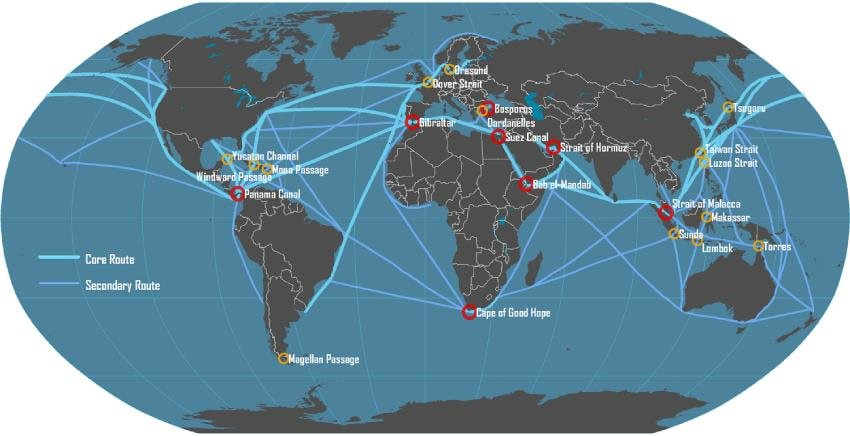
Why has this failure attracted so little attention? Why, for example, has it not even been mentioned by either side in the course of the Presidential election campaign? The answer, quite simply, is that the strategic rationale for the mission turned out to be spurious. “Vital shipping lanes” are not actually vital at all.
The closure of the Suez canal has, indeed imposed higher insurance costs on shippers using the canal, and has led much of the traffic to be diverted to the longer route around the Cape of Good Hope. But the overall impact on freight rates has been modest, and any effect on global economic activity has been too small to be observable.
There shouldn’t have been any surprise here. Despite some hyperbolic claims at the time, the six-day blockage of the Canal in 2019 (due to the grounding of the Ever Given) caused only modest disruptions, with massive insurance claims being quietly settled for much smaller amounts
And what is true of the Suez Canal is just as true of other “vital shipping routes”, such as the Straits of Malacca. It’s almost always better to take the long way around (for example through the Sunda straits or even through Australian waters in the Southern Ocean) than to fight a war to keep a short cut open.
On the other side of the coin, the failure of Russian attempts to block Ukraine’s exports of wheat and grain provides further lessons on the limits of naval power. Ukraine’s tiny navy was wiped out on the first day of the 2022 invasion. But Russia’s much-touted Black Sea Fleet has fared little better, being driven from its Sevastopol base to ports in Russia, out of reach of Ukrainian missiles. By sailing close to the western coast of the Black Sea, ships carrying Ukrainian grain can be protected by land-based defences, while sailing in waters too shallow to permit attack by submarines.
In summary, as a recent commentary put it, the failure of Prosperity Guardian poses an “existential threat” However, the threat is not to the world economy but to the US navy and, indeed, all the navies of the world. If keeping “vital trade routes” open is neither militarily feasible nor economically important, a large part of the rationale for surface navies disappears.
It’s unlikely that defeat by the Houthis will have much effect on perceptions of the US Navy in the short run. But with so many other demands on the defense budget, the rationale for maintaining a massive, but largely ineffectual, surface fleet, must eventually be questioned.
I haven’t discussed the broader horror of the various Middle East wars, which gave rise to the Houthi attacks. My long-standing view is that the US can do nothing useful and, beyond humanitarian aid, should do nothing to help any party. Please don’t derail discussion by talking about this.
I’ve been consistently critical of the Labor party since Anthony Albanese became leader after Labor’s narrow but unexpected loss in 2019. It’s always easy to fall prey to confirmation bias in this kind of thing, making much of the bad and ignoring the good. To check my beliefs, I’m taking a widely circulated list of Labor’s claimed achievements, and giving my own responses. This is by no means a complete list of the governments achievements, and of course it doesn’t mention failures, but I’m confining myself to the list for now. Readers can judge whether I’m being fair.
Claims are in bold, my responses in italic
*Establishing National anti-corruption Commission
No significant prosecutions yet, decision not to pursue robodebt
*Cheaper child care
Genuine, but partially eroded by fee increases
*Pay rise for aged care workers
A special case, amid real wage reductions for most workers
*Tripling the bulk billing incentive
Not sufficient to prevent a decline in bulk billing
*Single parent payment extended to age 14 (57,000 single carers will receive an extra $176.90 p/n)
Good. Reversal of change made by Howard and accelerated under Gillard
*$500 electricity rebate for all concession card holders
A once-off handout
*Savings on PBS subsidised meds
$12.50 per script Small but worthwhile
*60 Day dispensing halving the cost of medications
Overstated, but still worthwhile
*Paid domestic violence carers leave
Up to 10 days, small but worthwhile
*Increase to Jobseeker and Rent Assistance (biggest increase to rent assistance in three decades)
Jobseeker increase of $20 above indexation (Morrison gave $50 increase). Still way below poverty line. Rent assistance just kept pace with rising rents
*Cybersecurity developments
No idea what this is
*The Housing Australia Future Fund
A half-baked idea, still to produce any actual houses. Greens pressure drove much stronger action.
*Robodebt Royal Commission
No consequences for those responsible, no systemic reforms
*180,000 fee free TAFE places
Good. Probably the most significant expenditure initiative of this government
*NDIS sustainability
These are cuts. Arguably necessary but misleadingly described
*Largest increase ever for cancer nurses
Small but worthwhile
*Review into Australia’s visa system
If there is one thing this government does, it’s review
*Reopening trade to China
Overstated – China’s sanctions were largely symbolic and never affected our major export, iron ore
* Triple incentives for GPs
Repeated from above – not enough to stop decline in bulk billing
*58 Urgent Care Clinics
Worthwhile but small, and far too little to fix problems in emergency wards
* Fairer conditions for workers
Working conditions one of the positives for this government, but real wages have fallen
* Fixing a one-sided tax change
More hide than Jessie the Elephant. The one-sided tax change was their own election commitment, matching the LNP. Even after the fix, most middle income earners paid higher taxes than when the government was elected because of the scrapping of LMITO
* Two Surpluses (Two more than the LNP)
Who cares
* Aged care reforms
Marginal tweaks
* Halving of the inflation rate since coming into office.
If Labor wants credit for this, should be blamed for increase in unemployment rate and reduction in real wages
Another Monday Message Board. Post comments on any topic. Civil discussion and no coarse language please. Side discussions and idees fixes to the sandpits, please.
Announcements from major employers, including Amazon and Tabcorp, that workers will be required to return to the office five days a week have a familiar ring. There has been a steady flow of such directives. The Commonwealth Bank CEO, Matt Comyn, attracted a lot of attention with an announcement that workers would be required to attend the office for a minimum of 50% of the time, while the NSW public service was recently asked to return to the office at least three days a week.
But, like new year resolutions, these announcements are honoured more in the breach than the observance. The rate of remote work has barely changed since lockdowns ended three years ago. And many loudly trumpeted announcements have been quietly withdrawn. The CBA website has returned to a statement that attracts potential hires with the promise, “Our goal is to ensure the majority of our roles can be flexible so that our people can work where and how they choose.”
The minority of corporations that have managed to enforce full-time office attendance fall into two main categories. First, there are those, like Goldman Sachs, that are profitable enough to pay salaries that more than offset the cost and inconvenience of commuting to work, whether or not they gain extra productivity as a result. Second, there are companies like Grindr and Twitter (now X) that are looking for massive staff reductions and don’t care much whether the staff they lose are good or bad.
Typically, as in these two cases, such companies are engaged in the process Cory Doctorow has christened enshittification, changing the rules on their customers in an effort to squeeze as much as possible out of them before time runs out.
We might be tempted to dismiss these as isolated cases. But a recent KPMG survey found that 83% of CEOs expected a full return to the office within three years. Such a finding raises serious questions, not so much about remote work but about whether CEOs deserve the power they currently hold and the pay they currently receive.
Another Monday Message Board. Post comments on any topic. Civil discussion and no coarse language please. Side discussions and idees fixes to the sandpits, please.
Like most academics these days, I spend a lot of time filling in online forms. Mostly, this is just an annoyance but occasionally I get something out of it. A recent survey in which the higher-ups tried to get an idea of how the workforce was feeling, asked the question “Do you think of the University as We or They?”.
Another Monday Message Board. Post comments on any topic. Civil discussion and no coarse language please. Side discussions and idees fixes to the sandpits, please.
Another Monday Message Board. Post comments on any topic. Civil discussion and no coarse language please. Side discussions and idees fixes to the sandpits, please.

 John Quiggin