Another Monday Message Board. Post comments on any topic. Civil discussion and no coarse language please. Side discussions and idees fixes to the sandpits, please.
Are natural disasters economic disasters ?
Yes. This has been the latest in our series “Short Answers to Misconceived Questions”.
Actually, there’s a longer answer over the fold, another extract from my book-in-progress Economics in Two Lessons. You can find a draft of the opening sections here.
This extract is a subsection of Part 2, in which I explore the implications of Lesson 1:
Market prices reflect and determine opportunity costs faced by consumers and producers.
The conclusion is
if the damage bill measures the cost of restoring assets to their pre-disaster condition, it is also equal to the opportunity cost of the disaster, namely the goods and services that would otherwise have been produced.
I’ll be interested to see whether readers’ reaction is “That’s obvious” or “That’s obviously wrong”, assuming of course that you have any reaction at all. As always, civil comments of all kinds are welcome, particularly constructive criticism.
Solar PV (now with grid backup)
Following my previous post there was some discussion about the need for grid backup of solar PV to deal with extended periods of overcast weather. It’s obvious that storage will help with this to some extent, since batteries can store electricity from the grid as well as from distributed solar. I thought I would try to put some numbers on this (slightly changed from last time to simplify the numbers).
I’ll focus on 1 kW of solar PV generating an average of 4.8 kWh per day, with (as before) 2 kWh of storage. If there is zero solar generation and no demand management, the entire 4.8 kWh per day must be drawn from the grid. In the absence of storage, we might suppose that 1kW of backup capacity is needed to match the peak output of the solar PV system. But with storage, all that is needed is enough to supply 4.8 kWh over the course of a 24-hour day, that is, 0.2 kW.
The optimal backup choice is a fully dispatchable technology such as hydro or gas. Hydro resources are pretty much fixed, so I’ll focus on gas. According to the US Energy Information Agency, the capital cost of gas-fired power plants is around $1000/kw so our grid backup will have a capital of cost only $200 for each kW of distributed solar. There’s also the need to take account of fuel and distribution costs. Fuel costs will be low since the system is only used as backup, while distribution costs will be around 20 per cent of what would be need if peak loads were to be met by centralised generation.
To sum up, if battery storage becomes available at a sufficiently low price, there’s no obvious problem with a system in which over 80 per cent of capacity, and an even larger proportion of generation is distributed solar PV.
EROEI (batteries now included)
As I showed in a recent post, a typical solar cell will generate at least 10 times the electricity used to produce it, and probably substantially more. This Energy Return on Energy Invested (EROEI) calculation didn’t take account of battery storage, which is needed to make solar PV comparable to dispatchable technologies like gas.
For this purpose, I’ll assume that each kilowatt of PV capacity requires 2 kilowatts of battery storage. The reasoning behind this is that we get an average 5kWh/day from the PV system, of which 3kWh is used during the day and 2kWh is stored.
According to this life-cycle assessment, a 26.6 kWh battery has a life-cycle cost of 4.6 tonnes of CO2, which comes out to around 0.4 tonnes for the 2kWh system proposed here. Assuming that the system displaces black coal, which conveniently yields about 1 tonne of CO2 per mWh, we have a cost of 400 kWh, which is only a few months worth of generation from a 1 kW system.
This seems amazingly good, so I may have made an order of magnitude mistake somewhere. If so, I’d be grateful to have it pointed out. If not, I think we can put the EROEI constraint to bed, at least as regards solar PV.
Sandpit
A new sandpit for long side discussions, idees fixes and so on. Unless directly responding to the OP, all discussions of nuclear power, MMT and conspiracy theories should be directed to sandpits (or, if none is open, message boards).
Midweek Message Board
A special Midweek Message Board. Post comments on any topic. Civil discussion and no coarse language please. Side discussions and idees fixes to the sandpits, please.
Score one for the planet
Several pieces of news in quick succession, have made in clear that the nightmare prospect of six mega-coal mines in the Galilee Basin has been staved off, at least for the foreseeable future. The key to the whole process is the Carmichael mine proposed by Indian conglomerate Adani. The rail line and port expansion proposed by Adani is necessary if any of the other mines are to proceed. Now the goods news
* Having already sacked its contractors, Adani is laying off most of its own staff, their non-denial denial notwithstanding. The break with Korean Steel company POSCO is particularly notable since POSCO was a likely equity investor and could have brought in debt funding from the Korean Export-Import bank
* The Federal Court overturned Minister Hunt’s approval of the project. While the grounds were technical, the decision raises the possibility that the whole process will need to be reassessed in the light of the adverse information that
* The Commonwealth Bank, the last likely source of debt finance for the project has ended its role as advisor
The remaining question is why, with no mine remotely in prospect, the Queensland government is still calling for expressions of interest in dredging for the proposed Abbot Point expansion. Hopefully, they have just been going through the motions. But, with the latest news, it’s time to stop throwing public money at this mirage. The tender process should be halted, at least until, and unless, the project is re-approved.
The generation game and the 1 per cent
For a generation (fifteen years) or more I’ve been writing and rewriting the same piece about the silliness of the “generation game”, the idea that one’s year of birth matters more than class, gender or race in determining life outcomes and attitudes. But this is a zombie idea that can never be killed.
Stephen Rattner in the New York Times is the latest example, with a piece showing that US Millennials (those born after 1980) are doing much worse than previous generations at the same age, despite higher levels of education. Rattner notes the role of the recession, now nearly a decade old, but then jumps to the conclusion that it is the Baby Boomers, as a group, who are to blame. His only evidence for this is the long-discredited claim of a looming crisis in Social Security.
Rattner doesn’t present any evidence about the recent experience of non-Millennials, but his piece leaves the impression that the experience of doing worse than older cohorts at the same age is uniquely Millennial. So I thought I’d do his work for him, and dug out this graph prepared by Doug Short 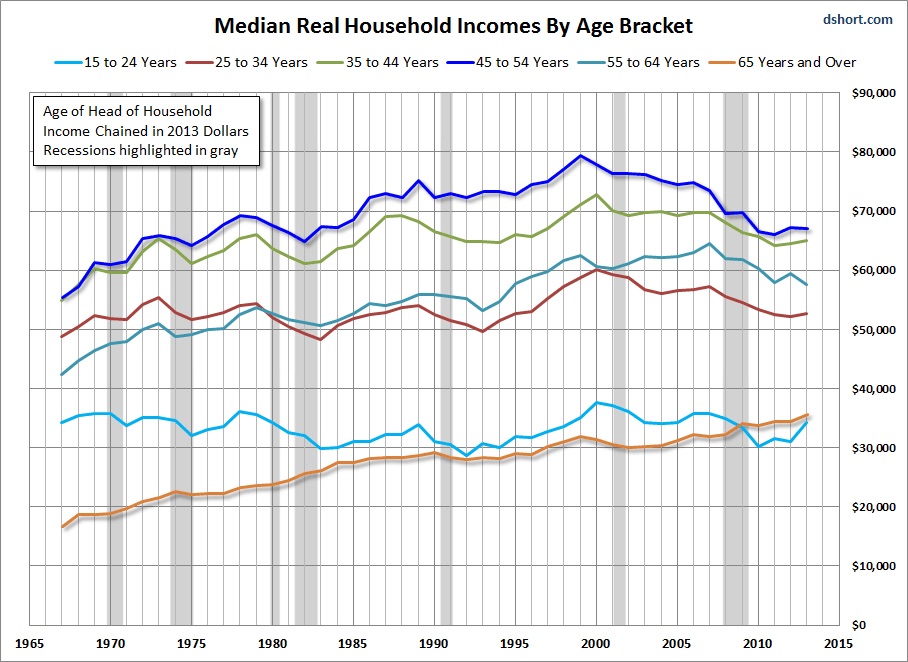 As can be seen, the group suffering the biggest loss, relative to older cohorts at the same age, are those households with heads aged 45-54 in 2013, a mix of late Boomers (for aficianados, this group is called Generation Jones) and early X-ers. But the main point is that median household income is falling for all groups except the 65+ cohort (mostly called Silents in the generation game). Part of this is due to declining household size, but (IIRC) household size has stabilized recently as forming a new household has become less affordable.
Rattner doesn’t mention, even once, the obvious and well-known explanation for the fact that median income is falling while mean income rises. This can only occur if the distribution of income is becoming more skewed, with the top tail (the 1 per cent) benefiting at the expense of everyone else.
EROEI
Among critics of renewable energy, one key idea is that of Energy Returned On Energy Invested (EROEI). The central idea can be illustrated by the case of ethanol produced from corn in the US. It’s argued by critics that the production of ethanol from corn uses more fossil fuel inputs than it displaces. The US Department of Agriculture has an EROEI slightly greater than 1, but it’s still clear that corn ethanol is not going to do much to solve the carbon dioxide problem.
Now lets look at the case of solar PV. The energy-intensive component of a solar PV module is the polysilicon used to produce the wafer, which is produced using an electric furnace. Clearly, if more electricity is used in this process than is generated by cell, EROEI < 1, and the idea does not work. We can do a rough check by observing that a typical wafer uses 5 grams/watt of polysilicon. The cost of polysilicon is $20/kg. To be conservative let's assume this is all electricity, at a cost of 5c/Kwh. Then a quick calculation shows that each watt of PV requires 2 KWh of electricity in production or about 1 year's generation in a favorable location. So, for a panel with a 10-year lifetime, the EROEI is 10. Clearly not much of a problem. The estimate omits the energy costs of the rest of the module, but that's almost certainly more than offset by the conservative assumptions about polysilicon.
Some EROEI fans don't like this calculation. They want to include all sorts of other costs, going as far as the food energy used by the workers who instal the panel. At this point, the exercise becomes one of trying to price all economic activity in terms of energy, an idea that has been tried without success for decades. For everything except energy-intensive activities like smelting, energy costs are a small part of the total, and imputing such costs to any particular energy source is a fools errand.
No regrets
Another quick reaction piece, this time on Obama’s climate policy, for The Conversation. My key observation is that, despite its ambitious goals, Obama’s policy is still in the “no regrets” class. That is, the domestic benefits for the US, disregarding climate effects, outweigh the costs. More over the fold
 John Quiggin