Another Monday Message Board. Post comments on any topic. Civil discussion and no coarse language please. Side discussions and idees fixes to the sandpits, please.
Another Monday Message Board. Post comments on any topic. Civil discussion and no coarse language please. Side discussions and idees fixes to the sandpits, please.
Among other things, the unlamented former autocrat Viktor Orban was one of the leading proponents of pro-natalist policies, and more open than most about the racist underpinnings of his view. However, like others who have tried to raise birth rates, he wasn’t particularly successful. To understand why not, it’s useful to consider the question: how many babies do we want. In particular, since their choices are the relevant ones, how many babies do young women want?
Photo: Filip Mroz via Unsplash
Three distinct concepts are relevant here: the ideal number (a normative answer to a survey question), the intended/expected number (what respondents plan to have or think they will actually have), and the actual number (completed fertility). These diverge in systematic and informative ways.
Start with the ideal. Across most high-income countries, around 50-60% of young women report an ideal family size of two children, with a smaller group preferring 3 and another, smaller group preferring 1, Only a small number see childlessness, or large families of four or more children, as ideal. This has been relatively stable for decades, despite large changes in education, labour markets and gender roles. In Australia, Europe and North America, the modal response is still two, with a minority favouring one or three, and very few choosing zero as an ideal. However, there has been a gradual decline in the mean ideal family size over time, with more women reporting an ideal size of one or zero.
Next, consider intentions When young women are asked how many children they intend (or expect) to have, the number is consistently lower than the ideal, typically by about 0.2–0.5 children on average, and the gap is larger for the youngest cohorts. That is, as ideal family size has declined, expected family size has declined slightly faster. Most importantly it has been below replacement, at least since the 1990s. Expectations are also more sensitive to circumstances. They fall when housing costs rise, when career paths become more uncertain, and when partnership formation is delayed. In other words, expectations embed a constraint set: they are a forecast conditional on anticipated economic and social conditions.
Two further patterns are worth noting. First, the gap between ideal and expected fertility is larger for more educated young women, reflecting steeper career–family trade-offs and later partnering. Second, the share of young women expecting to remain childless has risen, even though very few state childlessness as an ideal.
Finally, actual fertility. This is where the big drops have shown up. Completed fertility for recent cohorts in most OECD countries is now around 1.5–1.7 children per woman, and period TFRs are often lower still, especially after the post-GFC and pandemic shocks. Australia has moved from around replacement (near 2) in the late 2000s to roughly 1.6 or below in recent years. For women currently in their twenties, completed fertility will almost certainly end up below both their stated ideals and their early expectations, unless there is a substantial reversal of current trends. For a while it seemed as if births were merely being postponed, but this does not seem to be be the case any more.
In short, when young women are asked how many babies they want, they still mostly say two. When asked what they expect, they say something less. And what actually happens is less again. For policy, the distinction matters. If the objective were to raise fertility, measures that relax constraints—housing affordability, childcare, predictable career paths, and support for combining work and parenting—are the natural levers.
Changing society to make it more child-friendly is difficult but feasible. Given the massive monetary and labour cost of raising children, no subsidy is going to have a significant effect on ideal or planned numbers. But the removal of constraints like the absence of childcare can reduce the gap between palnned and actual births.
Other constraints are harder to fix. Most importantly, plans for having children commonly anticipate a stable life partnership, which cannot be guaranteed. The same is true of fertility problems. Finally, for some parents, the experience of having a first child is traumatic as a result of health problems, postpartum depression or the failure of the transformative experience of parenthood to offset the loss of freedom it entails. The result, often, is a decision to stop at oen
With better institutions and economic policy, it might be psssible to reverse the increase in the gap between intentions and outcomes that has occurred this century. That might raise births by between 0.2 to 0.3 children per woman. That’s not enough to push fertility above replacement. But it would rule out the collapse scenario we see in places like South Korea, where the combination of patriarchal norms and a modern economy makes childbearing an unappealing choice for most young women.
Another Monday Message Board. Post comments on any topic. Civil discussion and no coarse language please. Side discussions and idees fixes to the sandpits, please.
As I approach formal retirement from my academic job, I’m still thinking about ideas in my main theoretical field of decision theory. But I’ve largely lost interest in publishing journal articles, leaving the chore of dealing with Manuscript Central and other robotic systems to my younger co-authors in the case of joint work, and not submitting many of my own. I’ve also gone retro on reviewing. If I’m invited to review a paper, I write back to the editor and offer to do the job as long as they send me the manuscript directly.
That distance from the process provides me with a somewhat different perspective on how Large Language Models (LLMs) are changing things. The rise of LLMs combined with the growth of the global university sector and the dominance of a “publish or perish”[1] has inevitably produced a flood of AI-generated slop which threatens to overwhelm the whole journal process, especially when AI is also being used to generate referee reports.
John Quiggin’s Blogstack is a reader-supported publication. To receive new posts and support my work, consider becoming a free or paid subscriber.
But will it always be slop? I’ve been trying out various LLMs, including OpenAI Deep Research and, more recently, its French competitor Mistral. I recently used DR to write a piece in the format of a journal article, though I have no plans to submit it anywhere.
I was interested because Hempel’s work is adjacent to my main remaining research project on reasoning with bounded awareness. And, I love me a good paradox.
The paradox runs as follows. Suppose we want to make a probability judgement about the claim “all ravens are black”. Every time we see another black raven, we count this as confirmation of the claim. But, as Hempel observes, “all ravens are black” is logically equivalent to the contrapositive “every non-black thing is not a raven”. When we observe, for example, a white shoe, we should increase our belief in the contrapositive, and therefore in the original claim.
Black raven and white snow, public domain image via pikist.com
This seems obviously wrong, but the majority view of the philosophers who’ve written on the subject is that we should, indeed, increase our belief in the blackness of ravens very marginally upwards whenever we see a non-black non-raven. It’s easy enough to come up with what seems like a refutation, along the following lines “Consider a world with one raven and one shoe. Each may be black or non-black. If the colour of the shoe is independent of the colour of the raven, observing the shoe tells us nothing about the colour of the raven”
I tried this out on Deep Research, and it turns out that this isn’t a new argument: a more complicated version was put forward by I.J. Good (a collaborator of Turing, and early predictor of superhuman AI), back in the 1960s, but didn’t settle the dispute. Here’s an updated statement of the problem from Branden Fitelsen
DR put up a vigorous defence of the mainstream position, and forced me to refine my position, as well as giving me lots of useful references, in a part of decision theory with which I’m not so familiar. However, as is usual with LLMs, and despite the shift away from the sycophancy that used to prevail, DR eventually came around to my way of thinking.
My final position was that the paradox reflects the impossibility of Hempel’s core project of deriving probability judgments independent of any model of the world. I saw the analogy to a similar project that was popular in economics in the 1980s, vector autoregression. It was claimed to be theory-free, but actually depended on (often implicit) identification assumptions, that is, the way in which variables are introduced into the estimation process.
What have I learned from this episode? Most notably, there is a version of vibe coding here. Starting with an idea, which might or might not be original, it’s now pretty easy to turn it into a working paper that looks like the standard product, including citations [2]. That’s a good thing for the growth of knowledge, but it is going to create huge problems for the use of journal publications as a credential by academics seeking employment or tenure.
Instead of just AI slop, journals are going to be faced with increasing volumes of papers that are plausibly publishable. In fields like economics and philosophy that will mean increasing rejection rates from their current absurdly high levels (above 90 per cent anywhere decent) to the point where acceptance or rejection is a lucky dip, or else the result of insider connections (for example, I saw this paper on the US seminar circuit and I know the author is a good fellow)
It’s also important to remember that while LLMs are causing big changes, they are a continuation of a process that’s been going on steadily at least since 1970 (it seemed brand-new when I started university in 1974). Innovations around that time were citation and keyword indexes (big thick books in tiny print) and survey/review journals like the Journal of Economic Literature. Then came the Internet. Even though it hasn’t lived up entirely to its early promise, Internet access has massively reduced the gap between the core and the periphery of the academic world, at least to the extent that the gap reflects communication problems. For me, as an Australian not particularly keen on international travel, this has been transformational.
In some ways, it’s a pity to be leaving the academic game when such marvellous new tools are available. In other ways, I’m glad to have done my work without worrying about whether I would be replaced by a computer program. But either way, LLMs aren’t going away and we will have to work out a way to live with them.
fn1. Although that’s a pejorative, I’m not a fan of the norm, dominant in philosophy and most of economics, of publishing only a few articles (say, one per year) and only in the very top-rated journals. As was once said of me, I embody the primal urge to publish, and used to turn out articles by the dozen. But now that we have blogs, Substack on so on, I can satisfy my need to express my views on every topic without the tiresome process of dealing with referees (I now deal with comments, but I can respond to these or ignore them as I please).
fn2. As some recent examples have shown, you need to check these. But that was always good practice, if not universally followed – a lot of citations I’ve seen turn out to be cut and pasted from earlier papers, propagating errors along the way. And the replication crisis has turned up numerous examples of papers being cited after they were retracted.
A couple of weeks ago, just before my 70th birthday, I completed the Mooloolaba standard distance triathlon (1,500m swim, 40km cycle, 10km run). There was nothing exceptional about my performance, placing 1,509 out of 1,730 overall and 14th out of 18 in my 65-69 age category.
But not that long ago, it would have been exceptional. Until about 1980, competitive sport for those over 70 was restricted largely to golf and lawn bowls. Until the 1990s, there wasn’t even a category for 70-year-olds in most competitive triathlons. The small number of competitors over 65 were lumped into a single category. The first 70-year-olds recorded as completing the demanding Kona Ironman event in Hawaii (3.8km swim, 180km ride, 42.2km run), to which I still aspire, were Hiromu Inada (male) and Ethel Autorino (female) in the year 2000.
What’s true of triathlons is true of endurance sports in general. Older athletes seem to be becoming more numerous, and also quite a bit faster, across a wide range of sports.
One example is the rise of parkrun, the weekly timed 5km run which has grown virally since it began in the UK in 2004. Tens of thousands of Australians over 70 have completed at least one parkrun and cursory review of the published results suggests a thousand or more turn out on an average week.
This reflects a broader change, with studies indicating an increase in physical activity among older Australians. The proportion of adults over 65 in Australia who were insufficiently physically active fell from 72% to 57% between 2017-18 and 2022.
This hasn’t changed the way we talk or think about the over-70 population. People are still classified as “older” or even “elderly” (a term more redolent of walking frames than running shoes) as early as 65, even though they are now expected to keep working until they are 67.
This has an impact on discussions around health and aged care. In 1980, Australians who reached the age of 70 could expect to live another 12 years or so. Today, they (in my case, we) can expect to live another 17 years on average, with more than half surviving to 80.
The assumption that the 80-year-olds of today will have the same health needs as those of the past implies a big increase in health care costs. But increased survival rates mean that old people today are healthier on average than people of the same age in the past.
Most 70-year-olds are much less likely than those in the past to have smoked. When combined with increased physical activity, the result has been a drop in the incidence of coronary heart disease, a major cause of both death and disability.
The Australian Burden of Diseases Study (2024) reported that while life expectancy at age 70 rose by about two years between 2003 and 2024, the expected time spent in ill health rose by as little as six months.
The trends we are seeing are better understood not as an “ageing population” but as a gradual stretching of the lifespan, with most milestones being reached later and later. Young people study longer and form households later, a fact reflected in the current rental crisis. Prime-aged adults, who were retiring earlier and earlier until recently, can now expect to work well into their 60s.
And, while the inevitable end comes for us a bit later than it used to, the process hasn’t changed much. Most people retain moderately good health until their last few years, before declining rapidly. Few spend more than a couple of years in residential aged care, with only a small fraction of that involving high-intensity care.
I’m old enough to be thinking about this future fairly regularly. For the moment though, I’m more focused on my imminent graduation into the 70-74 category, where I will be among the youngest (or least old) competitors, and a serious chance at a podium finish.
Another Monday Message Board. Post comments on any topic. Civil discussion and no coarse language please. Side discussions and idees fixes to the sandpits, please.
Another Monday Message Board. Post comments on any topic. Civil discussion and no coarse language please. Side discussions and idees fixes to the sandpits, please.
Another Monday Message Board. Post comments on any topic. Civil discussion and no coarse language please. Side discussions and idees fixes to the sandpits, please.
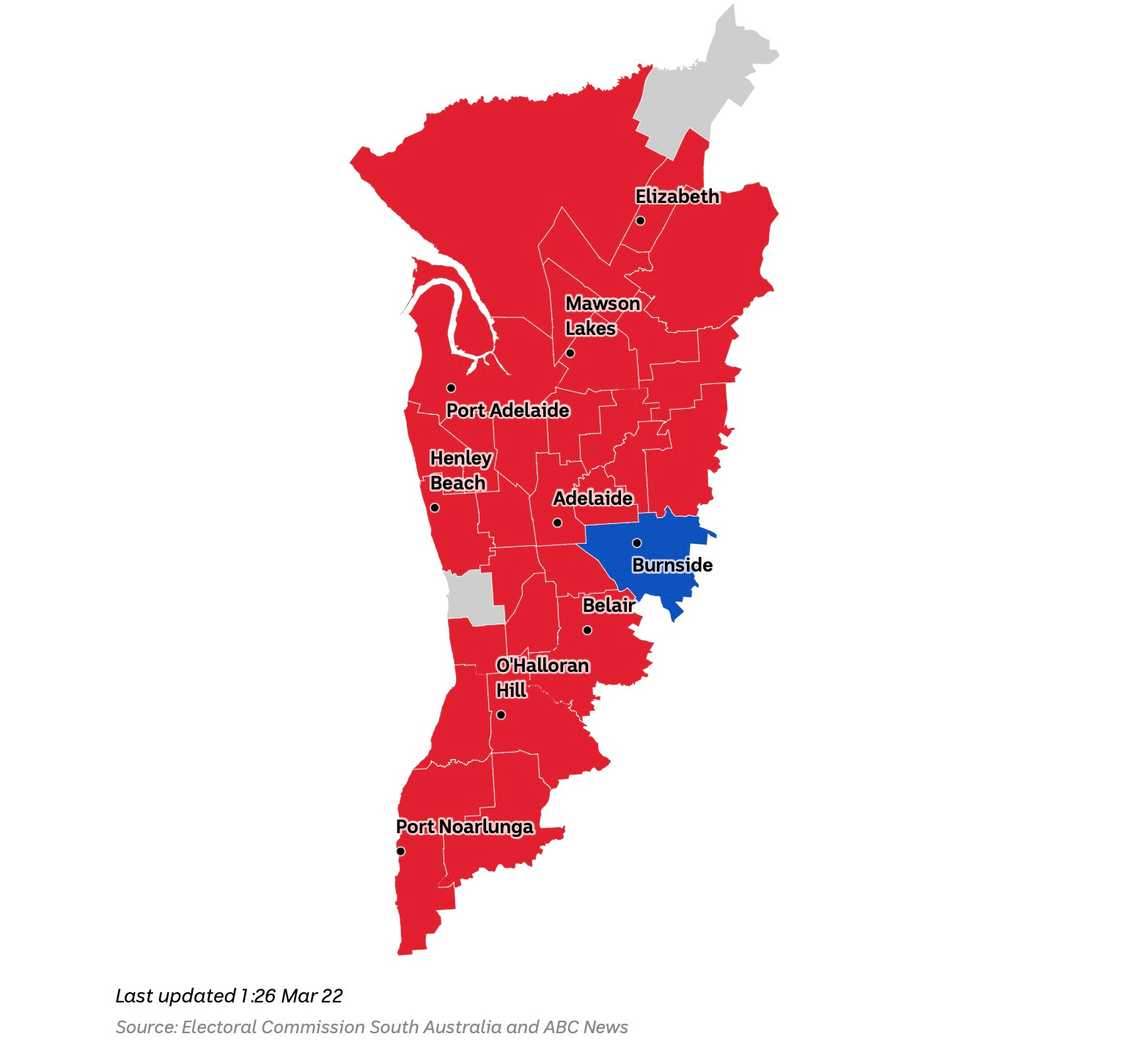
The South Australian election is done, and the results were very close to the predictions of the polls. Labor won a crushing victory, while One Nation [international readers, see note below] got more votes than the Liberals, though probably only one or two seats. Rather to my surprise, Labor finished third in lots of regional seats, and their preferences will push the Liberals over the line.
Meanwhile, the Liberals were wiped out almost completely in metropolitan Adelaide, commonly finishing fourth behind Labor, One Nation and Greens. For a party that was in government only four years ago, and won the two-party vote several times this century, this is a truly appalling result.
Despite much confused talk about “left behind” voters, the rise of One Nation, reflected in the South Australian election represents, quite simply, a split in the Liberal Party. Although it is not always safe to interpret changes in total party votes as shifts from one party to another, the evidence in the South Australian case is overwhelming. In almost every electorate, the rise in One Nation in support is exactly matched by a decline for the Liberals, while Labor and Greens are largely unchanged.
This is part of the broader global decline of rightwing “hard neoliberalism” which I first analysed back in 2016. Throughout the period of neoliberal dominance, the mainstream right relied on the votes of people who didn’t care much for free markets, but cared a lot about being the dominant identity in society. Since the GFC, the power balance has reversed, and dominant identity politics is in the ascendant. The archetypal representative of this group (emerging just after I first wrote the piece) is Donald Trump.
Most of these identity voters have not been “left behind” in an economic sense. On the contrary, One Nation gets its strongest support (above 30 per cent) from voters over 65, who are largely insulated from the economic shocks that affect those in insecure employment. Age pensions are indexed to the higher of CPI and wages, and are much more generous than unemployment benefits. Those with superannuation benefit from strong returns to capital. The only group of old people with significant exposure to economic shocks are the minority who don’t own their own home, and have no income besides the pension.
One Nation’s voters are people who in Andrew Hastie’s words, don’t recognise Australia as the country they grew up in. Like Tony Abbott, they are nostalgic for the days of the White Australia policy, when such anti-migrant prejudice as existed was directed against Italians and Greeks.
And Hastie’s comment reveals the fact that there is now no significant policy gap, between One Nation and the now-dominant right wing of the Liberal-National coalition. Both want (mostly unspecified) cuts in immigration, oppose any kind of action on climate, and trade in anti-Islamic rhetoric. But One Nation is loud and offensive, while the LNP tends to trade in euphemisms.
The convergence has been accelerated by the rise of community independents (“teals”) in formerly conservative areas. As well as replacing much of the moderate section of the Liberal party this trend has resulted in the Liberals adopting increasingly anti-urban rhetoric, once confined to complaints about the “inner city”.
The Liberal shift to the right is particularly evident in South Australia where the Christian nationalist faction led by Senator Alex Antic has crushed what remained of the moderate liberal tendency going back to Steele Hall and (in his way) Sir Thomas Playford. By contrast with this group, One Nation looks positively leftwing, advocating medicinal cannabis and having little interest in the Christianist agenda on abortion, voluntary assisted dying etc.
The big disappointment so far has been the absence of a comparable upsurge on the left. The Greens have held and slightly increased their share of votes (around 12 per cent) while others disillusioned with the major parties have gone for community independents.
In part, this reflects the responses of the incumbent parties to challengers. The Liberals have normalised One Nation, and shifted policies closer, effectively giving their own voters permission to switch. By contrast, Labor has ruthlessly demonised Greens, and has made as few concessions as possible, even though Greens policies are those put forward by Labor until recently. It’s clear which of these is working better politically.
I’ll write more about how the Greens should change their approach. But for the moment, I’ll just enjoy some quiet schadenfreude/
What is One Nation ?
Officially named Pauline Hanson’s One Nation, the party has a lot of similarities to Geert Wilder’s Party for Freedom in the Netherlands. Like Wilders, Hanson was originally a member of the main Australian conservative party (confusingly called the Liberals). She was expelled in the late 1990s for her racist views, and formed her own party, with great initial success. Also, both parties have been run by their founders, with no real party structure. Under current rules, Hanson is party President until she chooses to resign, and to choose her successor, who may also continue until resignation. The result has been a long series of splits and defections, with members elected on the One Nation ticket departing to become independents or else to form short-lived micro-parties.