This is one of the most depressing Australia Days I can remember. We are still recovering from the horror of the Bondi massacre and the disgraceful jostling for political advantage that followed it. Meanwhile, the news is that opposition is hardening on changing the date to one less offensive to First Nations people. The actual shifts aren’t that great in statistical terms, but there’s no doubt that this shift, along with the rise of One Nation reflects something real.
In part what we are seeing is the global collapse of the “centre-right” and the ideology I’ve called “hard neoliberalism”, a combination of privatisation, pro-rich tax cuts and attacks on workers rights. For decades, hard neoliberals relied on the votes of the 20-30 per cent of the population who are consistently racist, but delivered little more than gestures. Now, with the failure of neoliberalism evident to all, the boot is on the foot. The racist right now dictates terms to the remaining neoliberals. We see this most obviously with Trump, but it’s happening in much of Europe as well. Germany is one of the few places where the mainstream right has (so far) held the line against doing deals with parties like AfD.
In Australia, the former coalition made their deal with the devil when they decided to preference One Nation ahead of Labor. Now they are paying the price. The Nationals will either be wiped out by One Nation or forced to merge with them. Either way, and assuming Labor wins again, the opposition in the next parliament will be dominated by overt racists.
Coming to Australia Day specifically, it’s unsurprising that the right is hardening its position. The bigger problem, as usual, is the failure of leadership from Labor and, more specifically Anthony Albanese. Having bungled the Voice referendum, he has walked away from any serious efforts at reconciliation with First Nations and from any attempt to redefine Australia’s position in the radically changed world brought about by Trump.
I can’t see any good outcomes here, at least in the short term. Until Albanese and Marles are gone, we will have no leadership from this government. That’s not going to happen soon, even if Albanese’s popularity continues to decline. And while Chalmers seems more aware of what is going on, there’s no guarantee he would be radically different. Plibersek could once have been an alternative but she has been fatally compromised by her stint as minister for environmental destruction. The same is true of Wong, leaving aside the problem that she is a senator.
The only consolation, looking at the world scene, is that things could be a lot worse. This is still a great country, even if our political class does not reflect the fact.
The Australian government’s legislation seeking to ban access to social media for people under 16 has received plenty of attention in International media, mostly leading with the government’s that 4.7 million accounts were banned or deactivated when the legislation came into effect. Rather less attention has been paid to discussion of the outcome within Australia, where the consensus is that there has been very little effect for most. With most kids still active, the minority who have been caught by the ban have suffered feelings of ostracism and exclusion When discussing the issue on my own social media (which had few if any teenage readers to begin with) I’ve only had one parent report their kids being thrown off.
As part of my critique of pro-natalism, I’m looking at the philosophical foundations of the idea. Most of the explicit discussion takes place within the framework of consequentialism (the idea that the best actions or policies are those with the best consequences) and particularly of utilitarianism, broadly defined to say that the best consequences are those which maximise some aggregate function of individual happiness or wellbeing. Other philosophical traditions either avoid the issue explicitly (for example Rawls’ theory of justice) or offer little that can illuminate debate over population numbers (virtue ethics, contractarian theories).
Looking at the utilitarian analysis immediately creates a puzzle. All the early utilitarians, from Jeremy Bentham to John Stuart Mill supported population limitation. They accepted Malthus’ claim that, in the absence of limitation, population growth would inevitably reduce the great majority of people to subsistence. But unlike Malthus, who used this argument to say that attempts to make the poor better off were futile (he rejected birth control as “vice”) the early utilitarians accepted the desirability of limiting family size.
Most notable among this group was Francis Place. Taking significant legal risks in the repressive climate of the time, Place sought to spread information about contraceptive methods in pamphlets such as Illustrations and Proofs of the Principle of Population(1822).
Importantly, and in contrast to many 20th century Malthusians, Place rejected coercive measures, placing his trust in families to make prudent decisions given access to information and the methods of family planning. Except for his failure (unsurprising at the time) to consider possible conflict within households, Place’s position stands up very well 200 years later.
The classical utilitarians argued for public policies which promoted the welfare of the community to which they applied, on the basis of “each to count for one, and none for more than one”. This contrasted sharply with alternative guides like “national greatness” or “God’s laws”. And, while no philosophical debate is ever resolved, this way of thinking about policy choices (particularly economic policy choices) has remained dominant, or at least influential, down to the present day.
By contrast, contemporary utilitarian philosophy yields bizarre spectacles like “longtermism” which implies that our primary goal should be to produce as many descendants as possible provided that the result is an increase in aggregate utility.
This is far from the only problem with contemporary utilitarian philosophy. It’s commonly presented as a theory of individual ethics, saying that our actions ought to be those which promote the maximal happiness of everyone affected, giving ourselves the same weight as everyone else. Apart from being impossibly demanding, this prescription seems perfectly designed to produce absurd counterexamples (trolley problems, organ kidnapping etc)
The task of tracing where and when a tradition of thought has gone off the rails is usually complex and ambiguous. But in this case, the answer is amazingly clear. in 1874, one year after the death of JS Mill (the last of the classic utilitarians), Cambridge philosopher Henry Sidgwick published The Methods of Ethics, which became the standard interpretation of utilitarianism, at least in the philosophical literature
In the space of a few pages, Sidgwick introduced all three of the errors I have criticised above,
First, (Book IV 1.1) he states, “By Utilitarianism is here meant the ethical theory, that the conduct which, under any given circumstances, is objectively right, is that which will produce the greatest amount of happiness on the whole; that is, taking into account all whose happiness is affected by the conduct. ”
Second 1.2 “on Utilitarian principles, population ought to be encouraged to increase, is not that at which average happiness is the greatest possible,—as appears to be often assumed by political economists of the school of Malthus—but that at which the product formed by multiplying the number of persons living into the amount of average happiness reaches its maximum.”
Sidgwick asserts these points, but doesn’t really argue for them . Rather, his style of presentation is tight and rigorous, at least by the standards of 19th century philosophy and his tone is authoritative. The result is that even among philosophical critics, most notably GE Moore, his version of utilitarianism became established as the norm.
Superficially, it might seem that modern social welfare theory has taken Sidgwick’s approach and given it a mathematical formalism. The standard workhorse of this model, the social welfare function, is an aggregate of individual welfare measures, with properties that ensure that the higher the value of the function the better the outcome. But this function is invariably applied in ways that reject Sidgwick’s errors. First, it is used to evaluate public policy, typically in the context of models that do not assume individuals act as disinterest utilitarian ethicists. Second, it is applied to specific fixed populations. Where comparisons are made between populations, they are almost invariably presented in average rather than aggregate terms.
There are plenty of arguments to be made against the utilitarianism of Bentham and Mill. But the starting point for such arguments ought to be a complete rejection of Sidgwick’s errors.
The events of 2025 have broken the world order that had prevailed throughout this century.
The United States has abandoned any pretence of upholding rules-based trade. Its longstanding refusal to allow the filling of vacancies on the WTO’s Appellate Body has left dispute settlement inoperative, with more than 50 members relying instead on the Multi-Party Interim Appeal Arbitration Arrangement (MPIA) as a substitute.
US trade agreements with Australia and many other countries have been broken with the imposition of across-the-board tariffs. As a result, other economies, such as Canada and the European Union, are now seeking to rebuild trade patterns to work around the United States.
The world is recognising that reliance on either China or the United States is a dangerous mistake. Australian policy thinking has yet to adjust, still starting from the premise that the world is dominated by the two great powers, and that Australia’s task is to find an appropriate balance between them.
In reality, neither the United States nor China is as dominant as they appear in these discussions. Though they are easily the largest individual countries, between them they only account for approximately 20 per cent of the world’s population and 30 per cent of global economic output.
The United States and China command massive military forces. But so far, this has done them little good. Attempts by the United States to solve problems with military power — most recently by confronting Houthi attacks on shipping in the Red Sea — have proved ineffective. China has wisely refrained from anything more than ‘grey zone’ sabre-rattling, and confident predictions of an assault on Taiwan as early as 2026 have largely been forgotten.
China and the United States account for just over a third of Australia’s trade in goods and services. Measures of soft power are even more striking. The United States and China ranked fourth and fifth among Australian travel destinationsin 2024–25, behind Indonesia, New Zealand and Japan. This data, captured in June 2025, only partially accounts for the decline in travel to the United States following the re-election of Donald Trump.
The United States continues to dominate popular culture in Australia but is declining elsewhere in the region with the rise of rivals like K-Pop music and Bollywood films. China has long punched below its weight in soft power and, despite the short-lived fad for Labubu, this seems unlikely to change.
None of this would matter much if, as in the days of the Cold War, the United States and China offered competing economic and social models that others aspired to emulate. Broadly speaking, the United States has accepted the Chinese Communist Party view of the world — one in which markets are to be exploited and democracy is a weakness. Both countries are now in the process of becoming personal dictatorships, with success in business depending as much on cultivating the right political connections as on market competition. To put it simply, the United States and China now offer variant forms of crony capitalism.
This is unlikely to change any time soon. On all indications, and in the absence of any major crisis, Chinese President Xi Jinping is effectively president for life. When he passes on, succession is unlikely to be orderly or predictable. As for the United States, Trump has already indicated his intention to run for a third term and his determination to ensure that any future election will produce a Republican Party victory. He may or may not succeed, but in any case, the United States is highly unlikely to return to pre-Trump normality.
Responding to these developments, the rest of the world is gradually moving to disengage from both the United States and China. For ASEAN, this disengagement involves ASEAN countries no longer acting as entrepots, facilitating the transhipment of goods from China on their way to the United States. Trump’s tariffs have rendered this model unviable, without offering a satisfactory alternative. The only way forward for ASEAN is through the expansion of trade within the region and with other non-aligned partners.
Unlike its ASEAN neighbours, Australia’s Anthony Albanese government has so far sought to ignore the realities of the world in which Australia now lives. Its central focus is the Australia–United Kingdom–United States (AUKUS) agreement, signed in 2021 at a moment of high tension with China, and now an untouchable icon of domestic politics. AUKUS locks Australia into a world view dominated by the US–China rivalry, with a side order of British Empire nostalgia.
But sooner or later, Australia must break with great power rivalry and seek a future based on cooperation with other small and medium-sized countries, which collectively matter more for Australia’s future and for the good of the new global order
TL;DR Not good. Taking account of economic failure, nothing Trump has done – rape, war crimes, corruption, insurrection, ICE or trashing the constitution – has cost him a single vote on balance.
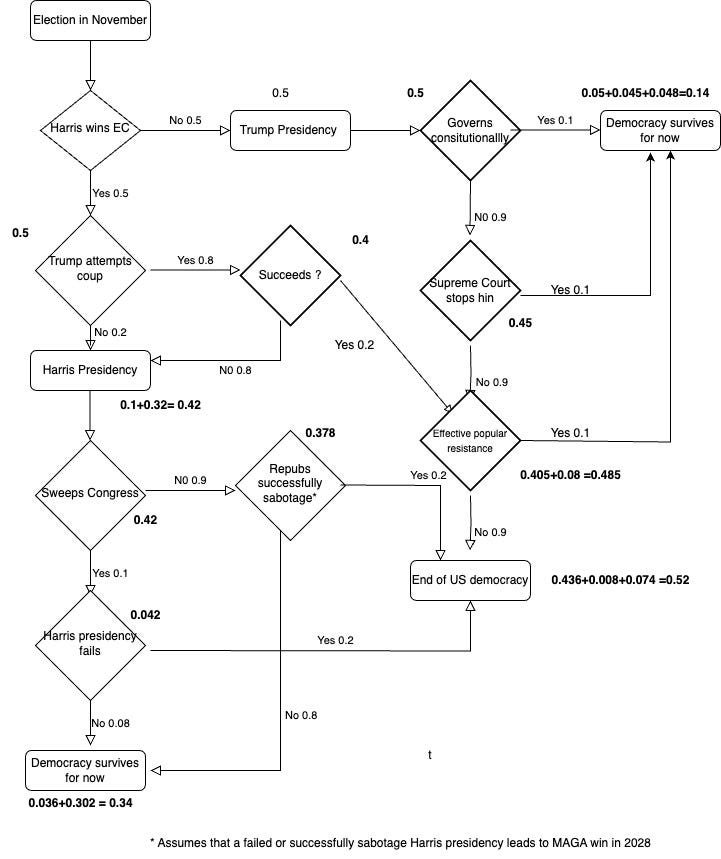
In a flowchart prepared before the 2024 election, I gave US democracy a 30 per cent chance of surviving a Trump election win. This was broken down as 10 per cent that Trump would govern constitutionally, 10 per cent that the Supreme Court would stop him and 10 per cent that he would face effective popular resistance. Obviously, the first of these didn’t happen. And while the Supreme Court has occasionally ruled against Trump, it has more helped him by overturning lower court judgements.
That leaves popular resistance, including both the public as a whole and institutions like the media, law firms, big business and universities. The level of acquiescence, or outright collaboration from the institutions, with the partial exception of universities, has exceeded my most pessimistic expectations. For me, as a lifelong Apple fan, the sight of CEO Tim Cook fawning over Trump while he handed over protection money was particularly galling, but Wall Street and Big Law have been just as bad
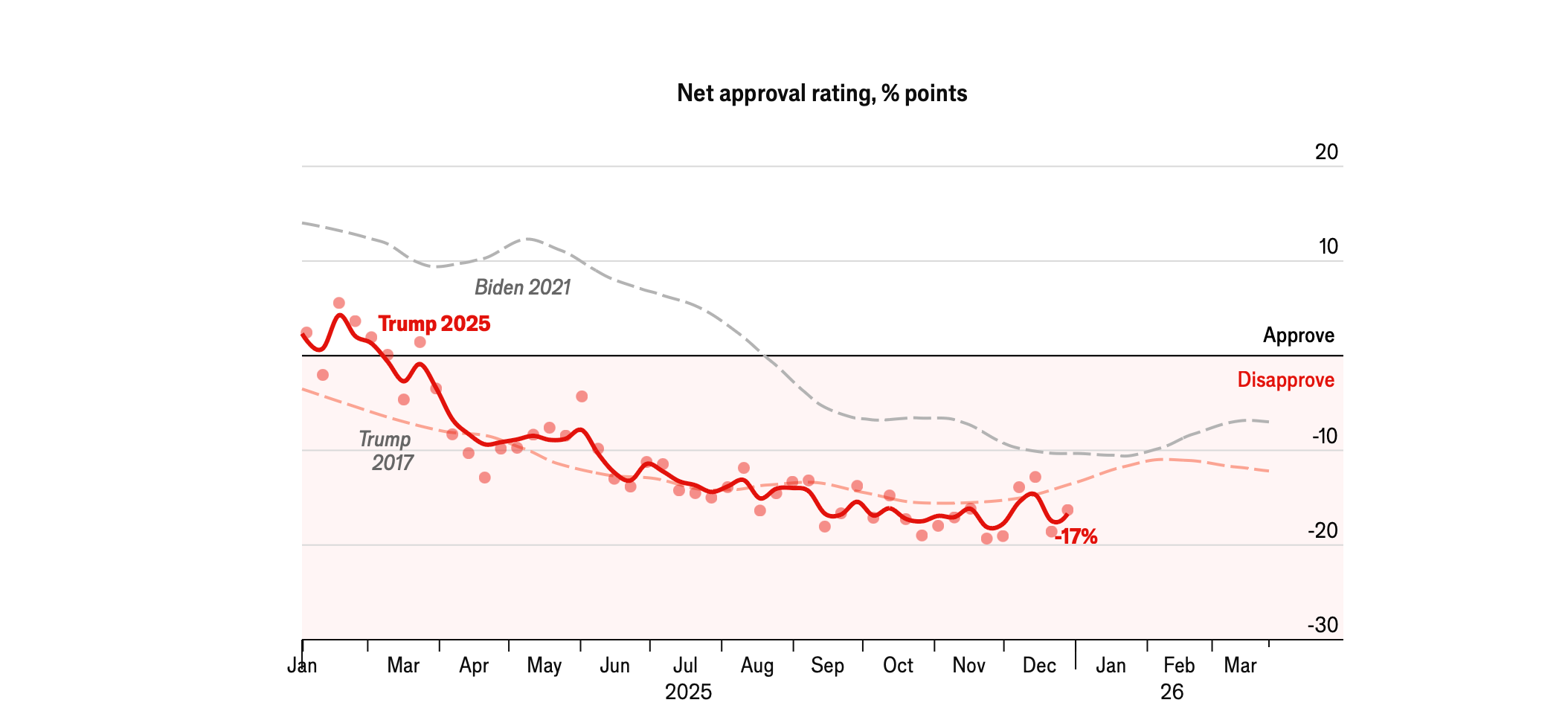
As regards the public at large, optimists have taken heart from the fact that Trump’s popularity has dropped sharply from the 49 per cent he won at the 2025 election. But the drop is about what would be expected for a president of either party who ran on a promise of lower prices and failed to deliver. Trump’s decline almost exactly parallels Joe Biden’s, as well as Trump’s own first term
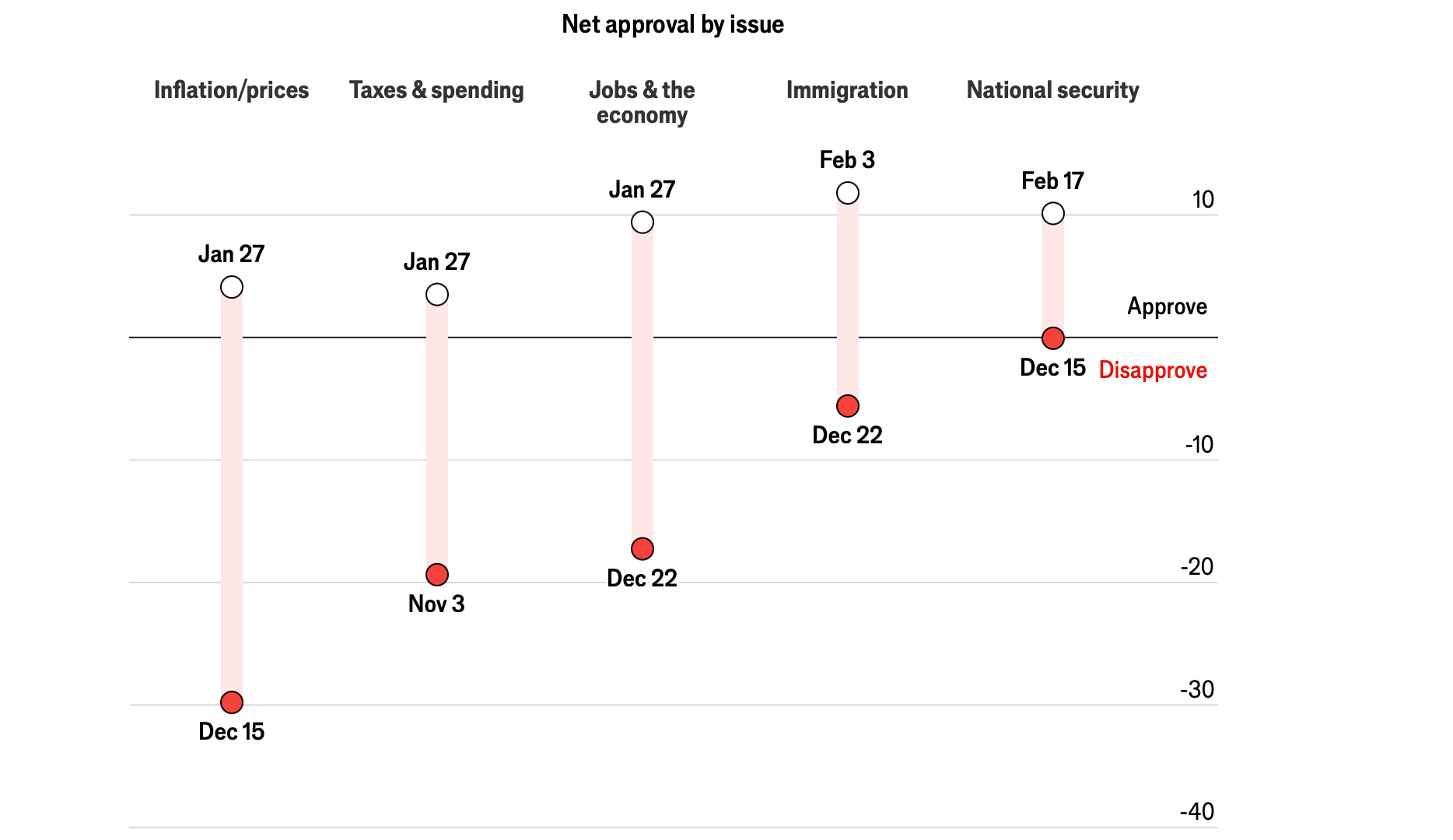
Putting this as sharply as possible, once you take account of economic performance, nothing else Trump has done – rape, war crimes, corruption, insurrection, megalomania, secret police or trashing the constitution – has cost him a single vote on balance. An issue-by-issue analysis for The Economist supports this. Trump is deep underwater on the issue of inflation, but has barely lost any ground on national security and immigration since the election. And his support among Republicans remains rock solid.
The big problem Trump faces in 2026 is that of the mid-term elections to be held in November. Under normal circumstances, the party of a relatively unpopular incumbent would lose. And this would set the stage for the successor to a term-limited incumbent to be defeated in the subsequent presidential election. The incumbent would then retire to write his memoirs, give speaking tours etc.
But it’s obvious that a Democratic presidency with control of Congress would put Trump and his cronies in grave danger. Even if Trump could not be criminally prosecuted, and even with liberal use of the pardon power, he would surely be subject to civil actions of all kinds and state-level prosecutions which (hopefully) would not be bungled. The problems for cronies would be even greater.
For that reason, it’s highly unlikely that Trump will willingly accept a mid-term defeat. Can he prevent it? His first attempt to stop the outcome, taking gerrymandering to extremes, proved counterproductive when California Democrats responded in kind. And it’s unlikely that the usual long-standing forms of voter discouragement will be enough to change the outcome. That leaves two possibilities: forcible suppression using ICE or military forces, and annulment of results.
Trump somewhat botched the first option with his order of troops into US cities, which achieved nothing and undercut any basis for invoking the Insurrection Act. Even the Supreme Court rejected his attempts to establish control over state-level national guards against the wishes of governors. But there are still plenty of possibilities. For example, ICE could be mobilised to arrest Hispanic voters on the suspicion of being illegal immigrants and detaining them long enough to stop votes being cast. Or mail-in ballots could be seized and destroyed on some pretext or other.
Alternatively, Trump could direct Republican officials to “find” the necessary votes to deliver the desired outcome in close contests, as he tried to do in Georgia in 2020. While Secretary of State Brad Raffensperger resisted that time, it’s doubtful that many Republican officials would do so now.
Finally, the current speaker Mike Johnson could seat Republican losers in place of elected Democrats. The only limit here is the willingness of the House of Representatives to countenance such an action. With a slim majority in the existing House, there would be a risk of defection.
Looking at this, it struck me that Trump could make Johnson’s task easier by detaining enough Democrats to ensure the vote went the right way. When I searched on whether this was possible, I received the reassuring answer that members of Congress are protected by privilege and that arresting them would be a felony, “except in cases of treason, felony or breach of the peace”. The last of these exceptions seems broad enough to drive a truck through. And, when I asked what remedy was available, the first answer was “impeachment”, which was grimly amusing. More promising options are actions under habeas corpus, but as recent cases of arbitrary arrest have shown, the government can drag its feet over such actions for a long time.
Successful suppression of the voters’ will in the mid-terms would clearly mark the transition of the US from democracy to dictatorship. A “normal” election or successful resistance to suppression would allow some breathing space, but would still imply an uphill battle for the remainder of Trump’s (current) term.
Overall, I’d say that the probability of US democracy surviving past 2028 is a little better than the 10 per cent implied by by my 2024 flowchart, but still well below 50-50.
This came out in The Conversation, a while ago, but I didn’t get around to posting it here. I’m posting my original version, which includes a discussion of vapes
Few Australians can have failed to notice the proliferation of tobacconists and “convenience stores” in the last few years. And most of us are aware that these stores aren’t making much from the limited set of offerings on public display. Rather, their profitability comes from under-the-counter sales of untaxed tobacco and illegal vapes.
The growth of illegal tobacco sales has reached the point where the national accounts produced by the Australian Bureau of Statistics have been significantly distorted. The ABS has announced that it is taking steps to “measure the consumption of illicit nicotine related products to supplement existing measurement. ”
Before looking at how this decision will affect the national accounts, it’s worth asking how we got here. The short answer is that, over the past decade or so, tobacco excise has been steadily increased to the point where there are big profits to be made from dodging the tax.
But that’s not the whole story. Taxes on spirits have also been raised substantially, yet we haven’t seen a return of the “sly grog” shops that were common in Australia until the 1960s, when 6pm closing of pubs was abolished. And despite heavy taxes on gambling, illegal casinos seem to be a thing of the past.
What explains this difference? The sale of alcohol and gambling services is subject to licensing restrictions, managed by state authorities and enforced by police specifically allocated to these duties. By contrast, until very recently, nicotine products have been treated as normal grocery items. Enforcement has been left to health inspectors with many other duties and very limited powers. A store found to be selling illegal cigarettes might get a warning, or at worst, a 24-hour closure.
The Australian Taxation Office, along with the Australian Border Force, makes serious efforts to prevent illegal importation of tobacco products as well as seizing tobacco crops grown here. But it appears unable or unwilling to do much against retailers who sell cigarettes under the counter.
State police forces have been similarly unwilling to enforce the law in this respect. Their reluctance here contrasts with the reasonably effective licensing enforcement discussed above and with the positively draconian measures taken against suspected users of drugs like ecstasy, which are less dangerous than tobacco.
State governments have gradually tightened up the law, and have begun shutting down tobacconists found to be breaching it. But the imbalance between the incentive to dodge the tax and the risks of being caught remains. Until it is resolved, the federal government would do well to defer further increases in taxation.
Another measure that would help to resolve the problem is the abandonment of the anomalous policy under which vapes (legally available only from pharmacists, many of whom are unwilling to supply them) are more severely restricted than cigarettes and loose tobacco. The aim here was to prevent the arrival of a new form of nicotine, but that horse has well and truly bolted by now.
A question that remains open is whether the growth of illegal tobacco has led to an increase in smoking. Evidence here is mixed. AN AIHW survey in 2022-23 showed a continued decline in smoking with an increase in vaping. However, a more recent Roy Morgan survey suggests an increase of smoking among young people as a result of the vaping ban
Now, back to the ABS. The objective in producing national accounts statistics like Gross Domestic Product (GDP) is to measure economic activity, giving a guide as to whether the economy is operating at full capacity. As critics have often pointed out, this measure pays no attention to whether the production being measured is socially desirable, neutral or harmful. Similarly, the ABS has always been aware that not all economic activity is legally recorded.
The solution, in the past, has been to add an adjustment of 1.5% to official measures, to take account of unrecorded activity. There hasn’t been a perceived need for anything more detailed. But with untaxed and unrecorded products now accounting for around half of all tobacco consumption, this ad hoc adjustment is no longer sufficient. The ABS estimates that growth in final household consumption expenditure has been underestimated by more than 0.5 percentage points over the past year, which is a big deal given that the typical annual change is around 5 per cent.
Finally, it’s worth noting that this isn’t the only issue the ABS is looking at in response to an ever-changing economy. As more and more households meet their electricity needs through rooftop solar, the ABS has faced a conceptual issue. This might be thought of as household production, like growing your own vegetables or cooking your own meals, which isn’t counted in GDP. But the ABS has decided it’s between to regard solar rooftops as a home-based small business, whether the electricity is self-consumed or fed back into the grid.
As distinctions between home and work, and between licit and illicit production become increasingly blurred, statisticians will need to make more and more judgements like this.
How my AI report on housework started well, then went off the rails
I’ve long been interested in the topic of housework, as you can see from this Crooked Timber post, which produced a long and unusually productive discussion thread [fn1]. The issue came up again in relation to the prospects for humanoid robots. It’s also at the edge of bunch of debates going on (mostly on Substack) about living standards and birth rates.
I’m also interested (like nearly everyone, one way or another) in “Artificial Intelligence” (scare quotes intentional). My current position is, broadly, that it’s what Google should have become instead of being steadily enshittified in the pursuit of advertising dollars. But I’m alert to other possibilities, including that more investment will deliver something that genuinely justifies the name AI. And I think a lot of the concerns about power and water use, the spread of AI slop and so on are either overstated or (as with deepfakes) are mostly new iterations of concerns that always arise with new IT and communications technology, and can be addressed with existing conceptual and legal tools.
With this background, I thought it would be interesting to try out ChatGPTs Deep Research (DR) on the question of what has happened to housework and why. As I may have mentioned before, I’ve trained DR on a big volume of my own writing. That produces a passable imitation of my style, and means I don’t worry about the ethical issues of plagiarising the writing style of others (of course, standard norms of citation and attribution still apply).
I decided to focus on single-person households, to abstract away from the issues of child-raising (which I want to look at separately) and the allocation of work between partners (about which there is a vast literature to which I can’t add anything new).
Everything went really well to start with. I prompted DR for time use data, then pushed further on with more detailed questions like the impact of air fryers on male cooking habits (I was given one recently and was impressed enough that I promptly bought a second). I asked for a literature search and got references to Judy Wajcman and Michael Bittman, both of whom I knew and a couple of people I didn’t. DR missed Ruth Schwartz Cowan’s classic More Work for Mother.
On the other hand, I wasn’t aware of Wajcman’s recent Pressed for Time and hadn’t thought about the broader issue of life administration, which DR pointed out. I gave it a more economistic take, trying to divide labour-saving innovation (electronic bill paying) from the labour costs of more digital consumption (retrieving passwords for streaming services etc).
I got DR to produce a LaTeX file, and was nearly ready to go to digital press when I noticed that the references were incomplete. At this stage, the whole process spiralled into disaster. Every draft seemed to lose more material, and to be worse written. Finally, I demanded an explanation\
Source: Enkiai. com
DR graciously explained that this is the way it does things. Here’s its response with original formatting (more detailed version here)
Why Deep Research Fails
The core issue: The “illusion of continuity” in long-context LLMs
Large-context models appear to preserve every part of the conversation, but in reality:
They do not reliably retain or retrieve long-form outputs they themselves generated.
Even though the conversation window may be large, the model often cannot:
accurately locate the version you consider the “full text,”
reliably differentiate between multiple drafts (short, medium, long) created earlier,
or accurately regenerate from earlier output unless it is verbatim re-supplied by the user.
This is because the internal contextual representation compresses earlier tokens. Information is not stored sequentially; it is represented in a latent space, which cannot always reconstruct past outputs faithfully.
Fortunately, my LaTeX program took continuous backups, so I’ve been able to retrieve the last good version, but I’m going to keep it away from DR for now.
I was going to go on with more detail about the actual report, but my op-ed training leads me to feel that a post should have 700 words, and I am at 675 as I type this.
fn1. I can take a victory lap on my jihad/crusade against ironing, which has disappeared almost entirely, contradicting the expectations of many commenters.
I’ve been seeing more and more alarmism about the idea that, on current demographic trends, the world’s population might shrink to a billion in a century or two. That distant prospect is producing lots of advocacy for policies to increase birth rates right now.
One of the big claims is that a smaller population will reduce the rate of scientific progressI’ve criticised this in the past, pointing out that billions of young people today, particularly girls, don’t get the education they need to have any serious chance of realising their potential. But it seems as if I need to repeat myself, so I will do so, trying a slightly different tack
It’s surprisingly difficult to get an estimate of the number of researchers in the world, but Google scholar gives us a rough idea. Google Scholar indexes research across all academic disciplines, including social sciences and humanities. No exact count is available, but I’ve seen an estimate that 1.5 million people have Google scholar profiles. I’d guess that this would account for at least half of all active researchers, for a total of 3 million.
The US is one big grift these days: the Trump Administration, traditional and social media, corporations, crypto, financial markets are all selling some kind of spurious promise. It’s hard to pick the most egregious example. But for me, it’s hard to go past Tesla. Having lost its dominant position in the electric car market, the company ought to be on the edge of delisting. Instead, its current market capitalisation is $US1.33 trillion ($A 2 trillion). Shareholders have just agreed on an incentive deal with Elon Musk, premised on the claim that he can take that number to $8.5 trillion.
Having failed with the Cybertruck and robotaxis, Tesla’s value depends almost entirely on the projected success of the Optimus humanoid robot. There’s a strong case that Optimus will be outperformed by rivals like Unitree But the bigger question is: why build a humanoid robot at all?
107 years ago*, the guns fell silent on the Western Front, marking a temporary and partial end to the Great War which began in 1914, and has continued, in one form or another, ever since. I once hoped that I would live to see a peaceful world, but that hope has faded away.
fixed my arithmetic error, noted by several readers – I seem to be getting worse at this. Also, the date is 11/11 in Australia, where I’m writing.





 John Quiggin