Category: Uncategorized
Armistice Day
With the smoke of a global catastrophe swirling all around, I nearly forgot to mark the end of the Great War, the (the first stage of the) long-ago catastrophe that defined most of the 20th century, and is still causing chaos and suffering even today. Lest we forget.
Wouldn’t know if their a**e was on fire
From 2014, sadly more apposite today
As I type this, it’s currently 35 degrees, at 9am on an October morning in Brisbane. And, while one day’s temperatures don’t prove anything, a string of studies have shown that the increasingly frequent heatwaves in Australia can be reliably attributed to global warming. We haven’t had an El Nino yet, but according to NOAA, the last 12 months have been the hottest such period on record.
It will be interesting to see what the denialists come up with in response to this combination of record breaking local and global warming. We can safely rule out anything along the lines of “as a sceptic, I like to wait for convincing evidence before accepting a new hypothesis. But, with the steady accumulation of evidence I’m now convinced”. I suspect we’ll get more along the lines of
* Graham Lloyd, reporting a new study by Jennifer Marohasy, showing that the…
View original post 89 more words
Begging the question, or not
Over at Club Troppo, Nicholas Gruen says of the phrase “begs the question”
I love this term because it is such a simple, chummy way of naming something that’s maddening in is subtlety. To beg the question in its traditional meaning is to mistake the form of answering a question for its substance. One ‘answers’ the question by simply asking it again in another guise … Today, ‘begs the question’ is much more often used to mean ‘prompts the question’.
My response
The problem with the old use of “begs the question” is that it makes no sense. It’s a literal translation of “petitio principii”. The problem is that “question” here means “conclusion” and “begs” means something like “asks the listener to assume”. The modern use is also nonsensical. My solution is to use “offers a circular argument” for the old use and “prompts the question” for the new one.
Sloan and Quiggin agree?
If there’s one reliable constant in Australian economic policy debate it’s that Judith Sloan and I will be on opposite side. However, she’s picked up my idea of a nuclear “grand bargain”, with the rather striking claim that the carbon price side of the deal is already done
Interestingly, professor John Quiggin, a left-wing economist, has given his blessing to the introduction of nuclear power in Australia. He does this on the condition that a carbon price also be introduced, which he sees as a necessary prerequisite to make nuclear power cost-competitive.
The good thing is that we already have a (shadow) carbon price, given our Paris emissions reduction commitment. Estimates put a figure of $90 a tonne on the carbon price by 2030. This part of the bargain is already in the locker
The unstated premise here is that the government will do whatever is necessary to meet our Paris commitments, without reliance on accounting tricks, and with a path to further decarbonization. If I could be sure of that, I’d be happy to support removing the legislative ban on nuclear power.
Sadly, I don’t think there is any reason to believe that the government has any coherent thoughts at all on energy policy. Angus Taylor’s absurd claim that the Sydney City Council spent $15 million a year on air travel is enough to show that he is both innumerate (a minute’s thought would have shown that this would require every gardener and office worker in the council to get an overseas trip each year) and more concerned with culture war than with policy outcomes. This is par for the course – Abbott provides the template, and Morrison fits it perfectly.
Arrogance destroyed the World Trade Organisation …
… what replaces it will be even worse. That’s the (slightly premature) headline for my recent article in The Conversation.
The headline will become operative in December, if as expected, the Trump Administration maintains its refusal to nominate new judges to the WTO appellate panel. That will render the WTO unable to take on new cases, and bring about an effective return to the General Agreement on Trade and Tariffs (GATT) which preceded the WTO.
An interesting sidelight is that Brexit No-Dealers have been keen on the merits of trading “on WTO terms”, but those terms will probably be unenforceable by the time No Deal happens (if it does).
Taking a break …
… back in a week or two.
Middle-aged Millennials stuck in the mud
Given that Millennials are now approaching middle age, could someone compile all the 1990s cliches about Boomers for recycling, rather than doing it piecemeal? Then we can use the Millennial stuff (lazy, entitled, not like in my day) on Generation Z. Personally, I’m waiting to hit Generation Trump.
The big yellow grader, yet again
I swore off big yellow grader posts a while back, but I can’t resist. Adani’s head of communications, Kate Campbell, has a piece in the Mackay Mercury (paywalled, but I found it on PressReader) getting stuck into the Institute for Energy Economics and Financial Analysis (IEEFA).
The article is full of attacks on IEEFAs ties to the Rockefeller Family Foundation and similar lefty groups. But what struck me was the photo, which was supposed to show that Adani had indeed started work.
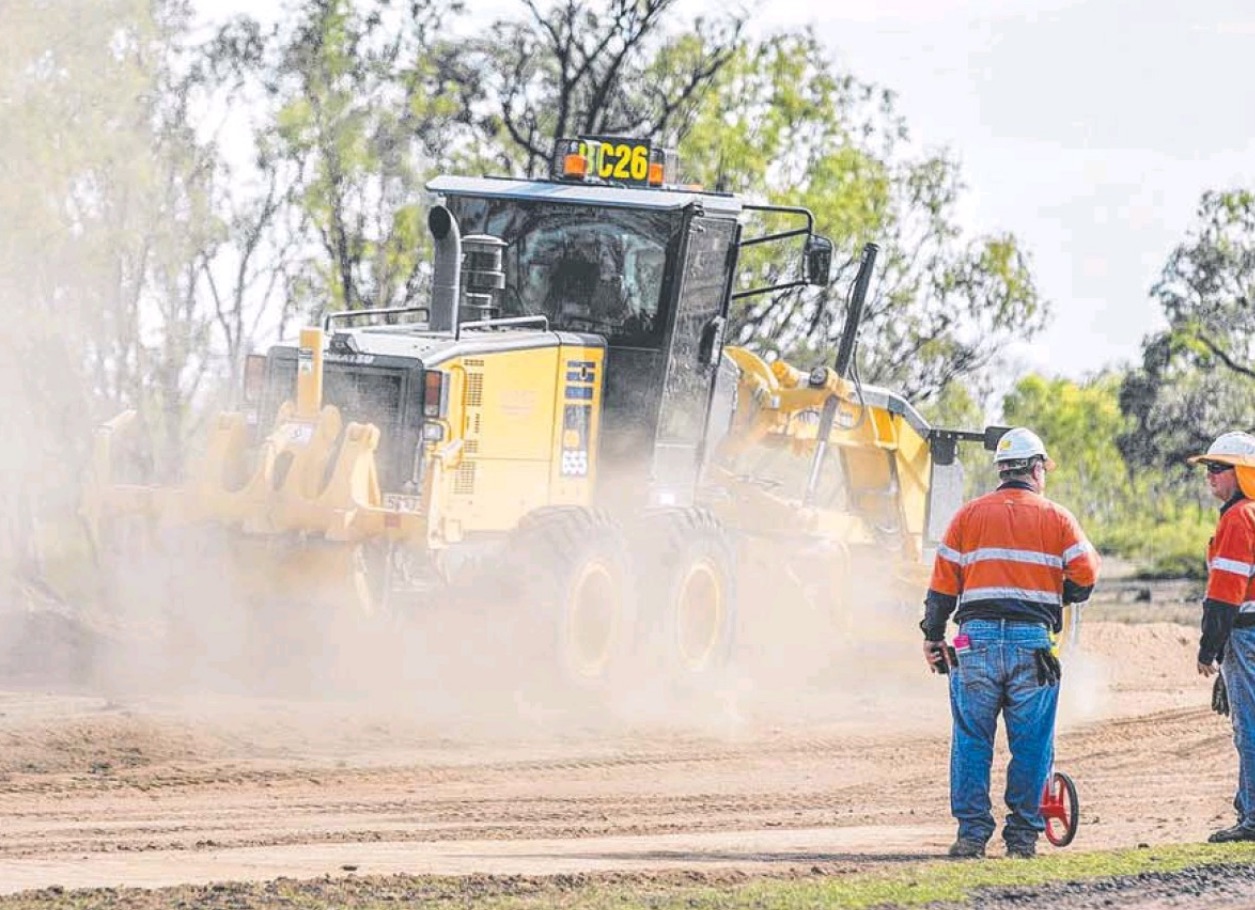
Readers with long memories will recall that this same picture was posted back in January.
Rather than bagging out IEEFA, perhaps Ms Campbell could organize some new publicity shots, showing how Adani Australia is spending the $2 billion it has supposedly received from its parent company.
In related news, Axis Capital has withdrawn a bid to insure the Carmichael rail line. That’s interesting as another step towards decarbonizing finance, but even more so because Adani has been insisting since last year that it has insurance in place.
With the price of thermal coal falling steadily, this project makes less economic sense than ever (it’s always been an environmental disaster). It remains to be seen whether Adani will go ahead on his own, or whether one of the governments his cronies control will tip in more public money
Cum/ex
Looking for a different story in the business pages of The Guardian, I happened across a headline stating The men who plundered Europe’: bankers on trial for defrauding €447m. That attracted my attention, but the standfirst, in smaller print, was even more startling
Martin Shields and Nick Diable are accused of tax fraud in ‘cum-ex’ scandal worth €60bn that exposes City’s pursuit of profit
For those without a calculator handy, that’s about $A100 billion.
I think of myself as someone who pays attention to the news, but I had missed this entirely. Google reveals essentially no coverage in the main English language media. There’s a short but helpful Wikipedia article and that’s about it. The scandal has been described as the ‘crime of the century’, but it’s just one of many multi-billion dollar heists, with the GFC towering abover them all.
It remains to be seen how the trial will turn out, but it’s already clear that, as usual, the banks have got away with it. The bank most closely involved in the scam, HypoVereinsBank in German has set aside €200 million euros to cover its potential liability. That’s less than 1 per cent of the tax avoided or evaded (the lawyers will be fighting out which, for some time, but the effect on ordinary citizens is the same).
The crucial point here isn’t the failure of the law to punish wrongdoing.
What matters is that crooked deals of this scale suffice for a complete explanation of the growth of the global financial sector since the 1970s. The point of the financial sector is not to allocate capital more efficiently, but to undermine the regulatory and tax systems that are supposed to make the economy work properly. Unsurprisingly the huge financial boom has been accompanied by miserable productivity growth, repeated business collapses and massive growth in inequality.
The only way to fix the problem is to shrink the financial sector to a tiny fraction of its current size, and tightly regulate what remains. The rational route to achieve this would start with the kinds of reforms being proposed by Elizabeth Warren. But we may be stuck with a messier path, in which courts tire of giving slaps on the wrist to recidivist banks and start shutting them down.
Read More » John Quiggin