Economics in Two Lessons Chapter 16: Environmental policy

Nearly seven years after I started work, here’s the final draft chapter from my book-in-progress, Economics in Two Lessons. Thanks to everyone who commented on the first 15 chapters and encouraged me in the project as a whole.

I’ve had quite a few amusing snarks on Twitter to the effect that 16 chapters and 90 000 words is an awful lot for just two lessons.  That’s true and yet there are even more topics I wanted to cover. In particular, I wrote quite a bit on health and education but have had to omit most of it for space reasons. Still, if anyone wants to point out critical omissions, now’s the time.

Comments, criticism and praise are welcome. I’m also on the lookout for telling graphs, insightful illustrations and apt quotations.

Read More »

The LDP: Trumpism in Australia

The reaction to Senator David Leyonhjelm’s recent attacks on women have mostly focused on Leyonhjelm personally. If he were a private citizen or an independent member of Parliament, that would make sense, and would lead to the conclusion that best thing to do is to ignore him.

In fact, however, Leyonhjelm is the most senior elected representative of the Liberal Democratic Party, a national political party. His statements on the matter give his position as Parliamentary leader of the party and appear in the media section of the LDP website. They may be taken as official statements of the LDP position.

Leyonhjelm’s statements are entirely consistent with the general position of the LDP which may be summarized as “well off white men should be able to say and do whatever they like with no adverse consequences”. That’s pretty much the essence of Trumpism.

Read More »

Are we on the way to ending coal: the coal plant pipeline

I’ve managed to get a little free time, and I’ve decided to do a series of posts looking at the vital question of whether we are on the way to ending reliance on coal as a source of energy. I’m going to focus first on thermal coal used for electricity generation. We have the apparent contradiction of a resurgence in coal prices combined with ample evidence that new coal plants are no longer economic, and that, when health costs are taken into account, the same is true of most existing coal plants.

I’m going to start with a “fact sheet” issued by the pro-coal Monash Forum. Interestingly, it draws on the work of the anti-coal site CoalSwarm, so there’s a fair bit of basic agreement.  Here’s the sheet
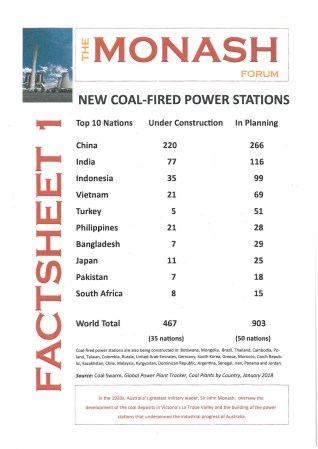
Larger version available here

These numbers are taken from the table Coal Plants by Country (Units) which is available in a convenient Google Docs form.  They are accurate as far as they go – Monash has extracted the top ten countries* in terms of planned plants, and given the total over all countries. If all these plants are constructed and operate for a lifetime of 40 years, there will be continuing demand for coal well into the future, and no hope for a stable climate.

However, the table has a lot more interesting information, not reported by Monash. Here’s a table with the same countries and all the columns.
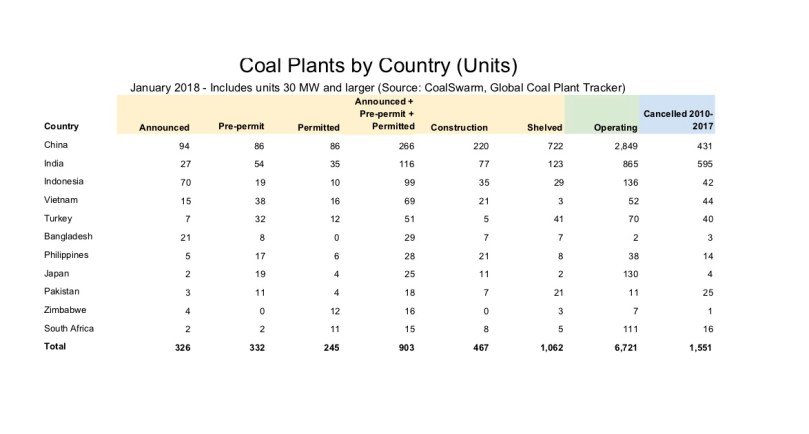
Scalable version available here

The complete table gives a rather different story to that told by the Monash Forum. The number of plants cancelled since 2010, nearly 200 per year, is substantially greater than the number still in planning.  The crucial question is whether the trend of cancellation will continue, so that the vast majority of planned plants are never built.  That’s what needs to happen if we are to have any chance of saving the global environment.

The evidence from the table shows that the necessary scale of cancellations is possible. If the 2010-2017 trend continued for another five years, the pipeline of planned projects would be wiped out**.  Such a total wipeout is unlikely, but its equally unlikely that all the projects in the list will go ahead. I’ll try to say a bit more about this in later posts.

One promising straw in the wind: A few days after the release of the Monash fact sheet, the Pudimadaka Ultra Mega Power Project, a proposed 4 *1000-megawatt coal-fired power station in India, was cancelled. As I understand the table, this counts as four units off the list. There’s still nearly 900 to go but every little helps.


* For some reason, South Africa (11th) was included and Zimbabwe (10th) omitted. It’s not important, but I’ve included both in my list.

** Some projects under construction may also be cancelled. A close look at the state of progress would be needed to make an estimate of the possibilities.

Say not the struggle naught availeth

With all the grim news from the US Supreme Court today, it’s easy to feel despairing. And there are certainly strong arguments to support a pessimistic view.

On the other hand, we’ve been here before many times before. Arthur Hugh Clough’s poem Say not the struggle naught availeth was written in 1849 the aftermath of the collapse of Chartism, a movement that demanded universal male suffrage, secret ballots and other democratic reforms. Clough himself spent 1848 in Italy during the “Year of Revolutions”, most of which were defeated within a few years. Yet, in the end, the Chartist demands were met*, and then surpassed through the struggle for women’s suffrage. The struggle for democracy in Europe as a whole has ebbed and flowed (it’s ebbing at the moment), but has so far been successful.

Coming to the US situation, even though the right has all the levers of power, they are still losing ground on lots of issues, both in terms of public support and in terms of actual outcomes
* Obamacare has survived, and there’s now rising support for a single-payer system.
* The Republican tax cuts are less popular than ever.
* Equal marriage is firmly established, and talk of a constitutional change to stop it has disappeared.
* Gun control, one of the few issues on which the right had gained popular support in the culture wars, is now back on the agenda
There are lots more examples both economic and cultural, including minimum wages, Confederate monuments, and the decline of for-profit education.

<!–more–>

That’s not to say that we are necessarily on the winning side of history. It’s easy, for example, to imagine a scenario where the Republicans offset steadily declining support with steadily increasing voter suppression. And the strength of racist/xenophobic appeals to a formerly dominant group, on the way to becoming a minority, can never be underestimated.

On the other hand, if the existing support of the majority of the public translates into a Congressional (or at least House) majority in November and a progressive Democratic President and Senate in 2020, a right wing majority on the Supreme Court won’t be able to reverse trends like those I mentioned above.

* The only exception being the demand for annual Parliaments.

Nothing

The big word on the Left in response to Anthony Albanese’s Gough Whitlam oration was “nothing”.  Bill Shorten observed that “there was nothing in the speech that caused me offence at all”.  Twitter was full of observations that there was nothing to suggest any kind of split or leadership challenge.

I have a mixed reaction. The Press gallery always loves leadership stories and sees everything through that frame, even though Labor’s rules make a leadership challenge virtually impossible between elections. So, the pushback is understandable.

On the other hand, I think we could shorten (sic) Shorten’s response to “there was nothing in the speech”.

Read More »