Another Monday Message Board. Post comments on any topic. Civil discussion and no coarse language please. Side discussions and idees fixes to the sandpits, please.
Supermarkets are the public face of inflation. Every time we go shopping, we are reminded that just about everything costs more than it did before Covid. And shrinkflation, once subtle and insidious, has become blatant. A standard chocolate bar is now what used to be called “fun size”. A natural response, particularly for politicians seeking to divert attention from themselves, is to blame greed and monopoly power.
Explanations based on greed are rather naive. Corporate executives are paid by shareholders to be greedy – that is, to maximise profit subject to a somewhat hazy concept of “social licence” regarding the treatment of customers, employees and other stakeholders. And there is no reason to think that Coles and Woolworths were any less greedy before the arrival of the pandemic than after.
The role of monopoly power is a bit more complex. Coles and Woolworths dominate the market, but if anything their dominance has eroded in recent years as Aldi’s market share has grown. However, their capacity to benefit from market power was increased by strong growth in demand after the end of lockdowns. Under conditions of strong demand, firms with market power can pad their profit margins and amplify inflation, as appears to have occurred in this instance.
The big problem with the supermarket sector is not monopoly but the monopsony (the technical term for a market dominated by one, or a few, buyers) power of supermarkets who can push down the prices and terms they offer to their suppliers. The mandatory code of conduct proposed after a review by Dr Craig Emerson might help to address these problems.
What about divestiture? Perhaps mistaking the late Joseph Stalin for a trustbuster, Anthony Albanese has described this as a “Soviet” option. In fact, forced divestiture is a standard feature of competition policy internationally, available in such distinctly non-Soviet countries as the US and UK.
Nevertheless, divestiture is unlikely to be the right remedy for the problems of the supermarket sector. Most people have only one or two supermarkets in easy reach, and splitting Coles and Woolworths into two or more competing businesses wouldn’t change that. The problems of dealing with suppliers are better dealt with through conduct measures rather than a breakup. The only obvious targets for divestiture are the liquor businesses and the loyalty programs (Flybuys and Everyday Rewards).
But there are other parts of the Australian economy where divestiture powers could be a useful tool for competition policy. Perhaps the most notable example is that of airlines. The Sydney-Melbourne-Brisbane “golden triangle” comprises three of the busiest city-pair routes in the world, and ought to be fiercely competitive. But a single corporation, Qantas, holds more than 60% of the market under its own name and through its wholly owned subsidiary Jetstar.
There are many factors contributing to Qantas’s dominance. These include control of crucial slots and cabotage rules restricting international competition. And Qantas has received favourable treatment reflecting residual goodwill from its historical role as the national flag carrier (much eroded by the Joyce era, but still present).
But the ownership of Jetstar as a “flanker” or “fighter” brand is at least as important. Wikipedia notes that flankers are “lower-priced offerings launched by a company to take on, and ideally take out, specific competitors”, and the first example listed is that of Qantas. Forcing divestment would yield an immediate increase in competition in the airline market.
Another candidate for divestiture is Transurban, the owner of most of Australia’s privatised toll roads. Here the main issue is not competition per se, since toll roads in different locations don’t compete with each other, but the political power associated with having a single company control so much of our transport infrastructure.
It is now becoming clear that the deals that have greatly enriched Transurban shareholders have been a disaster for motorists and for coherent urban planning. The solution, as others have argued, could be to take these roads back into public ownership and redo road pricing from scratch. A breakup of Transurban into separate state-level businesses would be a first step.
Big business in Australia faces less competition than almost anywhere in the world and likes it that way. The era of privatisation and “light-handed” regulation has only made matters worse. Turning the situation around will require a full set of policy tools, including conduct measures, divestiture and, in some cases, a return to public ownership.
That’s what the Bible (or at least, the preacher in Ecclesiastes) says, and sometimes I feel as if that’s right. But right now, I’m basking in the glow of having returned final proofs for Public Policy and Climate Change: Politics, Philosophy and Economics, a text to appear in the Lecture Notes in Economics and Policy series put out by World Scientific Publishers.
As well as approving the proofs, I produced an index, using a program with the self-explanatory title PDF Index Generator (this is different from the index function in Acrobat, which indexes every word for search purposes). As with lots of software, it’s not as good as what a professional editor would produce, but much cheaper and faster. I plan to write about the economic implications some time, but this kind of thing has been going on for a long time – in my own experience, starting with desktop publishing on the Mac.
I’ve got a couple more books in the pipeline. One of them, a volume of my collected articles optimistically entitled After Neoliberalism, is almost at proof stage. The other a cartoon history of privatisation in Australia is about to start.
I’ve been spending a lot more time on the Sunshine Coast, hoping to move there permanently. Perhaps as a benefit of local training, I did better than expected in the Mooloolaba Olympic triathlon, finishing in 3 hours 14 minutes, one of my better times in a decade or more of competition.
As I’ve already mentioned, I’ll be doing a virtual version of the MS Brissie to the Bay ride, raising money to help in the fight against multiple sclerosis and to help people living with MS. You can support me here.
Another Monday Message Board. Post comments on any topic. Civil discussion and no coarse language please. Side discussions and idees fixes to the sandpits, please.
Daniel Kahneman, who was, along with Elinor Ostrom, one of the very few non-economists to win the Economics Nobel award, has died aged 90. There are lots of obituaries out there, so I won’t try to summarise his work. Rather, I’ll talk about how it influenced my own academic career.
Elections over the last week have seen some pretty good outcomes for the Greens and some very bad outcomes for both Labor and the LNP.
Here’s what ChatGPT came up when I asked for a representation of Green Labor
In the Brisbane Council elections, the Greens got 23.1 per cent of the vote, barely behind Labor on 26.9. The combined total of exactly 50 per cent wasn’t reflected in terms of seats, mainly because of preference leakage and exhaustion, but I want to focus on the longer term implications here.
In Tasmania, the incumbent Liberals suffered a 12 per cent swing on primary votes, falling to 37 per cent, after a series of elections in which they received an absolute majority, or very close to it, on first preferences. Most of the aggregate loss went to independents and the Jacquie Lambie network with Labor and the Greens each picking up small gains.
That doesn’t mean that all the people who voted for JLN and independents switched from Liberals. More likely, the Greens (and maybe also) Labor picked up some Liberal voters, but lost ‘protest’ voters to JLN in particular. What’s really striking here is that the combined vote of Labor and the Liberals was below 66 per cent. “Other (including informal/blank)” comfortably outpolled Labor, and came close to beating the Liberals.
Finally, in the by-election for the South Australian seat of Dunstan (vacated by the former Liberal Premier), the Greens polled 22 per cent of the vote. Starting from a primary vote of 32 per cent, which would once have been considered disastrous, Labor won the seat comfortably on preferences, a rare by-election defeat for an opposition party.
Despite this striking evidence of dissatisfaction with the two-party system, journalists reported the Tasmanian outcome as a “hung Parliament”. This is a nonsense way of describing the situation. A hung jury is one that can’t reach a verdict. An election in which no party wins an outright majority of seats is a verdict rejecting the idea that the Parliament, or at least the Lower House, should be a rubber stamp for the winning party (or rather for the leader of that party) in between elections, when the voters have a chance to switch one ruling party for another. For some years, Tim Dunlop and I have been pushing the term “deliberative parliament” to describe this outcome.
The two-party system is one which is familiar and comfortable for the political class, including political journalists. It’s striking to observe that, while there are plenty of journalists who are clearly identified with either Labor or the Liberals, or can be seen as balanced between the two majors, there are none who align with the Greens, or Jacquie Lambie, or the teal independents, even in general terms.
All of these parties, along with the various rightwing parties that have won seats in Parliament are treated by the Press Gallery as alien intruders who will soon be gone. Similarly, a “hung parliament” of which we have seen at least a dozen in Australia, in recent years, is treated as an unfortunate aberration.
For the left, the big problem here is the difficulty of establishing a working relationship between Labor and the Greens. The only place this has worked consistently well is the ACT, where some form of Labor-Green coalition has held office since 2008. There are two big problems here. The first is the general problem of a centre-left coalition (or less formal arrangement) in which the centrist party (in this case Labor) is dominant, and the left party (the Greens) must take responsibility for policies that disappoint their voters. The second, local factor, is the toxic relationship between (large groups of) Green and Labor politicians and activists, of which Anthony Albanese is a notable exemplar.
One way or another, these difficulties will have to be resolved. That will take time, and perhaps some generational replacement, so that those making Labor-Green agreements won’t be distracted by the question of who did what to whom in 2010. But the days of pliant parliamentary majorities are drawing to a end, and democracy will be the better for it.
Another Monday Message Board. Post comments on any topic. Civil discussion and no coarse language please. Side discussions and idees fixes to the sandpits, please.
Another Monday Message Board. Post comments on any topic. Civil discussion and no coarse language please. Side discussions and idees fixes to the sandpits, please.
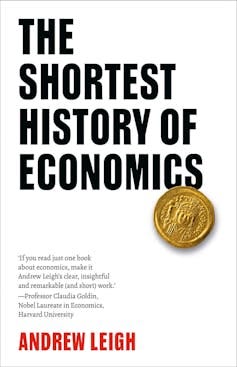
Andrew Leigh’s The Shortest History of Economics is the latest in a series of such histories, mostly focused on particular countries.
It begins with a striking mini-history of household lighting, focusing on the amount of labour required to produce the light now given off by a standard lightbulb: 58 hours for a wood fire, five hours for a candle based on animal fat, a few minutes for an early electric lightbulb, and less than one second for a modern light-emitting diode.
The Shortest History of Economics – Andrew Leigh (Black Inc.)
Importantly, what is true of labour hours is also true of material inputs. Older technologies required felling a tree or killing an animal, but an LED uses the photoelectric properties of common crystals. It only needs tiny quantities. The input of electricity is similarly modest.
Start your day with evidence-based news.
Meanwhile, because workers in all kinds of activities have become more productive, the purchasing power of their wages, expressed in terms of services like lighting, has risen. The result is that services like lighting have become exceptionally cheap.
As this example shows, The Shortest History of Economics is not, as might be supposed, a history of economic thought (a topic primarily suited to retired economists like the author of this review). Rather, it is primarily a history of economic life, from Paleolithic times to the COVID pandemic.
The history is, however, informed by modern economics, included in the narrative in palatable doses.
Standards of living
The first half of the book, covering the period up to the Industrial Revolution, is mostly about technology. Leigh begins with the transition from hunter-gatherer societies – made up of relatively small groups of people, who followed their food sources around – to agriculture, which permitted and required larger settled populations.
The effect on living standards was ambiguous at best. Farmers were less likely than hunter-gatherers to suffer violent deaths or starve in winter, but they were almost permanently undernourished. They overworked to produce a surplus that enabled a small stratum of priests and warriors to live relatively luxurious lives.
The millennia following the agricultural revolution are covered pretty quickly, with a focus on developments in transport (mostly water transport) and trade. Leigh traces the gradual emergence of a global economy, culminating in the rise of European empires, whose reach depended on sail.
There are lots of interesting vignettes, covering topics such as social mobility. There wasn’t much, as can be seen by the persistence over centuries of the same surnames in high-status positions. More depressing is the discussion of the central role of the slave trade, which was a major source of labour in the Americas and income for European nations.
The second half of the book, covering the period after the Industrial Revolution, shifts the focus from technology to economic institutions and policy. The 19th century saw the rise of the corporation and the concentration of economic power.
This produced responses in the form of “anti-trust” legislation in the United States, usually referred to as “competition policy” in Australia. This remains an issue of central concern to Leigh in his day job, as assistant minister for Competition, Charities and Treasury.
The 19th century also saw the rise of the trade union movement and the beginning of an era of continuous struggle over the distribution of income between capital labour. The balance has ebbed and flowed.
As Leigh shows, labour has been losing ground since the 1970s in most countries, while those at the top of the income distribution have gained massively. The offsetting positive development is that the very poorest people in the world have generally improved their lot, thanks to the belated arrival of modern technology.
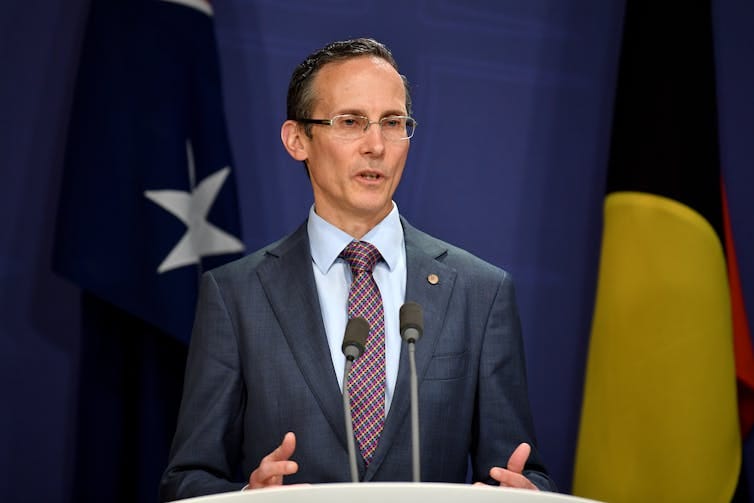
Andrew Leigh at a press conference in Sydney, August 23, 2023. Bianca De Marchi/AAP
The issues I have discussed so far have mostly concerned markets and prices, the topics studied by economists under the label “microeconomics”. But the 20th century also saw the emergence of “macroeconomics”, the analysis of booms, depressions, inflation and mass unemployment.
The key figure here was English economist John Maynard Keynes, whose General Theory of Employment, Interest and Money (1935) provided the theoretical basis for the use of public expenditure and taxation (fiscal policy) to stabilise the economy.
As Leigh notes in his introduction, The Shortest History of Economics is unusual among recent popular works on economics in covering both microeconomics and macroeconomics.
Despite proceeding briskly through millennia of economic history, Leigh manages to convey the essential points in a way that does not leave the reader feeling rushed through an incomplete argument. While it makes sense to begin by reading the book from beginning to end, it is also enjoyable to dip into it, more or less at random.
Inevitably, I have some points of disagreement. At a couple of points, Leigh gives uncritical credence to beliefs widely held among economists, but not supported by the evidence.
He repeats Adam Smith’s creation story for money as a more efficient alternative to barter. But a hundred years of anthropological evidence, beginning with my namesake Alison Hingston Quiggin and continuing to the work of the late David Graeber, suggests that money first emerged as a way of discharging debts (owed to the king whose face appeared on coins or as recompense for private injuries). It was only later adapted to use in commerce.
But in reality, although Hayek had criticised Keynes’ earlier Tract on Monetary Reform (1923), he did not even review his General Theory of Employment, Interest and Money. Arguably the most effective critic was A.C. Pigou, best known nowadays as the inventor of pollution taxes.
The idea of Hayek as Keynes’ primary antagonist is largely a piece of retroactive continuity (“retconning” in the jargon of genre fiction). The myth was created in the 1970s, following Hayek’s Nobel Prize in Economics in 1974 and his influence on political leaders, including Margaret Thatcher and Augusto Pinochet.
But these are quibbles, which will be of little concern to the general readership at which the book is aimed. As with all of the dozen or so books Leigh has produced since his election to Parliament (while also raising three children and maintaining a strenuous athletic regime – how does he do it?), The Shortest History of Economics is an engaging read, conveying economic insights to readers who would find a standard economics text both boring and impenetrable.
Another Monday Message Board. Post comments on any topic. Civil discussion and no coarse language please. Side discussions and idees fixes to the sandpits, please.