It’s time again, at long last, for the Monday Message Board. Post comments on any topic. As usual, civilised discussion and no coarse language.
Who has gained from the inequality boom? — Crooked Timber
A question that comes up at CT quite a bit is: who has benefited from the massive increase in US income inequality over recent decades. I finally got around to chasing down Congressional Budget Office data (derived from tax records for the period 1979 to 2005), and the answer, in short is:
- The top 1 per cent roughly doubled their share of both pre-tax income (9 per cent to 18 percent) and after-tax income (7.5 per cent to 15 per cent)
- The rest of the top 10 per cent slightly increased their share (from about 20 to about 22 per cent)
- The next 10 per cent held their share (about 15 percent)
- The remaining 80 per cent of households saw their share drop (from 58 per cent to 48 per cent of post-tax income, with the biggest drops coming at the bottom. The bottom 40 per cent of households now get a smaller share of post tax income (14 per cent, down from 19) than the top 1 per cent.
A couple of observations on this.First, to answer the question “who gained from the inequality boom” we need a counterfactual. If, as is commonly claimed, pro-rich policies raised the average rate of growth of income, people in the top 20 per cent of the income distribution were better off, since they had a constant share of a bigger cake. The effects are ambiguous for everyone else, and, on any plausible numbers, everyone below the median is worse off than they would have been with moderately slower, but equitably distributed growth. On the other hand, if pro-rich policies contributed to the slowdown in economic growth for the period since the 1970s, compared to the postwar boom, then the only net beneficiaries are those in the top 1 per cent of the income distribution.
Second, the picture would probably change a bit if benefits (particularly employment-related health benefits) were taken into account. My guess is that this would probably improve the outcome for the top quintile (since this group mostly held on to benefits which increased faster than wages) and worsen it for those below the median (who have lost access to benefits over time).
Finally, it’s striking that, on the CBO figures, the tax system is almost exactly proportional: that is, it has no net redistributive effect at all. The top 1 per cent have a somewhat smaller share of post-tax income than of (measured) pre-tax income, but that almost certainly reflects their capacity to hide income from the tax system.
Votes for clunkers
Julia Gillard has announced an Australian version of the cash for clunkers program of the Obama Administration. Reader Ben Elliston writes
read an article some months ago by Jeffrey Sachs evaluating a
similar policy from the Obama administration:
http://www.scientificamerican.com/article.cfm?id=a-clunker-of-a-climate-policyIt turns out that the Gillard proposal is even worse than Obama’s.
Sachs calculated the greenhouse gas abatement value of Obama’s scheme
at US$140 per metric tonne. Gillard’s policy will reduce emissions by
1 million tonnes at a cost of $394 million dollars ($394/tonne).
My only observation is that Ben’s estimate is taken directly from the government’s press release, which is almost certainly overoptimistic. For comparison, at about $25/tonne, brown-coal electricity generation becomes uneconomic compared to gas and black coal. At $100/tonne, just about all the alternatives (including wind, nuclear, CCS, and solar) look pretty good. Cash for clunkers is, as Sachs concludes, a clunker of a policy.
And just in case anyone has forgotten, Abbott’s anti-policies are even more focused on this kind of nonsense/
Cover design for the living dead
The choice of cover design for a book is always a tricky process, at least for authors like me who are more comfortable with text than images. A while back Eszter at CT dealt with the problem by crowdsourcing the cover for her book Research Confidential.
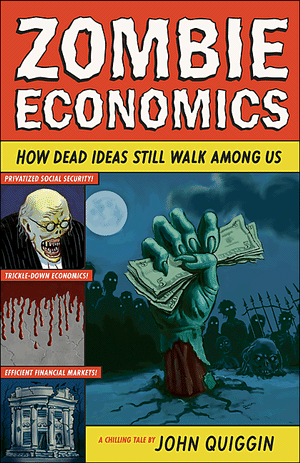
I got lots of input from readers here on the text and title of Zombie Economics, but I left the cover design to the professionals, and I’m glad I did. Here’s the cover, based on a horror comic and here,at the Princeton University Press blog, is a discussion of how it came about.
There was one anxious moment when we discovered that the design included a reference to a chapter (on central bank independence) that I’d deleted at a late stage in the process. But the designer came up with a clever tweak that changed the reference (to refer to financial markets) without affecting the impact of the design.
This is the first book I’ve done since I took up blogging (I use to say blogs kill books, but this book grew out of the blog) and the process has left me with renewed respect for the range of skills that are involved in turning an idea and a rough draft into a book.
Non-policy or anti-policy
My column in yesterday’s Fin (over the fold) advocating agreement between Labor and the Greens on a short-term carbon price was rendered obsolete almost immediately by Julia Gillard’s speech (as it happened, I was in the building next door when she gave it).
Gillard’s non-policy represents a failure of leadership. The best that can be said for it is that the delay generated by this process is only supposed to last for 12 months, and that 150 randomly selected Australians could scarcely do a worse job on this vital issues than our political leaders have done.
But, as is so often the case, Abbott is even worse, offering an anti-policy that would represent an obstacle to any real action. I’m feeling happy about my decision to vote for the Greens. With rather less enthusiasm than before, I’ll still give Labor my second preference.
Live on video!
After the usual hassles, UQ School of Economics finally has its own videoconference facility, an IP-based Tandberg system, which should (fingers crossed) be interoperable with other standards-based systems. I just did my first conference, and it worked very well. Unfortunately, we are still waiting for an upgrade that will let me run a presentation at the same time as appearing on video. But I’m confident of ultimate success, so I’m now announcing that I’m available to give seminars and talks on a wide range of topics to anyone (subject to time and timezone constraints!) who would like to organise a videoconference. Email me j.quiggin at uq.edu.au if you are interested.
Support John Abraham
Potty peer Christopher Monckton has stepped up his campaign to shut down John Abraham’s debunking of one of his talks last year, by asking supporters to flood Abraham’s university with emails demanding it start a disciplinary inquiry.
I can only endorse this comment on Monckton and the lunacy of a world in which someone like this is taken seriously.
Update I thought Posterous would include the link automagically but apparently not. Here’s Garth Renowden’s site where you can support Abraham and/or bag Monckton.
Economists and climate change
Ross Gittins repeats the criticism he, Ken Henry and Martin Parkinson, have put forward previously, that economists were either missing in action or actively unhelpful in the climate change debate. I disagree – I think academic economists as a group look a lot better on this issue than do economic columnists, and (on the limited available evidence) at least as good as public servants.
The case for the Greens
As I said last time, I’ll be advocating a vote for the Greens. Unlike some commenters here, I plan to give my second preference to Labor[1]. To justify my second preference first, I regard the Liberals under Abbott as utterly unfit for government. Abbott has behaved as an unprincipled opportunist throughout his period as opposition leader, denouncing “great big new taxes”, then proposing taxes of his own with no regard for consistency or good public policy. In office, I expect he would discover that he had a mandate for the hardline rightwing policies he has always favored.
Coming to the choice between Labor and the Greens, this isn’t the first time I have given a first preference to the Greens, but it’s the first in some years. The main substantive issues that concern me are economic management and climate change, but these issues (and particularly climate change) can’t be separate from questions about process and principle. The government has done a good job on economic management, while the opposition has been consistent only in error. On the other hand, the government has made a terrible mess of climate change policy, almost entirely because of its reluctance to deal with the Greens and to confront the opposition and the lobby groups that back them. In the long run, the only way they will be able to govern effectively is through co-operation with the Greens, and the sooner they are forced to realise this the better.
It’s obvious at this point that the CPRS proposed last year is dead, and that a new ETS will have to be developed, hopefully when we have seen some more progress in other countries. For that reason, I think a carbon tax, with few exemptions and a tight cap on compensation to emitters is the best way to go. The Greens idea of a two-year interim carbon tax would be a good starting point for discussion and there is still time for Labor to announce in-principle support for a deal of this kind.
On other issues such as asylum seekers, the government’s position is carefully ambiguous, while the opposition is as close to overt racism[2] as it has ever been. A big vote for the Greens would force the government back towards a decent position.
Then there is the machine politics that led, first to Rudd being forced to dump the CPRS, and then being sacked when this decision had such disastrous consequences. Without excusing Rudd for some earlier failures on the issue, this alone would be enough to deprive Labor of my first preference in the presence of any decent alternative.
It seems reasonable to hope that the Greens will get enough votes to hold the balance of power in the Senate from July 2011. It seems unlikely, except by a fluke that they could do the same in the House of Representatives. But the loss of even two or three inner-city seats would put Labor on notice that its core support can’t be taken for granted.
I’m even marginally hopeful as regards the seat of Ryan, where I live. The incumbent Liberal, Michael Johnson, has been disendorsed over corruption allegations, but claims to be the victim of factional smears and is running hard against the official LNP candidate. The Greens have done well in the past, and might benefit from a flow of preferences.
fn1. This assumes that there is no preference deal made that would lead me to think otherwise. For example, if Labor were to preference Steve Fielding or the like again, I would consider exhausting my Senate ballot in a way that gave a preference to neither major party (to see how, read here.
fn2. The one genuine example of “political correctness” in Australian politics is the one that prevents us from using the word “racist” to describe racism, but there’s no doubt that’s what it is.
Back on air
The final proofs of Zombie Economics went off to the typesetter this morning, and you’ve all seen this evening’s news. So, I guess it’s time for me to end my hiatus, and make whatever contribution I can to the marvel of democracy. Not to keep anyone in suspense, I’ll be advocating a vote for the Greens.
 John Quiggin