Another Monday Message Board. Post comments on any topic. Civil discussion and no coarse language please. Side discussions and idees fixes to the sandpits, please.
My son Daniel points me to a piece by Nate Silver which announces the discovery that highly educated workers with low or precarious income are the natural constituency of the Democratic Socialists of America. We’ve been over this at length here and at Crooked Timber, starting as far back as 2012 (and it wasn’t new then). Given that Silver treats the question as new, I thought it might be useful to restate the basic points from this discussion.
Because of the history of slavery, civil war and segregation, US, Southern Whites in the US vote like an ethnic bloc, defined in opposition to Blacks. This fact largely accounts for the greater success of Trumpism compared to European far-right parties
The most important form of identity politics is default identity politics, based on the idea that members of the unmarked category (in the US, white Christian men) are the natural representatives of the country and should therefore run it
All of these are tendencies rather than uniform rules. There have always been “working class Tories”, “millionaire liberals” and so on
A nearly final observation following from this. As a conceptual tool for analysing voting patterns, the term “working class” is too ambiguous to be useful. It can mean anything from “wage workers in labouring and manual trade occupations” (perhaps 20 per cent of the population) to “below median income” (50 per cent by definition) to “did not complete 4 years of college” (about 60 per cent) to “income not primarily derived from capital ownership” (95 per cent), with only partial overlap between these categories. All of these definitions are useful in some contexts, but in debates over voting patterns they form a hopeless jumble.
And finally a restatement, While I’ve linked all of this to my own posts, I’m not claiming originality for these ideas. Just making the point that Silver is claiming as a discovery something that anyone paying attention could have observed at least a decade ago.
As I observed last year, the statement that “The cemeteries are full of indispensable people.” is just as true of nations, and in particular the US. That was a little controversial at the time, but now it’s become sufficiently conventional wisdom to be restated in the New York Times. I’ve been working on an update. and that seems like a signal to get it out
Another Monday Message Board. Post comments on any topic. Civil discussion and no coarse language please. Side discussions and idees fixes to the sandpits, please.
Another Monday Message Board. Post comments on any topic. Civil discussion and no coarse language please. Side discussions and idees fixes to the sandpits, please.
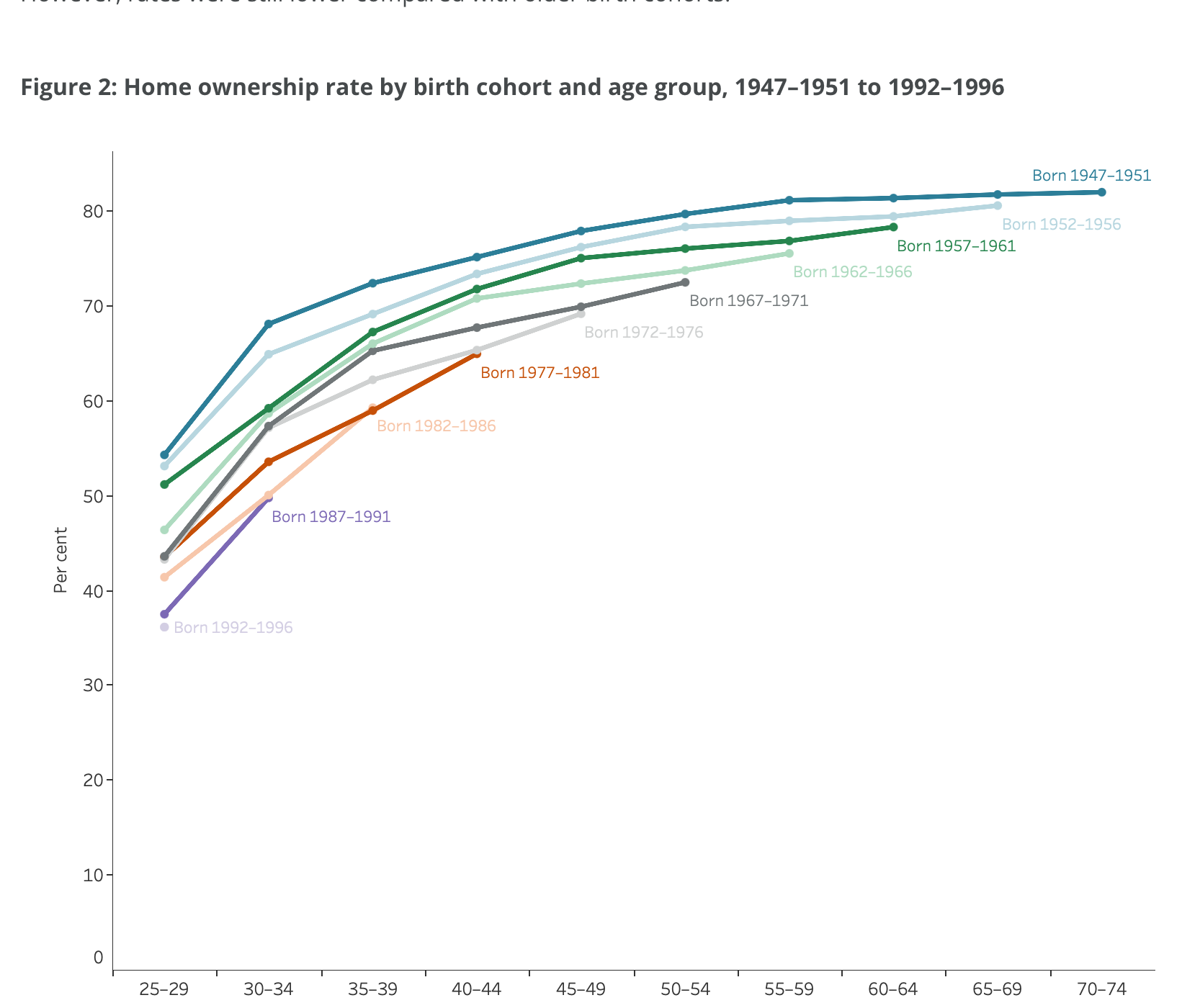
Some brief notes written in response to a request from the Parliamentary Select Committee on Intergenerational Housing Inequity)
Class not cohort
The current crisis reflects the interaction between three main forces
* Changes in the life course meaning that most major stages of life are reached later than in the past. These include completion of education, entry into the mainstream labour force, family formation, childbirth, retirement and death.
* Growing inequality, particularly in relation to inter-generational transfers of wealth within families
* Decades of misguided public policy which have kept housing prices high
Contrary to the implications of a concept like “intergenerational inequity”, within-family transfers of wealth between generations have increased. These transfers traditionally focused on inheritance, but are now increasingly dominated by “in vivo” gifts and loans (the “Bank of Mum and Dad”) from wealthy parents to their adult children. This is better described as “intergenerational transmission of inequality”
The interaction between these forces has created a large class of young adult renters, in age groups where home ownership was the norm. In the mid-late 20th century, when current social attitudes were formed, renting was, for most young people, a brief transitional stage. The normal expectation was that marriage would be followed in short order by the birth of children and the purchase of a (heavily mortgaged) “home of one’s own”.
Only a small proportion of the population, around 20 per cent of the population, were lifelong renters.
But this is primarily a matter of delay. As in the past, around 80 per cent of Australians are home-owners by the time they retire from the labour market.
Summing up:
* The issue is not one of inequality between different generations, but the transmission of inequality from one generation to the next. The children of well-off homeowners will mostly become well-off homeowners themselves, with a delay reflecting later entry to the labour force
* This delay means that, for many people, renting is no longer a transitory experience between youth and adulthood, but a significant life stage.
*.As in the past most deprived group are the minority of long-term renters.
There was a renewed burst of enthusiasm for nuclear power a few years ago. In Australia, it was confined to the political right and didn’t last long, but elsewhere support was broader. Most notable was the 2023 commitment by more than 20 countries, led by the US, UK and France, to triple global nuclear capacity by 2050. In the three countries mentioned, that would imply building 330 GW of new capacity as well as replacing retiring capacity.
So far, this commitment has produced only one final investment decision, for two reactors at Sizewell C in the UK. Construction is expected to start in 2027, with commercial operation in the late 2030s at best. After that, there are no large plants even on the drawing boards in the UK. A few sites have been identified, and there’s a proposal for some half-size reactors (called SMRs but not actually modular or very small) to be built by Rolls-Royce. These don’t even have a prototype yet.