As borders reopen and Covid-related restrictions are relaxed, lots of academics are celebrating the return of in-person conferences. I’m not one of them. Although I miss a lot of aspects of conferences, I’ve tried to avoid indoor meetings since the pandemic began, and there’s no reason to change that yet. And with the climate disaster getting worse all the time, I want to minimise, or at least reduce, air travel.
Another problem is that it’s become much more difficult for researchers from Africa and Asia to get access to conferences held in Europe and North America. One possible response would be to move the conferences to more generally accessible locations, but there aren’t many without problems of some kind.
At least for the moment, the most compelling argument in support of in-person conferences is that they provide junior researchers with the opportunity to establish contact with potential co-authors, future employers and so on. But, as with the “water cooler conversations” advanced as a reason for going back to the office, this is a serendipitous by-product of a costly process, rather like the non-stick frypans supposedly delivered by the US space program. Could we get the same benefits more directly.
The contact problem doesn’t really arise for established researchers. If I want to make contact with someone doing related research, I send them an email and suggest we open a discussion. That doesn’t always work (people are busy, and have different interests) but the same is true if you approach someone in person at a conference.
The difficulty for junior researchers is one of social convention. It’s much more socially acceptable to chat to a more senior colleague at a conference where you are both presenting than to cold-call them with an unsolicited email. But social conventions aren’t set in stone. As the social cost of in-person conferences goes up, and the benefits (relative to remote presentations) decline, it’s time to think about alternative ways of delivering those benefits.
Suppose we were starting from scratch, with today’s technological possibilities and constraints, and thinking about how to start and sustain collegial contact between researchers from different locations. How would we go about it? The first requirement, I think, would be an explicit norm that participating in an online meeting includes an obligation to be available to talk to junior researchers. One way might be to replace the current model of talk+discussant with something like talk+panel discussion. Perhaps presenters could nominate preferred discussants and a matching algorithm could be used.
We could also think about changes that could be made at the university level, such as explicit acknowledgement of interaction with developing country colleagues. This seems like it would be easy to sell to university administrators – no cost to them, and it would look good on the annual report. The harder bit would probably be to get academics to treat it as more than another exercise in box-ticking.
Note: Oddly enough, as I was writing this, I received an invitation to attend a conference in Perth where PhD students present their work, and get comments from established researchers. That encapsulates many of the difficulties I’ve discussed above. Still thinking about it.
I’ve just written an “explainer” piece for The Conversation with my longstanding colleague co-author (and former PhD student) Thilak Mallawaarachchi, trying to make sense of the crisis in Sri Lanka. Thilak contributed his extensive knowledge of the Sri Lankan economy, while I focused on the specific role of a fixed exchange-rate regime.
Sri Lanka is facing its worst economic crisis in modern history. Its 22 million strong population is struggling with huge price increases for food, power, medicines and other necessities. That’s if they can get them at all, with private motorists spending hours queuing for their fuel quota.
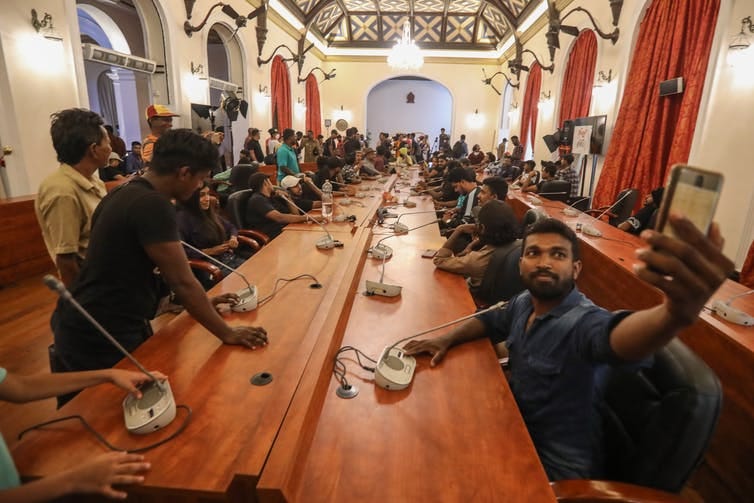
This is why Sri Lankans have been protesting on the streets and stormed the President’s House.
People in a conference room in the Sri Lankan president’s palace a day after the storming official residences on July 9 2022. Chamila Karunarathne/EPA
How did it come to this?
The immediate cause of the crisis is straightforward: Sri Lanka ran out of foreign reserves, the currencies its government and citizens need to pay for imports.
How it got into this situation requires more explanation. It’s a story of fiscal imprudence, unsustainable exchange rate policy and chronic mismanagement.
Since the beginning of 2020 Sri Lanka’s demand for foreign currency has increased while its ability to earn foreign currency – through exports, loans and other capital inflows – has declined.
This is reflected in the steady decline in official foreign reserves held by the Central Bank of Sri Lanka, falling from about US$8 billion to less than $U2 billion. (The Sri Lankan currency is “closed”, meaning it isn’t traded outside the country, so foreign exchange transactions have to go through the central bank).
As bad these figures are, the reality is worse.
Gross reserves aren’t the same as money in a bank account that can be used for payments. They include, for example, currency already committed to payments, and loans with conditions that limit imports from certain countries.
The actual amount of “usable” foreign currency is less. By early May it was barely US$50 million – a miniscule level for an economy that by the end of 2021 needed about US$75 million a day to pay for imports. This led to Sri Lanka’s government defaulting on a US$78 million interest payment in late May.
Declining currency inflows
Sri Lanka’s declining foreign currency inflows and increasing outflows are due to imports outpacing exports, Sri Lankans overseas sending less money home, the devastation of the tourism sector and higher debt repayments.
In two years Sri Lanka’s annual trade deficit has climbed from about US$6 billion to US$8 billion.
Two other key sources of foreign currency, money sent home by Sri Lankans living abroad and international tourism, were also hit hard.
At their peak, they more than offset the trade deficit for goods.
But since 2019 the value of remittances has fallen more than 20%. Income from tourism, devastated by the 2019 Easter bombings in which 269 were killed, has dropped almost 90% from its 2018 peak.
Propping up the exchange rate
Ordinarily a nation can avoid running out of foreign currency in two ways.
One way is to borrow money. Sri Lanka, however, was already heavily in debt before this crisis. Successive governments borrowed to finance infrastructure projects and prop up loss-making public utilities. With estimated annual debt service costs of US$10 billion, Sri Lanka is now a bad bet for lenders.
The second, and better, way is a floating exchange rate along the lines of those in Australia, Britain, Japan and the United States.
A floating rate helps to balance trade value because the currency’s value changes according to demand.
Technically Sri Lanka has a floating currency, but it is a “managed float” – with the government, primarily through the Central Bank of Sri Lanka, pegging and repegging the rupee’s value to the US dollar.
A government can do a number of things to maintain the value its currencies, but the main way is buy the currency itself, using foreign reserves. This is what Sri Lanka’s central bank did.
As foreign reserves ran down, the government adopted other riskier policies. Particularly disastrous was the April 2021 decision to ban fertiliser imports.
This was marketed as a policy to promote organic farming, but really it was about cutting demand for foreign currency.
The subsequent drop in agricultural production has only compounded the economic crisis.
Deepthika Rupasinghe works in her garden in Colombo on June 24 2022. All government workers now get Fridays off to spend time growing vegetables to prevent looming food shortages. Chamila Karunarathne/EPA
Rising prices
Just as short-term solutions can create longer-term problems, so too can long-term solutions mean short-term pain.
Allowing the (pegged) rupee to depreciate more than 40% against the US dollar has pushed up inflation to 54%.
The help the Sri Lankan government is seeking from the International Monetary Fund is likely to hit people hard, at least initially.
Based on past experience, the IMF will want major commitments on government expenditure and other economic indicators before bailing out Sri Lanka.
But without action, life in Sri Lanka looks even more grim.
With shortages of imported raw materials, industrial output will shrink, creating a downward spiral of low output, low investment, and resultant low economic growth.
On the other hand, Sri Lanka has some natural advantages – from its natural beauty to the most literate population in South Asia. What it needs now is principled political leadership, competent economic management and the right policies.
In the early days of the Ukraine invasion, one of the main lines pushed by Putin’s defenders was that the expansion of NATO posed a threat to Russia and that Ukraine was about to join. This didn’t stand up to even momentary scrutiny. The Baltic States had been members since 2004 without doing anything to threaten Russia.
And while Ukraine’s constitution included a goal of joining NATO, Zelenskiy was describing this as a ‘remote dream’ even before the invasion took place, and clearly indicated willingness to abandon the idea in return for peace.
But there is an important sense in which NATO shares responsibility for this disaster. The US intervention in Kosovo, including the bombing of Belgrade, was undertaken by NATO, to avoid the need to get the support of the UN Security Council, where Russia had a veto. This was a substantial breach of international law, followed by a much bigger breach in the invasion of Iraq.
At the time, there was general agreement in the ‘Foreign Policy Community’ aka ‘the Blob’, that
“The number one rule of the bi-partisan foreign policy community is that America can invade and attack other countries when vital American interests are threatened.”
This rule was implicitly confined to the US. In the brief period of US hyperpower, it could be assumed that the US, as sheriff of the global system, could enforce rules of non-agression against others, while also being judge and jury in its own actions. I argued against this at the time, pointing to the power of example, and was roundly criticised for my naivety.
But Putin was paying close attention, and drew the conclusion that if America was above the law, so was Russia. [1] The Kosovo precedent played a big role in his increasingly aggressive actions, culminating (so far) in the Ukraine invasion
Counterfactuals are tricky. Perhaps Putin would have acted in the same way, even without the precedent provided by NATO. But he was certainly encouraged by the sophisticated realists who dismissed international law as a figleaf.
fn1. Another participant in this debate, Glenn Greenwald, took the argument to its logical extreme and became a Putin backer, beginning with the invasion of Georgia in 2008.
When I first found out that the UK Treasury proposes to issue Non-Fungible Tokens (NFTs) as part of a general push to make Britain a world centre for crypto-currency, I assumed that this was a Boris Johnson stunt. The obvious model is El Salvador, where Johnson-style demagogue Nayib Bukele has made Bitcoin legal tender, with results ranging from disappointing to disastrous depending on who you read.
It turns out, however, that the source of the push is Rishi Sunak, until recently Chancellor of the Exchequer and now the favourite to become Prime Minister when Johnson leaves office. I don’t know anything about Sunak, but assumed on the basis of his job title that he would be a believer in “sound money”, hostile to, or at least sceptical of dodgy innovations like crypto.
I’m not fully on top of the issue yet, and would welcome clarifications from anyone better informed. It appears that Sunak is at least as confused as I am, and is pushing different, contradictory proposals.
The first to emerge, in 2021, was the idea of a central bank digital currency (CBDC). Such a development, would, in my view be kryptonite for crypto as it now exists, providing all the supposed benefits with none of the energy waste, scams and volatility we now observe. A CBDC would have radical implications which are still being discussed. In particularit, in effect, allow households and businesses to bank directly with the central bank, rather than holding digital deposits in existing banks. If successful enough, it could amount to nationalisation of the banking sector.
It looks as if the predictable opposition of the UK financial sector has killed off the CBDC idea. Instead, Sunak has been pushing proposals to put the UK at the centre of the existing crypto market. Strikingly, it’s the dodgiest forms of crypto (NFTs and “stablecoins”), that are being pushed hardest.
As I’ve argued in the past, the fact that something as provably valueless as Bitcoin is now an accepted part of the financial system is evidence that any claims about the efficiency of financial markets are indefensible. The same can now be said about the idea that the UK Conservative party stands for sound economic management.
Suppose(!) an Oz government or IR tribunal, wanted to shift the standard working week to four eight-hour days. Here’s one possible path:
Reduce standard working week from 38 hours to 35, a demand of the trade union movement that’s been on the books for the last 50 years. With four weeks annual leave and 10 public holidays per year, that implies just over 1600 hours per year (excluding sick leave etc) 1/..
Now move to the four-day, 32 hour week, with the proviso that the full four days are worked in weeks with public holidays. That gives 1536 hours worked in a standard year 2/..
Now shift from four weeks annual leave to two, with the proviso that workers can put in up to eight 5-day weeks during the year and take the time off in an additional two-week block. That brings annual hours back up to 1600 3/…
A new sandpit for long side discussions, conspiracy theories, idees fixes and so on.
To be clear, the sandpit is for regular commenters to pursue points that distract from regular discussion, including conspiracy-theoretic takes on the issues at hand. It’s not meant as a forum for visiting conspiracy theorists, or trolls posing as such.
Last week, I presented a webinar to the Australian Industrial Transformation Institute at Flinders Uni. The slides are here – I’ll update when the video becomes available
Summary: From four-day weeks to unconditional basic income to free education, it’s possible to imagine a future where society’s focus has moved from consumption to quality of life.
My latest Substack newsletter, a report on what I’ve been up to in June and early July. My biggest news is that I’ve decided to take a break from commenting on day-to-day politics. Even starting with low expectations, I’ve been deeply disappointed by the Albanese government. That feeling seems to be widely shared, especially as regards Covid and Climate. Perhaps the public response will turn things around, but I don’t have anything much to add beyond what I’ve said already.
Instead, I’m trying to think about longer term issues, making the case that we need a utopian vision as an alternative to the current dystopia.

 John Quiggin