Labor shuffles to centre-right as three-party system waltzes in

My latest piece in Crikey

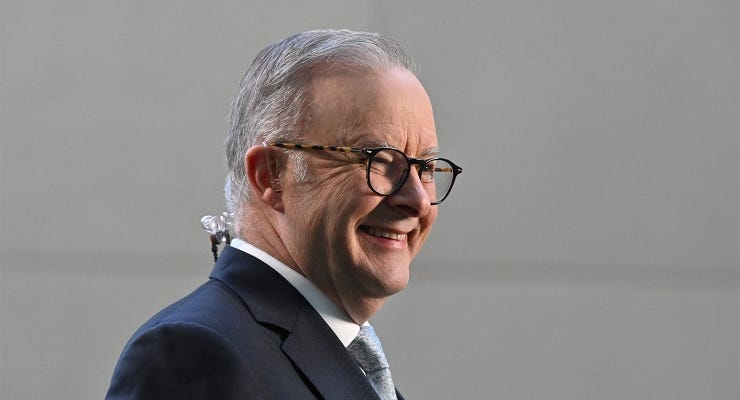
Prime Minister Anthony Albanese (Image: AAP/Mick Tsikas)

A year after the Albanese government’s election win, Labor’s strategy for its first term in office is clear.

On the issues where the Coalition has historically had an advantage, most notably economics, defence and foreign policy, Labor has adopted those policies and sought (so far successfully) to more competently implement them. On everything else — climate, health, education, human rights — Labor has pitched just far enough to the left of the Coalition to provide a point of difference while minimising the risk of losing votes on the centre-right.

Examples of the first part of the strategy are the stage three tax cuts and AUKUS, but they’re only the most prominent. As well as promising to implement the stage three cuts, the government allowed numerous initiatives of the previous government — funded for a limited time — to expire on schedule. Most notable was the low- and middle-income earners’ tax offset, which ensures the tax system will be more regressive by the end of the government’s first term than it was at the start, even if the stage three tax cuts are trimmed.

In foreign policy, as well as AUKUS, the government has outdone its predecessor in supporting the Quad alliance to contain China. Prime Minister Anthony Albanese’s embrace of the ethno-nationalist Narendra Modi government, and (literally) of its prime minister, goes beyond anything seen under former prime minister Scott Morrison.

The government has interpreted its House of Representatives majority as a mandate to do precisely what was contained in its election platform (and nothing more), but one major promise has been watered down and, for practical purposes, repudiated.

In 2021, Albanese promised a renewed commitment to full employment. The plan included a jobs summit, leading to the issue of a white paper on full employment. Its title echoed that of the 1945 white paper on full employment in Australia, which was the founding document for Australian economic policy during the decades of postwar full employment.

But then the jobs summit became a jobs and skills summit, with most of the discussion centring on the difficulties faced by employers when full employment unexpectedly became something close to reality. Similarly, the word “full” disappeared from what is now promised as the employment white paper.

Finally, the 2023-24 budget projected an increase in unemployment during Labor’s first term. The projected rate of 4.5% exceeds even the Reserve Bank’s estimate of the “non-accelerating inflation rate of unemployment”. In contrast with Albanese’s statement that a return to 2019 conditions would be unacceptable for a Labor government, the projected rate is within half a percentage point of that prevailing before the pandemic.

Left, right and centre

In summary, Labor has taken a position in the centre-right of the Australian political spectrum, occupying a space vacated by the disappearance of the moderate Liberals epitomised by former Liberal prime minister Malcolm Turnbull. On the right, the Liberals and Nationals are in dire straits nearly everywhere. To the left, Labor is fending off the Greens and independents, whose economic views are broadly in line with Labor’s but who want more action on issues such as climate policy and human rights.

While most of the political commentariat is still focused on the long-standing two-party system, urban Australia has already moved to a three-party system, in which Labor confronts a divided opposition.

The Liberals now hold only 19 seats in the metropolitan areas of Australia’s capitals, barely more than the combined total of Greens and independents. The trend is even clearer among young voters. According to the Australian Electoral Survey, about 38% of those under 40 voted Labor, compared with about 25% each for the Liberals-Nationals and the Greens, leaving about 12% for independents and minor parties.

The closest international analogue is France, where the centrist party of Emmanuel Macron in France secured 39% of the votes in the 2022 legislative election, compared with 32% for the left-wing coalition NUPES (Nouvelle Union populaire écologique et sociale) and 25% for the right and far-right. Unlike in Australia, this was not enough to secure an absolute majority.

Neoliberalism on the wane

The best way to understand these developments is that they follow from the decline of neoliberalism as a dominant ideology. For most of the time since the 1980s, politics in developed countries has involved an alternation of power between versions of neoliberalism: hard, represented by LNP, US Republicans, UK Conservatives and European conservative parties; and soft, represented by Labor in Australia, New Labour in the UK, US Democrats and European social democrats).

Since the global financial crisis in 2007-08, the failure of neoliberalism to deliver on its promises has led to the erosion of support for this comfortable duopoly. On the right, this has been manifested by the rise of demagogic leaders such as Donald Trump, Boris Johnson and Marine Le Pen. On the left, traditional social democrats have lost support to the Greens and others, so there is no longer enough support to sustain two neoliberal parties.

The consequences are still playing out globally. But in Australia, it appears Albanese’s Labor Party has taken hold of the mantle of neoliberalism, with the Coalition reduced to a rural and peri-urban rump. In metropolitan Australia, Labor is facing a challenge from Greens and independents, whose positions are probably closer to the actual views of most urban voters. But enough voters still think in two-party terms to keep Labor in front for the moment.

On this analysis, Albanese’s ambition to hold office for three terms, or even more, looks quite feasible. But it will be achieved by abandoning most of the policy goals Labor previously aspired to. And as urban voters shift left, it will be harder and harder for Labor to hold on to its narrow majority in Parliament. 
Self-defence economics vs military economics

Yesterday, I gave a presentation to the Canberra Security Economics Network. Central point:

*Self-defence is special, military expenditure is not*

Spelling this out

*The need to defend the country against invasion, air attack or naval blockade involves existential risk

  • Any other use of military power should be assessed in terms of (opportunity) costs and benefits

Compared to alternative public or private expenditures

Utilitarianism comes to benefit-cost analysis

Kevin Drum points to an obscure, but radical proposal to change the way the US government does benefit cost analysis. The Office of Management and Budget has released draft guidance saying

One practical approach to implementing weights that account for diminishing marginal utility uses a constant-elasticity specification to determine the weights for subgroups defined by annual income. To compute an estimate of the net benefits of a regulation using this approach, you first compute the traditional net benefits for each subgroup. You can then compute a weighted sum of the subgroup-specific net benefits: the weight for each subgroup is the median income for that subgroup divided by the U.S. median income, raised to the power of the elasticity of marginal utility times negative one. OMB has determined that 1.4 is a reasonable estimate of the income elasticity of marginal utility for use in regulatory analyses.

This is pretty obscure, but what it means is that, a project that delivers a dollar of benefits to each of a group of poor people is worth more than a project that delivers a dollar of benefits to each of a group of poor rich people.

A lot more !

Kevin uses a graph to illustrate, showing that an extra dollar for the median household is worth 50 times as much as an extra dollar for a household with an income of $1 million a year. Conversely, an extra dollar for households at the bottom of the income distribution is worth 12 times as much as an extra dollar at the median.

It’s actually simpler to get the intuition of you use an elasticity of 1, which corresponds to logarithmic utility. Then you can sum up the implications by saying that a given percentage increase (or reduction) in income yields the same additional (or reduced) utility no matter who gets it. So, for example, if a policy halved Elon Musk’s income, while doubling the income of a single randomly chosen US household, it would be evaluated as neutral. If the policy doubled the income of two households, it would be beneficial. More generally, you can just add up all the percentage changes in income from the project (included the taxes needed to finance* it). If that sum is positive, the project should be approved.

This proposal would imply such radical changes that it is almost certain to be killed off. But it’s a straightforward implication of mainstream neoclassical welfare economics, based on utilitarianism. And the estimated elasticity is very close to that we usually get when we look at individual choices under risk (you can translate to social welfare using a device like Rawls veil of ignorance).

Even if the proposal is never implemented, it has some striking implications for the way we think about utilitarianism. For instance, it means that the limitarian position for which Ingrid Robeyns has argued follows from utilitarianism, if we accept the additional claim that the existence of very rich people has a net negative impact (not necessarily large) for society as a whole.

More generally, this kind of calculation ought to give some pause to critics of utilitarianism who worry about trolley problems, forced organ donation, and the like. Unless they go with a similarly sharp case for radical income distribution, arguments like this are, in practice, politically aligned with the kind of logic-chopping practised by US-style libertarianism/propertarianism.

(H/T James Wimberley)

  • Please no MMT quibbles. Substitute “release resources for” if you must.

Yes, Environment Minister Tanya Plibersek approved a coal mine.

But save the angst for decisions that matter more

My latest piece in The Conversation looks at Tanya Plibersek’s masterclass in the delivery of bad news. We were softened up with the rejection of two zombie coal mines, then distracted by the approval of a relatively unimportant mine. The real news is that the Labor government, having rejected a formal “climate trigger” for environmental approvals, intends to complete disregard the climate effects of our coal and gas exports.

Reviving post-post-Fordism

I had an odd intellectual experience recently. A US high school student wrote to me as part of an assignment, asking for my thoughts on Brave New World, and its current relevance. I replied talking about the role of “Our Ford”, and Gramsci’s contemporary concept of Fordism.

That got me thinking about post-Fordism, and then to the idea of post-post-Fordism, referring to the information economy that has emerged since the rise of the Internet. I expected that this would be a reinvention of the intellectual wheel on my part, but when I popped the phrase into DuckDuckGo, I got a single hit, which was part of a 2015 interview with UK radical economist Robin Murray. whose ideas about the concept were very similar to mine, but whose comments were very brief.

I didn’t know of Murray, but I thought I should write to him and ask him how he had developed the idea. Sadly, I was led to Wikipedia, which reported that Murray had died in 2017, apparently without writing anything further on the topic. I’ve found a handful of citations, but of the “in passing” variety.

I’m not sure where to go next with this. I’d like to revive the idea (if indeed it died with Murray), but I’m not sure how to deal with an intellectual history like this. Perhaps some of my readers knew (or knew of) Murray or have seen the idea of post-post-Fordism?

Job creation isn’t always a good thing.

Hobart’s new stadium can only make Tasmania’s housing crisis worse

That’s the headline for my latest piece in The Conversation

The Albanese government’s announcement it will provide $240 million for a new stadium in Hobart has not had the favourable reception it might have hoped.

Those concerned with the proper operation of the federal system can point out that this kind of funding is the concern of state and local governments.

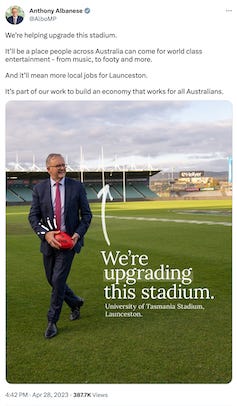
Anthony Albanese's Twitter account spruiks the federal funding for Tasmania.

Twitter, CC BY

Concerns about process are reinforced by the sorry history of “sports rorts”. Both Labor and Liberal federal governments have funded sports facilities to curry political favour.

To be fair, it is hard to see this project as targeted at a particular seat, but presumably the aim was to win support in Tasmania as a whole. Even compared with the dubious economics of sporting events such as the Formula 1 Grand Prix and the Olympic Games, stadium developments stand out as boondoggles.

Extensive research in the US is summarised by the conclusion that over the past 30 years, building sports stadiums has been a profitable undertaking for large sports teams, at the expense of the general public.

While there are some short-term benefits, the inescapable truth is the economic benefit of these projects for local communities is minimal. Indeed, they can be an obstacle to real development.


Read more: Devils in the detail: an economist argues the case for a Tasmanian AFL team – and new stadium


Making the business case

The economic case for the Hobart Stadium is startlingly thin. The only clear-cut benefit attributable to the project is that the new Tasmanian AFL team will play its home games there, replacing the small number of AFL rounds played at Hobart’s existing stadium, Bellerive Oval.

In 2022, eight AFL men’s games were played in Tasmania – four at Bellerive, four at UTAS Stadium in Launceston. A local AFL team will play 11 home games.

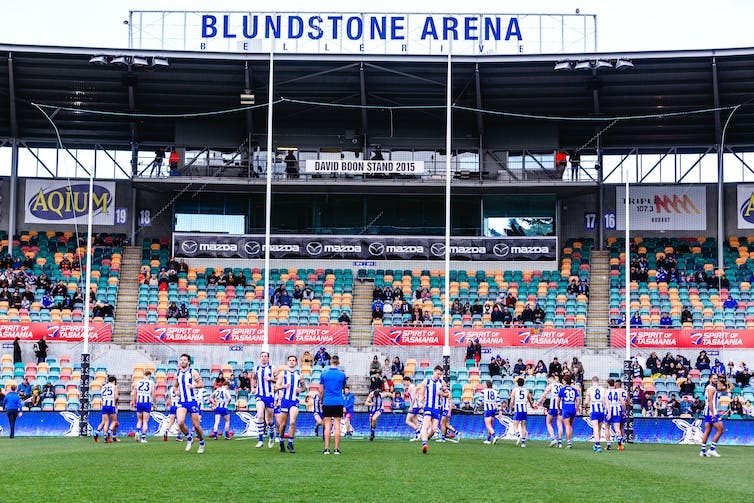
The North Melbourne Kangaroos warm up before their Round 15 match against the Adelaide Crows at Blundstone Arena, also known as Bellerive Oval. Linda Higginson/AAP

The state government’s business case estimates that 5,000 interstate visitors will attend seven matches a year. It seems safe to assume some will fly in and out on the same day, and that few will stay more than two nights.

If we allow an average of one night per visitor, that’s 35,000 bed nights, or an increase of about 0.3% in current visitor nights for Tasmania (about 11 million a year in 2022).

Against that must be offset the Tasmanians who will travel to Melbourne and elsewhere for away games.

What about housing?

All of this is par for the course for projects of this kind. The big problem for both state and federal governments is that it comes at a time of a housing crisis.

The federal government’s press release contains some vague references to housing developments associated with the project. But this is little more than the sort of PR spin we’d expect from, for example, the proponents of a new coal mine.

The numbers here are quite startling. The centrepiece of federal Labor’s election platform was a $10 billion fund for housing, providing $500 million year to support social housing. (Labor’s bill is currently held up in the Senate, with the Coalition opposed, and the Greens demanding stronger action.)


Read more: Labor’s proposed $10 billion social housing fund isn’t big as it seems, but it could work


If this $500 million were allocated proportionally by population, Tasmania would get about $10 million a year. The Commonwealth’s $240 million contribution to the stadium would cover this expenditure until nearly 2050. The total public outlay on the Hobart stadium (with $375 million from the Tasmanian government) would cover most of this century.

At a time of extreme fiscal stringency, such a massive outlay on a luxury project is very hard to justify.

What about job creation?

No serious benefit-cost analysis of this project has been made. Instead, supporters have relied on announcing the number of jobs it will create – 4,200 jobs during construction and 950 jobs when operational.

Such numbers are questionable. To make them bigger, governments typically count on the “multiplier effect” of work created for suppliers of various kinds. This is a long-standing tradition taken to new heights by the Albanese government. The announcement of the AUKUS submarine project, for example, was all about the jobs it would create.


Read more: $18 million a job? The AUKUS subs plan will cost Australia way more than that


But wait a moment. At the same time as trumpeting the creation of jobs for construction workers, the government is seeking to solve Australia’s “skills shortage” arising from historically low unemployment.

Tasmania’s unemployment rate is 3.8%, marginally above the average for Australia, but lower than at any time since the economic crisis of the 1970s. This low rate represents a situation of full employment, where numbers of unemployed workers and job vacancies are roughly equal.

In such circumstances, creating a job means luring a worker away from another. If the new job is on a major construction project, that means one less worker available to build housing.

As I argue in my book, Economics in Two Lessons (Princeton University Press, 2019), the true costs of wasteful public expenditure are opportunity costs – the alternatives that are foregone.

Multiplier effects make opportunity costs even larger. The project diverts the workers employed directly, and takes all kinds of resources that could otherwise be used for socially useful purposes. This diversion of necessary resources is the truly pernicious aspect of publicly subsidising projects like the AFL stadium.

Tasmania, like the rest of Australia, does not need government action to create any more jobs, particularly in construction. It needs to ensure skilled workers are employed where they can be most valuable.

May Day

Yesterday was May Day, celebrated as the Labour Day public holiday here in Queensland*. And this week, appropriately enough I’m giving two presentations on the case for a four-day working week, one to the Committee for Economic Development of Australia, a business-oriented thinktank, and one to a parliamentary inquiry.

I started writing a post about the prospect of a radical change in the relationship between workers and managers in the information economy, arising from the combination of near full-employment and the shift to remote work for large groups of workers. But I ran out of time, so for now, I will just toss up some points I want to discuss

  • Will full employment be sustained, or will central banks succeed in recreating the reserve army of labor ?
  • How real is the threat of employer spyware extending surveillance into home workplaces ?
  • How should we conceptualise the relationship between workers, managers and owners of capital ?
  • What are the implications for unions?

I’ll throw it open for comments, and think some more about all this

  • At least until the LNP get back in, which I hope is a long time off