Have your say on the results as they emerge
Category: Uncategorized
Sandpit
A new sandpit for long side discussions, conspiracy theories, idees fixes and so on.
False balance
An almost-universal feature of current Australian political commentary is the idea that the process of major party breakdown is a symmetrical one, affecting both side of politics equally. At a global level, this is broadly true. European social democratic parties have faced huge challenges arising from their complicity in austerity, and their inability to formulate a coherent response to racism and xenophobia. Quite a few, like PASOK in Greece, have disappeared altogether.
In Australia, the situation is very different. The rise of the Greens, and the formation of an effective Labor-Green coalition, long predates the crisis of neoliberalism. And the coalition has become more stable over time, not less. As Labor has moved, slowly but substantially, to the left on most issues, the Labor-Green coalition has come to resemble, more and more, the permanent coalition between the Liberals and Nationals (nearly always treated as a single party in Australian discussion. The issue of refugees has provided the most important single point of difference, but hasn’t driven the kind of collapse seen in Europe. Moreover, there has been no sign of any kind of radical or populist left alternative to the Labor-Green party. Rather, the remains of the old Marxist left have continued their gradual decline.
The contrast with the chaos within the LNP, and in its fractious relationship with the various far-right groups* it now relies on for support could not be more evident, and has been discussed at great length. I’m just hoping that we can get past the ritual need for balance, and recognise that, in Australia, this problem is specfic to the right.
The fact that the right is in a chaotic and chronic mess doesn’t mean they will necessarily lose. Labor has shown the capacity to mess things up massively, even without any serious ideological divisions, as in the Rudd-Gillard feud and the spectacular corruption of the NSW party. But that’s just day-to-day politics.
The bigger picture is that the Australian left is making a successful adjustment to the collapse of neoliberalism, while the right is not.
* There are also the centrist independents, most of whom hold seats that would normally belong to the LNP.
Life in a Socialist Future (updated)
I’ll be talking at the Ngara Institute’s Politics in the Pub event in Mullumbimby tonight. Unfortunately, their website appears to be offline today, but I’ll link if it comes up.
The talk won’t be quite as utopian as the title might suggest, but it will be a “light on the hill” vision rather than short-term politics . I’m trying to think about how life might look 30 years from now, if Australian society returns to the progressive path we seemed to be following from the 1940s until the defeat of the Whitlam government.
For those readers unable to make it to northern NSW on short notice, there should be a YouTube of the event later and I am working on some articles that I hope will clarify my optimistic vision of a possible future.
Updated: Here’s video from the Facebook livestream.
Queensland: beautiful one day, denialist the next?
One of the striking features of the current crackup on the right is the assumption, apparently widely shared, that climate science denial and subsidies for coal are winning issues in Queensland, however much they might appal the toffee-nosed elitists of Wentworth (and, presumably, Warringah and Kooyong among other long-standing Liberal party seats that can now be safely ignored).
Those pushing this view might consider the recent Queensland election, in which proposed subsidies to Adani were a key issue. Not only did the government and the Greens make gains in south-east Queensland at the expense of the LNP, Labor held on to seats in Townsville and Rockhampton where Adani was supposed to be a winner.
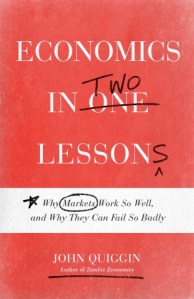
Here it is! #EconomicsInTwoLessons
Economics in Two Lessons is now officially available for pre-order. Here’s the front cover. Not quite as striking as the one for Zombie Economics, but that would be hard to cap. Thanks to everyone who helped with comments and encouragement.
Will a robot take my job?
As was pointed out to me on Twitter recently Betteridge’s law of headlines states that “Any headline that ends in a question mark can be answered by the word no.” That’s not entirely correct, I think. In many cases, the answer is “wrong question”. At any rate, that’s how I treat it in my recent Inside Story review article, where the headline[1] is followed by the standfirst text “Three new books challenge lazy thinking about job-stealing robots and infallible algorithms”. I talked about Ellen Broad and algorithms last time. Now for Tim Dunlop and robots.
Algorithms
This is an extract from my recent review article in Inside Story, focusing on Ellen Broad’s Made by Humans
For the last thousand years or so, an algorithm (derived from the name of an Arab a Persian mathematician, al-Khwarizmi) has had a pretty clear meaning — namely, it is a well-defined formal procedure for deriving a verifiable solution to a mathematical problem. The standard example, Euclid’s algorithm for finding the greatest common divisor of two numbers, goes back to 300 BCE. There are algorithms for sorting lists, for maximising the value of a function, and so on.
As their long history indicates, algorithms can be applied by humans. But humans can only handle algorithmic processes up to a certain scale. The invention of computers made human limits irrelevant; indeed, the mechanical nature of the task made solving algorithms an ideal task for computers. On the other hand, the hope of many early AI researchers that computers would be able to develop and improve their own algorithms has so far proved almost entirely illusory.
Why, then, are we suddenly hearing so much about “AI algorithms”? The answer is that the meaning of the term “algorithm” has changed.
Read More »
Will a robot take my job? Wrong question!
I’ve just done a review article for Inside Story. The headline is Will a robot take my job? but the central point is that this is the wrong question to ask. While technology has a logic of its own, what really matters is our current set of economic and social structures, the financialised version of capitalism commonly called “neoliberalism“.
The article is a review of three excellent books:
2062 by Toby Walsh;
Made by Humans by Ellen Broad; and
The Future of Everything by Tim Dunlop
Read my review and buy the books!
The Coal Cartel ? Why Adani’s prospects haven’t improved
In my recent piece in The Guardian, mostly about Adani, I observed
The paradoxes of Adani are mirrored in the global coal market. Despite a small increase in 2017, global coal production is below its 2013 peak. Yet prices have recovered strongly, yielding big profits to existing miners and offering a seemingly tempting prospect for new mines.
It turns out that this isn’t quite right. The benchmark Newcastle price, for low-ash coal with a heat content of 6000kcal/kg has risen strongly, to the great benefit of companies like Yancoal, Glencore and Whitehaven. It turns out, however, that this increase isn’t representative of the broader market. Prices for lower quality coal with lower heat content and higher ash content haven’t moved at all, with the result that the premium between higher and lower grades has grown dramatically.
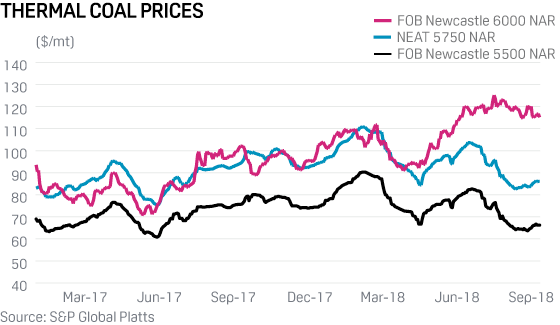
What’s going on here? One possible explanation is that Yancoal and Glencore, who produce the majority of Australia’s high-grade coal, have engaged in successful cartel behavior. Another is that the premium reflects shifts in demand (with China and India increasingly rejecting high ash coal, while Japan continues to demand high grade coal) and supply (few new mines are opening, and this has a bigger effect on the smaller market for high grade coal).
Whatever the explanation, most analysts agree that it is more likely to be resolved by a decline in the price of high-grade coal rather than an increase in the price of low-grade coal.
Where does Adani fit into all this. Most of the discussion I’ve found focuses on the premium between 6000kcal/kg and 5500 kcal/kg. Coal extracted from the Carmichael mine would be much lower quality, below 5000 kcal/kg.
 John Quiggin