Happy Birthday, Mrs Windsor

It’s the Queen’s birthday here in Queensland, having been moved by the Labor government to separate it from May Day, which they already moved from October, reversing a decision of the Newman LNP government. Apart from reports on what is open today, I couldn’t find any reference to this event in the media, even from notional monarchists.

That pretty much sums up the irrelevance of the British monarchy in Australia. So, this seems like a good time to think about when we should become a republic, and what kind of republic we want.

Our last attempt was run by the unlamented Malcolm Turnbull who assumed that what everyone wanted was a change of figurehead that left the reality of the system unchanged. That reality is a Prime Ministerial dictatorship, constrained only by elections, obstreporous Senators and the ever-present possibility of a party-room coup. Looking at our system over recent years, I don’t think it’s performed very well, and I suspect that Turnbull might now agree.

Another important change is that outright Lower House majorities are no longer assured and may soon become the exception rather than the rule. The role of the Head of State in deciding who should be invited to form a government is now increasingly important. These decisions ought to be made by a President with the independent legitimacy that comes from an election.

Obviously, this isn’t the most important issue facing the nation. But that doesn’t mean we shouldn’t discuss it and get moving on the issue. As usual, Bill Shorten (despite his unalterable image as a cautious timeserver) has taken the lead. I hope he will get the chance to act on this after the next election, and that he will take it.
Monday Message Board

Another Monday Message Board. Post comments on any topic. Civil discussion and no coarse language please. Side discussions and idees fixes to the sandpits, please.

If you would like to receive my (hopefully) regular email news, please sign up using the following link
You can also follow me on Twitter @JohnQuiggin, at my <a href=”https://www.facebook.com/JohnQuigginPublicPage/”>Facebook public page</a> and at my <a href=”https://www.facebook.com/EconomicsInTwoLessons/?modal=admin_todo_tour”>Economics in Two Lessons page </a><

Algorithms

This is an extract from my recent review article in Inside Story, focusing on Ellen Broad’s Made by Humans

For the last thousand years or so, an algorithm (derived from the name of an Arab a Persian mathematician, al-Khwarizmi) has had a pretty clear meaning — namely, it is a well-defined formal procedure for deriving a verifiable solution to a mathematical problem. The standard example, Euclid’s algorithm for finding the greatest common divisor of two numbers, goes back to 300 BCE. There are algorithms for sorting lists, for maximising the value of a function, and so on.

As their long history indicates, algorithms can be applied by humans. But humans can only handle algorithmic processes up to a certain scale. The invention of computers made human limits irrelevant; indeed, the mechanical nature of the task made solving algorithms an ideal task for computers. On the other hand, the hope of many early AI researchers that computers would be able to develop and improve their own algorithms has so far proved almost entirely illusory.

Why, then, are we suddenly hearing so much about “AI algorithms”? The answer is that the meaning of the term “algorithm” has changed.
Read More »

Will a robot take my job? Wrong question!

I’ve just done a review article for Inside Story. The headline is Will a robot take my job? but the central point is that this is the wrong question to ask. While technology has a logic of its own, what really matters is our current set of economic and social structures, the financialised version of capitalism commonly called “neoliberalism“.

The article is a review of three excellent books:
2062 by Toby Walsh;
Made by Humans by Ellen Broad; and
The Future of Everything by Tim Dunlop

Read my review and buy the books!

Defending Australian institutions

The issues dominating Australian public debate are many and various But most of them can be summed up as the defence of Australian institutions that have been under attack by radical extremists. I’m referring to such institutions as the ABC, CSIRO, the weekend, public education, the union movement, the fair go our natural environment and our indigenous heritage. Mention of any of these is enough to raise a derisive sneer from the radical rightwing apparatus that dominates much of Australian politics, most obviously the supporters of Tony Abbott who (ludicrously) call themselves “conservatives”.

Turnbull promised something better but was, if anything, worse than Abbott. So far, it seems as if Morrison is going to continue the trend. Having dumped nearly all his unpopular economic policies, he’s left with nothing but the culture war, which would be more accurately described as a war on culture.

We shouldn’t be wasting time on (Issue I oppose)

Something I read a lot in political discussion is the claim “We shouldn’t be wasting time on Issue X”. Almost invariably, the writer clearly has strong views on Issue X, supports the status quo, and is aware that some change has majority support. So, their best hope is to avoid any decision at all. Of course, while statements like this logically imply that the speaker shouldn’t waste their own time on the issue, this inference is rarely drawn. The same people who tell us not to waste our time on some proposed change will spend lots of their own time fighting against it.

Feel free to point to examples or, for that matter, counterexamples.

The Coal Cartel ? Why Adani’s prospects haven’t improved

In my recent piece in The Guardian, mostly about Adani, I observed

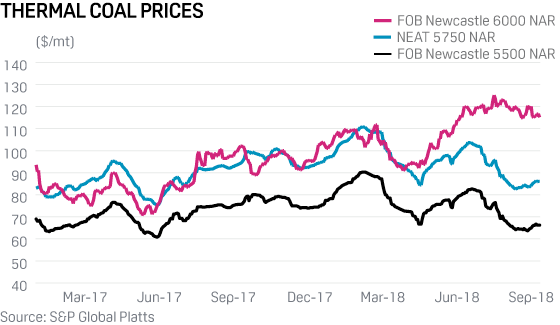
The paradoxes of Adani are mirrored in the global coal market. Despite a small increase in 2017, global coal production is below its 2013 peak. Yet prices have recovered strongly, yielding big profits to existing miners and offering a seemingly tempting prospect for new mines.

It turns out that this isn’t quite right. The benchmark Newcastle price, for low-ash coal with a heat content of 6000kcal/kg has risen strongly, to the great benefit of companies like Yancoal, Glencore and Whitehaven. It turns out, however, that this increase isn’t representative of the broader market. Prices for lower quality coal with lower heat content and higher ash content haven’t moved at all, with the result that the premium between higher and lower grades has grown dramatically.

What’s going on here? One possible explanation is that Yancoal and Glencore, who produce the majority of Australia’s high-grade coal, have engaged in successful cartel behavior. Another is that the premium reflects shifts in demand (with China and India increasingly rejecting high ash coal, while Japan continues to demand high grade coal) and supply (few new mines are opening, and this has a bigger effect on the smaller market for high grade coal).

Whatever the explanation, most analysts agree that it is more likely to be resolved by a decline in the price of high-grade coal rather than an increase in the price of low-grade coal.

Where does Adani fit into all this. Most of the discussion I’ve found focuses on the premium between 6000kcal/kg and 5500 kcal/kg. Coal extracted from the Carmichael mine would be much lower quality, below 5000 kcal/kg.