Another Monday Message Board. Post comments on any topic. Civil discussion and no coarse language please. Side discussions and idees fixes to the sandpits, please.
Bad for the client, bad for the bottom line
My report on the NSW governments proposal to sell (they prefer to say “lease”, but it’s a sale) assets and then undertake a large-scale infrastructure program notionally funded by the proceeds cited the former Secretaries of the NSW and Victorian Treasuries the point that selling income-generating assets does not create a ‘bucket of money’ that can be used to fund non-income-generating infrastructure. I made the claim that regardless of their attitude to privatisation, economists (at least when writing honestly on the subject) would agree with this.
My point was proved, twice over, a couple of days ago. The main point was proved when global bank UBS released a research note headed headlined “Bad for the budget, good for the state“. Of course, UBS supports privatisation, but the adverse effect on the budget was obvious.
However, it turns out that a different part of UBS is advising the Baird government on privatisation. A quick call from the Premier’s office produced a revised version of the note with the offending phrase removed. This proved, via the contrapositive, the parenthetical aside in my claim.
The episode raises the question: what reliance can be placed on published reports from firms like UBS cited in support of government policy? Of course, the same question is equally applicable to reports like my own, which more commonly oppose government policy? A few thoughts over the fold.
Read More »
Plan B
Now that the Senate has rejected Pyne’s university deregulation plan, the obvious question is, what is Plan B? The first, negative answer: there is no acceptable plan that will deliver what the advocates of deregulation wanted, namely a highly stratified system, catering to a smaller minority of the population than at present, and topped by high-status institutions comparable to Yale and Harvard. That’s the US model and, as a system for educating young people, as opposed to generating research and reproducing a tiny elite, it’s been a miserable failure.
The correct way to think about this is to begin with the core objective of the process: to provide young Australians with post-school education that fits them for work in a modern economy and life in a modern society. That leads to two main principles
* A single system encompassing both universities and post-school technical education with easy flow between the two
* Uncapped access with an objective of (near) universal participation in some form of post-school education
* As with school education, the aim should not be stratification by quality, but the provision of a high-quality education for all, with resource allocation based on educational needs, not institutional history or individual wealth
I’ll leave aside, for the moment, the problems of the TAFE sector, though these are, I think, more urgent and difficult than those of the universities.
The big problem with what I’m proposing is that it will require more money for undergraduate education. That’s because the existing system relies on a mixture of student payments (through HECS), government funding and a cross-subsidy from fee-paying overseas students. There’s no substantial scope to get more money from overseas students, so the more domestic students the more thinly that cross-subsidy is spread. Similarly, although more government funding is merited, maintaining existing funding on a per-student basis while expanding numbers is probably too much to hope for. However, a clear focus on the core goal of universal post-school education would help a lot, though it necessarily poses some tough choices.
Broadly speaking, the goal I’m thinking about is to maintain existing teaching resources per student, while expanding access to cover a steadily increasing proportion of the population.
Some ideas are listed below (over the fold)
The TPP: an attack on our freedoms
I have a piece in Inside Story looking at the Trans-Pacific Partnership.
Summary: It’s bad, and our only hope is that the US Congress will block it.
Neither up nor down
I’ve had the unusual experience of being cited as an authoritative expert* by both the Oz and AFR this week. Unfortunately, the Oz got the story wrong, and the AFR report, while correct on a careful reading, is misleading. The issue is the impact of electricity privatisation on power prices.
Direct comparisons suggest that consumer prices don’t differ much between NSW and Queensland (with public ownership) and SA and Vic (with privatisation), though SA is highest.
The advocates of privatisation have focused on distribution charges, showing in the process that they don’t understand the National Electricity Market reforms they and their ideological allies pushed through in the 1990s. Under the system of regulation, distributors are allowed to charge a price sufficient to cover their “efficient costs”, which are determined in large measure by benchmarking against other distributors. So, if private firms are more efficient than public firms, that should have no effect on regulated distribution charges, only on relative profitability. **
As the AFR and Oz both gleefully pointed out, that analysis contradicts what they called Luke Foley’s “great lie”, that prices will rise if privatisation takes place. Unfortunately, it also contradicts the equal and opposite lie, that prices will fall if privatisation takes place. The AFR gives a misleading headline, but is correct in the body of its report, saying “The prices charged by the government-owned NSW network companies will go down – not up – whether or not they are leased out to private operators.” That contradicts Foley’s claims, but also the opposite claims made by the Liberals.
I look forward to the AFR and Oz correcting this error and presenting the correct analysis (only joking!).
More seriously, I’m hoping to do a proper analysis of electricity prices and why they have risen so much under the NEM, contrary to the predictions of the micro reform lobby of which both the Oz and the Fin are part.
* Of course, I was cited in an “even the liberal New Republic …” way. The AFR noted, reasonably enough, that I was opposed to privatisation. The Oz went full-on as only the Oz can do, reprinting some of Michael Stutchbury’s hit piece, written for them before he jumped ship to the Fin. Since this piece earned me a very nice write up in the New York Times, I guess I can’t complain.
** Disclosure: I was for some years, a member of the Queensland Competition Authority, which regulated distribution charges. I’ll write more about this, if I get time.
Weekend reflections
It’s time for another weekend reflections, which makes space for longer than usual comments on any topic. Side discussions to sandpits, please. Absolutely no personal criticism of other commenters.
The US government didn’t lose the War on Poverty: it changed sides
I made this observation in comments on a Crooked Timber post, and got some pushback, so I thought I’d take a look back at the data
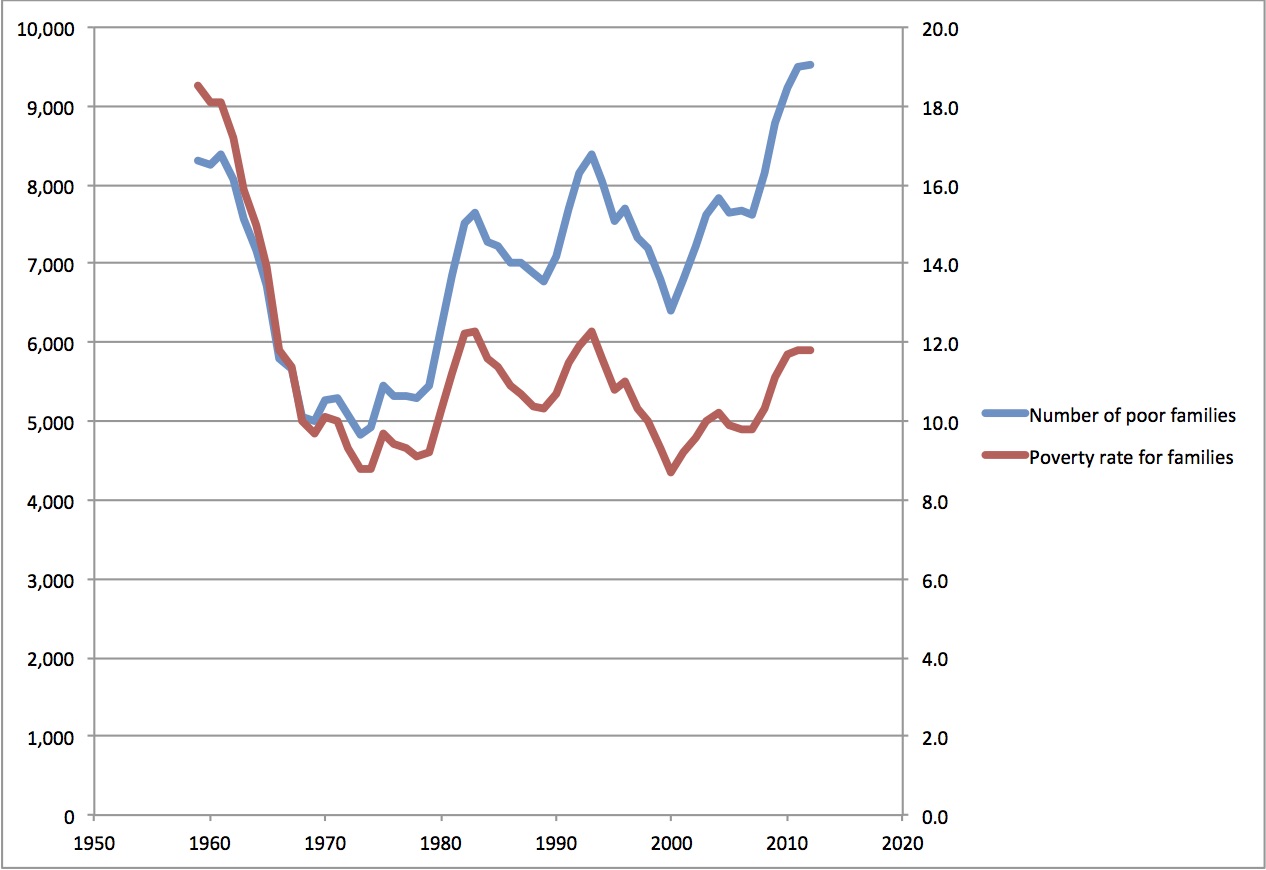
Both the number and the percentage of families in poverty dropped sharply during the 1960s when the “War on Poverty” was being waged actively, and remained near their all-time lows through the Nixon and Carter years until 1979, when the Volcker recession hit, followed by the election of Ronald Reagan. These events can reasonably be said to mark the point at which the government unequivocally changed sides.
The number of households in poverty has risen steadily since then and is now higher than in 1959, the year for which the poverty level was first defined by Mollie Orshansky. The poverty rate has remained consistently higher than in the 1970s, except for a brief deep at the peak of the late-1990s boom.
Read More »
NSW Privatisation
A life expectancy of 95 by 2050? This does not mean what you think it means
Among the scary numbers in the Intergenerational Report was the estimate that, by 2050, life expectancy would have risen to 95/96 years, which would seem to imply a huge increase in the number of years spent in retirement. I checked and found that the report gave current life expectancy as 92/93 years, far higher than the 80 or so that is usually quoted. The reason, it turns out is that the standard estimate is done on a “period” basis, using the age-specific mortality rates of the present. The higher estimate is done on a “cohort” basis, taking account of expected future reductions in mortality. More on this here.
A few observations on this point.
* An increase of four years is neither surprising nor alarming. This is doubtless why this comparison ins not made in the IGR.
* In my last post, I noted the use of the obsolete 15-64 category to estimate the working-age population. One possible defence was that this was done in consistency with past practice. But clearly this can’t apply to the (unannounced) shift from the standard period basis to a cohort basis
* More importantly, the 95-year figure is an estimate of the likely life expectancy of children born in 2050, who would reach retiring age some time after 2115. Even the current birth cohort won’t be of pensionable age until near the end of this century.
A cohort measure of life expectancy is more relevant to projections of future pension expenditure than a period measure, though it requires the use of estimates of future mortality. But the relevant cohorts for the purpose of the IGR are those born before 1983 who will be 67 and over in 2050 and will then (assuming no policy change) be eligible for the age pension.
One weird trick that proves the IGR is nonsense
I have a piece in today’s Guardian, written before the release of the Intergenerational Report and making the case that the intergenerational equity problem, as it was conceived in the 1980s and 1990s has already been resolved. Key quote
The resolution of the intergenerational fiscal problem was a major public policy achievement of the reform era of the 1980s and 1990s. But a political class still fixated on the most ideological version of the reform agenda, in which cutting public spending is desirable in and out of season has refused to drop the club of intergenerational equity. The idea that (very modest) budget deficits and public debt levels constitute “robbing our children” remains a staple in calls for “reform”.
Having seen the IGR, there’s a single statistical choice that shows the entire exercise to be worthless. The key issue in all this is whether changes in our demographic structure will create an unreasonable fiscal burden. The Report chooses to summarise this by reference to what it calls the “dependency ratio”, defined as the ratio of people aged over 65 to those aged 15-64.
In what kind of world would this make sense? Essentially, one in which
* Children aged 14 and under cost nothing to raise and required no public expenditure on schools, daycare etc
* Children leave school at 15. After this, they not only support themselves, but contribute to the support of those over 65
* People retire become eligible for age pensions at 65
 John Quiggin